
Can You Get HIV from a Nail Salon? What Clients Should Know

If you’re worried about a manicure or pedicure exposing you to HIV, the short answer is reassuring: transmission in a nail salon is extraordinarily unlikely. HIV is not spread by casual contact, shared surfaces, or intact skin. In plain language: HIV does not survive or spread in any practical way through dry salon surfaces, towels, or properly cleaned tools. For nail services to pose a real concern, there would need to be a very unusual chain of events involving contaminated blood and a direct route into the body.
That said, “unlikely” is not the same as “ignore hygiene.” Good sanitation still matters because nail salons can transmit other infections more plausibly than HIV, especially when tools are reused, skin is nicked, or blood is visible.
How HIV Is Actually Spread
HIV is transmitted through specific body fluids that carry enough virus to infect another person. In practical terms, that means exposure usually has to involve blood, semen, vaginal fluids, rectal fluids, or breast milk entering the body through a mucous membrane, damaged tissue, or a direct blood-to-blood pathway.
What does not spread HIV:
– shaking hands
– touching salon chairs, counters, or footbath surfaces
– sharing towels
– sitting near someone with HIV
– saliva, sweat, or casual contact
– having HIV-positive blood or fluid on intact skin without a route in
That distinction matters in a nail salon because most salon contact is surface contact. Even when a tool touches skin, the skin is usually intact. Intact skin is a very effective barrier, and HIV does not infect through intact skin.
For a plain-language public health overview, the CDC’s HIV transmission information is a useful reference.
Why Nail Salons Are Not a Common HIV Transmission Setting
A manicure or pedicure is not a setting where HIV typically spreads because the usual conditions are wrong for transmission. Tools may touch skin, but HIV does not spread efficiently through dry surfaces, towels, or footbath water. The virus also needs a viable path into the body, not just contact with a surface.
That is why a salon that looks “busy” or “used” is not automatically dangerous. The real issue is whether the salon is preventing blood exposure and handling tools correctly.
A mainstream public-health source, rather than a niche trade article, is the better way to think about this: HIV transmission requires specific blood or fluid exposure, not ordinary salon contact.
If you want to understand the difference between appearance and actual infection control, this is where many people get tripped up: a clean-looking station can still be poorly disinfected, while a modest-looking station may follow good procedures.
When a Nail Salon Exposure Could Matter
There are narrow situations where you should pay closer attention. The concern is not “I was in a salon.” The concern is blood plus a pathway.
Examples that deserve more caution:
– a sharp tool visibly had blood on it
– you had a deep cut that bled significantly
– a tool cut you after it had just contacted another person’s blood
– you have broken skin, and the service involved repeated trauma to that area
A tiny nick during cuticle work is different. Most minor nicks do not create meaningful HIV risk by themselves, especially if there was no visible blood contamination on the instrument and no significant blood-to-blood exposure.
A practical rule: if the incident was superficial, brief, and did not involve visible blood from someone else, HIV is not the infection you would usually worry about first.
HIV Risk vs. Other Infections You’re More Likely to Encounter
In nail salons, the infections that are more realistic concerns are hepatitis B, hepatitis C, and bacterial skin infections. That comparison is important because people often focus on HIV when the more plausible risk is something else.
Here’s a simple way to think about it:
| Issue | How it spreads in a salon | Relative concern in nail services |
|---|---|---|
| HIV | Requires specific blood or fluid exposure and a route into the body | Very low in ordinary salon settings |
| Hepatitis B | More infectious than HIV and can spread through blood exposure | More relevant if blood is involved; preventable by vaccination |
| Hepatitis C | Bloodborne; can spread through contaminated sharps | More relevant than HIV if tools are contaminated |
| Bacterial skin infection | Can enter through broken skin, nicks, or dirty implements | Often the most practical concern after cuts |
The big takeaway is not to panic about HIV while ignoring other risks. A reused cuticle nipper, a dirty file, or a pedicure performed over broken skin can be a more realistic problem for bacterial infection or hepatitis exposure than for HIV.
If you want broader context on salon chemicals and worker safety, the California Department of Toxic Substances Control’s Healthy Nail Salon Recognition Program is useful background reading. It focuses more on chemical exposure than bloodborne infection, but it shows why sanitation and safe practices matter across the board.
What Safe Nail Salon Sanitation Should Look Like
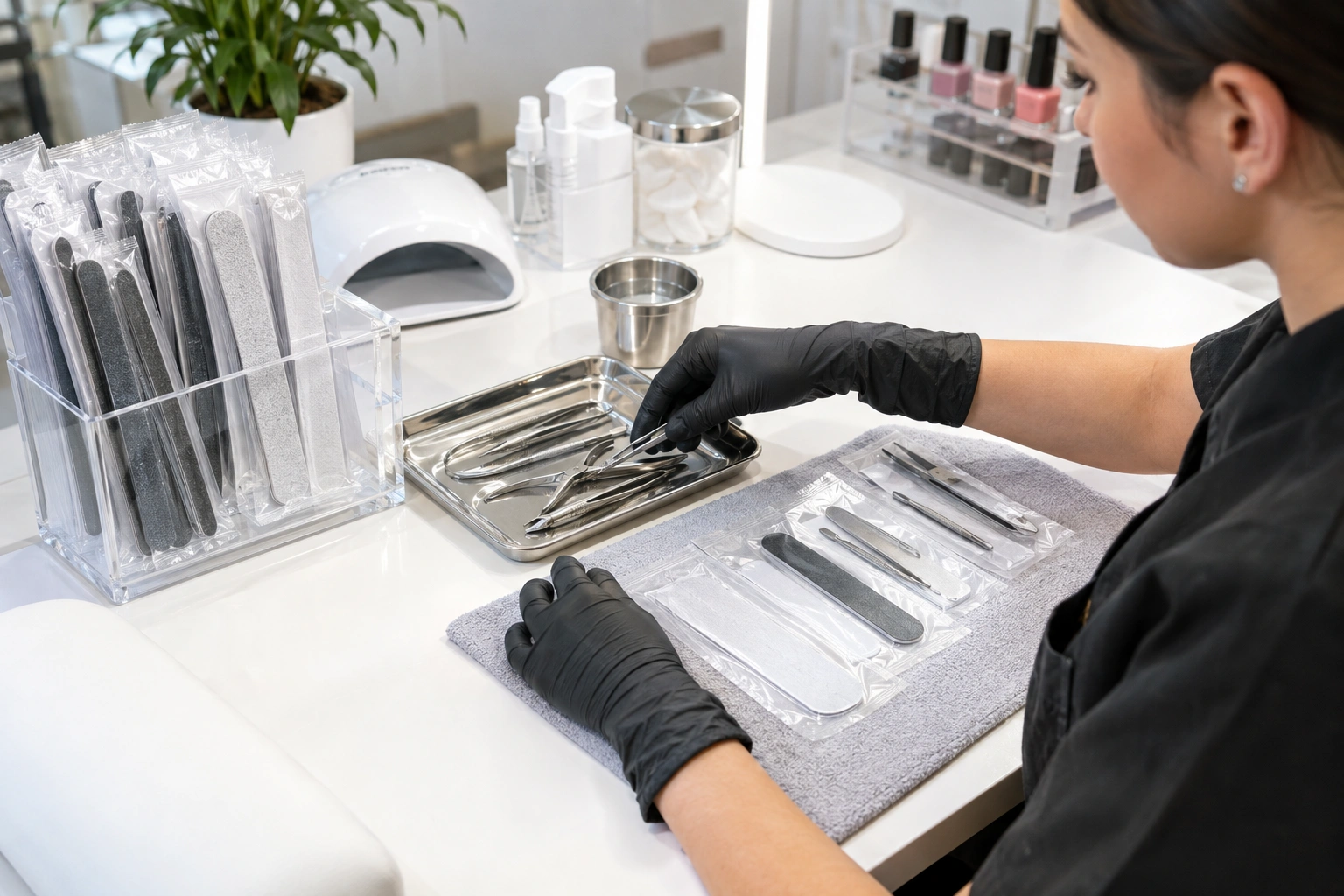
A safe salon does not rely on “we wipe things down.” It uses a system.
Disinfection vs. sterilization vs. single-use tools
These terms are not interchangeable:
- Single-use tools are used once and discarded. Think disposable files, buffers, or liners.
- Disinfection reduces many germs on a surface or implement, but it is not the same as making an item sterile.
- Sterilization is the strongest level and is meant to eliminate all forms of microbial life on reusable instruments.
For metal tools that can be reused, proper cleaning and disinfection are essential; for some instruments, sterilization is the stronger standard. In everyday salon decision-making, the question is not whether a tool “looks clean.” It is whether the salon has a real process for handling it between clients.
What a safe salon should do
Use this quick checklist:
– Reusable metal tools: cleaned first, then properly disinfected or sterilized as appropriate
– Porous items like files, buffers, and wooden sticks: treated as single-use or discarded after one client
– Footbaths: cleaned and disinfected between clients, with fresh liners used when applicable
– Work surfaces: wiped and disinfected between services
– Visible blood: stopped, contained, and cleaned with proper procedures
What to look for in practice
Reasonable signs of good sanitation include:
– tools removed from a clean container or sealed package
– fresh liners in footbaths
– visible hand hygiene before service
– separate clean and used tool areas
– single-use items discarded after one client
– no visible blood left on implements or work surfaces
A salon can be beautifully decorated and still be weak on infection control. On the other hand, a simple salon may be careful and consistent. Judge the process, not the décor.
For general infection-control guidance, the FDA’s consumer information on cosmetics and personal care products is a helpful starting point.
How to Judge Whether a Nail Salon Is Safe Before You Book
You do not need to interrogate the staff, but you do want enough information to make an informed choice.
Good signs
- The technician opens tools in front of you or explains how they were sanitized.
- The salon uses fresh liners or a clearly cleaned footbath.
- Files, buffers, and other porous items are treated as single-use.
- The technician stops and cleans up if a nick or cut happens.
- The station is organized, with separate clean and used items.
Red flags
- Reused tools are pulled from a drawer with no sanitation explanation.
- You see visible residue, dried product, or blood on implements.
- The same file or buffer is clearly being used on multiple clients.
- Staff seem casual about cuts, blood, or “just wiping it off.”
- Footbaths are not cleaned between clients.
A useful decision rule: if you would not feel comfortable using the tool on your own skin at home, do not assume it is safe just because it is in a salon.
If you want to know what to ask before a service, this related guide on what to ask for at a nail salon can help you turn that judgment into a conversation.
What to Do If You Were Cut, Bled, or Saw Unsanitary Tools
If something went wrong during a service, stay calm and sort the situation by severity.
If it was a tiny nick with no visible blood
- Stop if you need to.
- Wash the area with soap and water.
- Apply pressure if there is any bleeding.
- Monitor the skin over the next few days for redness, swelling, warmth, or pain.
A small nick without visible blood contamination is usually not a reason to panic about HIV.
If there was visible blood or a deeper cut
- Stop the service.
- Wash the wound right away with soap and water.
- Ask how the tool was sanitized.
- Contact a clinician the same day if the cut was deep, bleeding was significant, or the tool had visible blood on it.
When urgent or emergency evaluation is warranted
Seek urgent care or same-day medical advice if:
– the wound is deep or will not stop bleeding
– you think another person’s blood entered the cut
– you have a high-risk exposure and need guidance on whether post-exposure treatment is time-sensitive
– the area becomes increasingly red, swollen, warm, or painful
The most practical response is to treat the event as a sanitation problem first. HIV testing is not automatically needed after every salon nick; the decision depends on whether there was a real blood exposure.
Should You Get HIV Testing After a Nail Salon Exposure?
Testing is a medical decision, but the rule of thumb is straightforward: if there was no meaningful blood-to-blood exposure, HIV testing is usually not necessary because the exposure did not create a realistic HIV risk.
You may want to speak with a healthcare professional if:
– the cut was deep
– there was visible blood on a contaminated sharp tool
– you have a broken skin condition at the site
– you are unsure whether the exposure involved another person’s blood
If you are thinking about testing, it is reasonable to ask whether the concern is actually HIV or whether another infection is more plausible. That conversation can save you from unnecessary panic while still protecting your health.
When to See a Nail Technician or Dermatologist
If you have eczema, psoriasis, a fresh cut, an infected hangnail, or skin that is already broken, ask yourself whether the service is worth the irritation. Sometimes the safest choice is to reschedule until the skin is intact.
See a nail technician or dermatologist if:
– a manicure or pedicure repeatedly causes bleeding
– you get lingering redness, swelling, or tenderness after a service
– your skin barrier is already compromised
– you are unsure whether a nail problem is irritation, infection, or something else
For readers who are also planning a salon visit and want to reduce the chance of post-service frustration, our guide on how to prevent nail polish from chipping covers maintenance habits that help manicures last longer without extra trauma to the nail plate.
Bottom Line
So, can you get HIV from a nail salon? In ordinary salon conditions, the risk is extraordinarily low. HIV does not spread through casual contact, intact skin, saliva, sweat, towels, dry surfaces, or properly cleaned tools. The situations that matter are unusual: visible blood, contaminated sharp tools, and a real route into the body.
If you had a minor nick with no visible blood, wash it and monitor it. If there was deeper bleeding or visible blood on a tool, clean the wound and get same-day medical advice. And when choosing a salon, focus on whether it uses real sanitation practices for reusable tools, porous items, and footbaths.

