Do Toenails Grow Faster in Summer? What Research Really Says

If it feels like you reach for your toenail clippers more often during sandal season, you may have wondered: Do toenails grow faster in summer?
It is an easy assumption to make. Summer often means warmer weather, more time outside, more pedicures, open-toe shoes, swimming, and simply paying more attention to your feet.
But the science is more cautious than the popular beauty claim.
Research has not clearly shown that toenails consistently grow faster in summer. Toenails naturally grow very slowly, and differences between people, toes, health, nail damage, footwear, and grooming habits may matter more than the season.
Below, we will look at what research actually says, how fast toenails normally grow, why yours may seem faster in warm weather, and how to care for growing toenails safely.
Quick Answer
Do toenails grow faster in summer? Not necessarily. Research has not found a consistent seasonal increase in toenail growth. Healthy toenails generally grow around 1 to 1.6 millimeters per month, although individual rates vary. Summer habits may make growth more noticeable, but warm weather itself is not a proven toenail-growth treatment.
What Does the Research Say About Toenail Growth in Summer?

The idea that nails automatically grow faster during warm weather sounds reasonable, but research does not strongly support it.
A PubMed-indexed study examining seasonal changes in human growth detected seasonal changes in some types of hair growth but did not detect seasonal fluctuations in fingernail or toenail growth.
That is an important distinction.
Hair and nails are both made partly from keratin, but they do not necessarily respond to seasons in exactly the same way. So evidence that certain hair grows faster during part of the year does not prove that toenails do the same.
Another study of healthy young American adults measured average toenail growth at about 1.62 millimeters per month, substantially slower than fingernail growth.
This means that even if your individual growth rate changes slightly from month to month, the difference may be difficult to see without carefully measuring it.
So Is the “Summer Nail Growth” Idea Completely Wrong?
Not exactly.
It is possible for an individual person to notice differences throughout the year. Nail growth varies naturally, and lifestyle changes that happen during summer can affect how your feet and nails look.
What the research does not support is a simple rule such as:
“Everyone’s toenails grow significantly faster because the weather is hot.”
Your personal experience may be real, but temperature alone may not explain it.
How Fast Do Toenails Normally Grow?
Toenails are slow growers.
The Cleveland Clinic’s overview of fingernail and toenail anatomy notes that toenails typically grow around 1.5 millimeters per month, while fingernails grow around 3 millimeters per month. A complete toenail may require roughly 12 to 18 months to replace itself.
That slow timeline explains why:
- A damaged toenail can look abnormal for months.
- Old nail polish gradually moves toward the tip.
- A bruised or discolored section may take a long time to disappear.
- Fungal-nail treatment can seem frustratingly slow.
- A nail that was cut too short may take weeks before the difference looks obvious.
You usually will not see meaningful toenail growth from one day to the next.
Your Big Toenail May Grow Differently
Not every toenail grows at exactly the same speed.
Research involving healthy adults found that the great toenail grew faster than some of the smaller toenails.
So if your big toenail seems to need more frequent trimming than your little toenail, that difference does not automatically mean something is wrong.
Why Toenails May Seem to Grow Faster in Summer
Even without a proven seasonal growth boost, several summer habits can make toenail growth more noticeable.
1. You See Your Toenails More Often
During winter, your feet may spend most of the day inside socks, slippers, boots, or closed shoes.
Summer changes that.
You may wear:
- Sandals
- Flip-flops
- Open-toe heels
- Bare feet around the house
- Swim shoes
When your toes are visible every day, a small amount of new growth becomes easier to notice.
2. You May Get Pedicures More Frequently
Many people increase their pedicure routine during warmer months.
If you trim, shape, polish, and inspect your toenails every few weeks, you are naturally going to become more aware of how quickly they are growing.
A winter toenail might grow at the same rate without getting nearly as much attention.
3. Polish Regrowth Makes Growth Obvious
A polished toenail creates a convenient visual marker.
As new nail grows from the base, an unpainted gap becomes visible near the cuticle. That contrast can make a few millimeters of growth look surprisingly dramatic.
Bare nails do not always make that progress as obvious.
4. Your Activity Level May Change
Summer can mean more walking, traveling, sports, running, gardening, or outdoor activities.
Activity itself does not guarantee faster nail growth. However, changes in footwear, toe pressure, minor trauma, and grooming frequency can change the way the nail looks.
More activity can also damage toenails, especially when shoes are too short or narrow.
Do not mistake a thickened, lifting, bruised, or distorted toenail for healthy accelerated growth.
What Affects Toenail Growth More Than Summer Weather?
Your toenail growth rate depends on multiple factors.
| Factor | Possible Effect | What to Know |
|---|---|---|
| Natural biology | Growth varies between people | Some people simply grow nails faster |
| Which toe | Rates can differ | The big toenail may grow faster than smaller nails |
| Age | Growth may become slower | Nail thickness and texture can also change |
| Nail injury | May temporarily disrupt growth | Matrix damage can cause longer-lasting changes |
| Shoe pressure | May damage or distort nails | Tight toe boxes are a common problem |
| Nail infection | Can alter nail appearance | Thickening or crumbling needs proper evaluation |
| General health | Certain conditions can affect nails | Persistent unexplained changes deserve attention |
| Grooming habits | Does not directly speed growth | Gentle care prevents unnecessary breakage and damage |
The main lesson is simple: growth speed is only one part of nail health.
A slowly growing healthy nail is usually preferable to a damaged nail that appears to be changing quickly.
Does Better Circulation in Summer Make Toenails Grow Faster?
You may see explanations online claiming that heat improves circulation and therefore makes nails grow faster.
This sounds plausible, but it is too simple to treat as established fact.
Your nail grows from the nail matrix, an area underneath the skin near the base of the nail. The matrix produces cells that eventually become the hard nail plate you see.
Blood supply and overall health are important for living tissue, but that does not mean ordinary summer temperatures create a meaningful or predictable increase in toenail growth.
In other words, warmer feet do not equal a guaranteed nail-growth boost.
Can Sunlight or Vitamin D Make Toenails Grow Faster?
Summer sunlight is another common explanation.
Vitamin D is important for general health, but there is no good reason to deliberately increase sun exposure simply to try to make your toenails grow faster.
A nail-growth routine should never involve risking sunburn or excessive UV exposure.
If you are worried about a nutritional deficiency, persistent nail changes, or your overall health, discussing it with a healthcare professional is more useful than trying to self-diagnose based on your toenail growth rate.
Can Filing Your Toenails Make Them Grow Faster?
No.
A nail file works on the visible nail plate, which is made from hardened keratin. New nail cells are produced farther back in the nail matrix.
Filing the tip therefore does not send a signal to the matrix telling it to grow faster.
What filing can do is:
- Smooth sharp edges.
- Prevent snags.
- Refine the shape after clipping.
- Keep an uneven edge from catching on socks.
- Make routine pedicures look cleaner.
That can help you protect the length you already have.
Which Nail File Is Best for Routine Toenail Care?
You do not need an expensive professional tool for ordinary healthy toenails.
| File Type | Cost Level | Best Use | Main Limitation |
|---|---|---|---|
| Emery board | Low | Everyday smoothing | Wears out and is difficult to thoroughly clean |
| Glass/crystal file | Moderate | Gentle controlled shaping | Can break if dropped |
| Metal file | Low to moderate | Durable general filing | Heavy pressure can feel aggressive |
| Buffer | Low to moderate | Very light surface smoothing | Over-buffing can thin the nail |
| Electric file | High | Specialized nail work | Easy to over-file without training |
For most healthy natural toenails, a clean emery board or glass file is enough.
Do not use an aggressive file simply because a toenail is thick. Thickening can sometimes be caused by injury, repeated pressure, or a nail condition that filing alone will not solve.
How to Trim and File Growing Toenails Safely
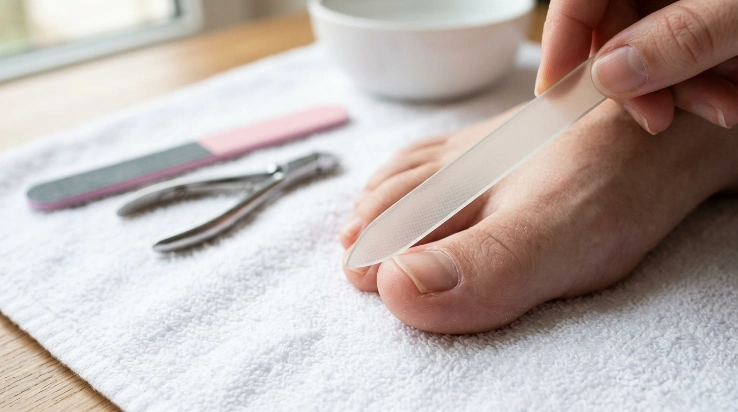
Healthy growth is easier to maintain when you avoid unnecessary damage.
The American Academy of Dermatology’s nail-trimming guidance recommends cutting toenails straight across and smoothing rough edges with a nail file or emery board. It also emphasizes keeping nail tools clean and leaving the cuticles alone.
A simple routine looks like this:
- Wash your feet and tools.
Start with clean nails and clean clippers. - Use proper toenail clippers.
A sharp tool gives you better control than forcing a dull clipper through the nail. - Trim mostly straight across.
Avoid digging deeply into both corners. - Leave a little nail visible.
Do not cut into the skin beneath the free edge. - Smooth rough areas gently.
Use a clean nail file with light pressure. - Stop if you feel pain.
Filing living skin or a painful nail is not normal grooming. - Keep personal tools personal.
Do not casually share files or clippers. - Moisturize dry surrounding skin.
Keep the nail folds comfortable without trapping constant moisture between the toes.
Expert Tip: Take one clear photo of your big toenail at the beginning of each month, using similar lighting and distance. Comparing monthly photos gives you a much better idea of your true growth rate than checking the nail every few days.
Does Frequent Trimming Make Toenails Grow Faster?
No.
Cutting your hair does not change what happens inside the hair follicle, and trimming your toenail follows a similar principle.
The part you clip is already hardened nail material.
Frequent trimming may create the impression of faster growth because you are paying close attention to the length. But trimming does not meaningfully stimulate the nail matrix.
Trim because the nail needs shortening—not because you are trying to force it to grow faster.
Can a Pedicure Encourage Faster Toenail Growth?
A standard cosmetic pedicure does not directly speed up nail production.
A good pedicure can still support healthy-looking nails by:
- Keeping rough edges smooth.
- Removing excess length safely.
- Helping you notice changes early.
- Reducing snagging.
- Encouraging consistent foot care.
The quality of the service matters.
Avoid aggressive cuticle cutting, painful digging around the nail, excessive buffing, or filing that leaves the nail plate thin and tender.
A nail technician can help with cosmetic grooming, but suspicious nail changes need medical assessment.
Common Mistakes to Avoid
When you are trying to maintain attractive toenails through summer, more grooming is not always better.
Avoid these common mistakes:
- Filing too aggressively. You can thin or irritate the nail instead of helping it grow.
- Cutting the corners deeply. This can encourage the edge to press into surrounding skin.
- Cutting toenails extremely short. Leave enough nail to protect the end of the toe.
- Sharing nail files or clippers. Personal grooming tools can carry nail and skin debris.
- Grinding down a discolored nail. Filing does not diagnose or cure fungal infections.
- Picking underneath a lifting nail. You can injure the tissue underneath.
- Removing cuticles aggressively. The cuticle helps protect the nail area.
- Assuming every nail change is caused by summer. Persistent changes can have many causes.
- Using polish to hide a painful or infected-looking nail. Cosmetic coverage does not treat the underlying problem.
- Expecting rapid results. Toenails grow slowly even when they are healthy.
Summer Foot Hygiene Matters More Than Faster Growth
Summer creates some conditions that deserve extra attention even if it does not reliably accelerate nail growth.
Sweaty shoes, pools, communal showers, gyms, and prolonged dampness can increase exposure to organisms that affect the feet and nails.
Let footwear dry between uses when possible. Change damp socks. Keep your feet clean and dry, particularly between your toes.
And pay attention to nail changes rather than simply filing them away.
Fungal nail infections, for example, can cause toenails to become discolored, thickened, brittle, misshapen, crumbly, or separated from the nail bed.
The Mayo Clinic’s nail fungus guidance recommends medical attention when nail changes continue to worsen or when symptoms include pain, swelling, bleeding around the nail, or difficulty walking.
When to See a Nail Technician or Dermatologist
Knowing who should handle a toenail concern can save you from unnecessary DIY damage.
See a Nail Technician When:
A licensed nail technician may be helpful for cosmetic concerns involving otherwise healthy nails, such as:
- Routine shaping
- Polish application
- Minor rough edges
- Cosmetic pedicure maintenance
- Choosing appropriate nail-care tools
- Maintaining healthy artificial enhancements
A technician should not be expected to diagnose a medical nail condition.
See a Dermatologist When:
Consider a dermatologist or other appropriate healthcare professional if you notice:
- A nail that becomes noticeably thicker or distorted
- Persistent yellow, brown, green, white, or black discoloration
- A new or changing dark streak
- Nail lifting without an obvious explanation
- Crumbling or repeated splitting
- Red or swollen skin around the nail
- Pus or drainage
- Bleeding
- Persistent pain
- A nail that appears to stop growing
- Suspected fungal infection
- Changes that continue to worsen
The American Academy of Dermatology notes that changes in nail color, shape, texture, lifting, and surrounding swelling may deserve examination because some nail changes can signal infection or another health problem.
Do not repeatedly file an unusual nail simply to make it look normal.
That may temporarily change the surface without treating the cause.
DIY Care vs. Professional Care
For a healthy toenail that is simply getting longer, DIY maintenance is usually straightforward.
You can trim it, smooth the edge, moisturize dry surrounding skin, and wear shoes that do not crush your toes.
Professional help makes more sense when:
- The nail is too thick to trim safely.
- You cannot comfortably reach your feet.
- Filing causes pain.
- The nail repeatedly becomes ingrown.
- The surrounding skin is inflamed.
- An injury has damaged the nail.
- You suspect infection.
- You cannot explain a major change in color or shape.
Beauty care has limits. A manicure tool should not be used as a substitute for diagnosis or medical treatment.
FAQs
Do toenails actually grow faster in hot weather?
There is no strong evidence that ordinary hot weather reliably makes everyone’s toenails grow faster. Research examining seasonal nail growth has failed to detect consistent summer-versus-winter changes.
What month do toenails grow the fastest?
There is no well-established month in which everyone’s toenails grow fastest. Individual nail-growth rates vary, and everyday differences are more useful to track over several months than by season.
How fast do toenails grow per month?
Healthy toenails commonly grow around 1 to 1.6 millimeters per month. Your rate may be somewhat faster or slower.
Why do my toenails seem to grow faster during summer?
You may look at your feet more often, wear sandals, get more pedicures, or notice polish growing away from the cuticle. Those visual clues can make normal growth much easier to see.
Do toenails grow faster when you cut them?
No. Cutting removes the hardened free edge of the nail. It does not directly stimulate the nail matrix that produces new nail cells.
Does filing toenails stimulate growth?
No. Filing can smooth rough edges and help prevent snagging, but it does not make the nail matrix produce new nail faster. Excessive filing can damage or thin the nail.
How long does a toenail take to completely grow back?
A completely replaced toenail commonly takes around 12 to 18 months. Severe nail-matrix injury or other nail problems can change that timeline.
Conclusion
So, do toenails grow faster in summer?
The best available evidence does not support a universal summer growth boost. Toenails naturally grow slowly—roughly around 1 to 1.6 millimeters per month—and individual differences, nail health, injuries, footwear, and grooming habits are more useful factors to pay attention to.
Summer can certainly make toenail growth look more obvious. Sandals expose your toes. Pedicures happen more frequently. Polish creates a visible regrowth line. You may simply notice your nails more often.
Instead of trying to force faster growth, focus on protecting the nail that is already growing.
Trim straight across, file gently, use clean personal tools, wear comfortable shoes, and avoid filing away unexplained discoloration or thickening. If a toenail becomes painful, swollen, unusually discolored, distorted, or starts lifting, choose professional evaluation over an aggressive DIY fix.
Healthy toenails require patience. Give them gentle care, track changes over time, and let normal growth do the rest.