
How Much to Tip at the Nail Salon: A Clear, Practical Guide

If you want the short answer, here it is: a tip of 15% to 20% is the usual range for nail salon services, and 20% is a solid default when the service was good. If you prefer a simpler rule, $5 to $10 works well for many basic or lower-cost services, especially when the bill is small and a percentage feels awkward.
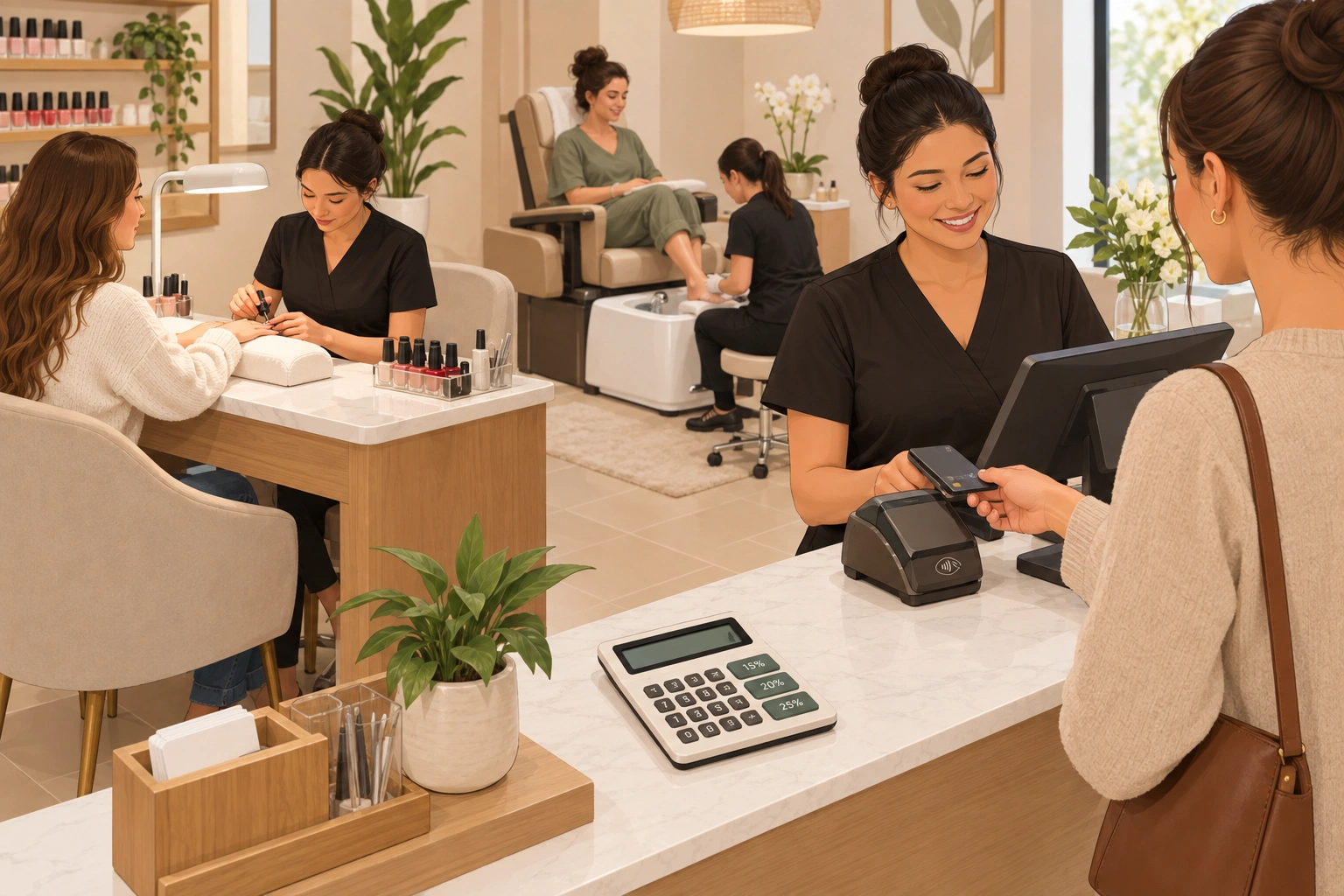
That said, nail salon tipping is not one-size-fits-all. A quick polish change, a regular manicure, a detailed gel set, and a long pedicure do not all call for the same approach. A fair tip should reflect the service price, the time involved, and whether one person or several people worked on your nails.
A helpful mental shortcut:
– Use a percentage when the service is standard and the bill is easy to calculate.
– Use a flat amount when the service is short, inexpensive, or simple.
– Tip more for detailed work, extra time, or exceptional care.
– Tip less only when the service was clearly disappointing, and even then, keep it respectful.
If you want more context on nail service types, our guide to what a full set at a nail salon includes can help you see why some appointments take longer and often deserve a higher tip.
Standard Tipping Range for Nail Salon Services
A practical rule for nail salon tipping is 15% to 20% for standard service, with 20% being a common default when you’re happy with the result. Lower-cost or very quick services can also make a flat tip more practical than a percentage.
Here’s the simplest way to think about that range:
- 15%: acceptable for a straightforward service that was done well
- 18%: a comfortable middle ground for good service
- 20%: a strong default when you’re happy with the result
Nail services are labor-based, so the tip reflects the time and skill involved, not just the polish or product used. The more detailed the work, the more the tip should reflect that effort.
One important detail: many people calculate the tip on the service total before tax because that keeps the math tied to the actual service price. Salon policies vary, though, so if the receipt or payment screen gives you a tip prompt based on the final amount, that’s usually fine too. What matters most is consistency and clarity.
How Much to Tip for Manicures, Pedicures, Gel Nails, and Acrylics
The service type matters because not every appointment requires the same amount of skill or time. A basic manicure is one thing; a full acrylic set or detailed gel design is another.
Here’s a simple comparison table to use at checkout:
| Service type | Typical tipping approach | When to lean higher |
|---|---|---|
| Basic manicure | 15%–20% or a flat $5–$10 | If the tech took extra care with shaping or cleanup |
| Basic pedicure | 15%–20% or a flat $5–$10 | If the service was detailed, longer, or especially relaxing |
| Gel manicure | 15%–20% | If removal, prep, or finish work took extra time |
| Acrylic nails / full set | 18%–20% or more if highly detailed | If the set was complex, sculpted, or time-consuming |
| Nail art / add-ons | Add a little extra beyond the base tip | If the design was intricate or custom |
| Quick polish change | Flat $3–$5 or about 10%–15% | If the visit included extra cleanup or attention |
Manicures
For a standard manicure, a 15% to 20% tip is the normal range. If the manicure was basic and fast, a flat $5 tip can be perfectly reasonable, especially on a lower bill. If you received careful cuticle work, precise shaping, and a polished finish, closer to 20% feels more appropriate.
Pedicures
Pedicures often involve more time and physical effort than a manicure, so many clients tip at the higher end of the range. A 15% to 20% tip is still the usual baseline, but a flat $10 tip is common when the service was longer or more detailed. If the pedicure included callus care, massage, or extra steps, tipping a little more is a fair way to acknowledge that work.
Gel nails
Gel services usually take more prep and finishing time than a basic polish service, so they tend to land closer to 18% to 20%. If you also had gel removal, extension work, or additional shaping, tipping at the higher end makes sense.
Acrylic nails
Acrylic services often require more technical skill and more time than a standard manicure. For that reason, 18% to 20% is a strong starting point, and a flat amount may not feel generous enough on a longer appointment. If the set involved detailed shaping or custom work, the tip should reflect that extra labor.
Nail art and add-ons
For nail art, the cleanest rule is to tip on the total service price and then add a little extra if the design was especially detailed. For example, if your manicure is $40 and you ask for a simple $10 accent design, you might tip on the full service and add a few extra dollars if the art took noticeable time. A simple accent nail is not the same as hand-painted art on every finger. If the work was custom or took significant time, a larger tip is a thoughtful way to recognize it.
Add-on services like removal, repair, or paraffin
If removal, a repair, or a paraffin treatment was not included in the main service, tip for that extra work too. A small add-on can still take time and attention, so it’s reasonable to add a few dollars more or include the add-on in your percentage calculation if it was billed separately.
For readers comparing service complexity, our guide to how to find a safe nail salon can also help you think about what good service and good salon habits look like in practice.
When a Flat Dollar Tip Makes More Sense Than a Percentage
A percentage is easy when the bill is moderate or high. But for small services, a flat tip is often more practical.
Use a flat dollar tip when:
– the service is quick
– the bill is low
– the appointment is simple
– you want to avoid awkward math at checkout
Examples:
– A quick cleanup or polish change may call for $3 to $5
– A basic manicure or pedicure may work well with $5 to $10
– A longer or more involved service may justify a higher flat amount
Flat tipping is especially useful when the bill is so small that a percentage would produce a tip that feels too low to be meaningful. If a service costs very little but still took someone’s time and skill, a small fixed tip is often the more respectful choice.
How to Adjust Your Tip for Service Quality, Complexity, and Time
This is where tipping becomes less about a formula and more about judgment.
A simple rule works well:
– Good service: tip within the normal range
– Exceptional service: move toward the high end, or add a few extra dollars
– Mediocre service: stay in range, but don’t feel pressured to go above it
– Poor service: keep the tip modest, but avoid making the amount feel punitive
Tip more when the work clearly took more effort
A nail tech may spend extra time fixing shape, correcting a previous set, handling difficult nail art, or making sure the finish is even and clean. That extra effort matters. Time is part of the value you’re paying for, and the tip is one of the few ways to acknowledge labor that isn’t visible on the receipt.
Tip less only when the service genuinely fell short
If the service was rushed, sloppy, or not what you asked for, you do not have to tip at the top of the range. Still, it’s usually better to keep the adjustment measured rather than dramatic. A lower tip can signal disappointment without creating a scene.
If you’re unsure how to respond to a disappointing visit, it can help to speak up politely before checkout. Sometimes a small issue can be corrected on the spot, which is better for both sides than silently leaving frustrated.
How to Tip When Multiple Technicians Help With One Visit
Split services can be confusing. If one person did your manicure and another did your pedicure, or one tech handled the base service while another did nail art, the safest approach is to tip the people who actually performed the work.
You have two practical options:
Option 1: Tip each technician separately
This is the clearest choice when different people worked on different parts of the appointment. It avoids guesswork and makes sure each person is recognized fairly.
Option 2: Ask the front desk how tips are handled
If the salon pools tips or has a specific checkout process, ask directly:
– “Should I tip each tech separately?”
– “Can I split the tip between them here?”
– “Does the system let me leave separate gratuities?”
That wording is simple, polite, and avoids awkwardness. It also helps if you’re paying by card and want to be sure the right person gets the tip.
If you received a full set or another more involved service, it may help to understand the appointment structure first. Our article on what is a full set at a nail salon explains why these services often involve more than one step.
Cash Tip vs. Card Tip at Checkout
Both are acceptable, but cash is often preferred because it is immediate and can be easier for the technician to receive directly. That said, card tipping is completely normal in many salons, especially when the payment terminal prompts you for gratuity.
Cash tip
Pros:
– usually goes straight to the tech
– easy to hand to the right person
– no confusion about the amount
Cons:
– you need to bring cash
– you may need smaller bills
Card tip
Pros:
– convenient
– easy if you’re not carrying cash
– works well when the salon uses a payment terminal
Cons:
– may be processed later
– may not feel as direct as cash
If you’re a first-time customer and the payment terminal shows a preset gratuity screen, take a second to check whether the suggested amount matches the service you received. You can usually choose a custom amount, select no tip if gratuity is already included, or ask the front desk before paying. If you know you’ll want to tip in cash, bring it in advance. That saves you from hunting for an ATM after your appointment.
Do You Tip on Discounts, Gift Cards, Packages, or Service Fees?
This is one of the biggest sources of confusion, and the answer depends on what the bill actually shows.
Discounts
If the salon gives you a discount, a simple rule is to tip on the original price if the service and timing were the same, or on the discounted price if you need to keep the total lower. If you want an easy minimum, a flat tip of at least $5 for a basic service is a reasonable fallback. If the discount was already generous and the bill is still small, tipping on the final amount is still better than skipping the tip altogether.
Gift cards
A gift card pays for the service, not the gratuity. If you use one, plan to tip separately out of pocket.
Packages
If the salon sells a package or membership, check whether gratuity is included. Some package pricing may already account for service charges, while others do not. If the bill doesn’t clearly include a tip, assume it does not.
Service fees
A service fee is not always the same thing as a tip. If a line on the receipt is labeled gratuity, that usually means the tip is already included, so you generally do not need to tip again unless you want to leave something extra for exceptional service. If the charge is only a service fee or administrative fee, it may not go to the technician, so you may still want to tip separately. When in doubt, ask before paying.
Do You Tip the Salon Owner or an Independent Nail Tech?
This is where etiquette gets a little nuanced.
If the salon owner performs the service, tipping is still often appreciated. A simple default rule is to tip the owner the same way you would tip any other nail tech if the service was good, unless the salon clearly says otherwise.
If you’re seeing an independent nail tech, tipping is usually still welcome unless the provider has clearly stated otherwise. Independent techs set their own pricing, so some clients assume the price covers everything. Others still tip for especially good service. The safest move is to follow the salon or tech’s stated policy.
If there’s no policy posted, a modest tip for good service is a reasonable default.
For product and service prep questions that affect the quality of your appointment, our guide to nail prep cleanser can help you understand why prep matters in the salon workflow.
Simple Nail Salon Tipping Examples
Here are a few real-world examples to make the math easier.
Example 1: Basic manicure, $30
- 15% tip = $4.50
- 20% tip = $6.00
A flat $5 or $6 tip fits well here.
Example 2: Pedicure, $50
- 15% tip = $7.50
- 20% tip = $10.00
A $10 tip is a clean, easy choice if the service was good.
Example 3: Gel manicure with nail art, $75
- 15% tip = $11.25
- 20% tip = $15.00
If the design was detailed, $15 feels appropriate.
Example 4: Acrylic full set, longer appointment
If the service took a long time and involved careful shaping or custom detail, moving toward the high end of the range is the fairest approach.
Example 5: Quick polish change, low-cost service
A percentage may come out very small here, so a flat $3 to $5 tip is often more practical.
If you want to compare service types before your next appointment, our guide on how much nail dehydrator to use and related salon prep topics can also help you better understand the work behind a polished result.
A Simple Rule You Can Use Every Time
If you want one rule that works in most situations, use this:
Tip 15% to 20% for standard nail services, use a flat $5 to $10 for simple or low-cost appointments, and tip more when the service is detailed, time-consuming, or handled especially well.
That rule is easy to remember, flexible enough for real salon visits, and polite in nearly every setting. It also gives you room to adjust without overthinking the checkout screen.
When to See a Nail Technician or Dermatologist
If your question is really about whether a service should be adjusted, repaired, or skipped because your nails or skin look unusual, a licensed nail technician can often help you decide what the salon can safely do. If you’re dealing with persistent nail changes, pain, or skin concerns, a dermatologist is the better professional to ask. For general cosmetic service questions, though, your nail tech is the right first stop.
FAQ
How much do you tip at the nail salon for a basic manicure?
Usually 15% to 20%, or a flat $5 to $10 if the bill is low.
Should I tip on the pre-tax or post-tax total?
Many people tip on the service amount before tax, but salon checkout systems may calculate from the final total. Either is generally acceptable if you’re consistent.
Do you tip for gel nails and acrylics?
Yes. These services often take more time and skill, so 18% to 20% is a common choice.
What if two people worked on my nails?
Tip each technician separately if possible, or ask the front desk how to split the gratuity.
Is cash better than card?
Cash is often preferred because it’s direct, but card tipping is still normal and convenient.
Do I still tip if the salon owner did my nails?
Often yes. A simple default is to tip the owner the same way you would tip any other nail tech if the service was good.
What if I used a gift card?
Plan to tip separately, since the gift card usually covers only the service cost.
What if the service was bad?
You can tip less, but keep it respectful. If possible, speak to the salon before leaving so they can address the issue.

