
How to Dry Nail Polish Faster Without Ruining Your Manicure

If you want your manicure to feel “instant,” the honest answer is this: nail polish usually cannot be fully dry in seconds, but you can make it dry much faster and far less likely to smudge. The trick is to speed up the surface set, protect the finish, and avoid the habits that keep polish soft underneath.

The biggest mistake I see is treating “looks dry” as “safe to use.” Fresh polish can feel smooth on top while still being vulnerable to dents from a sleeve, a zipper, or even the edge of a pillow. That’s why the best drying strategy is not one magic hack. It’s a sequence: apply thinner coats, use a fast-drying product if you have one, and choose a drying method that helps the top layer set without disturbing the paint.
If you want a deeper timing breakdown, you may also find how long nail polish takes to dry and how long to wait between coats of nail polish useful alongside this guide.
How Fast Can Nail Polish Dry, Really?
“Instant” is a convenient phrase, but in real life there are three different stages of drying:
- Surface-dry: the top no longer feels wet
- Smudge-resistant: light contact is less likely to leave a mark
- Fully set: the polish is much less likely to dent or wrinkle from normal use
Those stages do not happen at the same time. A manicure can seem dry enough to admire, then still dent when you press on a key or grab a bag. That’s why the goal is usually to get from wet to smudge-resistant as quickly as possible, then give the polish a little more time to fully settle.
A practical rule of thumb is that the surface can feel dry well before the manicure is truly ready for normal use. Even when polish no longer looks glossy-wet, the layers underneath may still be soft enough to mark. That is why a finish can seem fine until something presses into it.
Formula matters too. A quick-dry polish will usually move through those stages faster than a regular polish, but even quick-dry formulas still benefit from thin coats and careful handling. Older polish can also be thicker and stickier, which makes it harder to spread evenly and can slow the set.
Quick-Dry Polish vs. Regular Polish
If you are deciding what to buy, this is the clearest shortcut:
- Quick-dry polish is the better choice when speed matters most. It is designed to set faster and is usually easier to manage if you are trying to avoid smudges.
- Regular polish can still look great, but it usually needs more patience between coats and after the final coat.
If you often paint your nails in a hurry, a quick-dry formula is the better first purchase. If you already own regular polish, you can still speed things up with thin coats, a quick-dry top coat, and careful drying methods.
What You Need Before You Start
You do not need a drawer full of gadgets, but a few basics make a real difference:
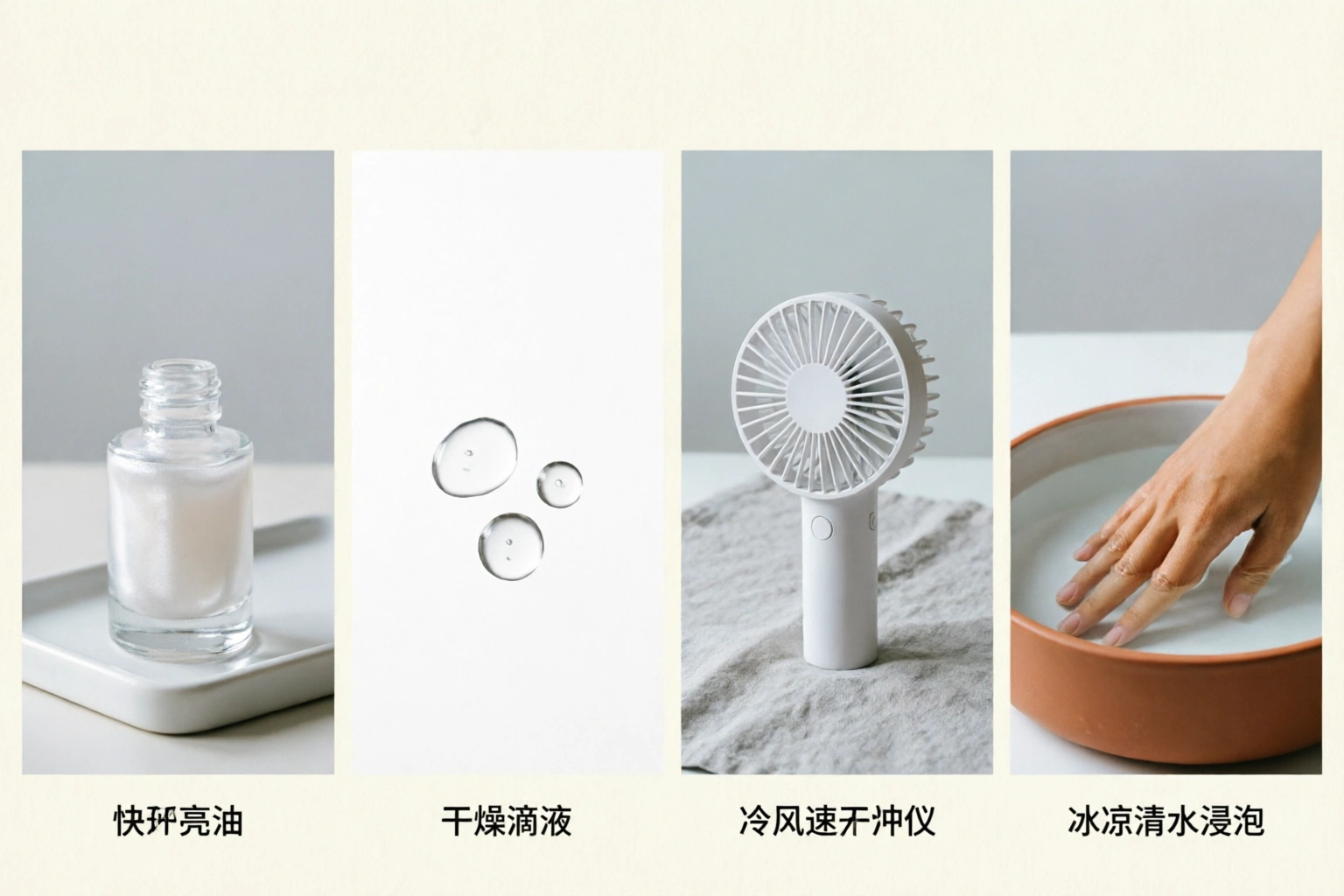
- Quick-dry top coat if you want the easiest all-around speed boost
- Drying drops if you want to reduce tackiness without adding much bulk
- Fan or cool-air dryer for gentle airflow
- Bowl of cold water or ice water if you prefer a household method
- Nail polish thinner if the bottle has gotten thick over time
- Clean, oil-free nails before application
A useful prep step is washing your hands before painting. That does not make polish dry instantly, but it does help the manicure behave better once it is on.
The Fastest Ways to Dry Nail Polish
Here is the practical order I recommend, from most efficient to most situational.
1) Use a quick-dry top coat
This is the simplest way to speed up drying while also protecting the color. A good quick-dry top coat helps seal the surface, which reduces the sticky window where smudges happen.
Use it as the final step after your color coats. Apply it in a smooth layer without overworking the polish underneath. If you brush too slowly or go back and forth repeatedly, you can drag color or create ridges.
2) Add drying drops
Drying drops are useful when you want speed without changing the look of the manicure much. They are especially handy when you are wearing a thicker manicure or multiple layers and do not want to disturb the paint with another brush stroke.
If you already use a quick-dry top coat, drying drops can be layered on top for extra help. They are not magic, but they can reduce that tacky, easy-to-dent phase.
3) Use cool air, not heat
A fan or hair dryer on the cool setting can help fresh polish set faster. Keep the airflow gentle and hold it at a comfortable distance so you do not disturb the surface.
This matters because hot air can soften the surface instead of helping it set. If you use airflow, choose cool and keep it light.
4) Try cold water or ice water
Cold water can help harden the outer layer once the polish has had a moment to settle. This method is best when you need to reduce smudging risk quickly, but it still requires care. Strong water flow can disturb wet polish, so a still bowl is safer than running water.
Quick-Dry Top Coat vs. Drying Drops
These two products solve slightly different problems.
| Feature | Quick-Dry Top Coat | Drying Drops |
|---|---|---|
| Main job | Seals color and speeds the surface set | Reduces tackiness and helps polish harden |
| Best for | Most DIY manicures | Thick manicures or people who want minimal brush contact |
| Finish benefit | Adds gloss and protection | Usually minimal effect on shine |
| Ease of use | Very easy | Very easy, but requires careful application |
| Trade-off | Can drag if applied too heavily | Less protective than a top coat on its own |
If you only want to buy one product, I would usually choose a quick-dry top coat first. It gives you speed plus protection. If you already own a good top coat and your manicure still feels soft, drying drops are a useful add-on.
Step-by-Step: Dry Your Nails Faster Without Smudging
Use this sequence after your last color coat.
-
Apply thin coats from the beginning.
Thin layers dry faster than thick ones, and they are less likely to wrinkle or stay gummy underneath. -
Wait 1 to 2 minutes between base coat and color.
The base coat should look set enough that the color glides on without pulling it around. -
Wait about 2 to 3 minutes between color coats.
If you are using a very thin formula, you may be able to move a little faster, but avoid stacking wet-on-wet layers. -
Wait 2 to 5 minutes before your top coat.
The color should lose its wet shine first. A slightly tacky layer is easier to work with than a fully wet one. -
Seal with a quick-dry top coat or drying drops.
Pick one based on what you have. If you use a top coat, float it on rather than scrubbing the brush across the nail. -
Let the final coat sit undisturbed for at least 5 to 10 minutes.
This is the window where smudges happen most easily, even if the surface looks fine. -
Choose one gentle cooling method.
Use either a fan/cool air or a cold-water dip after the polish is no longer visibly wet. Do not combine aggressive airflow with wet nails and do not use hot air. -
Keep your hands still for a little longer before normal use.
Light use may be possible sooner than full use, but avoid zippers, tight sleeves, heavy bags, and anything that presses on the nails.
First 5 minutes after painting: smudge-proof checklist
- Keep fingers straight and relaxed
- Do not touch clothing, hair, or your phone screen
- Avoid opening bags, drawers, or zippers
- Do not wash dishes or reach for water
- Let the manicure sit flat and undisturbed
How Coat Thickness and Formula Change Drying Time
This is where a lot of “my polish never dries” complaints actually begin.
A thick coat traps solvent underneath the surface. The top layer may firm up while the lower layer stays soft, which is why a manicure can dent hours later. Multiple thin coats usually dry more reliably than one heavy coat, even if the total number of layers is the same.
Regular polish also tends to need more patience than quick-dry formulas. If your bottle is old or thickened, it can apply heavier and dry less evenly. In that case, a nail polish thinner is safer than trying to fix the texture with more shaking or more product.
If you are painting with a sheer or buildable formula, thin coats are even more important. You may need an extra layer for coverage, but each layer will set faster than one overloaded coat.
What Not to Do When You Need Polish to Dry Fast
Some popular shortcuts make the problem worse.
- Do not use hot air. Heat can slow the drying process and increase the chance of bubbles or ripples.
- Do not paint thick, glossy-looking coats to save time. Thick polish takes longer to set underneath.
- Do not touch the nail just because it feels dry on top. Surface-dry is not fully set.
- Do not shake the bottle aggressively. That can build air bubbles that show up after application.
- Do not apply lotion or oil too early. If the surface is not set, you can soften or mark it.
A drying spray or other purpose-made product is a better fallback than improvised kitchen shortcuts. If you want the least risky option, stick with products made for nails.
How to Tell Whether Polish Is Dry Enough
Use these simple checks instead of guessing.
- Light reflection test: if the surface still looks wet and fluid, it needs more time.
- Gentle air test: if a cool fan does not change the finish, it may be moving into the set stage.
- Very light contact test on one nail: tap the edge, not the center. If it leaves a mark, stop and wait.
What you are looking for is not perfect hardness. You are looking for a point where ordinary movement is less likely to ruin the manicure. That is the stage where you can start being careful again, not reckless.
Troubleshooting Smudges, Dents, and Sticky Polish
A small dent is not always a full restart.
If the polish is still soft and the dent is shallow, sometimes you can gently smooth it with a little more top coat once the layer beneath has had time to settle. If the mark is deep, dragging, or textured, it is usually better to let the nail dry fully and then even it out with another coat.
If one nail smudges badly while the others look fine, redo that nail instead of redoing the whole hand. That is often faster and gives a cleaner result.
Sticky polish that stays tacky for too long usually points to one of three issues: coats were too thick, the formula is old or heavy, or the manicure was handled too soon. In those cases, more airflow may help a little, but it will not fully rescue a badly overloaded application.
Best Method by Situation
If you have only 10 minutes
Use thin coats, a quick-dry top coat, and cool air. That combination gives you the best chance of reaching a smudge-resistant stage quickly.
If you only have household items
Go with a fan or cool hair dryer, then a careful cold-water dip once the polish is no longer visibly wet. Keep the water still and shallow enough that you can move your hands gently.
If you used regular polish
Prioritize thin application and a quick-dry top coat. Regular formulas benefit the most from careful layering because they are usually slower than quick-dry versions.
If your manicure is thick or layered
Drying drops are especially helpful here because they can reduce tackiness without adding another heavy coat of product.
If you want the lowest-risk option
Air drying with a good quick-dry top coat is usually the safest bet. It is not the fastest, but it is less likely to disturb the polish than strong airflow or rushed handling.
When to Ask a Nail Technician
If your polish keeps wrinkling, never seems to harden, or chips off in sheets shortly after application, the issue may be formula compatibility, product age, or application technique. A nail technician can help you identify whether the problem is the polish itself, the base layer, or the way the coats are being built.
That is especially useful if you regularly wear thicker manicures or want a faster routine without sacrificing finish quality.
Final Takeaway
If you want the fastest realistic answer to how to dry nail polish instantly, think in terms of speeding up the set, not forcing a miracle. Thin coats, a quick-dry top coat, and gentle cool air are the most reliable everyday tools. Cold water and drying drops can help too, but none of them can fully replace careful application.
If you are in a hurry, choose quick-dry top coat first, then add cool air if you want an extra boost. For the safest natural-nail routine, keep the method gentle and give the manicure a few minutes of stillness before light use.

