
How to Tip at a Nail Salon: A Practical Guide to Getting It Right

If you want the simplest rule, use this: tip 15% to 20% of the service total, then adjust up or down based on how involved the appointment was and how happy you are with the result. For a basic manicure or pedicure, 15% is a common minimum in many salons; 20% is a common choice when the service felt careful, thorough, and pleasant. Some sources also note that cash is often preferred because it is easier to hand directly to the technician, while card tipping is still a practical option when that is what the salon offers. NerdWallet and DaySmart Salon both reflect that general guidance.
If you only remember one calculation trick, remember this: tip on the service price before tax unless the salon’s receipt clearly works differently. That keeps the math simple and avoids accidentally tipping on charges that were never part of the service itself.
How Nail Salon Tipping Usually Works
Tipping at a nail salon is usually handled at the end of the appointment, after the polish is dry enough and the service is complete. In most salons, the tip is not built into the listed price, so it is added separately if you choose to tip. One salon etiquette source recommends tipping about 15% to 20% of the total bill, and another says 20% is a common choice if you are completely happy. V Beauty Pure and DaySmart Salon both support that range.
A practical way to think about it: you are not tipping the “product,” you are tipping the person’s time, skill, and attention. That matters because a fast polish change and a two-hour acrylic set are not the same kind of labor, even if both end with polished nails.
If you are unsure who gets the tip, ask at the front desk before paying. Most salons can tell you whether the technician receives cash directly, whether the tip is added to the card receipt, or whether the front desk collects it for distribution.
Standard Tip Amounts for Manicures, Pedicures, Gel, and Acrylics
A basic percentage is useful, but the service type gives you better context. A simple manicure generally calls for a tip in the same 15% to 20% range. Pedicures often fall there too, though many clients lean toward the higher end when the appointment includes more massage time, more cleanup, or more detailed work.
For gel, acrylic, dip, or nail art services, the appointment often takes longer and requires more precision. That does not automatically mean you must tip more than 20%, but it is a good reason to choose the higher end of the usual range if the work was careful and the result was what you wanted.
Here is a quick reference:
| Service type | Common tip range | Practical note |
|---|---|---|
| Basic manicure | 15%–20% | 15% is fine for a routine service |
| Basic pedicure | 15%–20% | 20% is common if the service felt especially thorough |
| Gel manicure | 15%–20% | Longer wear and extra steps may justify the higher end |
| Acrylic set or fill | 15%–20%+ | More time and skill usually push people toward 20% |
| Nail art / detailed design | 20% or more | Extra time and custom work often earn a larger tip |
If you want a simple default, use 15% for routine work and 20% for more complex or time-consuming services.
How to Calculate the Tip on Real Salon Prices
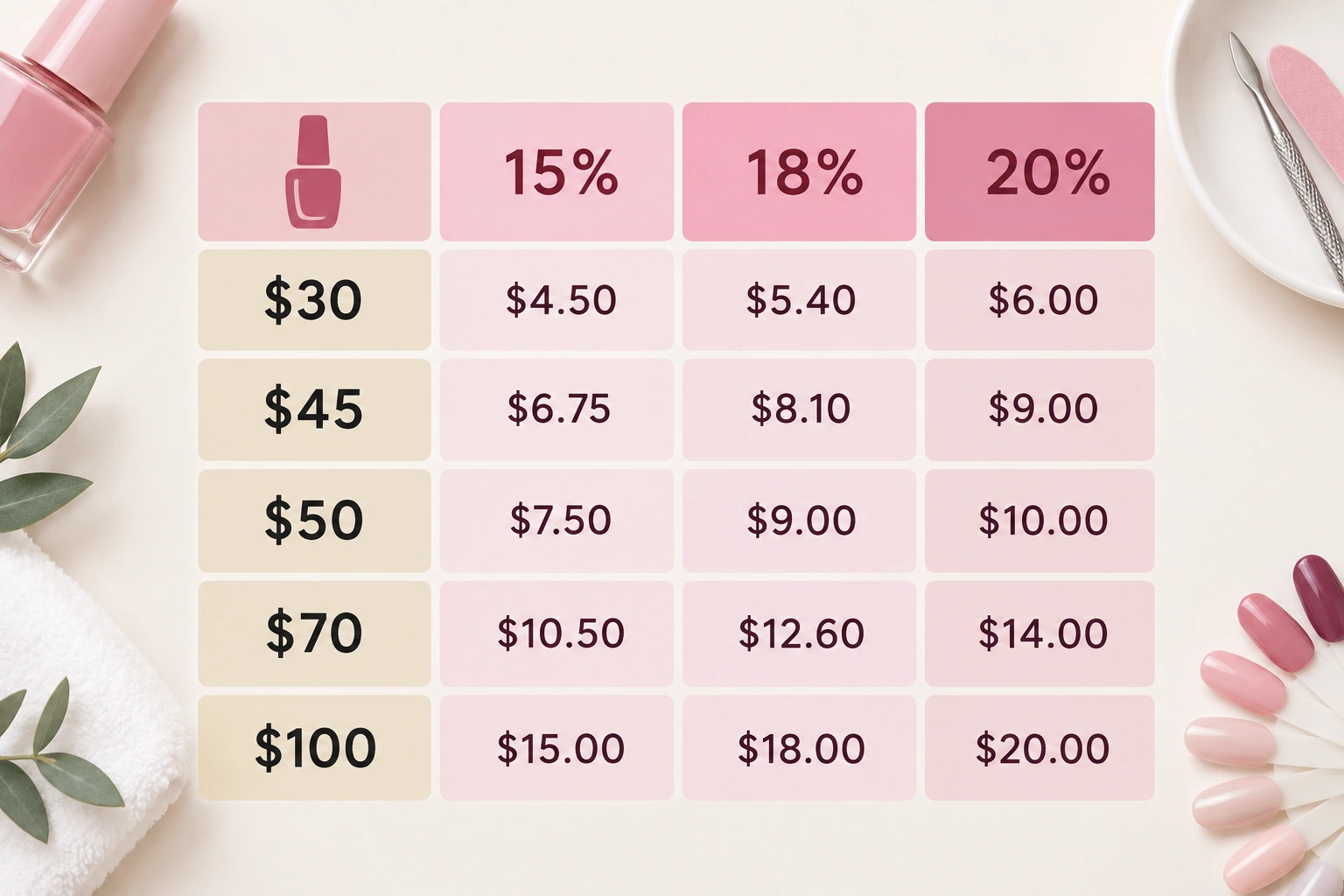
A percentage is easy once you see it in real numbers. Here are common examples using 15%, 18%, and 20%:
| Service price | 15% tip | 18% tip | 20% tip |
|---|---|---|---|
| $30 | $4.50 | $5.40 | $6.00 |
| $45 | $6.75 | $8.10 | $9.00 |
| $50 | $7.50 | $9.00 | $10.00 |
| $70 | $10.50 | $12.60 | $14.00 |
| $100 | $15.00 | $18.00 | $20.00 |
A few realistic examples help more than formulas:
- A $30 basic manicure: $4.50 at 15%, $5.40 at 18%, or $6 at 20%.
- A $50 pedicure with a massage upgrade: $7.50 to $10 is a sensible range.
- A $70 gel manicure with nail art: many clients would tip around $12 to $14 if the work was detailed and finished well.
- A $100 acrylic fill with custom design: $15 to $20 is a straightforward benchmark, with more possible if the design was especially intricate.
If you do not want to do math at the chair, round to an easy number. For example, 18% of a $45 service is $8.10, so $8 is perfectly reasonable if the service was standard. If the appointment was excellent, rounding to $10 is a neat and generous choice. For prices not listed here, estimate the percentage and round to the nearest dollar or two so the tip is easy to leave.
When to Tip More or Less
The cleanest way to adjust your tip is to look at three things: time, complexity, and service quality.
Tip more when the appointment took extra effort
Choose the higher end of the range when the service involved:
- detailed nail art
- a long acrylic or gel appointment
- careful cuticle work
- repairs or reshaping
- a massage upgrade or extra finishing steps
These services usually require more focus and more chair time, so a larger tip is a fair way to acknowledge that.
Tip less when the service was basic or very quick
A simple polish change, a routine cleanup, or a short maintenance visit does not usually require the same tip as a full set with custom art. In those cases, 15% is a reasonable baseline if the service was fine.
Keep your budget in view
If you are trying to stay within a set spending limit, tip from the amount you can realistically afford. A smaller but respectful tip is better than stretching your budget and feeling resentful. What matters most is that the tip matches the appointment and your means, not that it hits an exact number every time.
How to Tip for Add-Ons, Repairs, Removals, and Nail Art
Add-ons can make tipping feel confusing, but the easiest approach is to treat them as part of the service total unless the salon clearly separates them.
If you added nail art, a repair, a removal, or a massage upgrade, you have two workable options:
-
Tip on the full final price
This is the simplest method and usually the least awkward. -
Tip a little extra for special work
This can make sense when a technician spent noticeably more time on custom art, fixing a broken nail, or doing a removal that took patience.
For example, if your manicure was $45 and you added $15 of nail art, tipping on the full $60 total is straightforward. If the art was especially detailed, you might round up a bit more.
For multi-step appointments, what to ask for at a nail salon can also help you understand what is included before you sit down, which makes tipping easier later.
Cash Tip vs. Card Tip
Cash is often the easiest tipping method at a nail salon. One salon guide says cash is best because it can be handed directly to the technician. Another source says cash is generally preferred when you have the choice between cash, card, or a payment app. DaySmart Salon and NerdWallet both point in that direction.
That said, card tipping is still useful when you do not have cash. If the receipt or payment terminal offers a tip line, use it. If the salon lets you add a tip through a card machine or app, that is usually better than skipping the tip entirely because you are unprepared.
A simple decision rule:
– Have cash? Use cash.
– No cash, but the salon offers card tipping? Use the card option.
– No tip line or you are unsure how the system works? Ask the front desk before you pay.
How to Tip When More Than One Technician Helps
When more than one person contributes to your service, the fairest approach is to make sure the tip reflects the work each person did. One salon etiquette source says that when multiple services are involved, many clients tip separately for each part of the appointment. That same logic is helpful when different technicians handle prep, polish, nail art, or finishing work. V Beauty Pure
In practice, there are two common ways to handle this:
- One combined tip if one technician clearly led the service and the others only helped briefly.
- Separate tips if different technicians each performed meaningful parts of the appointment.
For example, if Technician A prepped and shaped your nails and Technician B did the art, and you want to leave a $10 total tip, you could give $6 to Technician A and $4 to Technician B. If you are not sure how the salon handles it, ask before paying: “Should I leave this with the front desk, or should I tip each technician directly?”
Where to Leave the Tip: Technician, Front Desk, or Receipt
This part is mostly about salon setup. Some salons want cash handed directly to the technician. Others prefer the front desk to collect it. Some let you add it on the card receipt.
If you are paying with cash, hand the tip directly to the technician unless the salon tells you otherwise. If you are paying by card, check the receipt carefully before signing. If there is a tip line, fill it in clearly. If there is no obvious option, ask the front desk to help so the money goes where it is supposed to go.
A good habit is to clarify this before the appointment ends. That saves the awkward moment of standing at the register trying to guess the salon’s system.
Tipping on Discounts, Packages, and Promotions
Discounts make the calculation feel trickier than it needs to be. A practical rule is to tip on the amount you actually paid, unless the salon explains a different policy.
That keeps things fair and budget-friendly. If a $60 service is discounted to $45, tipping 15% to 20% of the discounted amount is usually the simplest path. If the appointment was still a lot of work, you can always round up.
Packages are similar, but it helps to separate the services in your head. If you booked a bundled manicure-pedicure deal, tipping on the discounted package total is a common approach. If the bundle includes several meaningful services and one technician handled most of the work, you may want to tip that person on the final package price. If different technicians handled different parts, a split tip can make more sense.
For example, if a package originally priced at $80 is discounted to $60 and includes both a manicure and pedicure, you could tip 20% of the $60 total, or $12, and then split it if two technicians worked on separate parts of the appointment. If a coupon or membership discount applies to multiple services together, the cleanest rule is usually to tip on the post-discount total unless the salon says the tip should be based on the pre-discount service price.
The main thing to avoid is overthinking the original sticker price when the final bill is lower. Your tip should stay tied to the actual appointment you received and the amount you paid.
What to Do If the Service Was Poor
If the service felt rushed, careless, or significantly below normal, a smaller tip is reasonable. You do not need to pretend everything was great just to avoid an awkward moment.
A fair approach is:
– tip less than you normally would if the issue was mild
– skip a larger tip if the service was clearly poor
– speak up politely if something specific needs to be corrected before you leave
If the problem was serious enough that the salon had to redo part of the service, give the business a chance to fix it before deciding on the tip. If the result still does not meet basic expectations, it is acceptable to reduce the tip or, in extreme cases, not tip.
What matters is staying calm and specific. “The shaping is uneven” is more useful than a vague complaint, and it gives the salon a chance to respond.
Simple Nail Salon Tipping Cheat Sheet
Use this when you are standing at the register and want a quick answer:
- Basic manicure or pedicure: tip 15% to 20%
- Gel, acrylic, or detailed nail art: lean toward 20%
- Extra-long or especially detailed service: consider tipping a little above 20% if it felt warranted
- Discounted service: tip on the final amount paid
- Multiple technicians: tip each person if each did meaningful work
- Cash available: cash is usually the easiest and clearest option
- No cash: use the card tip option if the salon provides one
- Poor service: a smaller tip is acceptable; severe problems may justify no tip
If you want one number to remember, make it this: 20% is a comfortable default for a nail salon when the service was good and the appointment was more than just a quick touch-up.
When to See a Nail Technician or Dermatologist
If your question is about tipping, a nail technician can usually help with salon policy, service breakdowns, and what counts as an add-on. If your concern is about nail pain, redness, swelling, or a nail problem that keeps coming back, a dermatologist is the better person to ask. Tipping etiquette should never override basic health concerns.
For more salon prep and service planning, you may also find how to find a safe nail salon and what is a full set at a nail salon helpful before your next appointment.

