
What Percentage Should You Tip at a Nail Salon? A Practical Guide for Manicures and Pedicures

If you want the short answer, a 15% to 20% tip is the most common range for nail salon services. In practice, 15% works as a solid baseline, while 18% to 20% is the safer choice for good or excellent service.
Several nail-industry and consumer guides point to that same general range, but tipping customs can vary by salon, location, and service type. If you want one simple rule to use at checkout, 20% is a common default, but 15% to 20% is the standard range.
A quick reality check: tipping is usually customary, not mandatory. That means you are not breaking a rule if you tip less in a poor-service situation, but leaving a fair gratuity is still the norm in many salons.
Learn what to ask before your appointment if you want to avoid surprises at checkout.
Quick Answer: The Standard Nail Salon Tip Range
Here’s the simplest way to think about it:
- 15%: acceptable baseline for average service
- 18%: good middle ground for a solid appointment
- 20%: common default for polished, careful, or especially pleasant service
- More than 20%: for complex work, extra time, or exceptional care
If you are unsure, 18% is a balanced choice. It sits between budget-conscious tipping and the common “excellent service” standard.
A simple decision rule
Use this:
- Average service, no issues: 15%
- Good service, clean work, pleasant experience: 18%
- Excellent service or detailed work: 20%
- Extra-long appointment, repairs, or intricate nail art: 20% or more
That rule is practical because it keeps you from overthinking every appointment. It also gives you room to adjust when the technician spends more time on shaping, cuticle work, corrections, or design.
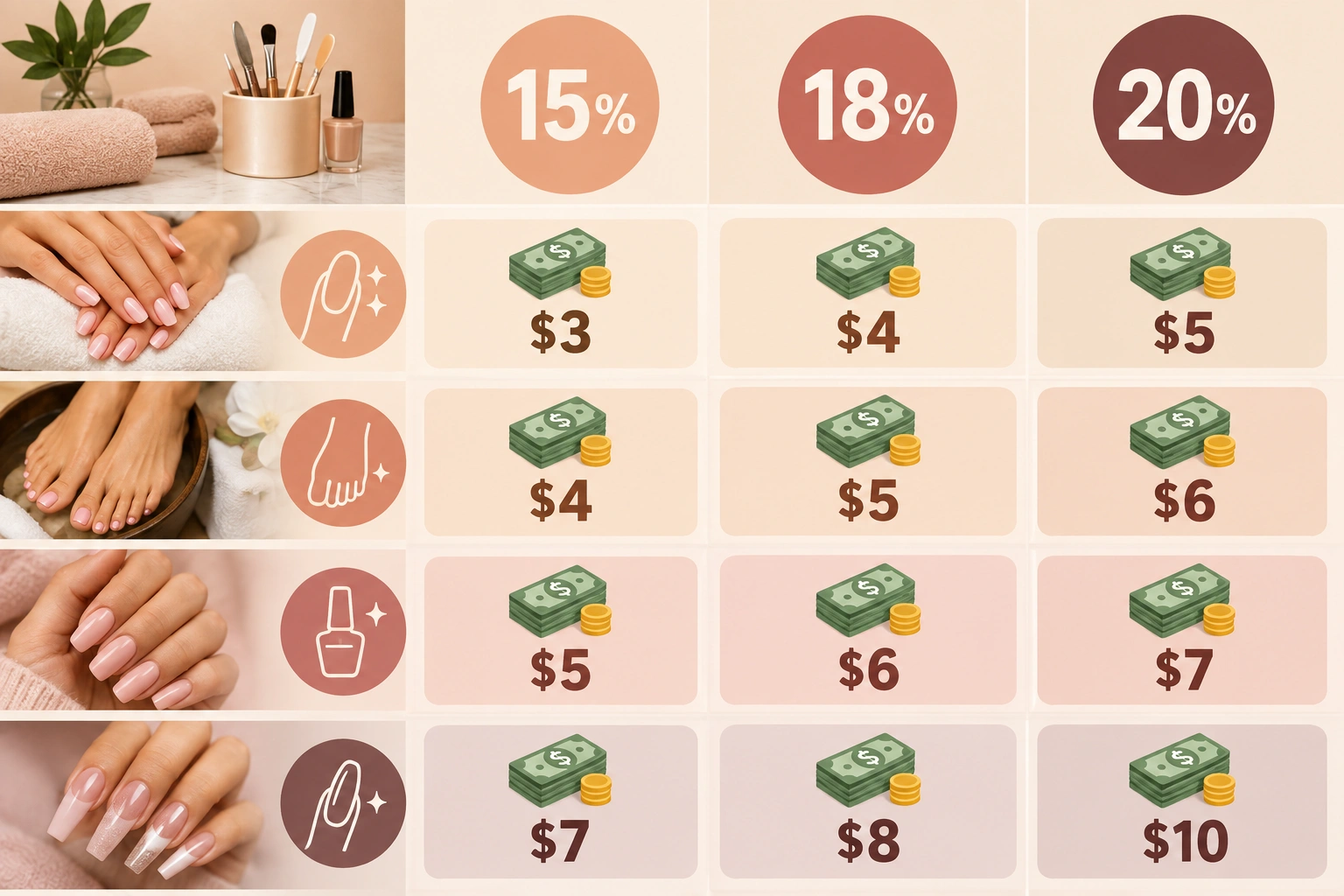
How Much to Tip for Different Nail Services
The service type matters less than the time, skill, and effort involved. A simple manicure and a detailed acrylic set do not carry the same workload, so the tip should reflect that.
| Service price | 15% tip | 18% tip | 20% tip | When it makes sense |
|---|---|---|---|---|
| $30 | $4.50 | $5.40 | $6.00 | Basic manicure or quick maintenance |
| $40 | $6.00 | $7.20 | $8.00 | Standard manicure or simple pedicure add-on |
| $50 | $7.50 | $9.00 | $10.00 | Gel manicure or routine pedicure |
| $60 | $9.00 | $10.80 | $12.00 | Better fit for a fuller service |
| $75 | $11.25 | $13.50 | $15.00 | Longer appointment or specialty service |
| $100 | $15.00 | $18.00 | $20.00 | Example of a higher-priced service such as acrylics, detailed design, or a multi-step appointment |
A table like this is useful because many people can do the percentage in their head but still hesitate when the bill arrives. If your salon total is not one of these exact numbers, round to the nearest dollar unless you are paying by card and want to be precise.
How to Calculate Your Nail Salon Tip
The easiest method is:
Bill total × tip percentage = tip amount
Examples:
- $35 manicure at 20% = $7 tip
- $48 pedicure at 18% = $8.64, usually rounded to $9
- $62 gel manicure at 15% = $9.30, usually rounded to $9 or $10
- $85 acrylic set at 20% = $17 tip
If math at checkout feels awkward, use this shortcut:
- 10% = move the decimal one place left
- 20% = double the 10% amount
- 15% = add half of the 10% amount to the 10% amount
So for a $60 service:
– 10% = $6
– 15% = $9
– 20% = $12
That makes tipping much easier when you’re standing at the front desk.
For service prep and aftercare, nail salon cleanliness and safety basics can also help you choose a place you feel good about returning to.
Should You Tip on the Pre-Tax Total, Discounted Price, or Add-Ons?
This is where people get tripped up.
Pre-tax total vs total with tax
Tip on the pre-tax subtotal, not the tax-included total. A common etiquette approach is to calculate the tip on the service subtotal before tax, which keeps the tip tied to the service itself rather than to government charges.
If your salon receipt makes the subtotal clear, using that number is the cleanest method.
Discounts and coupons
If you used a coupon or promotion, a fair rule is to tip based on the discounted amount you actually paid, unless the salon specifically says otherwise. That keeps the gratuity aligned with the real service cost.
Example:
– Original service: $70
– Discounted price: $55
– Tip at 20% on $55 = $11
Add-ons and upgrades
If you added nail art, gel removal, a French finish, or another upgrade, include those charges in the tip calculation if the technician performed them. Add-ons take time and skill, so tipping only on the base manicure can understate the work.
A practical rule:
– Base service only if the add-on was not handled by the same technician
– Base service + add-ons if one person did the full appointment
Gratuity already included
Always check the receipt. If gratuity is already included, do not tip again unless you want to leave extra for exceptional service.
That small habit prevents accidental double-tipping.
How Tipping Changes for Manicures, Pedicures, Gel Nails, Acrylics, and Nail Art
The service category matters because it usually signals how much time and detail were involved.
Basic manicures
For a simple manicure, 15% to 20% is standard. If the service was quick but done carefully, 18% is a comfortable middle.
Pedicures
Pedicures often take longer and involve more hands-on work, so many clients stay closer to 18% to 20% if the experience was thorough and comfortable.
Gel manicures
Gel services often justify a tip at the higher end of the range because of the extra preparation, curing steps, and removal considerations. If the appointment was especially neat and durable-looking, 20% is easy to justify.
Acrylics and fills
Acrylic sets, refills, and reshaping appointments can take more time and skill than a standard polish service. If the technician spent a long time balancing shape, structure, and finish, tipping 20% or a bit more is reasonable.
Nail art
Nail art is the clearest case for a higher tip. The more detailed the design, the more the appointment becomes a custom service rather than a routine polish job.
A practical way to handle it:
– Simple accent art: standard percentage
– Detailed hand-painted work: 18% to 20%
– Very intricate or time-consuming design: 20% to 25%, especially if the service took extra time
If you’re booking a more complex service, it helps to understand what’s included in a full set at a nail salon so you can budget for both the service and the gratuity.
When to Tip More, Less, or Not at All
This is the part most people worry about, especially if the service was not perfect.
Tip more when:
- The appointment took longer than expected
- The technician fixed a problem without making it awkward
- You asked for detailed shaping or design
- The work was careful, clean, and consistent
- The experience felt calm and professional
In those situations, a higher tip is not just polite; it recognizes the extra time and attention.
Tip less when:
- The service was rushed
- The result was only okay
- You had to ask for repeated corrections
- The appointment felt inattentive or uneven
If the service was merely average, 15% is still a fair baseline.
When not to tip at all
There are only a few situations where skipping the tip makes sense:
– Gratuity was already included
– The salon has a no-tipping policy
– The service was not completed
– You were charged incorrectly and the issue was not resolved
If the service was poor but still completed, many people leave a smaller tip rather than none. That is a judgment call, but it keeps the checkout interaction smoother.
Cash Tip vs Card Tip at a Nail Salon
Both are acceptable, but they do not feel exactly the same in practice.
Cash tip
Cash is often preferred by technicians because it is immediate and simple. If you want your tip to be easy to separate from the service charge, cash is the cleanest option.
Card tip
Card tipping is more convenient if you did not bring cash. It is also useful when you want to keep everything on one receipt.
Which is better?
- Choose cash if you want to make the tip unmistakable and direct
- Choose card if convenience matters more and the salon processes tips smoothly
If you know you’ll want to tip in cash, it helps to bring it ahead of time so you are not hunting for an ATM after your appointment.
Do You Tip the Salon Owner or Only the Technician?
This depends on who performed the service and how the salon is structured.
If the technician is an employee
Tipping is usually expected in the normal salon range if you’re happy with the service.
If the technician is an independent contractor
Tipping is still common, especially if the person did the full service themselves. The same percentage range usually applies.
If the salon owner did your nails
Owners are often tipped less consistently than other technicians, but if the owner performed the service, tipping is still commonly appreciated unless the salon says otherwise.
A practical approach:
– If the owner did an ordinary service and the salon culture is tip-friendly, tip as you normally would.
– If you are unsure, 15% to 20% is still a safe courtesy range.
– If the owner explicitly says they do not accept tips, respect that policy.
The key is to check the salon’s culture rather than assume every ownership setup works the same way.
Common Nail Salon Tipping Mistakes to Avoid
A few small errors come up again and again:
Tipping on the wrong amount
If the salon expects tipping on the subtotal, don’t accidentally calculate from the tax-included total unless you mean to.
Forgetting add-ons
If the same technician did gel removal, nail art, or a special finish, include that labor in the tip decision.
Double-tipping included gratuity
Always scan the receipt. If gratuity is already there, adding another tip can overpay by accident.
Using a flat dollar amount that is too low
A $3 or $4 tip can be fine on a very small bill, but it becomes too light on a higher-priced service.
Assuming every salon follows the same policy
Some salons have local customs or checkout systems that make tipping look different. When in doubt, ask before paying.
Frequently Asked Questions About Nail Salon Tipping
Is 15%, 18%, or 20% better?
For average service, 15% is acceptable. For most good appointments, 18% to 20% is the more comfortable range. If you want one default, choose 20%.
Should I tip on the full bill or just the service price?
Usually, tip on the service price or subtotal before tax. If the salon has a different policy, follow that.
Do I tip for gel nails and acrylics?
Yes, and those services often justify tipping at the higher end because they take more time and skill.
What if my service was only okay?
Fifteen percent is a fair baseline for average work.
What if the salon already added gratuity?
Then you usually do not need to tip again.
Is tipping expected everywhere?
Not always, but it is common in many nail salons. Tipping customs can also vary by location and salon type, so if you are unsure, look for a receipt note, posted policy, or a line on the checkout screen.
Is cash better than card?
Cash is often preferred, but card is fine if that is easier for you.
What if I had a discount?
Tip on the amount you actually paid unless the salon says otherwise.
What if I’m in a high-cost area?
A 20% tip can still be standard, but the dollar amount will naturally be higher because the service price is higher. In expensive markets, that often means the same percentage is appropriate even when the final tip feels larger.
A Simple Way to Leave the Right Tip Every Time
If you want the most practical rule possible, use this:
- 15% for average service
- 18% for good service
- 20% for great service
- More for complex or time-heavy work
- No extra tip if gratuity is already included
That keeps you polite, consistent, and confident without overcomplicating checkout.
For more help planning your next appointment, you may also find how to find a safe nail salon and what to ask for at a nail salon useful before you book.

