
What to Ask for at a Nail Salon: A Clear, Practical Guide for Better Manicures and Pedicures

A good salon visit usually comes down to one thing: clear communication before the service starts. If you can name the service, the shape, the finish, and any concerns about your nails, you’re far less likely to leave disappointed.
Here’s the simplest way to approach it: know what service you want, how long or short you want the nails, what finish you want, what your nail health can handle, and what the service includes. That gives you a solid starting point without needing nail-industry jargon.
What to Ask for Before You Sit Down
Before the first file touches your nails, ask to see the salon’s menu or booking page. That sounds basic, but it prevents most pricing and service confusion. Salon menus often separate a plain manicure from a spa manicure, or a pedicure from a pedicure with callus care, massage, or polish upgrades.
A simple check-in script works well:
- “Can you tell me what’s included in this service?”
- “What’s the price before add-ons?”
- “Do I need to choose gel, regular polish, or no polish now?”
- “If I want a different shape or length, is that an extra charge?”
If you’re unsure, ask for a quick consultation. Many salons will talk through your options before they begin, especially if you bring a photo or say you want something specific but don’t know the terminology. As Gloss ‘n Blink Nails notes, the first step is to review or ask for the salon’s service menu, and if you’re not familiar with nail services, you can ask for a consultation before deciding.
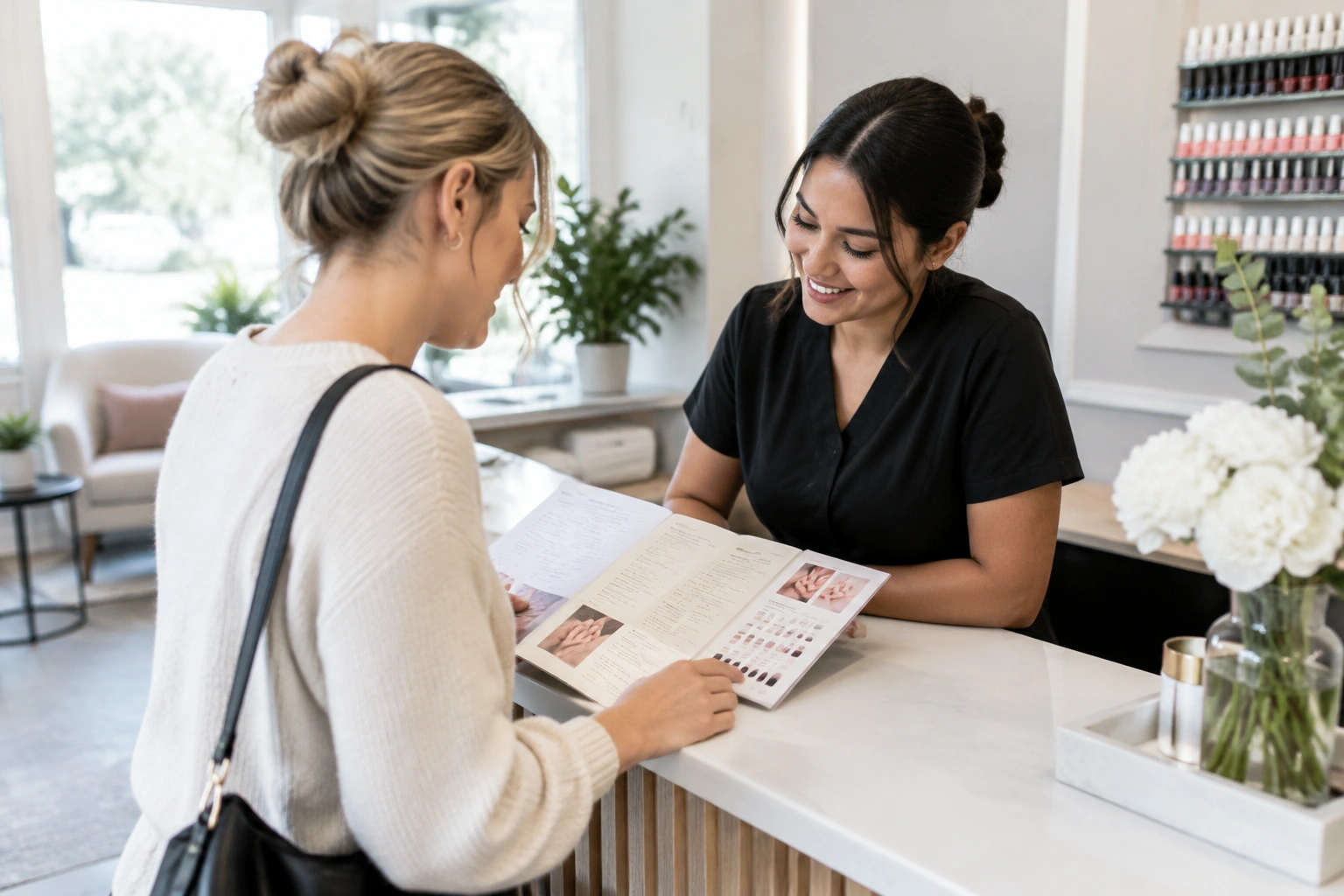
A useful decision rule: if the receptionist cannot clearly explain what’s included, ask again before you sit down. That is the safest moment to clarify, not after extra services have already been added.
What to Ask for the Look You Want
The most helpful thing you can do is name the service in plain language. You do not need to know every technical term. You just need to describe the goal.
For a manicure, say one of these:
- “I’d like a basic manicure on my natural nails.”
- “I want a manicure with gel polish.”
- “I’d like a spa manicure with extra cuticle care.”
- “I want a natural look, short length, and a glossy finish.”
For a pedicure, say one of these:
- “I’d like a basic pedicure with regular polish.”
- “I want a pedicure with callus care, but nothing extra.”
- “I’d like a spa pedicure if it includes massage and exfoliation.”
- “I want my toes polished only, with minimal trimming.”
If you want a French manicure, say it directly:
– “I’d like a French manicure with a soft white tip.”
– “Can you do a natural French, not a thick tip?”
– “I want a French look on short nails.”
If you want a no-cuticle-cut preference, say that before the service starts:
– “Please do not cut my cuticles.”
– “I’m okay with gentle pushing back, but no cutting.”
– “I only want tidy cuticles, not a deep cuticle trim.”
If you want a clean, natural “clean-girl” look, try:
– “I want a sheer nude that looks very natural.”
– “Please keep the nails short, neat, and glossy.”
– “I want a clean, minimal look with no heavy color.”
Short Comparison: Gel, Dip Powder, Acrylic, and Regular Polish
If you’re deciding between common salon services, it helps to know what the technician actually does.
| Service | What the technician usually does | Typical wear |
|---|---|---|
| Regular polish | Shapes the nail, applies base coat, color, and top coat | Often chips sooner than longer-wear options |
| Gel polish | Shapes the nail, applies base coat, color in thin layers, then cures each layer under a lamp and finishes with top coat | Usually lasts longer than regular polish |
| Dip powder | Prep the nail, apply base or bonding product, dip or layer colored powder, then seal and finish | Often chosen for longer wear and a firmer feel |
| Acrylic | Prep the nail, mix liquid and powder to build an enhancement over the natural nail or form, then file into shape and finish with polish or gel | Commonly used for added length and structure |
In salon language, base coat helps polish grip the nail, and top coat seals the color and adds shine or protection. Regular polish is the standard air-dried nail color. Gel polish is cured under a lamp. Dip powder uses a powder-based enhancement system. Acrylic creates a harder extension or overlay using liquid and powder.
A natural nail service usually means your own nails are kept at a practical length with polish or a simple finish. An enhancement means the salon adds structure or length, which may be helpful if your nails are very short, weak, or prone to breaking.
How to decide between natural nails and an enhancement
Choose a natural nail service if you mainly want neat, polished nails and your own nails are already in decent shape. Choose an enhancement if you want more length, stronger structure, or your nails don’t hold shape well on their own. If you bite your nails, have frequent breaks, or need a longer-lasting shape for daily wear, that’s worth mentioning before the service starts.
How to Ask for the Right Nail Shape, Length, and Finish
Shape and length change the entire look of a manicure, and they also affect how practical your nails will be day to day. If you type all day, care for children, work with your hands, or play sports, that matters.
Use everyday comparisons for length
Instead of saying “medium,” try:
– “Just a little past my fingertip”
– “Short enough to type comfortably”
– “About the length of a grain of rice past the fingertip”
– “Long, but still practical for daily use”
Ask for a shape by name
The most common shapes are:
– Round: soft and low-maintenance
– Square: clean edges, more structured look
– Almond: tapered and elegant
– Coffin/Ballerina: longer, more dramatic, usually best with enhancements
If you want a natural look, say so directly:
– “I want short round nails that look neat, not dramatic.”
– “Please keep them soft and natural-looking.”
– “I want a glossy finish, but nothing thick or bulky.”
If you want a bolder look:
– “I’d like almond-shaped nails with a medium length.”
– “Please make them sleek, not too chunky.”
– “I want a bold but clean shape.”
Finish matters too
You can ask for:
– Glossy: shiny, classic
– Matte: soft, modern
– Sheer: lighter coverage, more natural
– Opaque: full coverage, stronger color payoff
If you are unsure, a sheer nude or soft pink often gives the most forgiving, salon-friendly result.
For a broader overview of service choices, it can help to read a general guide like what to get at the nail salon before you book.
Which Polish or Enhancement Should You Choose?
This is where many people get stuck. The best choice depends on how long you want the result to last, how much upkeep you’ll tolerate, and whether you want added length.
Here’s a simple comparison:
| Option | Best for | Trade-offs | Typical salon reality |
|---|---|---|---|
| Regular polish | Low cost, easy change, natural nails | Chips sooner and needs more frequent touch-ups | Best if you like changing colors often |
| Gel polish | Longer wear and glossy finish | Needs proper removal and usually costs more than regular polish | Good for busy schedules |
| Dip powder | Durable color and a firmer feel | Removal and upkeep matter; not ideal for every nail type | Often chosen for longer wear |
| Acrylic | Added length and strong structure | Higher maintenance and more commitment | Best when you want dramatic shape or extensions |
| Natural nail service | Clean, simple, low-maintenance look | No added length | Great if your nails are already healthy |
A useful rule of thumb: if you want simple and flexible, choose regular polish. If you want longer wear without a lot of fuss, gel is often the middle ground. If you want length or a more sculpted look, acrylic may be the right conversation to have.
If you’re comparing acrylic specifically, this article may help you prepare for the appointment: what to ask for at the nail salon for acrylics.
What to Ask If You Want Longer-Lasting Results
If durability is your priority, ask questions that reveal the upkeep before you commit.
Useful questions:
– “How long does this service typically last with normal wear?”
– “What kind of maintenance will it need?”
– “Will I need fills, and how often?”
– “What is the safest removal method for this service?”
– “What should I avoid after I leave today?”
– “When should I come back for a fill, re-polish, or removal?”
That last question matters because long-lasting nails are not just about the product. They also depend on how you wear them. Frequent hand washing, typing, cleaning, gardening, and heavy lifting all affect wear.
The trade-off is simple: longer-lasting services usually ask more from you later. Gel, dip, and acrylic can hold up better than regular polish, but they also require more attention at removal and maintenance.
A smart question to ask is, “What maintenance am I signing up for if I choose this?” That answer tells you whether the service fits your routine.
What to Ask About Nail Health and Sensitivity
If your nails are weak, short, peeling, damaged, or sensitive, say that before the service begins. Don’t wait until the technician is already filing aggressively or applying product.
Try:
– “My nails are weak, so I want the gentlest option.”
– “I have short nails and I’m trying to protect them.”
– “Please be careful around my cuticles; I’m sensitive there.”
– “I’ve had damage before, so I want a low-stress service.”
– “I bite my nails, so I need something that works with very short nails.”
If you have a specific concern, it helps to say it plainly:
– “I have an ingrown toenail on one toe, so please avoid that area.”
– “I have calluses on my heels, but I don’t want aggressive scraping.”
– “Please don’t cut my cuticles.”
– “I want a natural shape that won’t catch on things.”
Why this matters: some styles and products put more stress on the natural nail than others, and some techniques are more forgiving if your nails are already fragile. A technician can often steer you toward a simpler service, lighter shaping, or a more conservative length.
If your nails are very damaged or your skin is irritated, a nail technician may suggest postponing certain services. If you have ongoing nail changes or concern about the nail itself, a dermatologist is the right professional to ask.
For general hygiene and product-safety information, the FDA’s cosmetics overview is a useful place to understand how cosmetic products are regulated.
How to Check Hygiene and Sanitation Before the Service
A clean salon should be able to answer basic sanitation questions without hesitation. You do not need to interrogate anyone, but you do need to feel comfortable with what you see and hear.
Ask:
– “How are your tools sanitized?”
– “Do you use new files or buffers for each client?”
– “Are single-use items used when appropriate?”
– “How do you clean pedicure tubs between clients?”
– “Can I see a fresh liner or a clean bowl setup for the pedicure?”
Watch for specific red flags:
– Dirty-looking tools left on the station
– Reused disposable items
– A drill bit, file, or buffer that looks worn and already used
– No visible handwashing or glove change before service
– A pedicure basin that has not been visibly cleaned or lined
– Open product containers with residue around the rim
– Towels or footrests that look damp, stained, or reused without being refreshed
– A rushed attitude when you ask a simple hygiene question
You can also look for simple cleanliness checks before you sit down:
– Freshly wiped station surfaces
– Sealed or newly opened tools and packets where appropriate
– Clean towels or disposable liners ready for use
– Hand sanitizer or soap available nearby
– A technician who washes hands or sanitizes before starting
– A tidy station without leftover nail dust, debris, or product buildup
The CDC’s guidance on cleaning and disinfection is a useful reference point if you want to understand why sanitation procedures matter in personal care settings. You do not need to know every protocol, but you should expect the salon to take hygiene seriously.
If the salon cannot explain its cleaning process clearly, that is reason enough to pause.
What Add-Ons Are Worth Asking About—and Which to Skip
Add-ons can improve the experience, but they can also inflate the bill quickly. Ask what each extra actually does before agreeing.
Usually worth asking about if you need them:
- Cuticle care if your nails look dry or overgrown
- Callus removal if your feet need smoothing
- Nail repair if one nail is broken and you want the set balanced
- Designs or accents if you want one or two statement nails instead of full nail art
- French tips or a French upgrade if you want a classic look and the salon charges separately for it
- Removal service if you are taking off gel, dip, or acrylic and want it done safely
Often skippable if you want to keep costs down:
- Extra massage if you mainly want a quick service
- Multiple decorative upgrades if you only wanted a clean, simple look
- Add-ons you didn’t request and don’t actually need
- A longer spa package if you only wanted nail care, not extra pampering
A practical approach is to ask, “What changes the result, and what is just extra comfort?” That question helps you separate useful upgrades from nice-to-have extras.
For example, callus care may make sense in a pedicure if your feet feel rough. A longer massage may feel pleasant, but it won’t change how your nails wear.
How to Confirm Pricing So You Don’t Get Surprised
Pricing surprises usually happen when the base service is clear but the extras are not. Before the appointment starts, ask for the total estimate with the specific choices you made.
Use these phrases:
– “What is the price for the exact service I’m asking for?”
– “Does that include removal, shaping, and polish?”
– “Is there an extra charge for length, shape, or design?”
– “Will there be a fee if I add repairs or nail art?”
– “Can you tell me the total before you begin?”
If you are bringing your own product, ask first. Some salons allow outside polish or tools, and some do not. As Dazzle Dry notes, you do not have to bring anything to a salon, though some locations may allow clients to bring their own polish or tools if the salon permits it.
Tipping expectations vary by region and salon, so if you’re unsure, ask the front desk what is customary there. That keeps the conversation simple and prevents awkward guesswork.
What to Say If You Don’t Know the Terminology
If you feel nervous, use one of these scripts exactly as written.
- “I’m new to this. Could you recommend a service for short, natural nails that will look neat and last reasonably well?”
- “I want something simple, natural-looking, and easy to maintain. What would you suggest?”
- “I need my nails to last as long as possible, but I still want to keep them practical for daily life.”
- “I’d like a French manicure, but soft and natural-looking, not thick or dramatic.”
- “Please do not cut my cuticles. Gentle pushing back is fine.”
- “I’d like a pedicure with basic care and polish, and I’d like to know what’s included before we start.”
- “My nails are a little weak, so I want the gentlest option that still looks polished.”
These scripts work because they lead with your goal, not just a photo. That gives the technician room to recommend something realistic.
Common Mistakes to Avoid at the Nail Salon
The biggest mistakes are usually communication mistakes, not beauty mistakes.
Avoid these:
– Saying “do whatever” when you actually have a clear preference
– Choosing a service only because it looks good online
– Forgetting to ask what’s included in the quoted price
– Ignoring maintenance needs before booking a stronger enhancement
– Staying silent if the shape, length, or color feels off early in the service
– Skipping sanitation questions when the station looks questionable
– Asking for a style that does not fit your daily routine
A good salon visit feels easy because the plan is clear. You should know what you’re getting, what it costs, and what maintenance it needs before the first coat goes on.
When to See a Nail Technician or Dermatologist
See a nail technician when you want help choosing a service, improving the look of your nails, or matching a manicure to your lifestyle.
See a dermatologist if you notice ongoing nail changes, pain, or skin concerns around the nails that need medical attention. A salon can help with appearance and routine care, but it is not the place for diagnosis.
Final Takeaway
If you remember only one thing, make it this: ask about the service, the shape, the finish, the price, the hygiene setup, and the upkeep before the appointment begins. That one habit prevents most salon disappointment.
A clear request does not have to sound complicated. “Short round nails with a glossy finish,” “gel on my natural nails,” or “a basic pedicure with callus care” is enough to get the conversation moving in the right direction.

