
Why Don’t Cats Like Nail Files? Reasons, Reactions, and Safety Tips

You pull out your nail file to smooth a chipped manicure, and your cat suddenly moves away, flattens her ears, stares at the file, or leaves the room. It can make you wonder: why don’t cats like nail files?
There is no single reason, and there is little research specifically on cats reacting to human nail files. Still, the reaction makes sense. Nail files can produce unfamiliar scraping sounds, rough textures, movement, vibration, and smells. A cat may simply decide that this strange object is better avoided.
Other cats react in the opposite way and want to sniff, lick, bite, or steal an emery board.
Below, we’ll look at the most likely reasons for both reactions, which nail files deserve extra caution, how to keep your manicure routine cat-safe, and when unusual chewing or fear deserves professional attention.
Quick Answer
Why don’t cats like nail files? Some cats may dislike the rough texture, scraping sound, movement, smell, or previous experience associated with a nail file. Others are simply cautious around unfamiliar objects. Avoid forcing your cat to interact with one, and keep files away if she tries to chew or swallow pieces.
Is It Normal for a Cat to Dislike Nail Files?
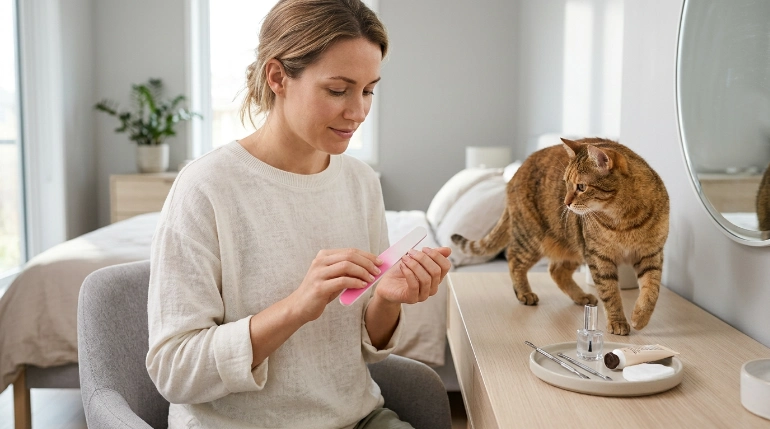
Yes. A cat avoiding a nail file is usually not unusual by itself.
Cats can be selective about unfamiliar objects. Something that seems completely harmless to you may look, sound, smell, or feel strange to your cat.
A nail file is especially unusual because you repeatedly drag it across your nails. That creates movement and noise while producing tiny particles of nail dust. Depending on the material, the file may also have a rough or hard surface.
A cautious cat might:
- Walk away when you start filing.
- Watch the file from across the room.
- Pull her head away when you bring it near her.
- Flatten or rotate her ears.
- Swat at the file.
- Hide during your manicure.
- Sniff it briefly and then lose interest.
None of those reactions automatically means something is wrong.
The safest response is to respect your cat’s choice to move away rather than trying to make her investigate the file.
Why Don’t Cats Like Nail Files? 6 Likely Reasons
Because individual cats react differently, it is better to think of these as possible explanations rather than a single proven cause.
1. The Scraping Sound May Be Unpleasant
Filing a nail creates a repetitive scratching or scraping sound.
A coarse emery board can sound very different from a smooth glass file. An electric nail drill can be even more noticeable because it adds a motor sound and continuous vibration.
If your cat leaves only when you start filing but does not care about the file while it is sitting still, the sound or movement may be the main trigger.
Try doing your manicure farther away from your cat’s resting or feeding area.
2. The Rough Texture Can Feel Strange
Traditional emery boards are intentionally abrasive. That rough surface is useful because it removes tiny amounts of nail material and smooths sharp edges.
But there is no reason your cat needs to enjoy touching it.
If her whiskers, nose, paw pads, or mouth brush against an abrasive file, she may immediately decide she does not like the sensation.
Do not rub a nail file against your cat’s face, paws, or body to test her reaction.
3. The File May Smell Unfamiliar
A used nail file can carry traces of nail dust, hand cream, cuticle oil, polish residue, remover, soap, or other products from your manicure routine.
Cats investigate their surroundings heavily through scent, so a file that smells ordinary to you may be interesting—or unpleasant—to your cat.
This is also a good reason to keep manicure tools away from food bowls, water bowls, cat beds, and toys.
If a nail file has recently been exposed to polish remover, gel-removal products, adhesives, or other nail chemicals, store it where your pet cannot lick or chew it.
4. Your Cat May Dislike the Movement
Think about what filing looks like from your cat’s perspective.
Your hand moves quickly back and forth while holding a narrow object. The movement may catch her attention even when the file itself does not.
One cat may treat that motion like potential prey and try to grab it. Another may consider it unpredictable and move away.
Avoid waving the file toward your cat or turning it into a chase toy.
5. She May Associate It With Paw Handling
If someone has previously tried to file your cat’s claws with a human nail file, she may associate the object with having her paws held.
Some cats tolerate paw handling well. Others strongly dislike it.
Cornell University’s information on feline destructive behavior and claw care recommends gradually getting cats accustomed to having their paws handled and warns that cutting into the quick—the sensitive living area inside the claw—causes pain and bleeding.
If your cat already dislikes paw handling, forcing a file onto her claws can make the negative association stronger.
6. Your Cat May Simply Be Cautious
Sometimes the simplest answer is the right one.
Your cat does not need a specific traumatic history to avoid a nail file. It is an unfamiliar object with an unusual texture and sound.
If she calmly moves somewhere else, you usually do not need to change her mind.
Letting her leave is often the easiest solution for everyone.
Nail File Types and How They Differ Around Cats
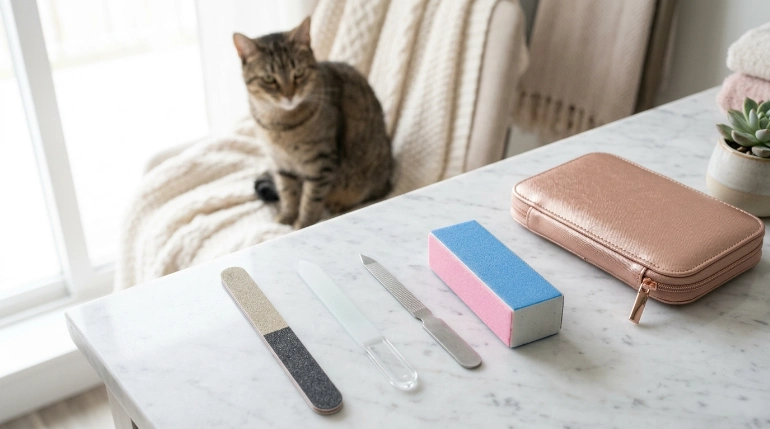
Different nail files create different concerns around pets.
| Nail file type | What it feels like | Possible concern around a cat | Practical choice |
|---|---|---|---|
| Emery board | Rough, lightweight, disposable | Easy to bite, shred, or tear into pieces | Store in a closed drawer |
| Glass/crystal file | Smooth but rigid | May break if dropped or knocked from a counter | Keep off edges and floors |
| Metal file | Hard, textured metal | Hard surface may injure the mouth if aggressively bitten | Put away immediately after use |
| Foam buffer | Soft center with abrasive surfaces | Pieces may be torn off during chewing | Do not leave out as a toy |
| Electric file/drill | Rotating bit with motor noise | Moving parts, vibration, cords, and attachments require extra caution | Use away from pets |
The best nail file for your manicure depends on your nails, not your cat’s preference.
For basic human nail care, the American Academy of Dermatology recommends smoothing rough nail edges with a nail file or emery board and filing in one direction rather than sawing aggressively back and forth. Their guide to trimming and filing nails provides simple dermatologist-backed nail-care guidance.
Why Do Some Cats Like Nail Files Instead?
This is where the question gets interesting.
While one cat may disappear as soon as filing starts, another may rush over and try to steal the file.
A cat might investigate because of:
- The smell of nail dust or products on the file.
- The rough texture.
- The movement in your hand.
- Simple curiosity.
- A desire to play with a small object.
- Attention she receives when she grabs it.
Curiosity does not mean the file is a suitable cat toy.
Cornell’s guidance on choosing safe toys for cats advises avoiding toys with small or detachable parts that can be chewed off and swallowed.
That same safety mindset makes sense for manicure tools.
Is a Nail File Dangerous for Cats?
A cat walking past or briefly sniffing a clean nail file is very different from a cat aggressively chewing and swallowing pieces of one.
The biggest concern is generally physical injury or ingestion, not simply being near the file.
Possible risks include:
- Small pieces breaking off an emery board or buffer.
- Mouth irritation from abrasive surfaces.
- Injury from a broken glass file.
- Swallowing pieces of cardboard, foam, coating, or another material.
- Exposure to cosmetic residue left on a tool.
- Injury from moving parts on an electric nail drill.
If your cat merely smells a file and walks away, there is usually no reason to panic.
If she bites pieces off or actually swallows material, take it more seriously.
Persistent eating of non-food objects can fall under a behavior called pica. VCA Animal Hospitals’ veterinary guide to pica in cats notes that cats with pica may chew or eat inappropriate non-food materials and can develop signs such as vomiting or reduced appetite.
A nail file should never be intentionally offered as a chew toy.
What to Do If Your Cat Hates Your Nail File
You normally do not need to train your cat to like it.
Instead, make your manicure routine easier for both of you.
1. Give Your Cat Space
If she walks away when you start filing, let her.
Avoid following her with the file or repeatedly presenting it for inspection.
2. Use Your Nail Tools in a Calm Area
Do manicures on a stable table or vanity rather than on the floor beside your cat.
This also makes it less likely that files, clippers, polish bottles, or small manicure accessories will become tempting toys.
3. Put the File Away When You’re Finished
Do not leave an emery board on a couch, bed, floor, or low table.
A closed drawer, cosmetic case, or storage box is better.
4. Clean Up Nail Dust and Debris
After filing, wipe down the work surface and dispose of broken or worn-out files.
This is especially useful if your cat likes investigating your manicure area immediately after you leave.
5. Offer a Real Cat Toy Instead
If your cat repeatedly tries to attack a moving nail file, redirect that playful energy toward a toy designed for cats.
Regular interactive play can also give an energetic cat a more appropriate target. Cornell notes that boredom may contribute to destructive behavior and recommends dedicated play and appropriate feline toys.
What If Your Cat Chews the Nail File?
First, remove the file without turning the situation into a game.
Then inspect it.
Ask yourself:
- Is any material missing?
- Did the file break?
- Could your cat have swallowed a piece?
- Is she gagging or repeatedly swallowing?
- Is she vomiting?
- Is she unusually quiet?
- Is she refusing food?
- Does she appear painful or uncomfortable?
If material is missing and you think it may have been swallowed, contact your veterinarian rather than waiting for obvious symptoms.
Do not intentionally make your cat vomit unless a veterinarian specifically instructs you to do so.
Expert Tip:
Keep a small covered manicure case beside your usual nail-care spot. Put each tool back as soon as you finish using it instead of leaving files and buffers where a curious cat can grab them.
Nail File Hygiene When You Have a Cat
Your manicure tools should stay manicure tools.
If your cat licks, bites, or carries a disposable emery board in her mouth, replacing it is often simpler than returning it directly to your nail kit.
For reusable glass or metal tools, follow the manufacturer’s cleaning instructions and make sure the tool is dry before storing it.
Avoid sharing the same file between:
- Your fingernails and an area with a suspected infection.
- Different people without appropriate cleaning.
- Your nails and your pet’s claws.
- Healthy nails and a visibly damaged or infected nail.
Your cuticle is the thin protective tissue around the base of the nail. Damaging this area can give germs an easier route into the surrounding skin. The American Academy of Dermatology recommends leaving cuticles alone and keeping nails clean and properly maintained.
Should You Use Your Nail File on Your Cat’s Claws?
A human nail file is not automatically the best tool for feline claw care.
A cat’s claw is structurally different from a human fingernail, and many cats dislike having their paws restrained for long periods.
If you need to maintain your cat’s claws, ask your veterinarian or an experienced cat groomer to show you safe handling and trimming techniques.
Do not experiment if:
- Your cat becomes highly distressed.
- She bites or scratches during paw handling.
- You cannot identify the quick.
- A claw is cracked, bleeding, swollen, or abnormal.
- The claw appears embedded in the paw pad.
A professional demonstration can be much safer than learning through trial and error.
Common Mistakes to Avoid
When cats and manicure supplies share the same space, a few small habits can prevent unnecessary problems.
- Do not force your cat to smell the file. If she backs away, respect that signal.
- Do not use a nail file as a cat toy. A manicure tool is not designed for chewing or rough play.
- Do not leave disposable files within reach. Lightweight emery boards are especially easy for cats to carry away.
- Do not ignore missing pieces. A partly shredded file may mean material was swallowed.
- Do not keep using a heavily chewed disposable file on your nails. Replace it.
- Do not leave electric nail equipment running near a curious pet. Keep moving bits, cords, and attachments controlled.
- Do not punish fear. Moving away from something unpleasant is normal defensive behavior.
- Do not assume repeated non-food chewing is just a funny habit. Persistent chewing or ingestion deserves veterinary advice.
When to Call a Veterinarian About Nail File Chewing
Occasionally sniffing a manicure tool is very different from repeatedly eating non-food objects.
Contact your veterinarian promptly if your cat has swallowed part of a file or develops concerning signs afterward.
Watch especially for:
- Repeated vomiting.
- Gagging or excessive drooling.
- Refusing food.
- Difficulty swallowing.
- Abdominal discomfort.
- Marked tiredness.
- Trouble passing stool.
- Persistent chewing or eating of non-food items.
VCA’s information on chewing and sucking behavior in cats explains that excessive chewing can sometimes be associated with medical problems, which is why persistent behavior should not automatically be dismissed as a personality quirk.
When in doubt, your veterinarian is the right professional for concerns involving your cat.
When to See a Nail Technician or Dermatologist
A nail technician can help with cosmetic nail shaping and routine manicure decisions, but technicians do not diagnose medical nail conditions.
Consider seeing a qualified nail technician if your own nails are difficult to shape cleanly, you keep damaging them during DIY filing, or you want help choosing an appropriate manicure technique.
See a dermatologist or other healthcare professional if your nail or surrounding skin develops symptoms such as:
- Persistent pain.
- Significant swelling.
- Pus or drainage.
- Increasing redness.
- Nail separation.
- Unexplained color or texture changes.
- A problem that keeps returning.
And remember: a dermatologist treats human skin and nails, not your cat. Concerns about your cat swallowing a nail file, unusual chewing, claw injuries, or behavior changes belong with a veterinarian.
FAQs
Why does my cat run away when I file my nails?
The scraping noise, repeated movement, unfamiliar texture, or smell may bother your cat. If she simply leaves the area and otherwise behaves normally, give her space rather than trying to make her get used to the file.
Are cats scared of nail files?
Some may be cautious or frightened by them, while others are completely indifferent. Cats have individual preferences, so there is no universal cat reaction to nail files.
Why does my cat hate the sound of a nail file?
Filing produces repetitive scraping sounds and vibrations. Your cat may simply find those sensations unpleasant or unfamiliar. Moving your manicure to another room is usually an easy solution.
Why does my cat bite nail files if she seems to hate them?
Swatting or biting does not always mean your cat likes an object. She may be investigating it, playing with its movement, or trying to make an irritating object go away. Either way, don’t let her chew the file.
Can cats chew on emery boards?
They can, but they should not be allowed to. Emery boards can become damaged and pieces may break off. Store disposable files where your cat cannot reach them.
What should I do if my cat ate part of a nail file?
Take the file away, check how much material is missing, and contact your veterinarian for guidance. Seek prompt veterinary care if your cat develops vomiting, appetite loss, drooling, pain, lethargy, or other concerning symptoms.
Should I file my cat’s claws with my own nail file?
It is generally better to use cat-appropriate grooming methods and get guidance from a veterinarian or experienced groomer if you are unsure. Never force prolonged paw handling or continue if a claw is painful, bleeding, cracked, or abnormal.
Conclusion
So, why don’t cats like nail files? The answer is usually simple: nail files are strange objects. Their abrasive texture, scraping sound, movement, smell, or association with handling can make some cats want nothing to do with them.
Other cats may be fascinated instead, which creates a different problem. A nail file still isn’t a toy, even if your cat desperately wants to steal it from your manicure table.
The safest approach is straightforward: let a cautious cat walk away, keep manicure tools securely stored, and prevent chewing or swallowing. If your cat repeatedly eats non-food objects or you think she swallowed part of a file, contact your veterinarian.
For your own nails, use clean tools, gentle filing techniques, and professional help when a problem goes beyond ordinary at-home nail care.

