Why Nail Fungus Matters in a Salon: Hygiene, Safety, and Smart Service Decisions

Nail fungus is more than a cosmetic issue in a salon. It can affect how a technician plans a service, which tools can be used, how thoroughly a station must be cleaned, and whether a client should be referred out for medical care. In other words, the concern is not just the look of the nail — it is the risk of cross-contamination, the limits of salon services, and the responsibility to protect other clients and staff.
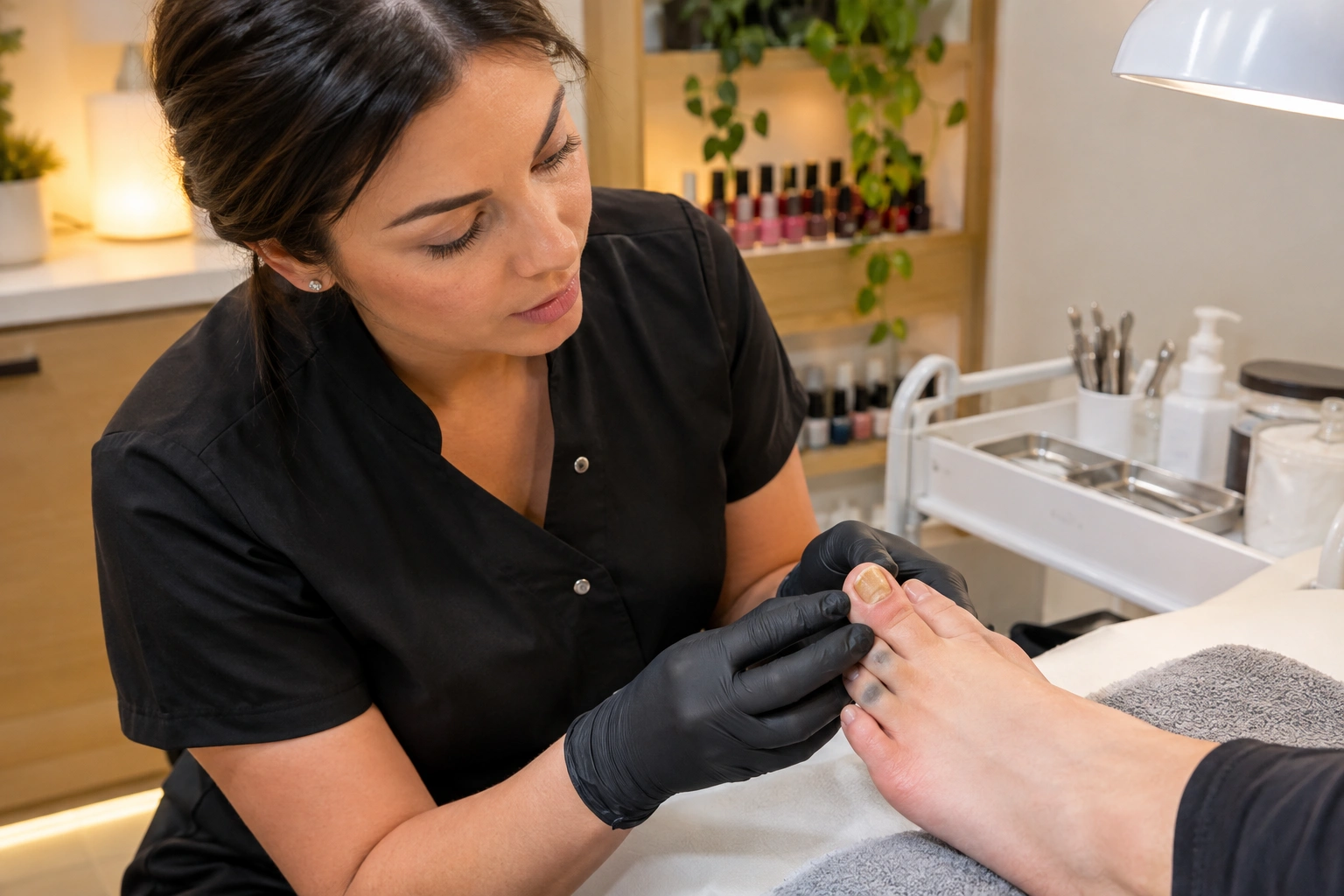
As a licensed nail technician, I think of suspected fungus as a decision point. A salon does not diagnose, and it does not treat infection, but it does need a clear process for noticing suspicious changes, stopping tool contamination, and keeping the service area safe. That process matters for client safety, staff confidence, and the salon’s reputation.
What Nail Fungus Is and Why Salons Should Care
Nail fungus, also called onychomycosis, is a fungal infection that affects fingernails or toenails. It can cause discoloration, thickening, and lifting from the nail bed. Toenails are affected more often than fingernails, and older adults are more likely to deal with it, according to WebMD’s overview of fungal skin infections.
That matters in a salon because a nail that looks “just damaged” may actually need more caution. A technician is not expected to diagnose, but a technician is expected to notice when a nail looks suspicious and avoid casual handling that could spread debris or contaminate tools.
There is also a business reason to take it seriously. Fungal infections are often misdiagnosed or undiagnosed, and public-health agencies continue to emphasize fungal awareness and infection control. When a salon treats every nail issue as routine, it can miss a problem that needs a different service plan. You can read more about that broader public-health concern on the CDC’s fungal disease awareness page.
How Nail Fungus Can Spread in a Salon
A salon concern is not that fungus “jumps” from the air in a dramatic way. The practical issue is cross-contamination: contaminated debris or residue can move from one client, tool, or surface to another if sanitation is weak.
The most common pathways to think about are:
- shared tools that are not properly processed between clients
- surfaces that are wiped but not disinfected
- pedicure foot baths that are not cleaned and disinfected correctly
- porous items that are reused when they should be discarded
A realistic example: if a technician uses the same file on a suspicious toenail and then on another client without proper disposal or processing, that file can carry contaminated debris to the next service. If a pedicure foot bath is not cleaned and disinfected correctly, residue can remain in jets, basin seams, or other contact points and affect the next client. The same logic applies to nail dust and any item that touches compromised nail material.
This is why salons need a real sanitation system, not just a quick wipe-down. The EPA explains that disinfectants are different from cleaners, and a product must be used according to its label instructions to work as intended. If you want the regulatory basics, the EPA’s disinfectant guidance is a useful starting point.
Signs a Technician May Notice During a Service
A salon cannot diagnose fungus, but it can notice patterns that deserve caution. Typical signs include:
- white or yellow patches or streaks
- brown or green discoloration
- thickening
- ridges
- lifting from the skin underneath
- crumbly debris under the nail
Those signs are consistent with the descriptions from Yale Medicine’s nail fungus guidance: what to know before heading to a nail salon.
A technician should treat these as clues, not proof. One thick nail may be fungus, but it may also be trauma from shoes, repeated pressure, or another nail condition. The goal is to pause and assess, not to label the client.
A simple rule helps here: if the nail looks altered in a way that changes texture, attachment, or debris pattern, slow down and review the salon’s policy before continuing.
Fungus vs. Look-Alike Nail Problems
This is one of the most important distinctions in a salon. Not every damaged or discolored nail is fungal.
| Look-alike issue | What it may look like | Why it can be confused with fungus | Salon takeaway |
|---|---|---|---|
| Fungal infection | Yellow/white discoloration, thickening, lifting, crumbly debris | Often changes nail shape and texture | Treat as suspicious and follow policy |
| Trauma | Dark spot, ridge, split, or one-nail damage | Can mimic discoloration or lifting | Ask about injury or pressure from shoes |
| Staining | Yellowing from polish or products | Color change without major nail thickening | Check whether the nail surface is otherwise healthy |
| Psoriasis or other nail conditions | Pitting, lifting, thickened nail changes | Can resemble fungal changes | Do not guess; recommend medical evaluation |
This comparison matters because overcalling every change as fungus can lead to unnecessary refusals, while missing fungus can expose others to contamination risk. The salon’s job is to recognize “possibly fungal” and act conservatively.
What a Salon Should Do When Fungus Is Suspected
A good salon has a decision framework, not a guess.
Step 1: Pause the service
If the nail looks suspicious, stop before filing, drilling, or using shared tools. That reduces the chance of spreading debris.
Step 2: Decide whether to proceed, modify, or refuse
Use this simple framework:
- Proceed only if the nail changes appear unrelated to infection and the service can be done normally without added contamination risk.
- Modify the service if the salon can safely provide limited cosmetic care without working aggressively on the suspicious nail. That may mean avoiding filing the affected nail, using single-use items, and limiting contact.
- Refuse or refer out if the nail looks actively infected, the service would require invasive work, the salon cannot control contamination risk, or the client has a medical risk factor that makes salon care unsafe.
Step 3: Check salon policy and local rules
State board regulations can shape what a salon may or may not do. Some salons set strict no-service policies for suspected infection, while others allow limited cosmetic services with extra precautions. Follow the salon’s policy first, then local requirements.
Step 4: Communicate clearly
The client should hear a calm explanation: the salon is not diagnosing, but the nail appearance suggests a possible infection and the service may need to be delayed, modified, or referred to a medical professional.
That approach protects everyone. It is also the boundary between salon care and medical care.
Sanitation Practices That Reduce Fungal Spread
This is where salons either do the job well or create avoidable risk.
Cleaning, disinfecting, and sterilizing are not the same
| Process | What it does | When it applies | Salon meaning |
|---|---|---|---|
| Cleaning | Removes visible dirt and residue | First step on most surfaces | Necessary, but not enough by itself |
| Disinfecting | Uses an approved product to reduce microbes on nonporous surfaces | Nonporous nail tools, foot baths, and hard surfaces after cleaning | Essential between clients when required |
| Sterilizing | Destroys all forms of microbial life | Usually for specialized instruments and controlled settings | Not the same as routine wiping |
For nail salons, the practical takeaway is simple: cleaning alone does not equal safe reuse. Nonporous tools and hard surfaces must be processed according to their intended use and the product label. Foot baths also need a full clean-and-disinfect process between clients, not just a rinse or wipe. For general infection-control guidance in a salon setting, the FDA’s nail care and cosmetic safety resources are worth reviewing alongside local board rules.
What good sanitation looks like in practice
- clean visible debris before disinfection
- use fresh liners or properly disinfect the basin between clients
- keep product contact points from touching contaminated surfaces
- avoid reusing porous items that cannot be effectively disinfected
- follow contact time exactly on disinfectant labels
A common mistake is wiping a station quickly and calling it sanitized. If the product does not stay wet for the required contact time, it may not do the job.
Single-Use vs. Reusable Tools and Supplies
Salons save time and money by reusing some tools, but that only works when the item can be properly processed.
Best candidates for single-use disposal
- emery boards
- buffers
- porous foot files
- orangewood sticks
- any item that has touched suspicious nail debris and cannot be fully disinfected
Better candidates for reuse after proper processing
- metal implements that are designed for disinfection or sterilization
- nonporous tools that can be cleaned thoroughly and processed according to protocol
The trade-off is straightforward: disposable items cost more per service, but they lower the chance of cross-contamination when a nail looks suspicious. Reusable metal tools are efficient, but only if the salon’s cleaning and disinfection system is reliable every time.
Client and Technician Responsibilities Before and During Service
Infection control is shared work.
Clients help most by mentioning suspicious nail changes before the appointment, especially if a toenail is thick, lifting, or crumbly. That gives the salon time to prepare the safest service plan instead of discovering the issue mid-service.
Technicians help by using gloves when appropriate, avoiding unnecessary contact with affected nails, and changing tools or disposables when the service changes risk level. They also need to keep their own hands clean and avoid moving from a potentially contaminated nail to a clean one without changing what they are using.
A practical example: if a pedicure starts with a healthy foot and then a suspicious nail is found, the technician should not keep using the same file, buffer, or basin approach without reassessing the service.
Is Nail Fungus Dangerous or Mostly Cosmetic in a Salon?
In many salon situations, nail fungus is mainly a cosmetic and service-planning issue. But it is not always “just cosmetic.” It can affect comfort, nail thickness, and the risk of spreading contamination through tools, surfaces, or foot baths. For some clients, especially those with diabetes, circulation problems, or weakened immunity, it can also create a more serious health concern.
That is why salons should take it seriously even when the nail problem does not look urgent.
When to Seek Medical Care vs. Salon Care
See a salon for routine cosmetic care when the nail looks healthy, the service is standard, and there is no sign of infection or unusual nail change.
See a dermatologist, podiatrist, or other medical professional when:
– the nail is thick, crumbly, or lifting in a way that suggests infection
– the discoloration is unexplained
– the nail problem is spreading
– there is pain, redness, or swelling around the nail
– the client has diabetes or a weakened immune system
That division keeps salons in their lane and helps clients get the right kind of care faster.
What Clients Should Ask a Salon About Hygiene Before Booking
If you are choosing a salon and want to reduce risk, ask direct questions:
- How do you disinfect pedicure basins between clients?
- Are disposable files and buffers used once and discarded?
- How are metal tools cleaned and processed?
- Do you sterilize tools, disinfect them, or both, depending on the item?
- What happens if a technician notices possible nail fungus?
- Do technicians follow state board sanitation rules?
You are not being difficult by asking. You are checking whether the salon has a real infection-control routine or only a cosmetic one.
If you want more client-side guidance, these related NailPrime guides may help: can you get nail fungus from a nail salon, can you go to a nail salon with toenail fungus, and will a nail salon work on toenail fungus.
When to Seek Medical Care Instead of Salon Care
See a dermatologist or other medical professional when:
– the nail is thick, crumbly, or lifting in a way that suggests infection
– the discoloration is unexplained
– the nail problem is spreading
– there is pain, redness, or swelling around the nail
– the client has diabetes or a weakened immune system
A salon can still be helpful by explaining why the service is being delayed or limited. That is not a rejection of the client; it is a boundary that protects skin, tools, and other guests.
FAQs
Can a salon tell for sure if a nail has fungus?
No. A salon can notice suspicious signs, but only a medical professional can diagnose the cause with confidence.
Can nail fungus spread from one client to another?
It can be a concern if contaminated tools, surfaces, or foot baths are not properly cleaned and disinfected between clients.
Is nail fungus only a cosmetic issue?
No. It can affect comfort, nail thickness, and in some clients increase the risk of skin infection around the nail.
Should a salon refuse service if fungus is suspected?
That depends on salon policy and local rules. Some salons refuse, some modify, and some refer out. The key is to avoid improvising.
What is the safest thing a client can do before a pedicure?
Tell the salon about any suspicious nail changes before the appointment so they can prepare the safest service plan.
What should I do if I think I got nail fungus from a salon?
Seek medical evaluation rather than trying to handle it as a salon issue. A clinician can tell you whether the change is fungal or something else.
Are disposable tools better?
For porous items that cannot be properly disinfected, yes. Single-use tools are often the safer choice when there is any contamination concern.
Why do salons care so much about one suspicious nail?
Because one contaminated service can affect the next client, the station, the technician’s tools, and the salon’s reputation.
