
Why Nail Polish Takes So Long to Dry and How to Make It Set Faster

If your manicure seems dry on the surface but still smudges the second you touch something, you are not alone. One of the most common beginner questions I hear is why does nail polish take so long to dry, especially when it looks finished but still feels soft underneath.
The short answer is that nail polish dries in stages. The solvents in the polish need to evaporate, and that takes time. If the coat is too thick, the room is humid, or the formula is slow-setting, the top may seem ready long before the layers below it are stable. That is why a manicure can look fine and still dent, wrinkle, or pick up sheet marks later.

How Nail Polish Dries
Regular nail polish does not “cure” the way gel polish does. Instead, it dries as the liquid solvents evaporate and the color film hardens. That process starts at the surface and moves inward, which is why the top can feel less sticky while the lower layers are still soft.
A simple way to think about it: the top of the polish can form a skin while the middle is still like soft paint underneath. It may seem dry to the touch, but that does not mean the whole layer is ready for normal use yet.
A thin coat gives the solvents less work to do. A thick coat traps more liquid inside the layer, so the surface can form first while the center stays wet. That is the main reason beginners often think their polish is dry when it really is not.
If you want a broader look at drying expectations, you may also find this guide on how long regular nail polish takes to dry useful.
How Long Nail Polish Usually Takes to Dry
There is no single drying time that fits every polish, but it helps to think in stages:
- Dry to the touch: the top layer no longer feels wet when you lightly test it
- Set enough for careful movement: the surface is less likely to smear from very light contact
- Fully dry or fully cured for normal wear: the manicure is much less vulnerable to dents and marks
For beginners, a realistic guide is to wait about 5 to 10 minutes between thin coats, then give the finished manicure at least 20 to 30 minutes before very careful use. For more normal hand use, many people need about 1 to 2 hours, and thicker coats or humid rooms may need longer. If you want to avoid sheet marks, it is often safest to let polish sit longer before bed, especially if you painted late in the day.
For beginners, the tricky part is that “dry to the touch” is not the same as “safe to use your hands normally.” A manicure may feel okay after the surface sets, but it can still dent if you press it against fabric, keys, a phone case, or another nail.
That is why patience matters even when the polish seems fine. If you want a second reference point, essie’s nail care resources are a helpful place to browse for general polish and manicure guidance.
The Main Reasons Polish Dries Slowly
Thick coats are the biggest culprit
A thick coat is the easiest way to make polish dry slowly. It looks efficient because you get color faster, but it usually causes more problems later. The top layer starts to set while the polish underneath stays soft.
A better approach is two or three thin coats instead of one heavy one. Thin coats dry more evenly, and they are less likely to wrinkle or stay gummy in the middle. If your brush is loaded with a lot of polish, wipe a little off before applying.
Too many layers can trap wet polish
Even when each coat is thin, piling on layer after layer without enough set time can slow everything down. Base coat, color, and top coat all need a chance to settle. If you rush the next coat too soon, you can drag the layer below it and create streaks or dents.
A simple rule: if the nail still looks glossy-wet and moves around when you tilt your hand, give it more time before adding the next coat.
Some formulas are slower by nature
Not all nail polish formulas behave the same. Very pigmented colors, glitter-heavy polishes, and older or thickened bottles often dry more slowly. Dark shades can also feel less forgiving because they usually need more opacity, which means more product on the nail.
If a polish has become stringy, gummy, or hard to spread smoothly, it may be past its best stage. Sometimes that is a sign to replace it instead of fighting with it every time you do your nails.
Application mistakes can keep polish soft
A few beginner habits make drying worse without people realizing it:
- overloading the brush
- flooding the cuticle area
- brushing over the same spot again and again
- applying the next coat before the last one has settled
- forgetting to seal the free edge
These do not just affect wear; they can also make the polish dry unevenly. If the edges are too thick, the manicure often stays soft longer at the tips where polish tends to collect.
How Your Environment Changes Drying Time
Humidity slows evaporation
When the air already holds a lot of moisture, polish solvents have a harder time evaporating. That is why a manicure may dry more slowly in a damp bathroom or on a humid day. If your nails always seem to stay tacky in one room, the environment may be part of the problem.
Airflow helps more than still air
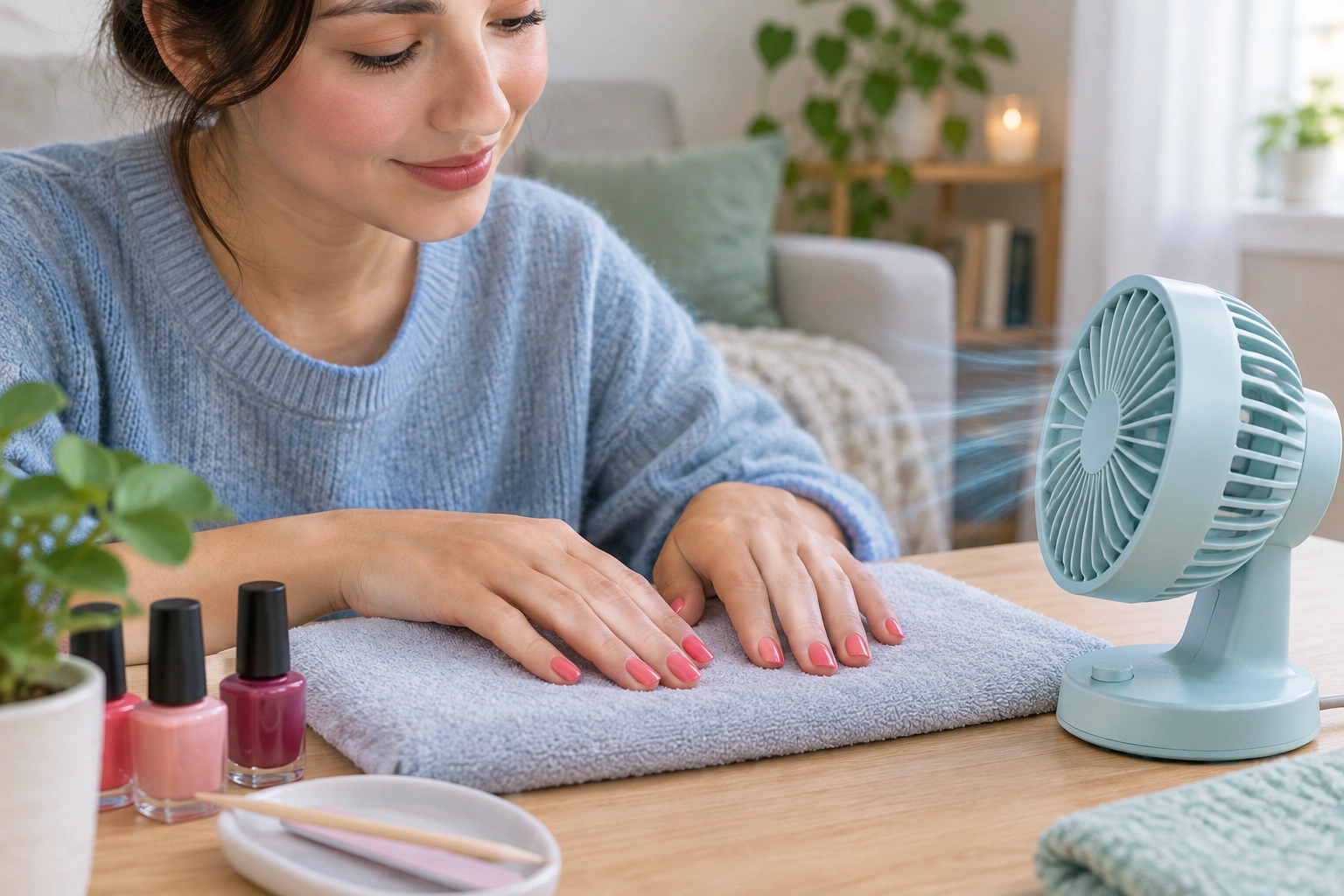
Gentle airflow can help solvent evaporation by moving damp air away from the nail surface. A small fan or a breezy room is usually more helpful than sitting in still air.
What you do not want is strong airflow that blows dust around or pushes the polish before it has started to set. Gentle is the key word.
Temperature matters, but not in the way many people think
Very hot air is not a good shortcut. It can disturb the surface and may make the polish set unevenly. A cool, comfortable room with light airflow is usually a safer environment than trying to “heat dry” your nails.
For general consumer safety information about cosmetic products and ingredients, the FDA’s cosmetics page is a useful reference.
Thin Coats vs. Thick Coats
Here is the simplest comparison:
| Approach | Drying speed | Reliability | Main trade-off |
|---|---|---|---|
| Thin coats | Faster | More even | May need an extra coat for full coverage |
| Thick coats | Slower | Less predictable | Faster-looking application, but higher smudge risk |
Thin coats usually win because less solvent has to leave the polish film. They also reduce the chance that the top looks dry while the bottom stays soft.
If your polish is sheer, thin coats may mean one extra layer. That is still usually better than a single heavy coat that stays tacky for ages.
What Actually Helps Nail Polish Dry Faster
Use a quick-dry top coat
A quick-dry top coat is one of the most practical tools for beginners. It is designed to help the surface set faster and give the manicure a smoother finish. Compared with a regular top coat, it often gives you a more noticeable speed boost.
What it does not do is fix a thick or overloaded manicure all by itself. It can speed up the top layer, but it will not make every layer instantly hard.
Try quick-dry drops if you like simple steps
Quick-dry drops can be useful when you want a low-fuss option. They are usually applied after the color coat has had a moment to settle, and they are meant to help the manicure move toward a drier finish.
They are different from a quick-dry top coat: drops are usually for helping the polish set from the outside, while a top coat also adds a protective finish on top. Neither one fully makes up for thick coats or rushed application.
Follow the label directions carefully. More product is not always better, and overapplying can sometimes leave the surface streaky or uneven.
Give each coat a little breathing room
One of the best ways to speed the whole process is not to rush the layers. Let each thin coat settle before adding the next one. That small pause reduces dragging, wrinkling, and soft spots.
If you are unsure whether to add another coat, check the nail under good light. If it still looks wet and glossy in a moving, liquid way, wait.
Use gentle airflow, not heat
A fan on a low setting can help polish dry more comfortably than still air. The goal is to move air across the nails without blasting them. That keeps the surface from being disturbed while evaporation continues.
Drying Methods That Are Less Reliable or Can Backfire
Hot air is not a safe shortcut
A hair dryer on a hot setting can cause more problems than it solves. Heat may make the surface behave unpredictably, and strong airflow can push the polish around before it has set. If you use a dryer at all, keep it cool and gentle.
Cold water is not a guaranteed fix
You may hear people suggest cold water as a quick-dry trick. It can make the surface feel firmer for some people, but it is not as dependable as thin coats and proper drying products. It may help the top feel less tacky for a short time, but if the polish underneath is still soft, water will not solve that.
Strong airflow can smear fresh polish
A fan can help, but too much force can blow dust onto wet nails or distort the finish. If your polish is still very wet, keep airflow light and avoid pointing a strong stream directly at the nails.
How to Avoid Smudges, Dents, and Sheet Marks
The most vulnerable time is the period right after painting when the polish seems okay but has not fully set. During that window, small habits make a big difference.
- Keep your hands still for about 10 to 15 minutes after painting
- Avoid typing, texting, or opening tight lids for at least 20 to 30 minutes
- Do not press nails into fabric, blankets, or pockets for at least an hour
- Be careful with zippers, bags, and phone cases until the manicure feels firmly set
- Let each hand dry before using the other one for chores
A lot of smudges happen because the manicure looks finished, so people start acting normally too early. Think of the polish as fragile until it has had time to settle.
When Slow Drying Means the Polish or Technique Is the Problem
If your manicure is always slow to dry, even when you use thin coats, the issue may be the product itself. Old polish, very thick polish, or a formula that is hard to work with can make the process frustrating every time.
Here is a simple decision rule:
- If your coats are thick: change your application technique first
- If your coats are thin but the polish still behaves badly: try a quick-dry top coat or drops
- If the polish stays gummy no matter what: consider replacing the bottle
A polish that never seems to set well is not worth saving if it keeps ruining your manicure.
Quick Answers to Common Drying Questions
Do quick-dry top coats really work?
Yes, they can help. They are one of the most practical ways to speed up the surface-setting stage. They do not replace good application, though, so thin coats still matter.
Does cold air help nail polish dry faster?
Gentle cool airflow can help more than warm air. The key is moving air, not blasting the nails. A fan on low is usually a better choice than heat.
Why does polish look dry but still smudge?
Because the top can set before the layers underneath do. The surface may feel less tacky, but the polish film is still soft inside.
Is air drying enough?
Sometimes, but it is usually the slowest option. If you are in a humid room or using thicker coats, air drying alone may feel painfully slow.
Should I add another coat if the last one is still tacky?
No. Wait until the previous coat has settled enough that the brush will not drag it around. Adding another layer too soon can trap softness underneath.
When to See a Nail Technician or Dermatologist
If your polish always stays sticky, peels strangely, or behaves unpredictably no matter what you do, a nail technician can help you troubleshoot the application side. If you also notice nail changes such as pain, discoloration, or persistent nail damage, a dermatologist is the better person to ask.
For the polish itself, though, the most common fix is usually simple: thinner coats, more patience, better airflow, and a quicker-drying top coat.
A Simple Beginner Rule to Remember
If you want your manicure to dry faster, focus on three things: thin coats, better airflow, and a faster-setting top coat. Those three steps solve most beginner drying problems without making the process complicated.

