
How to Make Nail Polish Dry Faster Without Ruining Your Manicure

Fresh polish is one of the easiest things to smudge and one of the hardest to fix once it happens. If you need your manicure to set faster at home, the safest path is usually not a “miracle hack.” It’s a combination of thin coats, the right drying aid, and a little patience while the polish hardens underneath. For most readers, thin coats plus a quick-dry top coat is the fastest safe method for regular polish.
Quick Answer: The Fastest Safe Ways to Dry Nail Polish
If you need a practical answer right now, do this:
- Apply thin coats only. Thick polish traps solvents and stays soft longer.
- Use a quick-dry top coat if you have one. It usually gives the best mix of speed and protection for regular nail polish.
- Keep your hands still for a few minutes after the final coat.
- Use cool air, not heat, if you want an extra assist.
- Treat the nails as “surface dry” before they are fully hard. A manicure can feel set on top and still dent underneath.
If you don’t have a drying product, the best first thing to try is a fan on a low setting or cool air from a hair dryer held a few inches away. Some guides also recommend cold water or icy water, but that method can be messy and is less reliable than a good quick-dry top coat. Essie also notes that cool air on a lower-power setting or cold water can help speed things along. See their guidance on drying nails faster.
What You’ll Need Before You Start
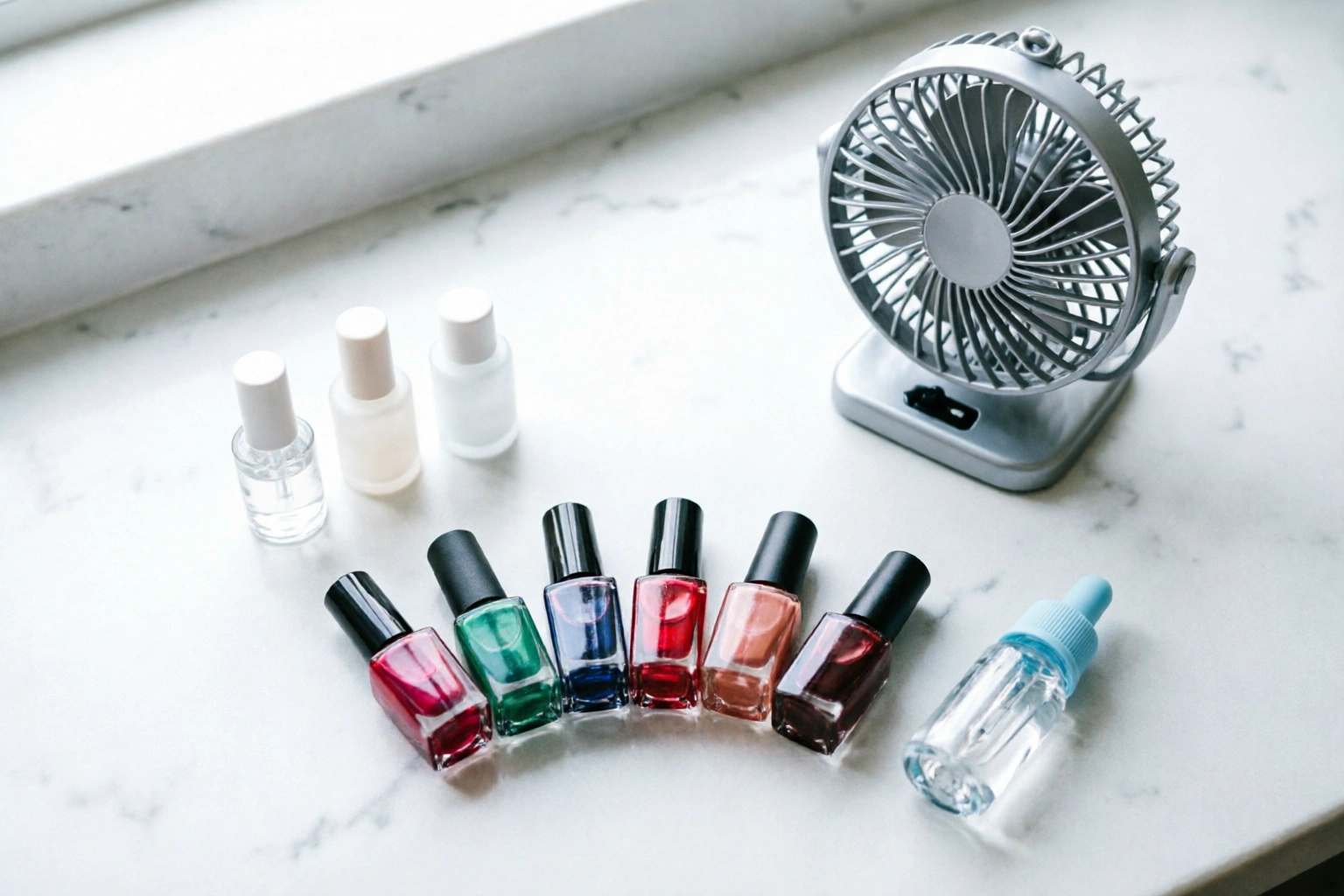
You can dry polish faster with either free tools or product-based helpers.
Basic setup:
– Nail polish
– Base coat
– Top coat
– Clean, dry nails
– A timer or clock
Helpful extras:
– Quick-dry top coat
– Nail drying drops
– Nail drying spray
– Small fan
– Hair dryer with a cool setting
If you’re choosing between a free method and a product, think about what matters more: speed, convenience, or reliability. A fan costs nothing if you already have one, but a quick-dry top coat usually does more to protect the manicure while it sets.
How Nail Polish Dries and Why It Can Stay Tacky
Regular nail polish doesn’t “cure” like gel. It dries mainly as the solvents evaporate. That means the top layer may seem dry before the layers underneath have fully set.
That’s why a manicure can look fine, then dent when you reach for a phone or zip up a bag. The surface has started to firm up, but the polish is still soft underneath.
A few things slow that process down:
- Thick coats hold more solvent.
- Too many layers create more material for the air to work through.
- Old, thickened polish goes on unevenly and can stay gummy.
- Poor prep can make the polish sit heavier or less evenly on the nail.
That’s why smoother application matters: when polish goes on evenly, it dries more predictably.
Step-by-Step: How to Make Nail Polish Dry Faster at Home
1) Prep the nail plate so polish goes on evenly
Remove old residue, wash and dry your hands, and make sure the nail surface is clean. If you use lotion or oil right before painting, wipe the nails well first. Oils on the plate can slow adhesion and make the polish slide around.
2) Use thin, controlled coats
This is the biggest speed factor you can control. Thin coats dry faster than thick ones because less solvent is trapped in each layer. Build color gradually instead of trying to cover everything in one heavy pass.
3) Wait briefly between coats
Give each layer a few minutes before the next one, especially if the polish is creamy or opaque. If you rush the next coat on top of a wet layer, the lower layer stays soft longer and the finish is more likely to wrinkle or dent.
4) Finish with a quick-dry top coat
If you own one, this is often the most useful add-on for regular polish. It seals the color, adds shine, and helps the top layer set faster. It won’t make every layer fully hardened instantly, but it can meaningfully reduce the time you need to baby your nails.
5) Let the nails rest before normal use
Even when the surface feels dry, avoid digging through a bag, typing heavily, or putting on tight shoes right away. Give the manicure a few quiet minutes before you test it.
Best Drying Methods Compared: Fan, Cold Water, Quick-Dry Top Coat, Drops, and Spray
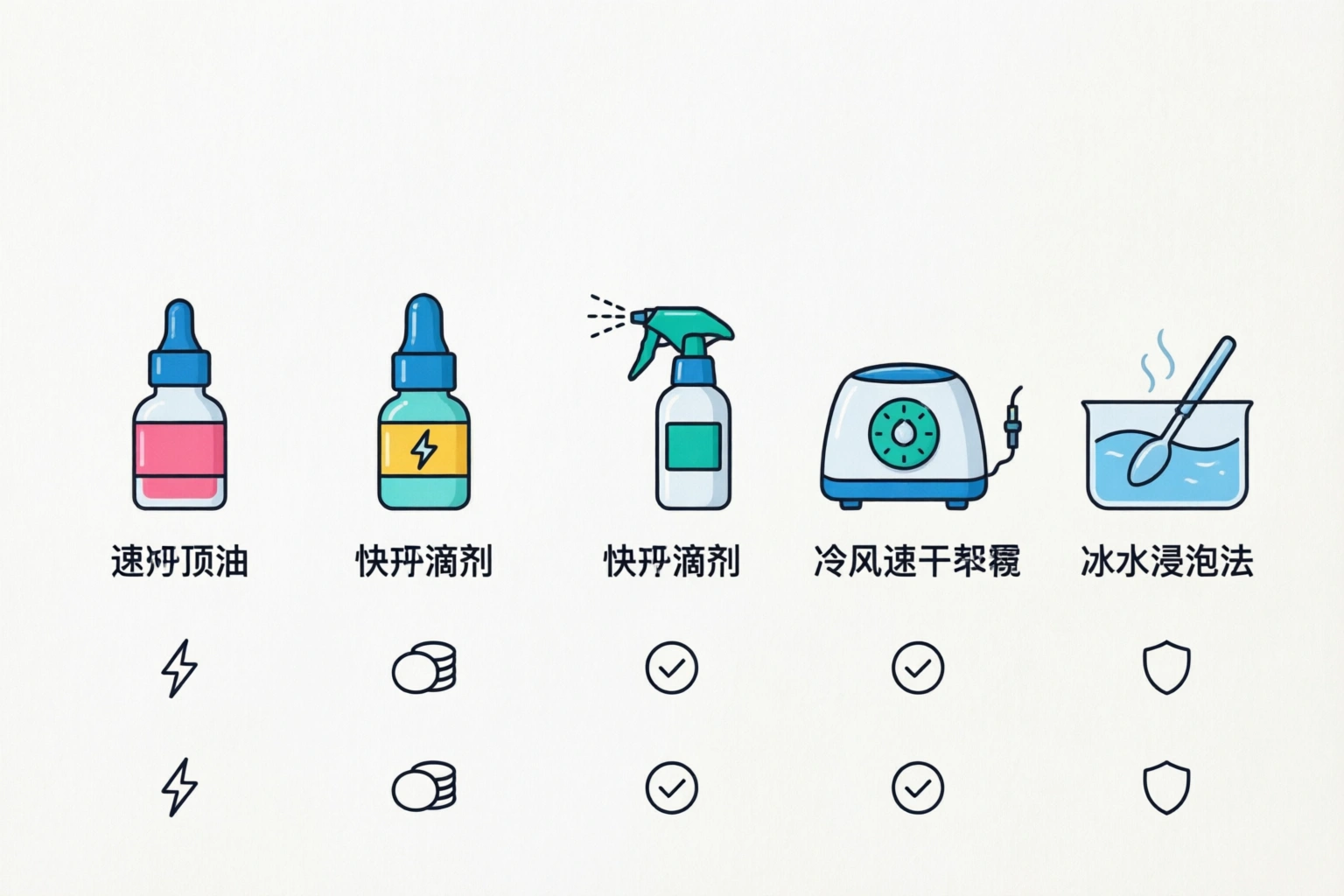
| Method | Speed | Cost | Convenience | Reliability | Best for |
|---|---|---|---|---|---|
| Quick-dry top coat | Fast | Medium | High | High | Most regular manicures |
| Drying drops | Fast to moderate | Medium | High | Moderate to high | Thicker or layered manicures |
| Drying spray | Fast to moderate | Medium | High | Moderate | Quick touch-ups and convenience |
| Fan drying | Moderate | Free if you own one | High | Moderate | Budget-friendly drying help |
| Cold water / icy water | Moderate for surface setting | Free | Medium | Mixed | When you need a simple backup |
Best overall: quick-dry top coat
Best budget: fan drying
Best if you already own it: drying drops or a quick-dry top coat
Quick-dry top coat vs. drying drops vs. spray
- Quick-dry top coat is usually the strongest all-around choice because it protects the manicure while helping it set.
- Drying drops can be helpful for a manicure with a little more buildup or layering. They’re a targeted option, but results depend on the formula.
- Drying spray is convenient, but results vary more by product.
Fan drying vs. cold water
- Fan drying is simple and low-risk.
- Cold water or icy water may help the surface set, but it is less elegant in practice. You have to be careful not to bump the nails while moving them in and out of the water.
Salon drying devices vs. at-home methods
Salon-style drying devices can be useful, but for regular polish they are not magic. At home, the best combination is usually thin coats plus a drying aid. That matters more than any gadget.
How to Apply Polish So It Dries Faster
If you want faster drying every time, focus on application habits.
Use fewer, thinner layers
A sheer or medium-opacity polish usually dries faster than a dense cream applied in thick coats. If you need a very opaque color, build it in thin passes rather than trying to cover everything at once.
Keep the brush load light
Wipe excess polish from the brush before applying. Heavy brush loads create thick ridges that stay soft longer.
Don’t flood the cuticle
Polish that pools near the cuticle or sidewall tends to stay wet longer and is easier to smudge.
Choose your finish strategically
If speed matters more than maximum opacity, a formula that covers well in fewer thin coats is a better choice than a very sheer polish that needs repeated layering.
What Not to Do After Painting Your Nails
Some common “fast drying” tricks are more trouble than they’re worth.
- Don’t use heat. Heat can make polish bubble or stay uneven.
- Don’t blast strong air too close to the nail. Strong airflow can shift wet polish and create streaks.
- Don’t stack tasks immediately. Reaching into a purse or buttoning jeans too soon is how many manicures get ruined.
- Don’t assume the top is fully hard just because it looks glossy. Shine is not the same thing as strength.
- Don’t overdo cold water. It may help some polish set on the surface, but it can also be awkward and inconsistent.
If you want a deeper look at prep-related products, our guide on how long a nail dehydrator takes to dry can help clarify where dehydrators fit into a manicure routine.
How to Tell When Nail Polish Is Actually Dry
A polish can be dry enough to look finished but not dry enough to live with normally.
Surface dry
This means the top no longer feels wet or sticky when you lightly touch it. It may look done, but the layers underneath can still be soft.
Safe for light activity
At this point, you may be able to do gentle tasks, but the manicure can still dent if pressed. This is not the same as fully hardened.
Fully hardened
This takes longer. The polish is much less likely to mark, even with normal handling.
A simple at-home test: very lightly tap two nails together or press a fingertip very gently to the polish. If you feel transfer, tackiness, or a dent, it needs more time. If you’re unsure, wait longer than you think you need. That’s especially true with darker shades and thicker formulas, which often look dry before they truly are.
Troubleshooting: Why Your Nail Polish Is Still Sticky or Smudging
Your coats are too thick
This is the most common reason. One heavy coat often dries slower than two or three thin ones.
Fix: Remove the habit of “covering in one pass.” Load less polish onto the brush and build color gradually.
You applied the next coat too soon
The lower layer stayed soft and trapped solvent.
Fix: Wait a few minutes between coats, especially with cream or opaque formulas.
The polish is old or thickened
Older polish can apply unevenly and stay tacky longer.
Fix: Replace it if the formula has become stringy or difficult to level.
You skipped a drying aid
If you’re using regular polish and need speed, a top coat, spray, or drops can make a real difference.
Fix: Add one drying product to your routine rather than trying three weak hacks at once.
The room is warm or humid
Warm, humid air slows evaporation.
Fix: Use cool air from a fan or cool-setting dryer instead of relying on ambient air alone.
Common Mistakes That Make Polish Dry Slower
- Painting thick coats
- Rushing between layers
- Using too many layers for the opacity you want
- Touching nails too early
- Using heavy heat instead of cool airflow
- Applying polish over oily nail plates
- Letting polish get too old and thick
If you want a better foundation for faster-drying manicures, it can also help to understand related prep steps like whether nail dehydrator dries on its own.
When to Switch to Quick-Dry Nail Polish
A quick-dry formula is worth considering if you:
– Paint your nails often
– Usually do your manicure on a busy night
– Hate waiting between coats
– Smudge fresh polish more than once a month
Regular polish still works fine if you have time and enjoy the process. But if your biggest frustration is waiting around, a quick-dry formula can save more hassle than any single drying hack.
Think of it this way: free methods help in the moment; quick-dry formulas help every time you paint. If you only do your nails occasionally, a drying top coat may be enough. If you do them weekly, a faster formula may be the better long-term buy.
Practical Examples: Fast Drying for Real-Life Situations
You need to leave in 15 minutes
Use thin coats, choose a polish that covers well, and finish with a quick-dry top coat. Then sit still for a few minutes and use cool air if needed.
You already smudged one nail
Don’t keep touching the area. Smooth it only if necessary, then add a thin corrective layer and a drying aid. Trying to “fix” a wet nail repeatedly usually makes the problem worse.
You want the cheapest possible method
Paint thin coats, wait between layers, and use a fan or cool air. That won’t be as fast as a drying product, but it’s the best no-cost approach.
You’re choosing between a spray and drops
Pick drops if you want more targeted control and don’t mind placing them nail by nail. Pick spray if convenience matters more and you want something quick to use over the whole hand.
Final Takeaway
If you want the shortest path to faster-drying polish, focus on the one thing that changes everything: thin, even coats. Then add a quick-dry top coat or drying drops if speed really matters. Cool air can help, but it works best as support, not as the main strategy. And no matter which method you choose, remember that a manicure can look dry long before it is actually hard.

