
How to Make Nail Polish Dry Faster: A Beginner’s Practical Guide

Fresh nail polish looks great until you smudge it with one impatient grab for your phone. If you want how to make nail polish dry faster at home, the safest answer is simple: apply thin coats, use a quick-dry top coat if you have one, and let cool moving air help the polish set. Those three steps do more than most “instant dry” tricks, and they’re beginner-friendly.
If you’re in a hurry right now, here’s the short version:
- Paint thin coats, not one heavy coat.
- Wait a little between coats so each layer can set.
- Use a quick-dry top coat or quick-dry drops if you own them.
- Sit near a fan or use cool air.
- Avoid heat. Hot air can cause bubbling or uneven drying.
- Don’t trust the surface alone. Polish can feel dry on top while still soft underneath.
For a deeper breakdown of drying methods and what actually helps, see our guide on how to dry nail polish faster, and if you’re deciding whether a quick-dry formula is worth it, this article on quick-dry nail polish basics is a useful follow-up.
Why Nail Polish Takes Time to Dry
Nail polish dries mainly as its solvents evaporate. That means the liquid ingredients need time to leave the polish film so it can harden. When the layer is thin, evaporation happens more easily. When the layer is thick, the polish traps more solvent and takes longer to set.
That’s why beginners often run into the same problem: the color looks fine, but a small bump leaves a dent. The top can seem dry before the lower part is ready.
A few things slow drying down:
- Thick coats
- Too many layers
- Heavy top coats
- Humid or still air
- Touching the nails too soon
If you want a smoother finish and less waiting, the biggest win is usually application technique, not a dramatic drying trick.
How Long Nail Polish Usually Takes to Dry
There’s a difference between dry to the touch and fully cured.
- Dry to the touch means the surface feels set enough that it may not smear immediately.
- Fully cured means the polish has hardened much more deeply and is less likely to dent or mark.
For most beginners, a realistic expectation is that regular polish often needs about 10 to 20 minutes before it feels mostly dry on the surface, and 30 minutes to an hour or more before it’s safer to use your hands normally. Thick coats, humid conditions, and slower formulas can take longer.
Thin coats dry faster than heavy ones. If you’re painting carefully, each thin coat may feel set in roughly 5 to 10 minutes, though that still does not mean the manicure is fully ready. A quick-dry top coat can shorten the wait, but it still helps most when the polish underneath is applied thinly.
Polish formula matters too. Fast-dry formulas are made to release solvents more quickly than regular formulas, while standard polish usually takes longer because it relies on slower evaporation. That’s one reason a product labeled quick-dry can behave differently even when the application looks the same.
Beginners often assume the first stage means the manicure is finished. It usually doesn’t. A nail can feel dry on top and still be soft underneath, especially if the coat is thick or the polish formula is slower-drying.
A practical rule: if you can lightly tap a nail and it feels cool, smooth, and not tacky, that’s a better sign than “it looks dry.” Even then, it may still need more time before you do anything rough with your hands.
The Fastest Ways to Dry Nail Polish at Home
If your goal is speed, use the methods that actually help the polish set instead of just making the surface feel different.
1) Apply thinner coats
This is the most reliable fix. Two or three thin coats are usually best for most beginners because they balance color coverage and drying speed without trapping too much solvent.
A good beginner approach:
- Wipe excess polish off the brush before painting.
- Use controlled strokes instead of flooding the nail.
- Build color gradually.
- Let each coat sit briefly before adding the next.
If a coat looks streaky, resist the urge to pile on more polish at once. A slightly sheer second coat is usually better than a heavy first coat that stays soft for ages.
2) Use cool moving air
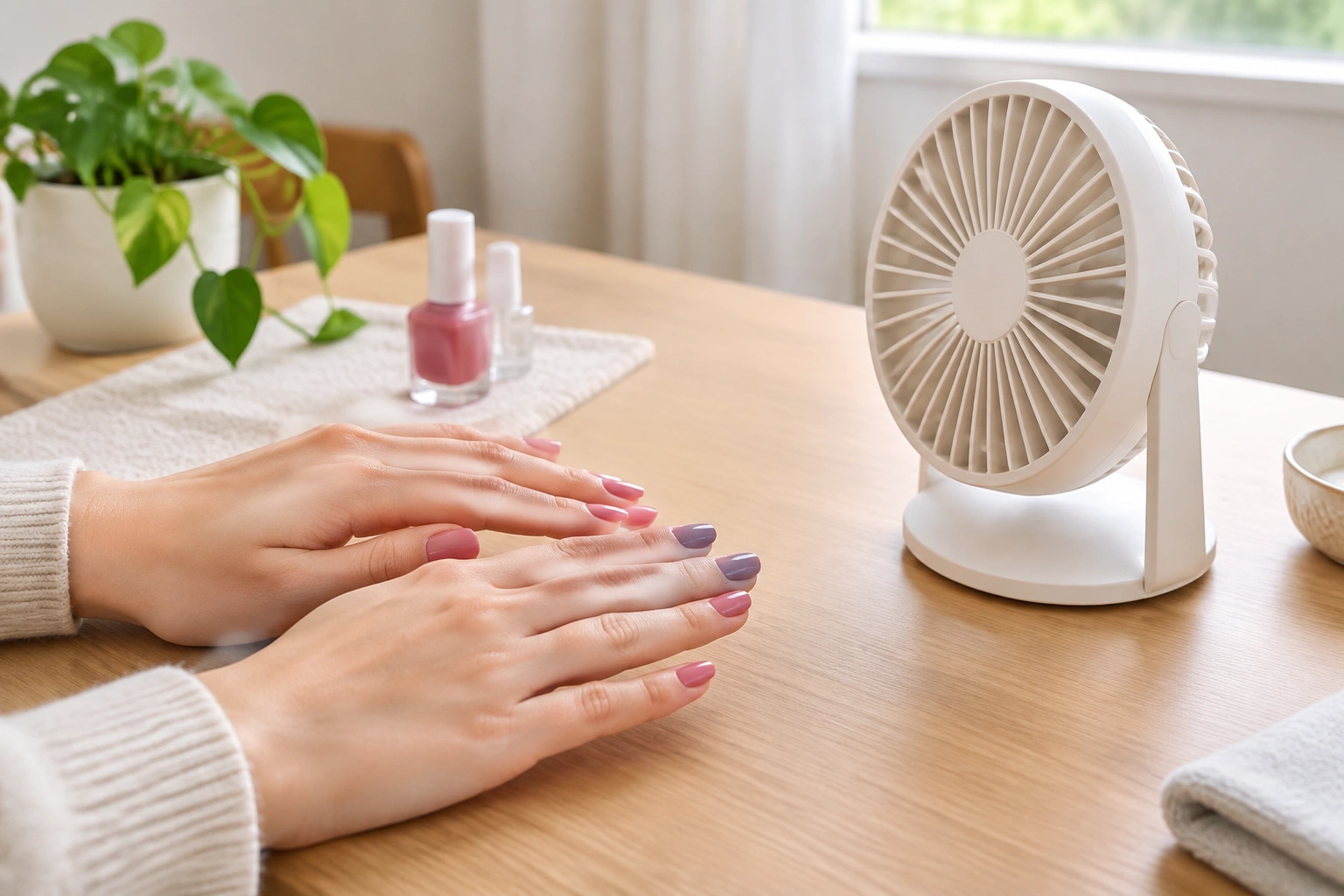
A fan or gentle cool air helps evaporation more than still air does. This is one of the simplest low-risk methods at home.
Set your hands in front of a fan and keep them still. The goal is not to blast the polish around; it’s to encourage the solvents to leave the surface evenly.
3) Add a quick-dry top coat
If you already own one, this is usually worth using. A quick-dry top coat is made to help the polish set faster than a regular top coat. It also adds shine and can help protect the manicure while it finishes drying.
4) Try quick-dry drops or spray
These products can be helpful when you want a little more speed without repainting. They’re designed to support surface drying and reduce the chance of smudges.
The key is to use them exactly as directed. More product is not automatically better.
5) Give yourself a little more time than you think
Even when polish seems mostly dry, the safest move is to avoid anything that presses on the nails. If you need to use your hands soon, plan for light tasks only.
If your polish is already on and feels too thick, the best choice is usually to wait it out rather than trying to fix it with more layers. If you repaint later, switch to thinner coats next time.
Quick-Dry Products: Top Coats, Drops, and Sprays
Quick-dry products are popular because they fit into a normal manicure routine without much effort. Here’s how they compare.
| Product | What it does | Best for | Trade-off |
|---|---|---|---|
| Quick-dry top coat | Seals the polish and helps it set faster | Most beginners who want one simple extra step | Adds another layer, so application still needs care |
| Quick-dry drops | Can help the surface set and reduce tackiness | People who want a small, targeted speed boost | Easy to overuse if you don’t follow directions |
| Quick-dry spray | A convenient finishing step for a manicure | Someone who wants a quick way to finish | Can be less precise than drops |
If you’re choosing between them, a quick-dry top coat is often the easiest all-around option. Drops can be handy if you already have them. Spray is convenient, but it’s best used carefully so you don’t disturb the fresh polish.
For readers who like comparing formulas and routines, our guide on how to make nail polish dry quickly covers the basics in a slightly different format.
Fan, Cool Air, or Cold Water: What Actually Helps
This is where a lot of beginner confusion happens. Some methods help the polish dry. Others mostly change how dry it feels on the surface.
| Method | Helps drying? | What to know | Best use |
|---|---|---|---|
| Fan or cool air | Yes, modestly | Supports evaporation in a simple, low-risk way | Everyday at-home manicures |
| Cold water | Sometimes, but mostly on the surface | May make the top layer feel firmer for a short time, but it does not guarantee the polish is dry underneath | Only if you understand it is not a full-drying method |
| Heat or hot air | No, not recommended | Can cause bubbling, uneven drying, or a rough finish | Avoid for fresh polish |
A fan is usually the most practical home method. Cold water can feel helpful, but it’s easy to misunderstand. It may harden the outer layer temporarily, yet the polish underneath can still be soft. You can still dent the manicure when you dry your hands or start using them.
If you want a deeper comparison of home drying methods, this guide on faster nail polish drying tips breaks down the main options clearly.
What Makes Nail Polish Dry Slower
If your polish always seems to take forever, the cause is usually one of these:
Thick coats
A thick coat traps more solvent and takes much longer to set. It may also wrinkle or bubble more easily.
Too many layers without enough time between them
Stacking coat after coat too quickly creates a soft base that keeps moving underneath the top layer.
Too much polish on the brush
A loaded brush makes it easy to flood the nail and apply more product than needed.
Overhandling
Checking your nails every minute can cause dents long before you notice any smudging.
Shaking the bottle too hard
That can add bubbles, which may affect the finish and make the polish look uneven while it dries.
If you already applied a thick coat, the most honest answer is usually: wait longer. Adding more tricks on top of a heavy layer rarely solves the real problem.
How to Tell When Nails Are Really Dry
A polish job can fool you. The surface may seem fine while the lower layer is still soft.
Try these beginner-friendly checks:
- Look for tackiness: If the nail still feels sticky, it needs more time.
- Check for movement: Very gentle pressure should not leave a mark.
- Watch for dents: If a tiny touch leaves a visible impression, it’s not ready.
- Notice the shine: A glossy surface can still be soft, so don’t rely on appearance alone.
The safest habit is to treat newly painted nails as delicate for longer than you think. If you need to do something right away, use the pads of your fingers carefully and avoid pressing the nail surface.
Best Choice Based on Your Situation
Here’s the simplest way to decide what to do:
If you just finished painting your nails
Do this now:
- Hold your hands still for a minute or two.
- Put them near a fan or other cool moving air.
- Avoid heat, water, and anything that touches the nail surface.
- If you have a quick-dry top coat, use it as directed.
- Leave the manicure alone as long as possible before doing normal tasks.
If you have thin coats and a little time
Use a fan or cool air, then leave the nails alone as long as you can.
If you already own a quick-dry top coat
Use it. That’s one of the easiest ways to speed up the process without changing your whole routine.
If your polish is thick
Don’t keep testing it. Give it more time, and remember that the problem is usually the layer thickness, not your drying method.
If you need to leave soon
Choose thin coats, a quick-dry top coat if available, and cool moving air. Skip heat and avoid water tricks that could make you think the manicure is safer than it is.
If you want the simplest routine
Thin coats plus a fan is the easiest beginner setup. It’s not dramatic, but it works consistently.
Common Questions About Drying Nail Polish Faster
Does blowing on nails help?
Not much. Your breath is warm and moist, which is not ideal for helping polish set. Cool moving air is a better choice.
Is a fan better than cold water?
Usually, yes. A fan helps evaporation directly. Cold water may only make the outer layer feel firmer for a short time.
Do quick-dry top coats really work?
They can help, especially when the polish is applied in thin coats. They’re not magic, but they’re one of the most useful products for beginners.
Are quick-dry drops or spray better?
Both can help. Drops are often easier to place accurately, while spray is faster to apply. The better option is the one you’ll use correctly.
How long should I wait before using my hands normally?
Long enough that the polish no longer dents under light contact. Even then, be gentle for a while. Fresh polish can stay vulnerable longer than it looks.
Should I repaint if I used a thick coat?
If the coat is very heavy and still wet, sometimes yes. If it’s already on the nail, though, the practical choice is often to wait it out and use thinner coats next time.
When to See a Nail Technician or Dermatologist
If your polish keeps bubbling, wrinkling, or refusing to dry even when you use thin coats and normal drying methods, a nail technician can help you troubleshoot your application. If you notice irritation, redness, or a reaction around the nails after using a product, stop using it and speak with a dermatologist.
The main takeaway is simple: thin coats, cool air, and quick-dry products are the most dependable beginner tools, and the best results usually come from applying fewer, thinner layers rather than trying to force a thick manicure to dry faster. Once you understand that polish dries by evaporation, the rest of the process gets much easier to manage.

