
How Much to Tip at a Nail Salon: A Practical Guide for Manicures, Pedicures, and More

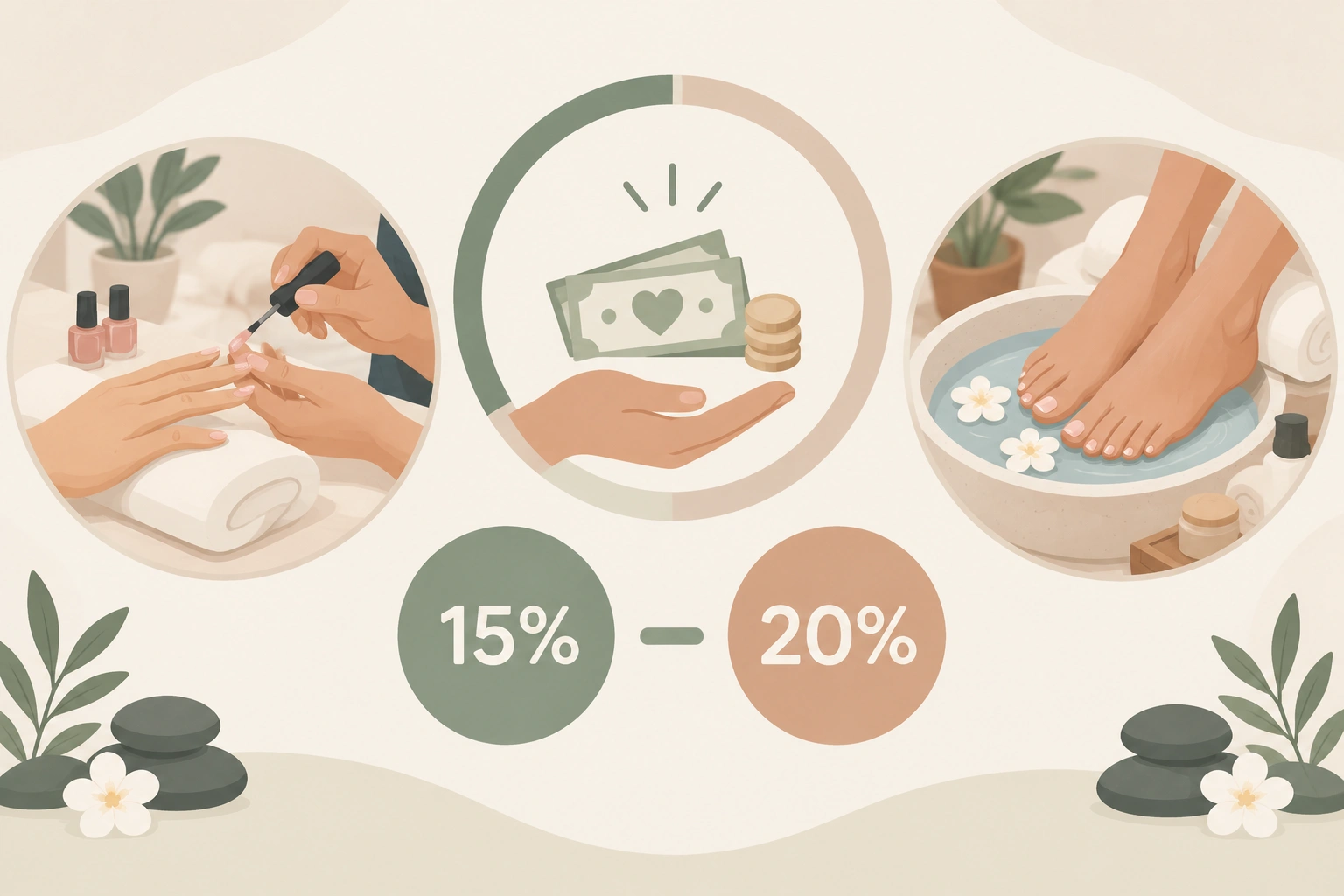
If you want the short answer, a tip of 15% to 20% is the most commonly recommended range at a nail salon in the U.S. If the service was simple, polished, and efficient, 15% is usually a reasonable floor. If your technician spent extra time on detail work, shape correction, gel removal, nail art, or a relaxing pedicure, 20% is a solid standard.
If you prefer a simple rule: tip on the service total, then round up to an easy number. For example, on a $48 manicure, a 20% tip is $9.60, so many people would leave $10.
For a quick reference before you sit down, see our guide to how nail salon tipping usually works, and if you want to understand the service itself, our breakdown of what counts as a full set at a nail salon can help when you’re comparing prices.
Quick Answer: The Usual Tip Range
In most U.S. nail salons, tipping is expected for standard services like manicures and pedicures. A common range is 15% to 20% of the service cost, with some people preferring a flat dollar tip for simpler appointments. That flat amount is often easier for quick services or lower-priced visits.
Here’s the practical version:
- Basic manicure: 15% to 20%
- Pedicure: 15% to 20%, often toward the higher end if it includes massage or extra care
- Gel, acrylic, or detailed nail art: usually closer to 20% or a higher flat amount
- Multiple services in one visit: tip each service appropriately, especially if different people worked on them
A helpful way to think about it: if the appointment felt routine and efficient, follow the lower end of the range. If it took more skill, more time, or more attention, move upward.
If you’re traveling or visiting a salon in a region or culture where tipping norms differ from the typical U.S. standard, it’s worth checking local expectations first. In some places, tipping may be less common or handled differently, so the usual U.S. percentages may not apply.
Standard Nail Salon Tipping Etiquette
Tipping at a nail salon is not exactly the same as tipping at a restaurant, but the same basic idea applies: you’re recognizing the person who performed the service. Many salon professionals and consumer guides point to 15% to 20% as the usual range. A common consumer rule of thumb is closer to 20% when you were very happy with the result, while other guidance notes a broader 10% to 20% customary range.
There’s also a difference between percentage tipping and flat-dollar tipping:
- Percentage tipping works best when the service price is clear and the appointment is more involved.
- Flat-dollar tipping can feel simpler for basic services, especially if the bill is modest.
In practice, many clients use whichever method feels most natural as long as the tip is fair. A flat $5 tip on a very basic service may be fine in some settings, but it may feel too low for a long or highly detailed appointment.
One thing to check before you calculate anything: whether the salon already added a gratuity or service charge. That matters more than people realize, because double-tipping by accident is easy.
How Much to Tip by Service Type
Different services require different amounts of time, precision, and skill. That’s why a single flat rule never fits every appointment.
| Service type | Common tip range | Practical note |
|---|---|---|
| Basic manicure | 15%–20% | Standard baseline |
| Spa manicure | 18%–20% | Extra massage or treatment often deserves more |
| Basic pedicure | 15%–20% | Often tipped at the higher end |
| Gel manicure | 15%–20% | More time and product steps than a basic polish service |
| Acrylic or extension service | 15%–20% or more | Often more labor-intensive |
| Nail art / detailed design | 20% or a higher flat amount | Time and precision matter here |
| Multiple add-ons | Tip on the total bill | Treat the visit as one service package |
A few quick dollar examples can make the table easier to use:
- $30 basic manicure: 15% = $4.50, 20% = $6.00, so many people would leave $5 or $6
- $45 gel manicure: 15% = $6.75, 20% = $9.00, so many people would leave $7 or $10
- $55 pedicure: 15% = $8.25, 20% = $11.00, so many people would leave $10 or $11
- $80 acrylic or full-set service: 15% = $12.00, 20% = $16.00, so many people would leave $15 or $16
Manicures
For a standard manicure, 15% to 20% is the usual range. If the appointment is straightforward—shape, cuticle care, polish—15% is acceptable. If the technician spends extra time correcting uneven nails, refining shape, or giving you a very clean finish, 20% feels more appropriate.
Pedicures
Pedicures often involve more time and more physical effort, so many clients tip toward the higher end of the range. A pedicure that includes exfoliation, massage, and careful detail work usually justifies 20% if you’re happy with the result.
Gel Nails
Gel services often take longer than a basic polish manicure because of prep, layering, curing, and removal steps. A tip in the 15% to 20% range is still standard, but if the service took noticeably longer or included careful removal of old product, 20% is the safer choice. If you want a real-world example, Moodby’s guide gives a $45 gel manicure example where 15% is $6.75 and 20% is $9.00.
Acrylics and Extensions
Acrylic services usually involve more skill, more time, and more product handling than a basic manicure. In those cases, a 20% tip or a slightly higher flat amount is common. If the set required shaping, repair, or a lot of detail, don’t treat it like a quick polish service.
Nail Art
This is where a flat tip can make sense. For nail art that takes extra time or precision, many clients choose to add a few extra dollars on top of the usual percentage tip. Young Nails notes that nail tech tipping is often a flat dollar amount, especially for labor-heavy services like complicated nail art.
When to Tip More or Less
The best tipping decision comes down to three things: time, complexity, and result.
Tip more when:
- The service took longer than expected
- You requested custom shapes, designs, or repairs
- The technician was careful with difficult cuticles or damaged nails
- You received multiple services in one visit
- The result looks polished, balanced, and exactly what you asked for
Tip less when:
- The service was very basic and quick
- The salon experience was rushed or minimal
- You were unhappy with the result and chose not to ask for a correction
That last point matters. If the service was disappointing, you do not need to force a full 20% tip just because it is the default. A smaller tip can reflect the experience without creating drama.
A practical rule: if the technician clearly saved you time, solved a problem, or gave you unusually careful work, lean higher. If the visit felt bare-bones and routine, the lower end of the standard range is fine.
For nail care between visits, a little maintenance goes a long way. If you want help keeping polish looking neat, you may also find our guides on how many coats of nail polish to apply and how long nail polish should dry between coats useful.
Should You Tip on the Full Bill or Base Price?
In most cases, tip on the service total before tax, not on the tax amount. If you added extras like gel removal, nail art, or a spa upgrade, those are usually part of the service total and should be included in the tipping calculation.
A simple decision rule:
- Base service only: tip on that amount
- Base service + add-ons: tip on the full service total
- Retail product purchases: usually not included in the tip calculation unless the salon specifically suggests otherwise
Why this matters: add-ons often increase the technician’s time and effort. If your appointment started as a basic manicure but turned into a longer, more customized service, tipping only on the original base price can understate the work involved.
How to Tip When Multiple Technicians Help
Sometimes one person does the main service and another helps with cleanup, polish, drying, or finishing details. In those cases, the cleanest approach is to tip the person who did the primary service and also tip anyone who clearly contributed.
If the salon makes it obvious who handled what, you can split the tip accordingly. If not, ask at the desk before paying. A quick, polite question like “Should I leave the tip with you, or separate it for each technician?” avoids confusion.
This is especially useful for:
– Pedicure stations where one person preps and another finishes
– Group appointments
– Services where an assistant applies polish or removes product
If more than one person helped, do not assume the first technician will share automatically. Some salons do, some do not. When in doubt, tip separately or ask how the salon prefers to handle it.
Simple tip-splitting examples
Here are a few easy ways to divide a total tip when multiple technicians share the work:
- One main technician and one helper
- Total tip: $20
-
Split: $15 to the main technician, $5 to the helper
-
Two technicians who worked about equally
- Total tip: $20
-
Split: $10 and $10
-
Three people involved in a group service
- Total tip: $30
- Split: $15, $10, and $5 if one person did most of the work and the others helped briefly
- If the work was evenly shared, $10 each is the simpler split
If the salon uses a shared checkout system, ask whether the tip can be entered as separate amounts for each person. That keeps the split clear and avoids guesswork.
Cash vs. Card: The Best Way to Tip
Cash is often the easiest option because it’s immediate and clear. You hand it over, and there’s no guesswork about whether the card terminal processed the amount correctly.
Card tipping is also common and perfectly acceptable if the salon’s checkout system supports it. Many payment terminals now offer tip prompts, which makes the process simple.
Cash is better when:
- You want to tip a specific person directly
- You’re splitting tips between multiple technicians
- You want to avoid confusion at checkout
Card is better when:
- You didn’t bring cash
- The salon’s payment screen makes tipping easy
- You want one clean payment record
If the card terminal prompts for a tip after a service charge has already been added, check the receipt first. If the service charge is a non-tip fee, the terminal prompt may still be asking for an additional gratuity. If the added charge is already an automatic gratuity, you usually would not need to add another tip unless you want to leave extra for exceptional service. When in doubt, ask the front desk before selecting an amount.
If you plan to tip in cash, bring it with you. That prevents the awkward last-minute search for an ATM. Also, some salon owners and technicians prefer cash because it is straightforward and immediate, though card tipping is still widely accepted.
What to Do If Gratuity or a Service Charge Is Already Added
Always check the receipt before tipping again. Some salons add an automatic gratuity or service charge, especially for larger appointments or group bookings. Those are not always the same thing.
Here’s the difference:
- Automatic gratuity: a tip that the salon adds for you. If it is clearly labeled as gratuity, it is generally treated like a tip.
- Service charge: a separate fee added by the salon. It may go to the business rather than the technician, so it should not automatically be treated as a tip unless the salon says it is distributed as gratuity.
That distinction matters because readers often assume any added charge counts as a tip, but that is not always true.
Here’s the practical checklist:
- Look for words like gratuity, service charge, or automatic tip.
- Check whether it was added to the total or listed separately.
- Ask the front desk if you’re unsure.
- Decide whether the added amount already feels like a fair tip.
If an automatic gratuity is already included, an extra tip is optional unless the service was exceptional or you want to reward a specific technician. If it is only a service charge, you may still want to leave a separate tip because the fee may not go to the person who performed the service. The key is to avoid double-paying by accident.
Examples of Common Nail Salon Bills and Tips
Seeing the numbers makes the decision easier.
- $30 basic manicure
- 15% tip = $4.50
- 20% tip = $6.00
-
Practical move: round to $5 or $6
-
$45 gel manicure
- 15% tip = $6.75
- 20% tip = $9.00
-
Practical move: round to $7 or $10
-
$55 pedicure
- 15% tip = $8.25
- 20% tip = $11.00
-
Practical move: round to $10 or $11
-
$80 acrylic or full-set service
- 15% tip = $12.00
- 20% tip = $16.00
-
Practical move: round to $15 or $16
-
$100 service with nail art and add-ons
- 15% tip = $15.00
- 20% tip = $20.00
- Practical move: $20 if the work was detailed
These are examples, not rules. The point is to make the math less stressful so you can tip confidently without standing at the register doing mental arithmetic.
What If the Service Was Poor?
If the service was disappointing, you have a few polite options. You can tip at the lower end of the range, leave a smaller flat amount, or speak up before paying if there was a correctable issue.
A calm approach works best:
– If the shape is off, ask whether it can be adjusted.
– If the polish is uneven, mention it before you leave.
– If the service felt rushed but still acceptable, tip modestly rather than generously.
You do not need to punish a technician over a small mistake, but you also do not need to tip as though the service was perfect. Match the tip to the experience you actually had.
When to See a Nail Technician or Dermatologist
If your concern is about the service itself—shape, finish, lifting, polish wear, or how to maintain your manicure—your nail technician is the right person to ask. If you notice nail changes that seem unusual, painful, or persistent, a dermatologist is the better professional to consult.
For general cosmetic nail care and salon etiquette, your technician can usually help you make the best choice for your next visit.
FAQs
Do I tip on the pre-tax or post-tax amount?
Usually, tip on the service total before tax. If the salon has add-ons that increased the service, include those in the total you use for tipping.
Is 20% too much at a nail salon?
No. In many salons, 20% is a standard “very happy” tip. If the service was simple and your budget is tighter, 15% is still within the commonly recommended range.
Should I tip the owner of the salon?
If the owner personally performed the service, some clients still tip, while others do not. Salon culture varies, so if you’re unsure, it’s reasonable to tip the owner the same way you would tip any technician who did the work.
What if the salon already added a gratuity?
Check the receipt carefully. If gratuity is already included, you usually do not need to tip again unless you want to add something extra for exceptional service.
Can I tip with a credit card?
Yes, many salons allow it through the payment terminal. Cash is often simpler, but card tipping is common and acceptable when the salon supports it.
Should I tip each person if more than one technician helped?
If multiple people provided service, it’s best to tip the people who actually worked on your nails. When the division is unclear, ask the front desk how they prefer tips to be handled.
Is a flat dollar tip okay?
Yes. A flat tip can work well for basic services or when you want a simple, quick method. Just make sure the amount still reflects the time and complexity of the appointment.
What’s the easiest way to avoid awkwardness?
Bring cash, check the receipt for any included gratuity, and decide your tip before you get to the register. That keeps the checkout smooth and removes the guesswork.

