
If your cat grabs your nail file, licks it, or tries to bite the end while you are doing your nails, you are definitely dealing with a curious pet. But can cats chew on nail files safely? The safest answer is no.
A few quick licks may not automatically mean an emergency, but nail files are grooming tools, not cat toys. Their rough surfaces, hard edges, coatings, and breakable materials can irritate a cat’s mouth or become a problem if pieces are swallowed.
Below, we’ll cover why cats may be interested in nail files, which file types create the most concern, what to do if your cat chews one, and when veterinary help is appropriate.
Quick Answer
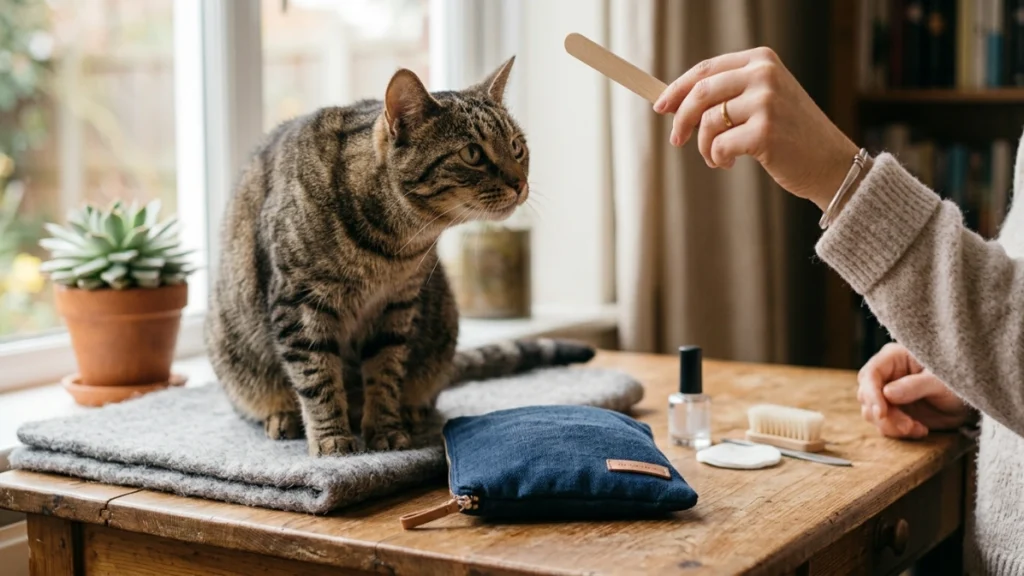
Cats should not be allowed to chew on nail files. Emery boards, glass files, metal files, and buffers may irritate the mouth, damage teeth, break into pieces, or become foreign bodies if swallowed. If part of the file is missing or your cat develops vomiting, drooling, pain, appetite loss, or lethargy, contact a veterinarian.
Why Does My Cat Want to Chew My Nail File?
Cats explore their surroundings with their paws, noses, and mouths. A nail file can be unusually interesting because it has several features your cat does not normally encounter in a toy.
The rough texture may feel interesting against the teeth or tongue. A recently used file may also carry unfamiliar smells from your hands, nails, lotions, or nail products.
Some cats are simply attracted to objects their owners are handling. If you repeatedly pick up a nail file, move it around, and make scratching noises with it, your cat may decide that it deserves investigation too.
There is not strong veterinary evidence showing one universal reason cats specifically love nail files. Avoid assuming that a cat’s interest automatically means the file contains an ingredient the cat wants to eat.
Curiosity Is Different From Eating
A cat sniffing a nail file once is different from a cat repeatedly biting pieces from it.
Persistent eating of non-food objects is called pica. According to VCA Animal Hospitals’ guide to pica in cats, pica involves persistently ingesting objects such as plastic, paper, fabric, string, or thread.
If your cat regularly tries to eat nail files, cardboard, plastic, fabric, or other household objects, bring the behavior up with your veterinarian rather than treating it as a funny habit.
Are Nail Files Safe for Cats to Chew?
No nail file should be considered a safe chew toy.
The level of concern depends partly on the material and whether your cat merely mouthed the file or actually removed and swallowed pieces.
| Nail File Type | Main Concern | What to Do |
|---|---|---|
| Emery board | Abrasive surface, cardboard fragments, coatings | Take it away and check for missing pieces |
| Foam buffer | Foam or abrasive material may tear off | Do not allow chewing |
| Glass/crystal file | Hard material may chip or damage the mouth | Store securely away from pets |
| Metal file | Hard edges may injure the mouth or teeth | Never use as a cat toy |
| Electric file bit | Hard material plus small removable parts | Keep tool and bits completely inaccessible |
Even an inexpensive disposable file is not worth letting a cat chew. Replacing the file costs far less—in money and stress—than dealing with a swallowed foreign object.
What Can Happen If a Cat Chews an Emery Board?
An emery board usually looks harmless because it is lightweight and flexible. However, it is still designed to grind down human nails.
That abrasive surface can rub against sensitive tissues inside your cat’s mouth.
The greater concern is what happens if your cat tears the board apart. Small pieces may be swallowed rather than spit out.
A tiny amount of loose material does not automatically mean your cat will become sick. However, you cannot reliably tell at home whether a swallowed fragment will pass normally or become lodged somewhere in the digestive tract.
Veterinary guidance on foreign-body ingestion in cats lists vomiting, diarrhea, abdominal discomfort, reduced appetite, straining to defecate, and lethargy among possible warning signs.
Do not deliberately give your cat an emery board to chew simply because the cat seems to enjoy it.
What About Glass or Crystal Nail Files?
Glass files are reusable and popular for human manicures, but that does not make them appropriate for pets.
A glass file is harder than a cardboard emery board. Biting a hard grooming tool may put unnecessary pressure on a cat’s teeth and gums.
The file may also become damaged if dropped, bitten, or knocked against another hard surface.
If your glass file is chipped or cracked after your cat gets hold of it, stop using it on your own nails as well. A damaged edge may no longer provide the smooth filing surface you expect.
Store glass files in a case, drawer, or closed manicure organizer when you are finished.
Are Metal Nail Files More Dangerous?
Metal files deserve especially careful storage.
They are firm, thin, and sometimes pointed at one or both ends. A cat that bites, bats, or runs with one may injure its mouth or face.
Do not wave a metal nail file around as a substitute for a wand toy. Even supervised play does not turn a rigid grooming tool into a pet-safe toy.
If your cat likes chasing the movement of the file while you manicure your nails, redirect that interest toward a proper cat toy instead.
What If My Cat Swallowed Part of a Nail File?
First, take the remaining file away and inspect it.
Try to determine:
- What type of nail file it was
- Approximately how much is missing
- Whether your cat actually swallowed anything
- When the chewing happened
- Whether the file had nail polish remover, gel residue, lotion, glue, or another product on it
- Whether your cat is currently acting normally
Keep the remaining file or packaging available. It may help a veterinary professional understand the material involved.
Do Not Try Random Home Remedies
Do not induce vomiting or give oils, milk, medication, or other home treatments unless a veterinarian or animal poison specialist specifically instructs you to do so.
The ASPCA Animal Poison Control Center advises pet owners who suspect ingestion of a potentially poisonous substance to seek professional poison-control guidance.
The American Veterinary Medical Association also recommends contacting a veterinarian, emergency clinic, or animal poison resource when a potentially hazardous exposure occurs. See the AVMA’s pet first-aid guidance.
Trying to make a cat vomit without professional advice can create additional problems.
Warning Signs to Watch For
After suspected ingestion, watch your cat closely.
Contact a veterinarian promptly if you notice:
- Repeated vomiting
- Gagging or retching
- Excessive drooling
- Repeated attempts to swallow
- Pawing at the mouth
- Refusing food
- Trouble keeping food or water down
- Unusual hiding
- Lethargy or weakness
- Abdominal tenderness
- Straining to defecate
- Little or no stool
- Blood in vomit or stool
- Obvious mouth bleeding or injury
A foreign object stuck in the esophagus can cause signs such as excessive drooling, gagging, regurgitation, and repeated swallowing attempts.
Some intestinal foreign bodies can become serious or even life-threatening if they create an obstruction. This is why a “wait and see” approach is not always appropriate when a noticeable section of a file has disappeared.
What If My Cat Only Licked the Nail File?
A brief lick of a clean file is generally a different situation from swallowing pieces.
Take the file away and inspect your cat’s mouth if your cat comfortably allows it. Look for obvious bleeding, irritation, or material stuck around the teeth.
Then consider what was on the file.
A clean, dry grooming tool creates a different exposure from a file covered with nail-polish remover, uncured gel product, adhesive, medicated cream, or another chemical.
If your cat licked a nail file contaminated with a product and you are unsure about its ingredients, contact your veterinarian or animal poison-control service with the product name and ingredient list.
Should You Let Your Cat Play With a Nail File?
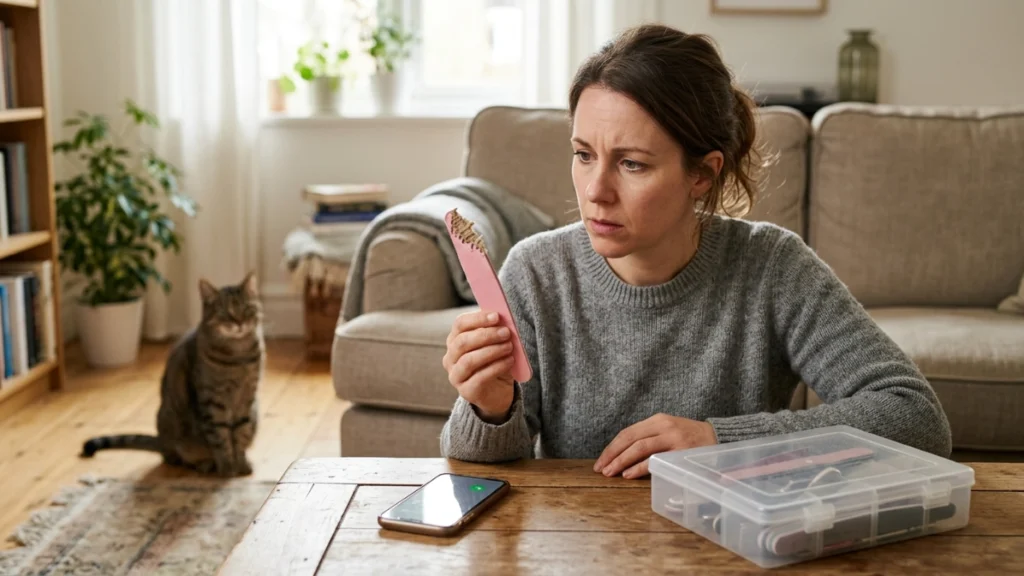
No.
Cats may turn almost anything into a toy, but that does not mean every household object should become part of playtime.
A safer approach is simple:
- Put the nail file away.
- Offer an appropriate cat toy.
- Reward your cat for interacting with the safer object.
- Store manicure supplies in a closed container when you’re finished.
Veterinary behavior guidance recommends giving cats appropriate outlets for play, scratching, chewing, and exploration while keeping unwanted chewing targets out of reach.
Better Alternatives
Depending on your cat’s preferences, consider appropriate:
- Interactive wand toys
- Cat-safe balls
- Food puzzles
- Scratching posts
- Scratching pads
- Cat toys intended for biting or kicking
- Short supervised play sessions
Choose toys specifically designed for cats and check them regularly for loose or damaged parts.
Expert Tip: Keep a favorite cat toy beside your manicure area. If your cat approaches the nail file, immediately redirect her toward the toy before she gets a chance to grab the grooming tool.
How to Keep Cats Away From Nail Files
Prevention is easier than trying to decide whether your cat swallowed part of a file.
1. Use a Closed Manicure Container
A zipper pouch, drawer, or lidded organizer is better than leaving nail tools loose on a vanity.
Make putting tools away part of your manicure routine.
2. Do Not Leave Used Files on the Floor
A dropped emery board can quickly become a chewing target, especially when nobody is watching.
Check your chair, couch, bedding, and floor after doing your nails.
3. Keep Chemical Products Separate
Acetone, nail polish, gel products, adhesives, removers, and treatments create their own safety considerations.
Close containers immediately after use and keep them where pets cannot knock them over or lick spills.
4. Replace Damaged Tools
If a file has been chewed, cracked, chipped, or heavily contaminated, replacing it is usually the sensible choice.
Do not continue filing your nails with a rough or damaged tool simply to save a few dollars.
5. Address Repeated Chewing
Occasional curiosity can happen.
Repeated attempts to consume non-food objects deserve more attention. Persistent pica may require veterinary evaluation and behavioral management.
Hygiene: Should You Keep Using a File After Your Cat Chews It?
It is better to replace disposable emery boards and foam buffers after a cat has had them in its mouth.
These materials are difficult to clean thoroughly without damaging them.
A reusable hard file may be cleanable according to its manufacturer’s instructions, but replacement is still sensible if it is scratched, chipped, bent, or otherwise damaged.
Also consider your own skin.
Filing around broken cuticles or irritated skin with a contaminated tool is unnecessary. Good manicure hygiene means starting with clean hands and clean, intact tools.
Common Mistakes to Avoid
- Letting the cat keep the file because the behavior looks cute. Curiosity does not make the object safe.
- Assuming cardboard means harmless. A torn emery board can still produce swallowed pieces.
- Pulling objects from deep inside the throat. You could cause additional injury.
- Inducing vomiting without veterinary advice. Different swallowed materials require different responses.
- Ignoring a missing chunk. If part of the file cannot be accounted for, call your veterinarian for guidance.
- Waiting for severe symptoms. Earlier professional advice may allow more options.
- Using a cat-chewed disposable file again. Replacement is the easier hygiene choice.
- Focusing only on toxicity. A material does not have to be poisonous to cause choking, mouth injury, or gastrointestinal obstruction.
When to See a Veterinarian
Contact your veterinarian if you know or strongly suspect that your cat swallowed a noticeable piece of a nail file.
Seek urgent veterinary attention if your cat has trouble breathing, appears to be choking, repeatedly vomits, cannot keep water down, has significant mouth bleeding, becomes weak, or shows severe pain.
Foreign-body cases may require physical examination and diagnostic imaging. Depending on the object’s location, size, and material, veterinary treatment can range from monitoring to endoscopic or surgical removal.
This is one situation where DIY treatment has clear limits.
When to See a Nail Technician or Dermatologist
A nail technician or dermatologist is not the appropriate professional for a cat that swallowed a nail file. Your cat needs veterinary care.
This section applies to your nails and skin.
Consider replacing the tool and speaking with an appropriate professional if your manicure tool causes repeated nail splitting, significant irritation, pain, or skin damage.
A licensed nail technician can help with routine manicure technique and tool selection. Persistent swelling, pain, drainage, skin inflammation, or suspected infection around your own nails belongs with a medical professional such as a dermatologist.
Do not use a salon visit as a substitute for veterinary advice when the concern involves your cat.
FAQs
Why does my cat lick my nail file?
Your cat may be interested in its unusual texture, movement, sound, scent, or residue from handling. There is no single proven explanation for every cat. Remove the file rather than encouraging licking or chewing.
Can cats chew on nail files if I supervise them?
It is still better not to allow it. Supervision may help you intervene quickly, but it does not prevent a cat from biting off a small piece or injuring its mouth.
Are emery boards toxic to cats?
The bigger practical concern is not simply whether the board is “toxic.” Abrasive surfaces can irritate the mouth, and swallowed pieces can behave as foreign material. Coatings and residues also vary by product, so contact a veterinarian or poison-control service when ingestion is suspected.
My cat took one bite of a nail file. Should I panic?
Not necessarily. Remove the file and check whether any material is missing. If the file remains intact and your cat is behaving normally, monitor closely. If pieces are missing or symptoms develop, contact your veterinarian.
What happens if a cat eats cardboard from an emery board?
Small pieces may pass, but you cannot guarantee that at home. Swallowed foreign material can sometimes irritate or obstruct the digestive tract. Call your veterinarian if a noticeable amount is missing or your cat develops symptoms.
Can I use the nail file after my cat bites it?
Replacing disposable emery boards and foam buffers is the simplest hygienic option. Replace glass or metal files too if they have been chipped, bent, cracked, or otherwise damaged.
Why does my cat keep eating non-food objects?
Repeatedly eating non-food material may be pica. Because persistent chewing can have behavioral or medical causes, discuss it with your veterinarian rather than simply hiding one particular object.
Conclusion
So, can cats chew on nail files? They may certainly try, but you should not encourage it.
Nail files can create mouth, tooth, hygiene, and foreign-body risks depending on the tool and how much your cat manages to bite off. Emery boards, glass files, metal files, and buffers are all better kept inside a closed manicure organizer.
If your cat only investigated an intact file, remove it and redirect her to a safer toy. If part of the file is missing, chemicals were involved, or your cat develops vomiting, drooling, trouble swallowing, appetite loss, pain, or unusual lethargy, contact a veterinarian.
The easiest next step is simple: put the nail file away and give your curious cat something designed for safe feline play instead.
