
Can Nail Oil Penetrate Nail Polish? What Actually Happens on Painted Nails

If you wear polish and want to keep your nails in good shape, the short answer is this: nail oil usually does not meaningfully penetrate intact nail polish to reach the nail plate the way it can on bare nails. But that does not make it useless. Nail oil can still condition the cuticle area, soften dry skin around the nail, and help keep the manicure looking more flexible and comfortable.
That distinction matters. A lot of people assume nail oil only “works” if it disappears into the nail. In practice, polished nails can still benefit from oil, just in a different way.
Quick Answer: Can Nail Oil Penetrate Nail Polish?
On a fully cured manicure, nail oil is mostly working around the polish rather than deeply through it.
- On bare nails, oil has a better chance of reaching the nail plate and surrounding skin.
- On regular polish, some oil may work along the edges or through tiny imperfections, but the coating still acts as a barrier.
- On gel polish, the cured surface is usually an even stronger barrier.
- On top coat alone, the same basic rule applies: the smoother and more intact the finish, the less direct penetration you should expect.
So if your question is, “Will nail oil soak through polish and feed the nail underneath?” the honest answer is usually not much. If your question is, “Is nail oil still worth using on polished nails?” the answer is yes.
How Nail Oil Works on Nails and Cuticles
Nail oil is mainly useful because it conditions the cuticle area, the surrounding skin, and any exposed nail edges. That’s where you’ll usually see the most immediate benefit.
The nail plate itself is made of keratin layers. On bare nails, some oils may have a better chance of interacting with those layers than they do through a sealed manicure, but the exact amount of penetration depends on the product, the nail condition, and the surface on top. In other words, it is safer to think of nail oil as a conditioner for the nail area first, and a possible nail-plate treatment second.
A practical way to think about it:
- Bare nail: more direct conditioning
- Painted nail: more surface and edge conditioning
- Dry cuticle skin: often the fastest visible payoff
Does Nail Polish Block Nail Oil?
Usually, yes — at least to a meaningful degree.
A cured polish layer is designed to sit on top of the nail and form a protective film. That film is not the same thing as waterproof armor, but it does reduce how easily oil can travel straight into the nail plate. If the polish is intact, smooth, and sealed with top coat, the oil mostly stays on the surface or works along the edges.
What changes in real life is the condition of the manicure:
- Fresh, intact polish: oil has the least access
- Chipped polish: oil can reach more exposed areas
- Worn free edges or lifted corners: oil can move farther into the perimeter
- Sidewalls and cuticle line: these are usually the easiest places for oil to help, even when the center of the nail is covered
That said, it is better not to count on polish being “porous enough” for major nail conditioning. A manicure is not a bare-nail treatment.
Regular Polish vs Gel Polish vs Top Coat: What Changes?
Different manicure types create different barriers. Here’s the most practical way to compare them.

| Nail surface | Barrier strength | What nail oil is most likely to do | Best use case |
|---|---|---|---|
| Bare nails | Lowest | Conditioning can reach the nail plate and skin more directly | Between manicures or during polish breaks |
| Regular polish | Moderate | Mostly conditions the cuticle area and edges; limited penetration through intact polish | Daily maintenance without disturbing the manicure |
| Gel polish | Higher | Mostly surface and cuticle conditioning; less chance of meaningful penetration | Keeping cuticles flexible during a longer-wear manicure |
| Top coat alone | Moderate to high, depending on formula | Similar to regular polish, but smoother finishes may block more contact | Protecting the manicure while reducing dryness around it |
A regular polish manicure may leave a little more room for oil to work at the edges than a thick, well-cured gel finish. But in both cases, the main benefit is still the same: keeping the surrounding skin and the exposed nail margins from drying out.
If you want direct conditioning, bare nails win. If you want to protect a manicure, polished nails win. Those are different goals.
What Nail Oil Can Still Do Over a Manicure
Even when oil cannot reach the nail plate deeply, it can still improve how your manicure looks and feels.
It is still beneficial because it can condition the cuticles, sidewalls, and free edges. Those areas dry out faster than most people realize, and they are often the first places to look rough or feel tight. So even if the polish blocks direct access to the nail plate, the oil is still doing useful work where the manicure is most exposed.
1. It can reduce dry, tight cuticles
This is the most obvious benefit. Dry cuticles can look rough, catch on fabric, and make an otherwise neat manicure look neglected. A small amount of oil massaged into the cuticle line can help the skin look smoother and feel less tight.
2. It can support flexibility around the nail
A very dry nail area tends to feel brittle. While oil is not a miracle fix, keeping the skin and edges conditioned can make the whole manicure area feel less stressed during daily wear.
3. It can help polish look fresher
Dry skin around the nail can make polish look older than it is. That is one reason oil is often used as a maintenance step even by people who are not trying to “treat” the nail plate itself.
4. It can comfort the free edge
The free edge is the part of the nail that extends beyond the fingertip. It is often exposed to water, soap, and friction. A little oil there can help reduce the dry, rough feeling that shows up first at the tips.
One source on nail care notes that oiling the nails can help polish last longer by helping keep it flexible. That is a useful idea, but it should be read carefully: oil is not fixing weak application or poor prep. It is more like maintenance support than a cure-all. Does Nail Oil Penetrate Polish?
When to Apply Nail Oil: Before, After, or Between Manicures
Timing matters more than most people think.
Before polish
Use oil before polishing only if you are planning a proper prep step and then removing any residue from the nail plate. Oil left on the nail can interfere with polish adhesion. That is especially relevant for gel manicures, where clean prep matters for wear.
After polish
This is the safest and most common choice for people who want to protect a manicure. Once the polish is dry or cured, you can apply a small amount of oil around the cuticle line, sidewalls, and free edge.
A practical waiting-time rule:
– Regular polish: wait until it feels fully dry to the touch, and ideally give it several hours before applying oil generously.
– Gel polish: wait until the manicure is fully cured and the surface has been wiped or finished according to the system you used; then apply oil after the nails are no longer tacky.
Between manicures
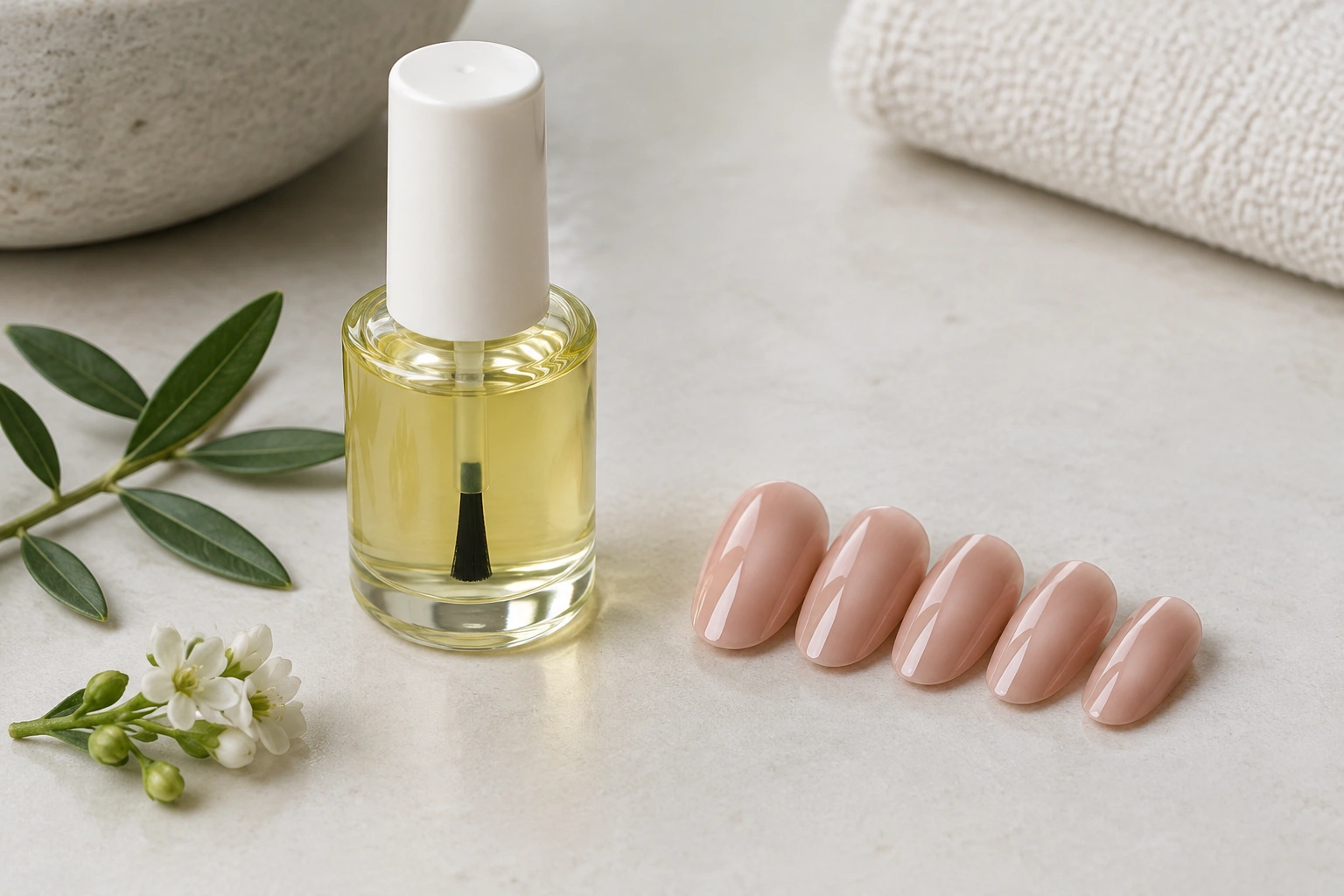
This is the best time for direct nail conditioning. If your nails are bare, oil has the best chance of reaching the nail plate and doing more than surface conditioning.
A useful rule:
– Want maximum conditioning? Use oil on bare nails.
– Want to preserve a manicure? Use oil after the polish has set.
For related prep guidance, see Can Rubbing Alcohol Be Used as Nail Dehydrator? and Can Alcohol Dehydrate Nails?.
How to Use Nail Oil Without Weakening Your Manicure
The main mistake is flooding the nail with too much oil, especially near the edges. That can make the manicure feel slippery and, if oil gets under the coating before or during application, may contribute to lifting.
Use this practical method instead:
- Apply a small drop near each cuticle.
- Massage it into the skin around the nail.
- Wipe away any excess sitting on the polish surface.
- Pay attention to the free edge and sidewalls, not just the center of the nail.
If you are using gel polish, be especially careful around the perimeter of the nail. The cured surface itself is usually stable, but the edges are often where wear starts first.
A precision applicator, brush, or pen-style bottle usually works better than a wide-dropper bottle for polished nails because it lets you control where the oil goes.
Signs Nail Oil Is Helping Even If It Is Not Penetrating Polish
You do not need to see the oil “sink in” to know it is doing something.
Look for these signs instead:
- The skin around the nail feels less tight after washing
- Cuticles look smoother and less ragged
- The nail edges feel less dry or sharp
- The manicure looks fresher because the surrounding skin is not flaky
- Your nails feel more comfortable during daily hand use
These are real benefits, even if the polish is still acting as a barrier. In other words, the oil can be useful without visibly disappearing.
Best Type of Oil to Use on Polished Nails
For polished nails, the best oil is usually the one that is easy to apply precisely and does not feel overly heavy.
A few practical guidelines:
- Cuticle oils in pens, brushes, or small dropper bottles are usually best for polished nails because they are easy to control.
- Light, spreadable oils are often easier for daily use.
- Richer body or face oils can work in a pinch, but they may leave more residue and are usually less convenient around a manicure.
- Dedicated cuticle oil is generally a better fit than a random facial or body oil if your goal is nail care rather than general skin care.
If your main goal is manicure maintenance, choose a formula that you can apply in a thin layer. If your main goal is bare-nail conditioning between manicures, a richer cuticle oil may be fine.
The molecular-size point matters most when the nail is bare. Some oils may be more suitable for nail care than others, but it is better to treat that as a general preference rather than a guarantee of penetration through polish. That is one reason jojoba-based cuticle oils are often favored for nail care routines, especially when the goal is more than just a shiny finish. Cuticle Oil: What Is It and Why Is It So Important?
Bare Nails vs Polished Nails: Which Gets More Benefit?
Bare nails get the more direct benefit. Polished nails get the more practical maintenance benefit.
Here is the simplest way to decide:
- Choose bare-nail oiling if your nails are dry, peeling, or recovering between manicures.
- Choose over-polish oiling if you want to keep your manicure looking neat and reduce dryness around the nail.
- Choose both at different times if you wear polish regularly: bare nails between sets, oil over the manicure once it is dry.
That approach gives you the best of both worlds without trying to force one product to do two different jobs at the same time.
When to See a Nail Technician or Dermatologist
If your nails are lifting, separating, or consistently painful, nail oil is not the solution to chase first. A nail technician can help you assess whether the issue is application, removal, or routine care. A dermatologist is the better choice if you have persistent nail changes, irritation around the nail, or a condition that seems to be worsening rather than improving.
Nail oil is a care product, not a medical treatment.
FAQ
Can nail oil go through regular nail polish?
Usually not in a meaningful way. Regular polish may allow a little more contact at the edges than gel, but most of the benefit is still on the cuticle, sidewalls, and free edge.
Can you use cuticle oil on gel nails?
Yes. In fact, it is commonly used after gel polish is cured to keep the surrounding skin from drying out and to help the manicure look fresher.
Does nail oil work better on bare nails?
Yes. Bare nails give oil the best chance of reaching the nail plate directly, so they are better for deeper conditioning.
Should I wait before applying nail oil after painting my nails?
Yes. For regular polish, wait until it is fully dry to the touch and ideally several hours if you can. For gel, wait until it is fully cured and finished before applying oil.
The Bottom Line
Can nail oil penetrate nail polish? Usually not in any meaningful way once the polish is cured. But that does not make it pointless. Over polished nails, nail oil is still valuable for the cuticle area, the surrounding skin, and the free edge — which is often enough to make a visible difference in comfort and appearance.
If you want the strongest direct conditioning, use oil on bare nails. If you want to protect a manicure, use it after polish has dried or cured, and keep it focused on the edges and cuticles rather than soaking the whole nail.

