
Can Oregano Oil Kill Nail Fungus? What the Evidence Says and How to Use It Safely

Toenail fungus can be stubborn, discouraging, and slow to change. If you’ve been looking for a natural option, oregano oil may have come up as a possible at-home remedy. The short answer is: oregano oil may help some mild cases, but the evidence is limited, and it is not proven to cure nail fungus.
There is some encouraging evidence, but it does not prove that over-the-counter oregano oil reliably clears onychomycosis in everyday use. Nails are hard for any topical product to penetrate, and fungal infections often need long-term, consistent treatment.
If you want to try oregano oil, the safest approach is to treat it as a cautious home trial for mild cases—not a replacement for medical care when the infection is thick, painful, spreading, or recurring.
What nail fungus is and why it is hard to treat
Nail fungus is called onychomycosis. It usually starts as a small change in color or texture: a white or yellow spot, a thicker edge, a crumbly tip, or a nail that looks dull instead of clear. Over time, the nail may become more brittle, lift away from the nail bed, or develop a rough surface.
The reason nail fungus is so frustrating is simple: the nail plate is a barrier. Topical products have to get through that hard surface to reach the fungus underneath or within the nail. That is why many home remedies seem promising at first but disappoint later. They may sit on the surface, help the nail look a little better, or reduce moisture around the nail, yet still fail to reach the infection deeply enough.
A practical example: if the nail is only lightly discolored at the edge, a topical approach has a better chance of helping than if the whole nail has turned thick, yellow, and crumbly. Once the nail is significantly changed, home treatment alone is much less likely to be enough.
Why oregano oil is thought to work
Oregano oil contains compounds such as carvacrol and thymol, which are often described as having antifungal and antibacterial activity. That is the main reason it gets attention in nail care discussions.
This matters, but only to a point. A substance can show antifungal activity in a lab and still fall short in real life. Lab tests do not have to deal with the same challenges you do at home: thick nails, repeated washing, skin sensitivity, inconsistent application, and an infection that may have been present for months.
So the logic behind oregano oil is reasonable. The leap from “it has antifungal compounds” to “it reliably kills nail fungus” is much bigger.
What the evidence says about oregano oil for nail fungus
The evidence for oregano oil is limited, especially compared with prescription antifungal medications. It helps to separate the evidence into three buckets:
- Lab evidence: Oregano oil and its compounds, including carvacrol and thymol, have shown antifungal activity in laboratory settings. That suggests biological plausibility, but lab results do not tell us how well a product works on a thick toenail.
- Human evidence: A 2019 study cited in a health review found that a topical treatment containing oregano oil improved toenail fungus and nail appearance and was safe to use. That is encouraging, but the details matter. The study design, sample size, and whether oregano oil was the only active ingredient all affect how much weight to give the result.
- Real-world OTC use: Over-the-counter oregano oil used at home is not the same as a studied formulation. Strength, dilution, application method, and consistency can all vary, so the results from a study may not translate directly to a bottle you buy yourself.
That is why oregano oil looks more like a promising natural option than a proven standalone cure.
If your goal is the highest likelihood of clearing a fungal nail, prescription treatment still has the stronger track record. If your goal is a lower-intensity home trial for a mild case, oregano oil may be worth considering carefully.
How oregano oil compares with tea tree oil, vinegar, Vicks, and prescription antifungals
Here is the practical comparison most readers want: what is most likely to help, what is safest, and what is realistic.

| Option | Evidence for nail fungus | Typical use | Safety notes | Bottom line |
|---|---|---|---|---|
| Oregano oil | Limited human evidence; some encouraging lab findings | Usually diluted and applied topically | Can irritate skin if used too strong | Worth considering for mild cases, but not a proven cure |
| Tea tree oil | Commonly used; evidence is mixed | Applied topically, usually diluted | Can also irritate sensitive skin | Similar “natural remedy” tier; may help some people, not reliable for everyone |
| Vinegar | Mostly anecdotal | Soaks or diluted applications | Can sting or dry skin | Low-cost, but weaker evidence and less direct antifungal support |
| Vicks VapoRub | Some people report benefit; evidence is limited | Applied topically | May irritate or feel greasy | More of an anecdotal option than a dependable treatment |
| Prescription antifungals | Strongest evidence among the options listed | Topical or oral, depending on severity | Side effects vary by medication | Best choice when clearing the infection is the priority |
A useful rule of thumb: the more severe the nail changes, the less likely a home remedy will be enough on its own. A mildly affected nail may be a reasonable place to try oregano oil. A thick, lifted, or multi-nail infection usually deserves medical evaluation.
How to use oregano oil safely on nails
Oregano oil should be handled like a strong essential oil, not like a gentle moisturizer. Applying it undiluted can cause burning, redness, or irritation around the nail fold.
Safer application basics
- Patch test first. Put a small amount of diluted oil on a small area of skin and wait before using it on the nail.
- Dilute it. Use a carrier oil such as coconut oil, jojoba oil, or olive oil rather than applying oregano oil straight from the bottle.
- Clean and dry the nail. Wash the area, then dry it well before application.
- Trim and file carefully. Shorter nails give topical products a better chance to reach the affected area.
- Apply consistently. If you choose to try it, use it regularly rather than on and off.
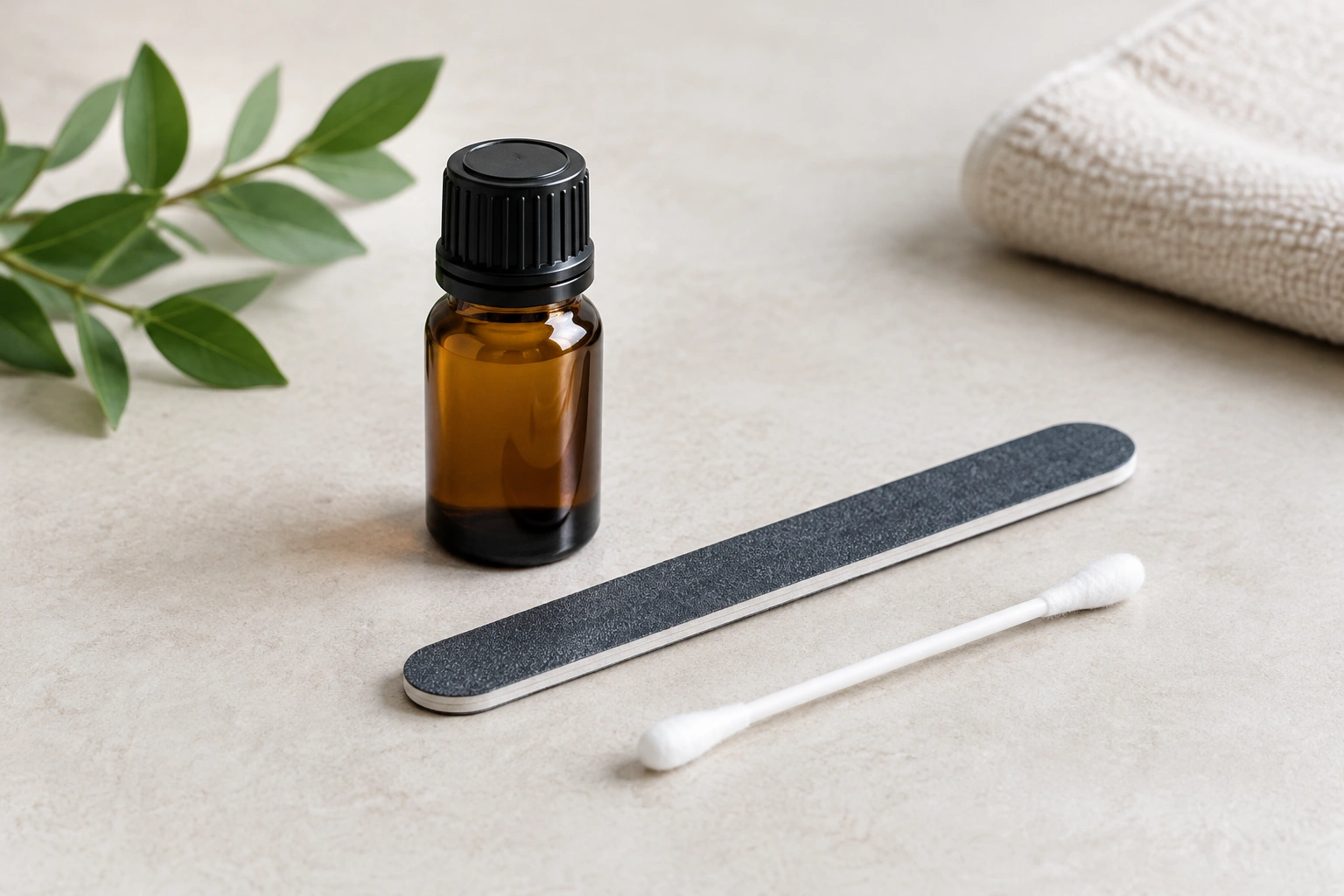
A practical routine is to apply a small amount to the affected nail and surrounding edge with a cotton swab or clean applicator, then let it dry before putting on socks or shoes. If you wear nail polish, remember that coverage can reduce how well any topical product reaches the nail.
For readers who prefer a broader overview of essential oil options, this practical guide to essential oils for nail fungus can help you compare common choices and application habits.
How much to dilute?
There is no universally established oregano oil dilution for nail fungus. A conservative starting point is to mix it into a carrier oil at about 1 part oregano oil to 10 to 20 parts carrier oil. If you have sensitive skin, starting closer to the weaker end is the safer choice.
Do not use oregano oil undiluted on nails or surrounding skin. Even if the nail itself seems tough, the skin around it can react quickly.
If the skin around the nail becomes red, itchy, raw, or painful, stop using it. “More” is not better with essential oils.
How long it takes to see results
Nail fungus changes slowly because nails grow slowly. Even if a treatment is helping, the nail will not look normal overnight. In many cases, the visible improvement is not in the infected part of the nail itself but in the new growth coming in from the base.
Toenails can take many months to grow out, so progress is usually slow. Fingernails generally grow faster, so changes may be easier to spot sooner. Even so, you still need to judge the trend over time rather than day by day.
A realistic way to track progress is to take a photo every few weeks in the same lighting. Look for:
– less yellowing at the base,
– smoother new growth,
– less lifting,
– fewer crumbly edges.
If there is no clear improvement after several weeks to a few months, the treatment is probably not doing much. If the nail is getting thicker, more painful, or spreading to other nails, that is not a sign to keep waiting indefinitely.
Side effects, risks, and when to stop using it
The main risk with oregano oil is skin irritation. Essential oils can be strong enough to cause burning or a rash, especially if they are not diluted.
Stop using it if you notice:
– burning or stinging that does not settle quickly,
– redness around the nail,
– swelling,
– itching,
– peeling or raw skin,
– worsening tenderness.
Do not apply oregano oil to broken skin, open cracks, or obviously inflamed areas. If the nail fold is already irritated, the oil may make the problem worse rather than better.
People with sensitive skin or known essential oil allergies should be especially careful. If you have diabetes, poor circulation, or a weakened immune system, home treatment is a poor place to gamble with a worsening foot or nail problem.
When home treatment is reasonable and when to see a podiatrist or dermatologist
A home trial can make sense when the nail change is mild, limited to one nail, and not causing pain. That is the kind of situation where oregano oil might be worth trying if you understand the limits.
Professional evaluation makes more sense when:
– the nail is thick, crumbling, or lifting,
– more than one nail is involved,
– the area is painful,
– the problem keeps coming back,
– you are not sure it is actually fungus,
– you have diabetes, poor circulation, or immune concerns,
– the nail is changing color in a way that looks unusual or dark.
A podiatrist or dermatologist can confirm whether it is truly fungus. That matters because nail trauma, psoriasis, and other conditions can mimic fungal infection. If the diagnosis is wrong, no home remedy will solve the real issue.
If you try oregano oil and see no improvement after several weeks to a few months, or if the nail worsens at any point, it is time to get checked.
A practical way to decide whether oregano oil is worth trying
If you want the simplest decision rule, use this:
- Try oregano oil cautiously if the case is mild, you want a natural option, and you are comfortable with slow progress.
- Choose medical treatment sooner if the nail is thick, painful, spreading, or has not improved after a reasonable trial.
- Stop immediately if the skin reacts badly.
That is the most honest way to think about it. Oregano oil may be a useful supportive option, but it is not the same as a proven antifungal cure.
Frequently asked questions
Can oregano oil kill nail fungus?
It may help inhibit fungus and improve nail appearance, but it is not proven to reliably kill nail fungus in real-world home use. The evidence is limited, and results are not guaranteed.
Is oregano oil better than tea tree oil?
Not clearly. Both are popular natural options with limited evidence. Some people prefer oregano oil because of its antifungal compounds, but that does not make it more reliable than tea tree oil.
Can I use oregano oil with tea tree oil?
Some people do use them together, but combining two strong essential oils can also increase irritation. If you try both, be conservative and patch test first.
How often should I apply it?
A cited health review mentions twice-daily use with a cotton swab, but that should not be treated as a proven dosing standard for over-the-counter oregano oil. The more important point is to keep the product diluted, use it consistently, and stop if your skin reacts.
Does it work better than prescription antifungal medication?
No strong evidence says that. Prescription treatments remain the more established choice when the goal is to actually clear the infection.
Should I keep using it if the nail still looks bad after a few weeks?
Maybe, if there is no irritation and you are seeing slow new growth improvements. But if there is no clear change after several weeks to a few months, or the nail worsens, it is time to stop and get checked.
Final take
So, can oregano oil kill nail fungus? It may help some mild cases, but it is not a proven cure. It has antifungal compounds and some encouraging early evidence, but nail fungus is a tough condition and topical home remedies often struggle to reach the infection deeply enough.
If you want to try it, keep the approach cautious: dilute it, patch test it, apply it consistently, and watch for irritation. If the nail is thick, painful, spreading, or not improving after several weeks to a few months, a podiatrist or dermatologist is the smarter next step.

