
Does UV Light Dry Regular Nail Polish? A Beginner-Friendly Guide

If you’re using regular nail polish, the short answer is no: a UV lamp does not properly dry it the way it cures gel polish. Regular polish usually dries by air-drying, as the solvents in the polish evaporate over time. Regular polish dries in air, while gel polish cures under UV or LED light, so a UV lamp is not the right tool for normal polish.
That’s the part many beginners miss: polish can feel dry on top long before it is fully set underneath. So even if your nails seem okay after a few minutes, they may still dent, smudge, or pick up texture if you rush them.
Quick Answer: Does UV Light Dry Regular Nail Polish?
No, not in the way most people mean by “dry.”
Regular nail polish generally needs time in open air to dry. A UV lamp is made to cure gel products, not to finish the drying process for standard polish. So if you place regular polish under a UV lamp, you should not expect the same hard, fully set result you get from gel.
If you want a simple rule, use this one:
- Regular polish = air-dry
- Gel polish = lamp-cure

That distinction saves a lot of frustration, especially if you’re new to doing your own nails.
For a deeper look at the drying process itself, you may also find how nail polish dries helpful.
Drying vs. Curing: What’s the Difference?
These two words get mixed up all the time, but they mean different things.
Drying usually means a product hardens as liquid ingredients leave the formula. With regular nail polish, that happens mostly through solvent evaporation. In plain language, the polish dries because the liquid part slowly disappears into the air.
Curing is different. Gel polish is made to react to specific light, usually UV or LED light, so it hardens when exposed to that lamp. The light helps trigger the setting process.
That means a UV lamp is not a universal “nail dryer.” It works for products that are made to cure under light. Regular polish is not built the same way.
A simple way to think about it
- If the product is regular polish, it needs time and airflow
- If the product is gel polish, it needs the correct lamp and the correct formula
If you’ve ever wondered why gel polish needs a lamp at all, does gel polish dry without UV light explains that side of the comparison in beginner terms.
How Regular Nail Polish Actually Dries
Regular nail polish dries when the liquid solvents in the formula evaporate. That’s why a manicure can look fine on the surface but still be soft underneath for a while.
Several things affect how fast that happens:
- Coat thickness: thick coats take longer
- Room airflow: moving air helps the solvents evaporate
- Temperature and humidity: a damp room usually slows drying
- Layer count: more layers mean more drying time
This is why a polished-looking manicure can still get ruined by a blanket, a sleeve, or a quick grab for your phone. The top may feel dry before the lower layers are ready.
What “dry to the touch” really means
Dry to the touch does not always mean fully hardened.
A beginner-friendly example: you finish painting your nails, wait a few minutes, and lightly tap one nail with a finger. If it doesn’t feel sticky, it may seem dry. But if you press the nail edge into something firm too soon, you can still leave a dent.
That’s why patience matters more than most people expect with regular polish.
How Gel Polish Works Under UV or LED Light
Gel polish is made for a different job. It is formulated to cure under a lamp, which is why UV and LED systems are part of gel manicures.
Here’s the practical difference:
| Feature | Regular Nail Polish | Gel Polish |
|---|---|---|
| Main drying method | Air-drying | Lamp curing |
| Needs UV or LED lamp? | No | Yes, for most gel systems |
| How it hardens | Solvent evaporation | Light-activated curing |
| Usual feel after application | Wet, then gradually sets | Stays tacky until cured, then hardens |
| Removal | Usually removed with remover | Often removed differently, depending on product |
If you’re deciding between the two, think about your routine. Regular polish is simpler and easier to remove. Gel polish is built for lamp use and usually lasts longer, but it also comes with a different application and removal process.
For readers comparing lamp-based options, does gel polish dry without a lamp is a useful companion article.
Why a UV Lamp Won’t Properly Dry Regular Nail Polish
A UV lamp does not solve the actual drying process for standard polish. Regular polish is not designed to cure under that light, so the lamp usually does not create the hard finish you’re expecting.
Using a lamp on regular polish can add UV exposure without giving you the main benefit the lamp is designed for. If you are not using a gel product that requires curing, there is no good reason to sit your hands under a UV lamp just to “dry” regular polish.
There’s also a practical issue: if you expect the lamp to “finish” the manicure, you may touch your nails too soon because they feel like they should be done. That can lead to dents and smudges.
The beginner mistake to avoid
Do not assume that “under a lamp” equals “fully dry.”
That shortcut works only when the polish is made for lamp curing. With regular polish, the better move is to focus on thin coats and proper drying time instead of trying to force a gel-style result.
How Long Regular Nail Polish Usually Takes to Dry
There isn’t one exact number that fits every polish, but regular nail polish usually needs more time than people expect.
A few practical guidelines:
- Surface dry: often around 5 to 15 minutes for thin coats
- Dry to the touch: often around 15 to 30 minutes
- More fully set: often 1 to 2 hours
- Fully hardened: can take several hours, and sometimes longer with thicker layers
These are only general ranges, but they help set expectations. A manicure may feel safe enough to handle lightly after a short wait, but that is not the same as being fully dry. If you plan to go to bed, put on socks, or do anything that presses on the nails, give them extra time.
If you want a more detailed breakdown of timing, how long nail polish takes to dry is a good next read.
What Actually Helps Regular Nail Polish Dry Faster?
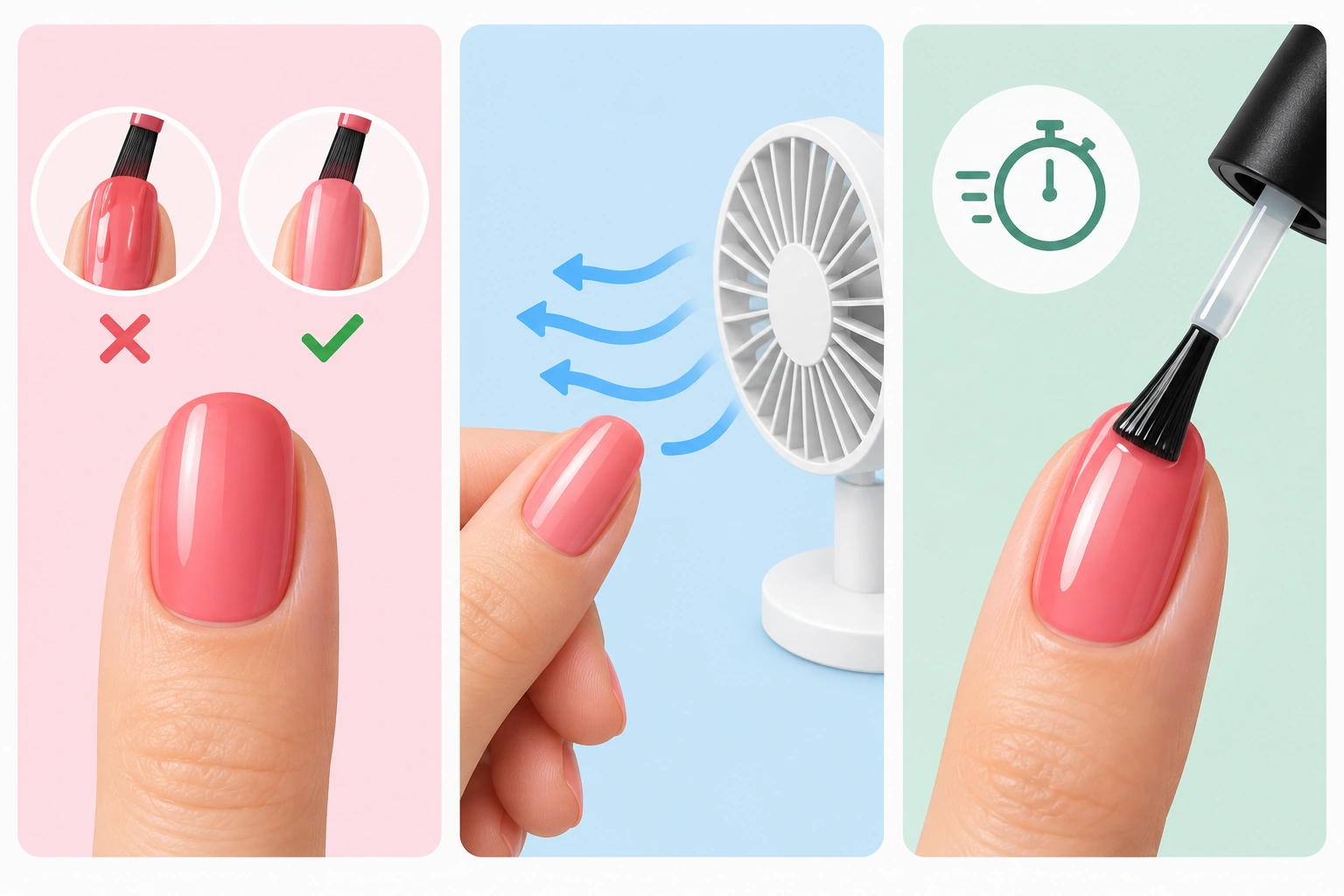
The best drying tricks for regular polish are simple, not fancy.
1. Use thin coats
This is the biggest one. Thick polish traps more liquid and takes longer to dry. Two thin coats are usually better than one heavy coat.
A good real-world habit is to wipe excess polish off the brush before applying. You want enough product to cover the nail, not so much that it pools at the edges.
2. Let each layer settle before the next one
If the first coat is still too wet, the second coat can drag and stay soft longer. A short pause between coats helps the manicure set more evenly.
3. Use airflow
A fan or simply sitting in a breezier room can help. Airflow supports evaporation, which is the drying process regular polish actually needs.
4. Try a quick-dry top coat
If you want a faster finish, a quick-dry top coat often helps more than a UV lamp. It is made to speed up the drying process for regular polish and can reduce the chance of smudges while the manicure sets.
5. Avoid heavy contact too soon
Even if your nails seem okay, skip tight gloves, bedding pressure, and hard tapping for a while. Small habits make a big difference in how clean the manicure looks later.
Quick decision guide
- Want the simplest routine? Air-dry with thin coats
- Want faster touch-dry results? Use a quick-dry top coat
- Want a lamp-based manicure? Switch to gel polish instead of trying to force regular polish to behave like gel
For a broader overview of timing, how long nail polish takes to dry completely can help set realistic expectations.
Is It Safe to Put Regular Nail Polish Under a UV Lamp?
Using a UV lamp on regular polish is generally not a useful shortcut, and it exposes your skin to UV light without giving you the main benefit the lamp is designed for.
That does not mean one accidental exposure is a disaster. It does mean the method is unnecessary for standard polish. If you are not using a gel product that requires curing, there is no good reason to sit your hands under a UV lamp just to “dry” regular polish.
If you use any UV nail lamp, follow the product instructions carefully and avoid staring at the light. If you want official safety guidance, the American Academy of Dermatology has patient information on UV nail lamps and skin protection.
Regular Nail Polish vs. Gel Polish: Which One Should You Use?
This is the choice that matters most if you’re deciding what to buy or use next.
Choose regular nail polish if you want:
- a simple at-home manicure
- air-drying without a lamp
- easy removal with standard remover
- a beginner-friendly routine
Choose gel polish if you want:
- a lamp-cured system
- a manicure designed to harden under UV or LED light
- a different wear and removal process
The trade-off is straightforward. Regular polish is simpler. Gel is built for lamp use. If you keep those roles separate, you’ll avoid most drying problems.
When to See a Nail Technician or Dermatologist
See a nail technician if:
- your polish keeps wrinkling even when you use thin coats
- you’re unsure whether your product is regular polish or gel
- you want help choosing the right top coat or drying routine
See a dermatologist if:
- you notice redness, itching, or irritation after product use
- your skin reacts after repeated lamp exposure
- your nails become painful, infected, or unusually damaged
If you’re ever unsure about a product label, a professional can help you match the polish type to the correct drying method.
FAQs
Can I use a UV lamp with normal nail polish?
You can put it under the lamp, but it usually will not dry the way gel polish does. Regular polish is meant to air-dry, so the lamp is not the right tool.
Will a UV lamp make regular polish harden faster?
Usually not in a meaningful way. If the polish is not formulated to cure under light, the lamp does not replace normal drying time.
What’s the fastest way to dry regular nail polish?
Thin coats plus a quick-dry top coat are usually the most helpful beginner-friendly combo. Airflow can help too.
How do I know if my nails are really dry?
If the surface feels dry but the polish dents easily when pressed, it is not fully set yet. Give it more time before doing anything that puts pressure on the nails.
Is gel polish better if I want to use a lamp?
Yes, if your goal is lamp curing. Gel polish is made for that system, while regular polish is not.
Do quick-dry top coats work better than UV light for regular polish?
For regular polish, yes in most cases. Quick-dry top coats are made to support the drying process you actually need.
Can I use the same lamp for regular polish and gel polish?
The lamp may be used with gel products if the product instructions match the lamp type, but regular polish still will not cure the same way. The product has to be made for lamp curing.
Bottom Line
If you’re asking, does UV light dry regular nail polish, the practical answer is no. Regular polish is meant to dry by air, not cure under a lamp. The easiest way to get better results is to use thin coats, give each layer time, and reach for a quick-dry top coat if you want a faster finish.

