How Long Nail Polish Takes to Dry: A Beginner-Friendly Guide to Smudge-Free Nails

If you’ve ever painted your nails, waited “long enough,” and still ended up with a dent or a smudge, you’re not alone. Drying time is one of the biggest beginner frustrations with nail polish. The short answer is that it can vary a lot based on the formula, how thickly you apply it, and how many coats you use.
A helpful way to think about it is this: nail polish can feel dry on the surface before it is truly ready for normal activity. That difference matters, because a manicure that seems fine can still mark if you press on it too soon.
In this guide, I’ll walk you through what drying time usually looks like, what changes it, and how to tell when your nails are actually ready. I’m Ella Hart, and I’ll keep this simple and practical so you can paint your nails with more confidence.
How Long Nail Polish Usually Takes to Dry
There isn’t one exact drying time that fits every polish. Regular nail polish, quick-dry formulas, base coats, and top coats all behave a little differently.
Here’s a simple comparison to help set expectations:
| Product type | What you can usually expect | Beginner note |
|---|---|---|
| Base coat | Often dries in about 1 to 3 minutes when applied thinly | A thin base coat helps the color apply more smoothly |
| Regular nail polish | Often feels dry to the touch in about 10 to 20 minutes per thin coat, but may need 30 to 60 minutes or more before it is less likely to smudge | Thick coats take much longer |
| Quick-dry nail polish | Often feels dry to the touch in about 5 to 10 minutes per thin coat, with a safer smudge-free wait of about 20 to 30 minutes | Still benefits from thin coats |
| Top coat | Often sets on the surface in about 2 to 5 minutes, but the manicure underneath may still be soft | Quick-dry top coats can help the finish feel ready sooner |
If you want a deeper breakdown of the full process, this guide on how long nail polish takes to dry completely can help you compare surface drying with full drying.
For a simple beginner example: if you paint two thin coats of regular polish plus base coat and top coat, it may look finished within minutes, but it is still smart to treat the manicure as delicate for at least 30 minutes and avoid pressure for longer if possible.
The biggest beginner mistake is assuming one coat of color is “done” as soon as it stops looking wet. In reality, polish often needs more time than it appears to.
Regular polish vs quick-dry polish
Regular polish is familiar, easy to use, and widely available. The trade-off is that it usually asks for more patience.
Quick-dry polish is made for faster surface setting. That can be a good choice if you hate waiting, but it may give you less time to fix streaks or uneven application before it starts to set.
If speed matters most, a quick-dry formula or a quick-dry top coat is often the more practical pick.
Dry to the Touch vs Fully Dry or Cured
These terms get mixed up a lot, and that’s usually where smudges begin.
Surface-dry means the polish no longer looks wet and glossy in an obvious way, but it may still dent easily if you press it.
Dry to the touch means the top surface feels set enough that a very light tap is less likely to leave a mark. For many thin coats of regular polish, this may happen around 10 to 20 minutes, but that is not the same as being safe for heavy use.
Fully dry means the manicure has hardened enough for normal movement and light contact. For regular polish, that often takes 30 to 60 minutes or more, and thicker coats can take longer.
Fully cured is a term you’ll hear more with gel polish. Gel polish needs a different process and a proper lamp to harden fully, which is why it behaves differently from regular polish.
A beginner-friendly example: if you paint your nails after dinner, they may feel dry enough to lightly check before bed, but they may still smudge if you press them into sheets or grab something firmly. That’s why “feels dry” and “safe for everything” are not the same thing.
A simple readiness test: gently touch the very edge of one nail with another fingertip or tap two nails together very lightly. If they stick, drag, or leave a mark, they need more time. If you can tap lightly without any movement, they are closer to ready, but you should still be careful with pressure.
For general nail and skin safety around cosmetic products, it’s worth checking trusted sources like the FDA’s cosmetics guidance and CDC hand hygiene recommendations.
What Makes Nail Polish Dry Faster or Slower
Coat thickness matters most
Thin coats dry faster than thick coats. That’s the simplest rule to remember.
A thick coat may look more opaque right away, but it traps more solvent and takes longer to set. It also dents more easily. If you’ve ever painted one heavy coat because you wanted to save time, that’s usually the opposite of what happens.
More layers mean more waiting
Each layer adds drying time. Base coat, color coat, second color coat, and top coat all need time to settle.
That doesn’t mean you should skip them. It means you should expect the whole manicure to take longer than the color coat alone.
Formula type changes the pace
Some polishes are designed to dry faster than others. Quick-dry formulas and quick-dry top coats are made for this purpose, while classic formulas may take longer.
Old or thickened polish can also apply unevenly and dry more slowly.
Airflow, humidity, and temperature matter
A room with gentle airflow usually helps polish set more comfortably than a still, humid room. Very damp air can slow drying, while moderate airflow can help solvent evaporate.
Too much heat is not the answer. High heat can cause bubbling or uneven drying, so avoid blasting your nails with a hot hair dryer.
If you’re curious about how nail prep products fit into the timing, this guide on how long nail dehydrator takes to dry explains that step clearly.
How Long to Wait Between Coats
For beginners, a practical rule is to wait about 2 to 5 minutes between thin coats of regular polish, and about 1 to 3 minutes between thin coats of quick-dry polish or base coat. If the coat is a little thicker, give it longer.
Use the next coat only when the previous one no longer looks wet and does not shift if you gently tilt your hand. If the polish still looks shiny and movable, or if the brush drags the layer underneath, it needs more time.
A thin base coat usually settles faster than a thick color coat. A thin color coat also gives the next layer a better chance to dry evenly. If your first layer is streaky, resist the urge to pile on a heavy second coat right away. A cleaner approach is to let the layer set, then add a thin second coat.
Thin coats vs thick coats
Thin coats are usually the better beginner choice because they dry more evenly and are less likely to dent.
Thick coats can look finished faster, but they often create a soft top layer with a wet center underneath. That is exactly the kind of manicure that gets ruined by a phone, a zipper, or a shoe.
If your polish looks sheer after one coat, that is normal. Two thin coats are usually better than one heavy coat.
How to Make Nail Polish Dry Faster at Home
You do not need fancy tools to improve drying time. A few simple habits make the biggest difference.
Use thinner coats
This is the most reliable method. Thin coats dry faster and are less likely to wrinkle or smudge.

Choose a quick-dry top coat
A quick-dry top coat can help seal the surface sooner and make the manicure easier to live with. It does not make polish magically hard in seconds, but it can shorten the waiting game.
Keep your coats even
Uneven, chunky application slows everything down. Try to load the brush lightly and use smooth strokes.
Use gentle airflow
A small fan on a low setting can help the surface feel set sooner. The key is gentle airflow, not a strong blast that can ripple fresh polish or blow dust onto it. A still, humid room is usually worse than light airflow.
Avoid the cold-water myth
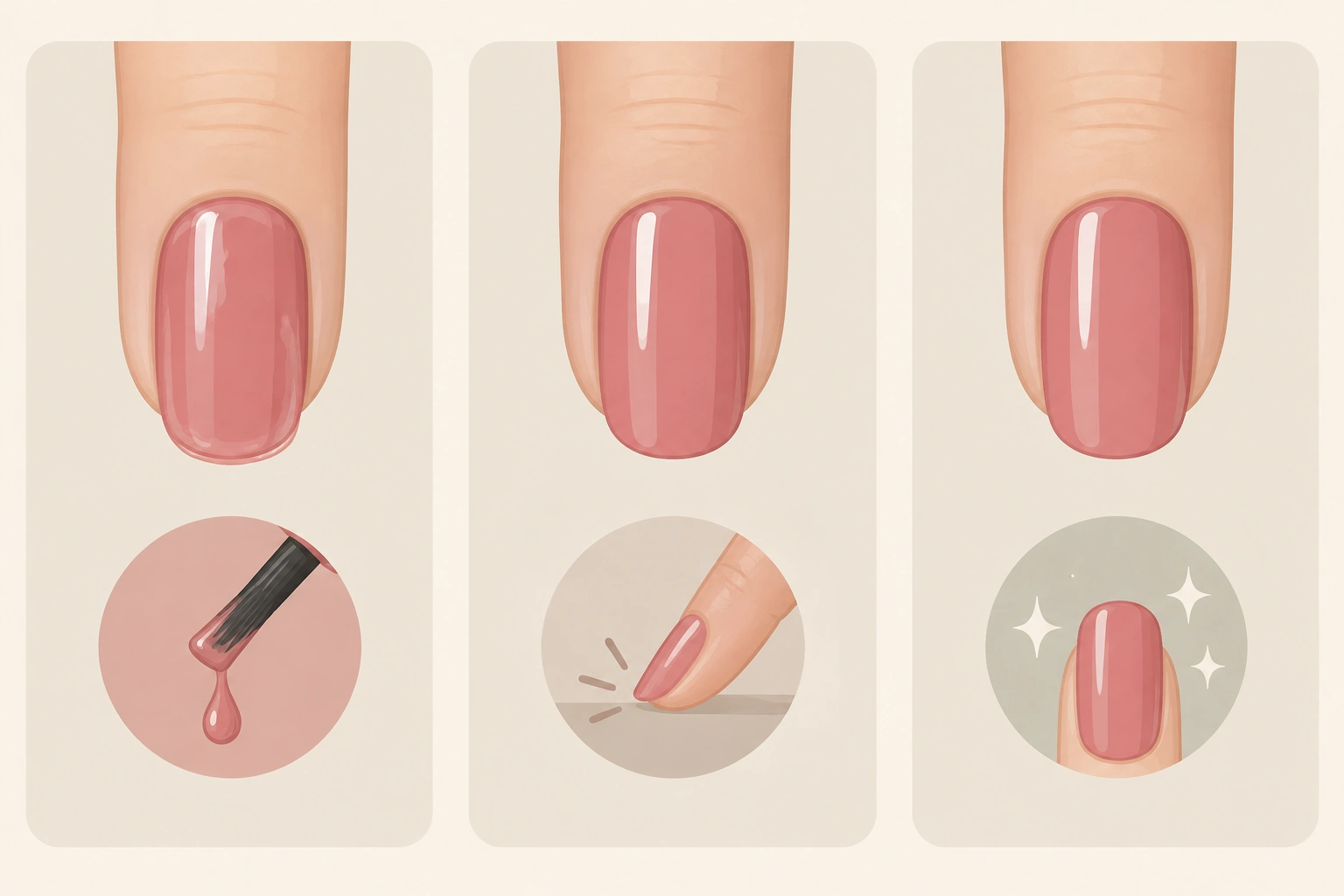
Cold water gets talked about a lot, but it does not instantly cure polish. At best, it may help the surface feel firmer for some people. It is not a shortcut you should rely on.
If you want a faster, longer-wearing finish and don’t mind a different process, gel polish is worth comparing. Just remember that regular polish and gel polish do not dry the same way and gel needs proper curing equipment.
How to Tell Whether Your Nails Are Really Dry
There are a few low-risk ways to check without ruining your manicure.
Use a very light test
Gently tap two nails together. If they stick, drag, or feel soft, give them more time.
Check the shine
If the polish still looks very glossy and wet, it may not be ready. A more settled finish usually looks less slippery.
Watch how it responds to movement
If you bend your fingers normally and the polish seems to shift or dent, it is still soft underneath.
Be careful with “just one touch”
Testing too often is one of the fastest ways to smudge fresh polish. One gentle check is enough. Repeated poking can make the problem worse.
If you’re unsure, wait longer than you think you need. That is usually safer than trying to rescue a dented manicure later.
Why Nail Polish Still Feels Soft After an Hour
If your polish still feels soft after an hour, a few common things may be happening:
- The coats were too thick.
- You used multiple layers without enough time between them.
- The formula is slower-drying.
- The room is humid or warm.
- The polish is old or a little thick in the bottle.
This does not always mean the manicure is ruined. Sometimes it just needs more time. Other times, the best fix is to remove the thick layer and repaint with thinner coats.
A good rule: if the surface keeps denting easily long after application, the problem is usually application, not just patience.
When It’s Safe to Do Normal Activities
A manicure can look ready before it is truly ready for everyday use. These general timing guidelines can help:
- Typing lightly: often okay after about 20 to 30 minutes for thin coats, but keep your nails away from hard keyboard edges if possible.
- Showering: safer after at least 1 to 2 hours for regular polish, and longer if the coats were thick. Hot water and steam can make fresh polish more vulnerable.
- Putting on shoes: wait until the polish is well set, especially for toenails. Tight shoes can dent polish even when it seems dry.
- Going to bed: ideally wait several hours after painting, or paint earlier in the day. Fresh polish can still mark against sheets and blankets.
If you need to use your hands sooner, keep contact light and avoid pressure, gripping, or friction.
Common Mistakes That Cause Smudges, Dents, and Slow Drying
Applying polish too thickly
This is the biggest one. Thick coats trap softness underneath and are easy to dent.
Painting too many layers at once
Even if each layer is thin, piling them on without enough set time can leave the manicure vulnerable.
Assuming “dry to the touch” means finished
That misunderstanding causes a lot of ruined nails. Touch-dry is only the beginning.
Using your hands too soon
Opening bags, typing hard, gripping shoes, or digging in a purse can leave marks before the polish is ready.
Blowing hard on your nails
Strong blowing can create bubbles and uneven drying. Gentle airflow is better.
If you want to understand polish freshness and thickness over time, this page on how long opened nail polish lasts is useful because older polish often behaves differently.
Regular Nail Polish vs Quick-Dry Polish vs Gel Polish
Here’s the simplest way to choose:
- Regular polish: easiest and most familiar, but usually the slowest to dry.
- Quick-dry polish: faster surface setting, good for busy schedules.
- Gel polish: cures under a lamp and can be more durable, but it follows a different application process and is not the same as regular polish.
If you want the simplest at-home option, regular polish is fine as long as you can wait. If you want less waiting, quick-dry products are often the easiest upgrade. If you want a longer-wearing manicure and are ready for a different system, gel may make sense.
What to Do If Your Polish Smudges
A small smudge does not always mean you need to start over.
If the mark is tiny
If the polish is only slightly dented or marked, stop touching it and let it sit for a few more minutes. Once it has settled a bit more, you can sometimes smooth the area with a very thin layer of top coat. Use as little pressure as possible.
If the dent is deep
A deep dent usually means the layer is still too soft. If the polish is only affected on one nail, it is often cleaner to remove that nail’s polish and repaint it thinly than to try to build over the dent.
If the polish dragged or wrinkled
If the surface pulled into a line or wrinkle, that usually means the coat was too thick or not dry enough between layers. In that case, it is better to remove the damaged nail and repaint it thinly than to keep layering over the mistake.
When to touch up versus restart
- Touch up: tiny surface marks, very light dents, or a small rough spot that does not disturb the whole nail.
- Restart that nail: dragged polish, deep dents, wrinkles, or a smudge that changes the shape of the finish.
The goal is not perfection on the first try. The goal is to know when a manicure can be rescued and when it needs a reset.
When to See a Nail Technician or Dermatologist
If your polish repeatedly smudges even when you apply thin coats and wait patiently, a nail technician can help you troubleshoot the application.
If you notice nail changes that are unrelated to polish timing—such as persistent pain, lifting, discoloration, or skin irritation—check with a dermatologist. That is separate from normal drying issues and deserves professional attention.
Simple Takeaway for Beginners
If you want smoother results, remember three basics: use thin coats, give each layer time, and do not trust “dry to the touch” too early. That simple approach solves most smudging problems before they start.