
How Much Should You Tip at the Nail Salon? A Practical Guide for Confident Tipping

If you want the quick answer, plan to tip 15% to 20% of the service total at a nail salon. That range is widely used, and 20% is a safe default when the service was solid and you’re happy with the result. For a simpler appointment or a tighter budget, 15% is still within the normal range.
A few fast examples:
- $25 basic manicure → tip about $4 to $5
- $40 pedicure → tip about $6 to $8
- $60 gel service → tip about $9 to $12
If you only remember one rule, use this: tip based on the service you received, then round up if the experience was especially good.
[Image placeholder: tipping basics at a nail salon]
The Standard Rule for Nail Salon Tips
The most common tipping approach is simple: 15% to 20% of the bill before tax is a practical benchmark for nail services. That range shows up consistently in consumer guidance, including NerdWallet’s nail salon tipping guide, which says it’s customary to tip 10% to 20%, and other salon-focused guides that place the usual range around 15% to 20%.
Here’s the decision rule I use with clients who want a stress-free answer:
- 15% if the service was standard and you’re watching your spending
- 18% if the appointment was good and you want to stay comfortably in the middle
- 20% if the work was thorough, the tech was attentive, or you want to show strong appreciation
Percentage tip or flat-dollar tip?
A percentage makes sense when the service price is clear and the appointment is more expensive. A flat-dollar tip can be easier for lower-priced services.
For example:
- On a $20 polish change, 20% is only $4
- On a $55 gel manicure, 20% is $11
That’s why many people think in dollars for simple services and in percentages for bigger appointments. If you’re unsure, percentage is the cleaner rule because it scales with the service.
If you want more context on how nail services are priced, our guide to what a full set at a nail salon includes can help you understand why some appointments take more time and cost more.
Typical Tip Amounts by Service Type
Different services take different amounts of time, skill, and product. A basic manicure is not the same as a detailed acrylic fill or a hand-painted design, so the tip should reflect that difference.
The table below gives practical examples using common price points.
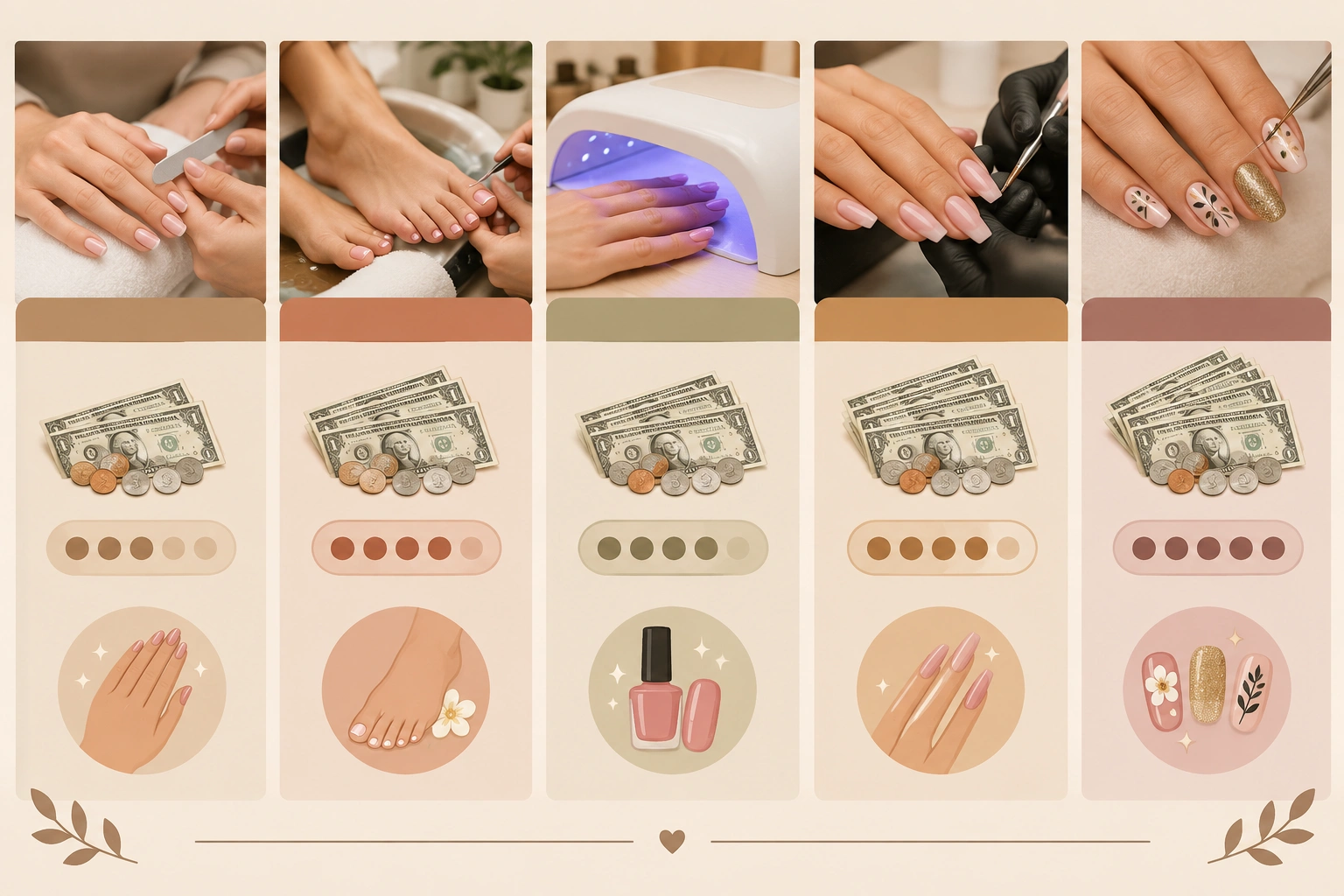
| Service type | Typical service price | 15% tip | 20% tip | Practical note |
|---|---|---|---|---|
| Basic manicure | $20–$30 | $3–$4.50 | $4–$6 | Good for quick, straightforward service |
| Pedicure | $35–$50 | $5.25–$7.50 | $7–$10 | Often tipped a little more because it takes longer |
| Gel manicure | $40–$60 | $6–$9 | $8–$12 | A safe place to use the 20% rule |
| Acrylic set or fill | $50–$80+ | $7.50–$12 | $10–$16+ | More time and technical skill usually justify a stronger tip |
| Dip powder nails | $45–$70+ | $6.75–$10.50 | $9–$14 | Tip rises with shaping, detail, or extra work |
| Nail art add-on | Add-on varies | Tip on the total | Tip on the total | More detailed art often deserves a higher tip |
These are not hard rules, but they are useful ranges. The real question is not just “What service did I get?” but “How much time and attention did this appointment require?”
Basic manicure
For a standard manicure, $4 to $5 is a common tip when the service costs around $20 to $25. If the manicure was more detailed, used gel polish, or included careful cuticle work, moving closer to 20% is reasonable.
Pedicure
Pedicures often take longer and can involve more steps, so many clients tip a bit more generously here. For a $40 pedicure, a $6 to $8 tip fits the usual range well.
Gel, acrylic, and dip powder
These services often take more skill, more time, and more product. That’s why a straight 20% tip is often the easiest path. If your gel manicure is $45, a 15% tip is $6.75 and 20% is $9, which matches the example in Moodby’s nail salon tipping guide.
Nail art and detailed designs
Nail art is where a flat percentage can understate the effort. A simple accent nail is one thing; hand-painted designs, intricate line work, or multiple correction passes are another. If the art clearly took extra time or precision, tipping above the standard percentage is a fair way to acknowledge that work.
When to Tip More or Less
The most useful tipping question is not “What’s the rule?” but “What happened during my appointment?”
Tip more when the service took extra care
Consider increasing your tip when:
- The tech spent extra time correcting shape or symmetry
- The design was more complex than expected
- You asked for changes and they handled them patiently
- The appointment ran long because of careful work, not inefficiency
- The technician gave you detailed, attentive service from start to finish
In those cases, a tip closer to 20% or slightly above is a practical way to say thank you.
Tip less when the service was rushed or disappointing
If the service felt careless, rushed, or incomplete, you do not have to pretend everything was perfect. A lower tip, such as 10% to 15%, may be more appropriate.
That said, there’s a difference between a minor preference issue and genuinely poor service. If the polish color looked different than expected but the work itself was careful, that’s not the same as a rushed appointment with visible mistakes. Use the tip to reflect the overall experience, not a single small disappointment.
If the result is fixable, a calm conversation before you leave usually helps more than silently over-tipping or under-tipping.
How Discounts, Coupons, Gift Cards, and Promotions Affect the Tip
This is where many people hesitate. The simplest rule is: tip on the amount you actually paid unless the salon tells you otherwise.
So if your service was:
- $80 originally
- $64 after a discount
then a 20% tip on the final amount would be $12.80, not $16.
That approach is practical because your tip should track the real bill, not the sticker price you didn’t pay.
Gift cards and comped services
If a gift card or comp covers the full service, a practical rule is to tip on the original service value, not just the amount you paid out of pocket. For example, if a $50 manicure is fully covered by a gift card, a 20% tip would still be $10. If a $70 service is comped, a 15% to 20% tip would be $10.50 to $14.
Promotions and package deals
When the salon runs a promotion, tipping on the discounted amount is usually the cleanest choice. If the discount is very deep and the final tip would feel unusually small, rounding up is a courteous compromise.
Cash Tip vs Card Tip
Cash is often the easiest tip for the technician to receive directly, which is why many people prefer it. NerdWallet also notes that it’s smart to have cash ready so you’re not hunting for an ATM at the last second.
Cash tipping
Pros:
– Simple and immediate
– Easy to hand directly to the tech
– Avoids card processing delays
Cons:
– You need to carry cash
– You may have to plan ahead
Card tipping
Pros:
– Convenient if you’re already paying by card
– Easy to calculate and add at checkout
Cons:
– Not every salon processes tips the same way
– It may take longer for the tech to receive it
If you want the most flexible option, carry cash for the tip and use the card for the service total. If that’s not practical, adding the tip on the card is still acceptable at many salons.
For a smoother appointment overall, it also helps to know basic nail prep and polish timing. Our guides on how many coats of nail polish to apply and how long nail polish should dry between coats can help you understand why a salon service may take longer than expected.
How to Tip When Multiple Technicians Help
If more than one person works on your service, don’t assume one tip covers everyone.
A common etiquette approach is to tip each person separately based on the part they handled. That matches guidance from salon educators such as V Beauty Pure’s nail salon etiquette guide, which recommends tipping each person who provided a service.
A simple way to split it
- The main nail tech does the manicure or enhancement
- Another staff member removes polish or performs a pedicure step
- You tip each person according to the service they actually completed
For example, if one technician does a $50 gel manicure and another technician helps with removal or prep, you might give the main tech $8 to $10 and the helper $3 to $5, depending on how much work each person did.
If that feels complicated, ask the front desk how the salon prefers tips to be handled. Some salons make this easy by letting you write separate amounts on the receipt or hand cash to each person.
What to Do If Gratuity or a Service Charge Is Already Included
This is the one detail you should never skip. Before adding a tip, check whether the receipt already includes:
- Gratuity
- Service charge
- Automatic fee for the appointment
- Group-service charge
If the receipt says the gratuity is already included, that usually means the tip has been added for you, so you do not need to tip again unless you want to add extra for exceptional service. If the charge is listed as a service fee or automatic fee and it does not say it goes to staff as gratuity, treat it as a separate charge and decide whether to leave a tip on top of it.
Why this matters
Double-tipping happens most often when the receipt wording is unclear. Read the line item carefully. If you’re unsure, ask the front desk before paying. That quick question can save awkwardness and prevent overpaying.
Simple Nail Salon Tipping Etiquette for First-Time Clients
If this is your first salon visit, keep it easy:
- Look at the service total
- Choose 15%, 18%, or 20%
- Check whether gratuity is already included
- Decide cash or card
- Round up if the service was especially good
A few practical etiquette habits help a lot:
- Bring a payment method that can handle the tip
- Have smaller bills if you plan to tip in cash
- Don’t feel pressured to overthink every dollar
- Say thank you directly to the technician
The goal is not to be perfect. The goal is to tip in a way that feels respectful and consistent.
Common Nail Salon Tipping Questions
Do I tip on the pre-tax or post-tax total?
Most people tip based on the service subtotal before tax. That keeps the calculation clean and is the most common approach.
Should I tip more for a holiday appointment?
Holiday tipping is often a little more generous, especially if you’re a regular client or the technician went out of their way to fit you in. A higher percentage or an extra few dollars is a kind gesture, but it’s not mandatory.
What if I can’t afford 20%?
Tip what you reasonably can. A thoughtful 10% to 15% tip is better than stressing over a number that doesn’t fit your budget. Consistency and courtesy matter more than forcing a percentage that creates financial strain.
Do I tip on add-ons like nail art?
Yes, if the add-on required extra time or skill, it should influence the tip. A more detailed service usually justifies a stronger gratuity than a simple polish change.
The Bottom Line on Nail Salon Tipping
15% to 20% is the normal range, with 20% as a simple default for most appointments. Adjust up or down based on service complexity, the care you received, whether a discount changed the final bill, and whether gratuity or a service charge is already included. If more than one technician helped, split the tip so each person gets recognized for the work they did.

