
Nail Polish Ingredients Explained: A Beginner’s Guide to What’s in the Bottle

If you’ve ever turned a polish bottle around and seen a long ingredient list, you’re not alone in wondering what it all means. Nail polish is usually a mix of ingredients that keep it liquid in the bottle, help it spread smoothly, add color, and form a hard finish on the nail.
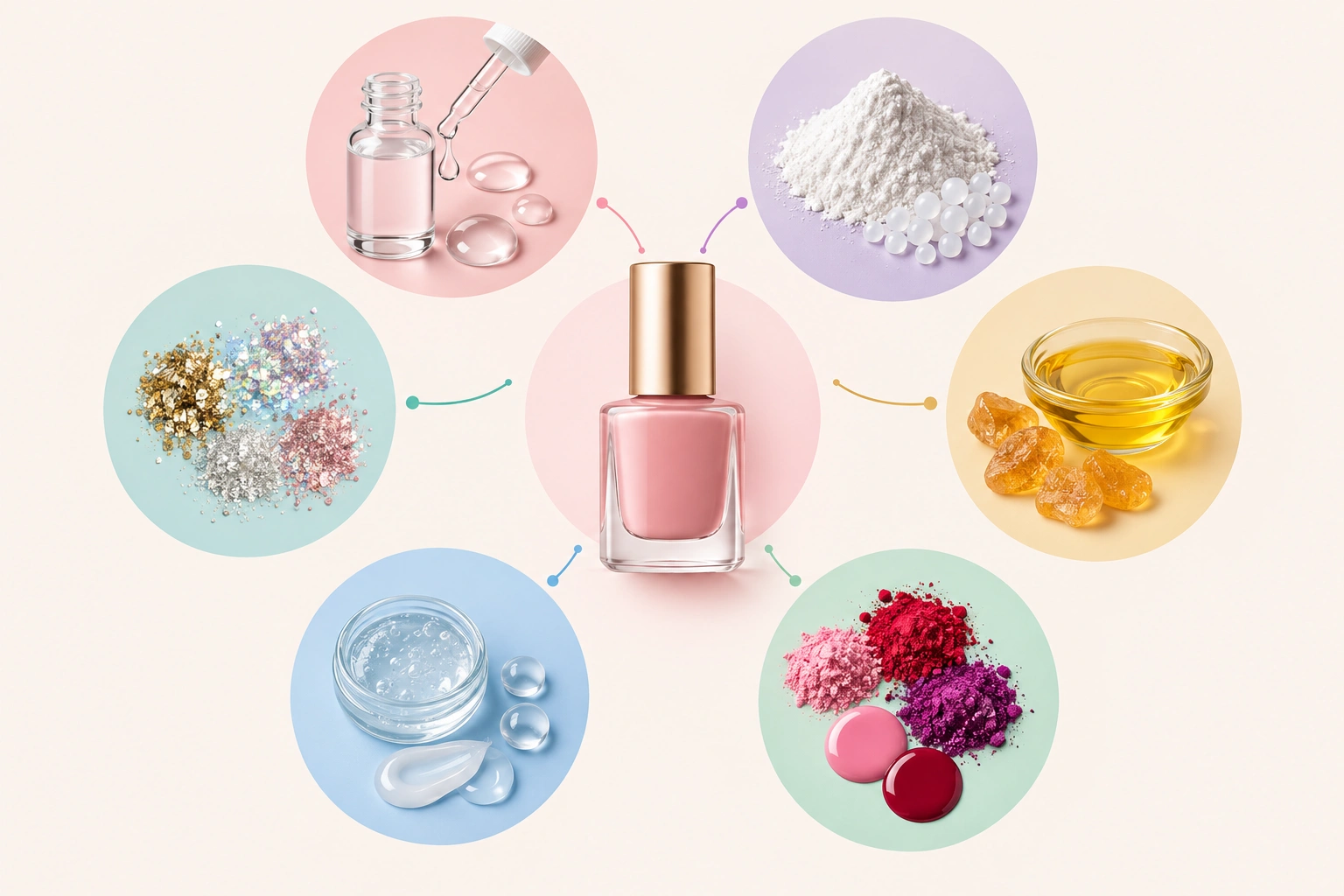
Once you understand the basic ingredient groups, shopping gets much easier. You can compare regular polish, quick-dry formulas, long-wear options, and gel polish with more confidence. You can also spot labels like “3-free” or “vegan” without assuming they mean the same thing as “safer for everyone.”
What Nail Polish Ingredients Are and Why They Matter
Nail polish is not just color in a bottle. It’s a formula built to do several jobs at once:
- stay mixed while sitting on a shelf
- brush on evenly
- dry at a useful speed
- leave a smooth, colored film
- hold up to chips and wear
- come off with a remover
That balance is why nail polish ingredients matter. A formula with more fast-evaporating solvents may dry quicker, but it may also feel less forgiving while you apply it. A longer-wear formula may last better, but removal can take more effort.
If you want a simple way to think about it, ingredients shape how a polish performs. Some formulas are made for speed, some for durability, and some for easier removal. That trade-off shows up in the ingredient list.
The Main Building Blocks of Nail Polish
Most nail polish formulas are made from a few ingredient categories. You don’t need to memorize chemistry terms. Just knowing the job of each group makes labels much less mysterious.
Solvents: the liquid part that helps polish flow
Solvents keep polish liquid in the bottle and help it dry after application. They evaporate once the polish is on the nail.
Common solvent names include ethyl acetate and butyl acetate. In plain language, these help the polish brush on smoothly and then disappear so the coating can set.
A formula with more fast-evaporating solvent may dry faster, but beginners may find it trickier to apply evenly because it can start setting sooner.
Film formers: the ingredients that create the coating
Film formers help the polish turn from liquid into a solid layer on the nail. Nitrocellulose is one of the best-known examples in traditional polish.
Without film formers, polish wouldn’t leave that hard, colored finish you expect. They are a major reason nail polish can look glossy and feel smooth after drying.
Resins: the ingredients that help polish stick and wear better
Resins can improve adhesion, shine, and durability. Think of them as support ingredients that help the polish cling to the nail and hold up better over time.
If a polish seems to wear longer or look glossier, resins may be part of the reason. They can also affect how hard the polish feels once it dries.
Plasticizers: the ingredients that add flexibility
Plasticizers help reduce brittleness and cracking. Without them, dried polish could become too rigid and chip more easily.
This matters if you prefer a formula that feels a little more flexible on the nail. More flexibility can sometimes mean less cracking, though performance still depends on the full formula.
Pigments and dyes: the color sources
Pigments and dyes give polish its color, opacity, and finish. They’re what make a sheer pink look soft, a cream red look bold, or a metallic polish shine.
Some formulas need more pigment to look opaque. Others use smaller amounts for a sheer or jelly effect.
Suspending agents: the ingredients that keep everything mixed
Suspending agents help keep pigments evenly distributed so they don’t settle at the bottom of the bottle.
If you’ve ever shaken a bottle and seen the color look more even afterward, that’s part of why these ingredients matter. They help the polish stay usable and consistent.
Common Ingredients You’ll See on a Label
Ingredient names can look intimidating, but many of them are easy to understand once you know what they do.
| Ingredient | Plain-language role | Why you may notice it |
|---|---|---|
| Nitrocellulose | Film former | Helps polish dry into a hard coating |
| Ethyl acetate | Solvent | Helps polish flow and dry |
| Butyl acetate | Solvent | Supports smooth application and drying |
| Toluene | Solvent | A traditional solvent that is often discussed in “free-from” marketing |
| Formaldehyde | Hardening ingredient in some formulas or a related concern in polish discussions | Often appears in “free-from” claims and safety questions |
| DBP (dibutyl phthalate) | Plasticizer | Helps reduce brittleness |
| Camphor | Plasticizer or fragrance-related ingredient depending on the formula | Often mentioned in “free-from” marketing |
| Acrylates | Polymer ingredients used more often in gel and long-wear products | More relevant in gel-style formulas and allergy discussions |
| HEMA | Acrylate-related ingredient often found in some gel systems | A common sensitizer in some gel systems |
A key point: a familiar ingredient name does not automatically mean a product is unsafe for everyone. It only tells you what role that ingredient may play and whether it matters for your own preferences or sensitivities.
For a simple practical check, compare labels across formulas. If you want faster drying, look for more quick-evaporating solvents. If you want long wear, you’ll often see stronger film-forming systems or gel-style chemistry. If you want easier removal, look for formulas that aren’t built for maximum durability.
If you’re also dealing with thick polish bottles, this guide on why nail polish gets clumpy can help you understand what happens when a formula changes over time.
Which Nail Polish Ingredients Raise Safety or Sensitivity Questions
Some ingredients are frequently discussed because they may be more likely to bother certain users or because they’ve been targeted by “free-from” marketing.
Ingredients often flagged in traditional polish
Toluene, formaldehyde, DBP, and camphor are names many shoppers notice on labels. These ingredients are often mentioned in “free-from” claims, but that does not mean every person needs to avoid them. It means the brand has chosen to leave them out.
For people with sensitive skin or a history of reactions, the better question is not “Is this ingredient always bad?” It’s “Have I reacted to this before, or do I want to avoid it for personal reasons?”
Gel and long-wear formulas can raise different concerns
Gel and long-wear formulas often use acrylates, and HEMA is one ingredient that comes up often in allergy discussions. That matters because sensitivity concerns in gel systems are not the same as concerns about traditional bottle polish.
If you’ve ever had redness, itching, or unusual irritation after gel manicures, it’s worth paying closer attention to the ingredient list next time. A formula that is great for durability may not be the best fit for a sensitive user.
Concern is not the same as everyday risk
This is the part many beginners miss. An ingredient can be widely discussed without being a problem for every person. Everyday risk depends on the formula, how often you use it, how you apply it, and whether you already know you’re sensitive.
For general ingredient safety guidance, government resources like the FDA’s cosmetics overview are a useful place to start. They won’t tell you which polish to buy, but they can help you understand how cosmetic ingredients are regulated and what claims are worth treating carefully.
What “3-Free,” “5-Free,” “7-Free,” Vegan, and Cruelty-Free Really Mean
These labels can be helpful, but they’re easy to misread.
“Free-from” labels
“3-free” usually means the formula leaves out three ingredients that are commonly flagged in nail polish marketing. “5-free” or “7-free” means the brand has removed more ingredients from its list.
That sounds straightforward, but the exact ingredients included in those claims can vary by brand. There is no single universal standard that makes every “5-free” polish identical, and some brands use the same label in different ways.
A useful rule: treat “free-from” labels as ingredient-avoidance claims, not as a guaranteed safety rating. “Non-toxic” is also a marketing term, not a regulated or standardized cosmetic safety category, so it does not have one fixed legal meaning across brands.
Vegan and cruelty-free are different claims
Vegan usually means the polish does not contain animal-derived ingredients. Cruelty-free usually means the brand says it did not test on animals.
Neither label automatically tells you how gentle the formula is or whether it suits sensitive skin. A vegan polish can still contain ingredients that bother some users. A cruelty-free polish can still be a long-wear formula that is harder to remove.
If animal-related claims matter to you, look for those labels separately from ingredient concerns.
For a practical example, a shopper might choose a vegan, cruelty-free polish for personal values, then still check whether it contains acrylates or HEMA if they’re sensitive to gel-style formulas. Those are two different decisions.
How Formula Type Changes Performance
The ingredient mix changes depending on the kind of polish you buy.
Quick comparison at a glance
| Formula type | Main ingredient pattern | Drying time | Wear | Removal difficulty |
|---|---|---|---|---|
| Regular polish | Traditional solvents, nitrocellulose, resins, plasticizers | Moderate | Moderate | Usually easiest |
| Quick-dry polish | More fast-evaporating solvents or similar drying tweaks | Fast | Moderate | Usually easy to moderate |
| Long-wear polish | Stronger film formers/resins and durability-focused ingredients | Moderate to long | Longer | Often more difficult |
| Gel polish | Acrylates/gel resins that cure under UV or LED light | Cures quickly under lamp, but not air-dry | Very durable | Usually most involved |
Regular polish vs quick-dry polish
Regular polish usually gives you more working time. That means you can smooth out strokes before it sets.
Quick-dry formulas often use more fast-evaporating solvents or other adjustments that make the polish set sooner. The trade-off is simple: faster dry time often means less time to correct mistakes.
If you want to compare drying expectations more closely, this guide on how long nail polish takes to dry completely is a useful companion read.
Regular polish vs long-wear polish
Long-wear formulas are usually designed to resist chips and stay put longer. That can be great if you don’t want to redo your manicure often.
The trade-off is removal. Stronger wear usually means more effort when it’s time to take the polish off, though the exact result can also depend on remover type and how thickly the polish was applied.
Regular polish vs gel polish
Gel polish is different from regular polish in both ingredient system and curing method. It often uses acrylates and usually needs UV or LED curing to harden properly.
That can give gel its durable finish, but it also means removal and sensitivity considerations can be different from standard polish. Gel formulas are more likely to involve acrylate-related allergy concerns, especially for people who react to uncured product or repeated exposure. If you’ve had issues with gel before, don’t assume a regular polish will behave the same way—or vice versa.
How Ingredients Affect Removal and Nail Damage
Some formulas come off easily with standard remover. Others are built to resist wear, so they may need more time, more soaking, or stronger remover.
That trade-off matters because repeated rough removal can be hard on the nail surface. A very durable formula is not automatically “better” if you prefer gentle upkeep.
A practical choice rule:
– choose easier removal if you change color often
– choose longer wear if you want fewer touch-ups
– choose gel only if you’re comfortable with curing and removal steps
If you’re trying to revive a thickened bottle before giving up on it, this article on how to fix thick nail polish may help you tell whether the formula can still be used.
What to Look For If You Have Sensitive Skin, Allergies, or Weak Nails
If you have known sensitivities, start by checking for ingredients you already react to. For many people, the most important label-reading step is not the marketing claim — it’s the ingredient list.
Practical label-reading tips
- If you’ve reacted to gel products before, look closely for acrylates and HEMA.
- If your skin is sensitive, avoid assuming “non-toxic” means gentle.
- If a bottle or website doesn’t show a full ingredient list, check the brand’s site or customer support before buying.
- If you have brittle or peeling nails, look for formulas that are easier to remove and avoid repeated harsh soaking when possible.
- If your nails are weak, a very hard-wearing formula may not be the best everyday choice if removal tends to be rough for you.
For weak, peeling, or brittle nails
A gentler regular polish may be easier to live with than a very durable formula, especially if you change colors often. Stronger wear can be appealing, but if removal is aggressive, it may not be the most nail-friendly option for you.
If you’re not sure what a brand means by “sensitive-skin friendly” or “clean,” check whether the claim is backed by a real ingredient list. The more specific the brand is about what it leaves out, the more useful the claim usually is.
How to Read a Nail Polish Ingredient List Without Jargon
You do not need to decode every word on the label. Focus on the ingredients that matter most to your goal.
A simple reading method

- Look for ingredients you already know you want to avoid.
- Check whether the formula is regular, quick-dry, long-wear, or gel.
- Note whether the brand makes “free-from,” vegan, or cruelty-free claims.
- Compare the formula’s purpose with your own priority: speed, wear, or easy removal.
- If the ingredient list is incomplete or hard to find, look on the brand website or ask the company directly.
What to watch for first
If you have sensitive skin or a known allergy, acrylates and HEMA deserve extra attention in gel and long-wear products. If you prefer traditional polish, solvent-heavy formulas may matter more for smell or drying speed.
If your concern is mainly values-based, such as vegan or cruelty-free shopping, check those claims separately from the ingredient list.
Choosing the Right Formula for Your Needs
Here’s a simple decision guide.
If you want easier application
Choose a regular polish with a bit more working time. Quick-dry formulas can be handy, but they may set too fast if you’re still learning to paint neatly.
If you want longer wear
Look at long-wear or gel formulas, knowing that stronger wear often means harder removal.
If you have sensitive skin or known reactions
Read the label carefully for ingredients you’ve reacted to before. If gel polish has caused trouble in the past, be extra cautious with acrylates and HEMA.
If you want vegan or cruelty-free
Check those claims directly. Then make a second pass for ingredient preferences, because animal-related claims do not tell you how the formula performs or whether it suits sensitive skin.
If you want the gentlest everyday option
A simpler regular polish may be easier to live with than a very durable formula, especially if you change colors often or prefer straightforward removal.
Common Mistakes Beginners Make When Judging Nail Polish Ingredients
The biggest mistake is assuming “non-toxic” means risk-free. That phrase is marketing, not a guarantee that a formula will suit every person.
Another common mistake is treating all “free-from” labels as the same. A 5-free polish and a 10-free polish may leave out different ingredients, and neither label tells you everything about performance or sensitivity.
It’s also easy to confuse cruelty-free with vegan, or to assume either one means safer ingredients. Those claims are about animal testing or animal-derived ingredients, not overall irritation potential.
Finally, don’t assume the hardest-wearing polish is the best polish. If removal is difficult for you, a less durable formula may actually be the better daily choice.
When to See a Nail Technician or Dermatologist
If you’ve had repeated redness, itching, swelling, or other reactions after polish or gel use, it’s worth talking to a professional. A nail technician can help you choose a more suitable formula, and a dermatologist can help if you suspect an allergy or skin sensitivity.
This is especially important if you’ve reacted to gel products before, since acrylate sensitivity can make future use more complicated. If a product causes a strong reaction, stop using it and get advice before trying another similar formula.
The Bottom Line
Once you know the main ingredient groups, nail polish labels become much easier to read. Solvents help polish flow and dry, film formers create the coating, resins and plasticizers shape wear and flexibility, and pigments provide color. From there, you can decide whether you care most about speed, wear, easy removal, or ingredient avoidance.
That’s the real goal: not memorizing every chemical name, but learning how to choose a formula that fits your nails and your routine.

