
Why Nail Polish Cracks: A Beginner’s Guide to Causes, Fixes, and Prevention

If your manicure looks fine at first and then starts splitting or breaking apart, the problem is usually not random. In many cases, nail polish cracks because one layer did not dry or bond properly, the coat was too thick, or the nail surface was not prepped well enough before painting. Cracking can also happen because of application mistakes, old polish, or the condition of the nail itself.
The good news: cracking is often fixable, and it is usually preventable once you know what to look for. Below, I’ll walk you through the most common causes, how to tell cracking apart from other polish problems, and what to do next time to help your manicure last longer.
Quick Answer: Why Nail Polish Cracks
Nail polish can crack when the layers on the nail dry unevenly, stay too soft underneath, or lose grip on the nail plate. That may happen because the polish was applied too thickly, the base coat was skipped, the bottle was old or separated, or the manicure was rushed before each layer had enough time to set.
Think of polish like a thin painted film. If one part dries faster than another, the surface can split. If the polish never bonded well to the nail in the first place, the finish may crack, lift, or break apart as you use your hands.
For a related beginner question about air bubbles and surface problems, you may also find why nail polish bubbles useful.
Cracking vs. Chipping vs. Peeling vs. Shrinking
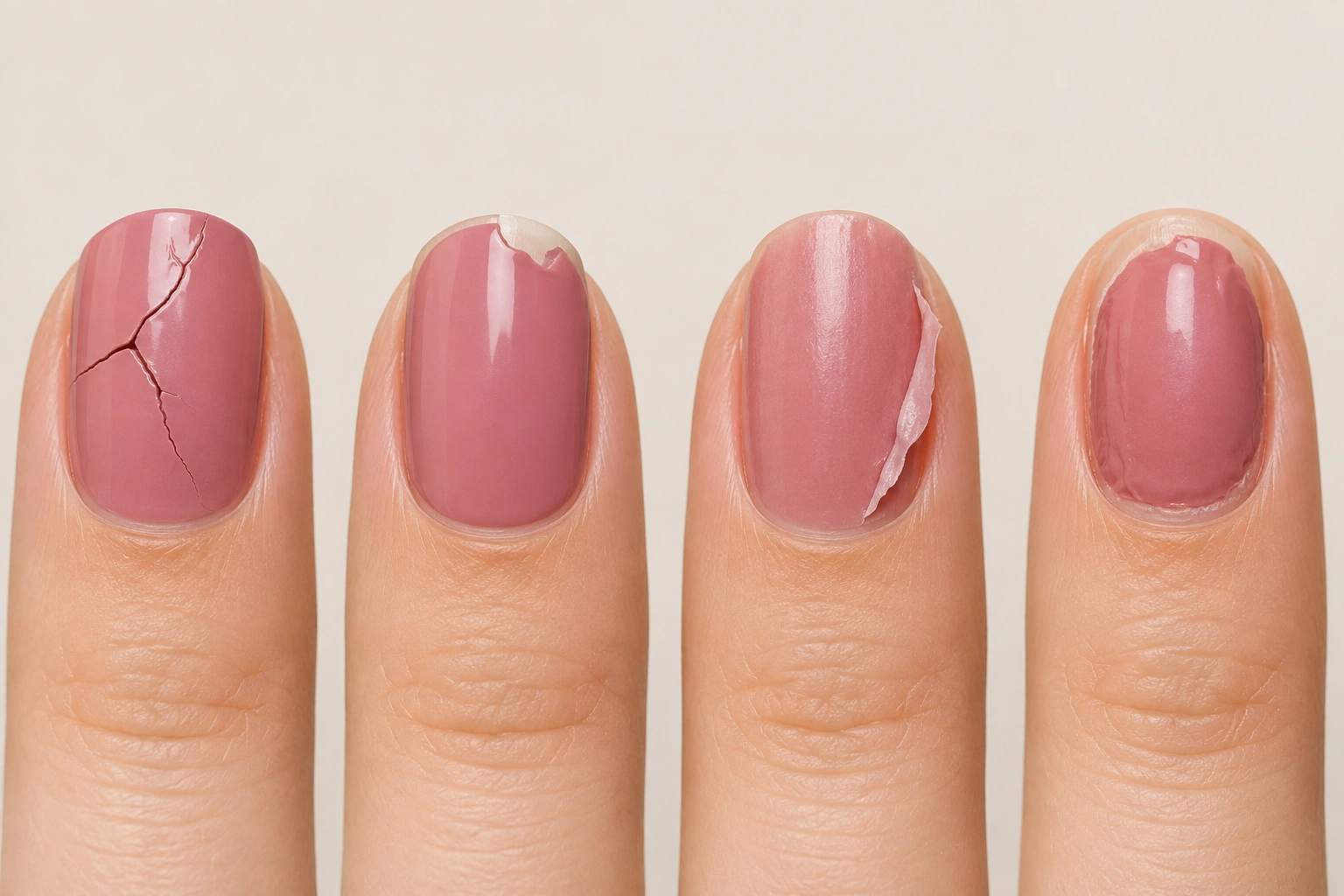
These problems can look similar at first, but they are not the same. Knowing the difference helps you choose the right fix.
| Problem | What it looks like | Common cause | Best response |
|---|---|---|---|
| Cracking | Fine lines or splits in the polish layer | Thick coats, rushed drying, weak adhesion | Repair small cracks or redo if widespread |
| Chipping | Pieces break off, often at the tip | Wear and impact, weak edges | File lightly and touch up or repaint |
| Peeling | Polish lifts in larger sections | Poor prep, oily nail surface, skipped base coat | Remove and repaint after better prep |
| Shrinking | Polish pulls back from the edges or looks tight | Incompatible layers, poor application, fast drying | Repaint with thinner, even coats |
A crack usually stays in place as a split line. A chip removes part of the polish. Peeling means the polish is lifting away from the nail. Shrinking is when the polish seems to pull back from the edge or leave gaps, almost like the color has contracted away from the sides. On the nail, that can look like a clean border of missing polish around the edge rather than a split in the middle.
If you are not sure which one you have, look closely at the edge of the damage. If the polish is still attached but split, that is cracking. If a piece is missing, that is chipping. If the polish is curling up or lifting, that is peeling.
Regular nail polish and gel polish can fail in different ways, too. Gel is cured under a lamp and may crack, lift, or peel for different reasons than regular polish, so the same fix does not always apply.
The Most Common Reasons Nail Polish Cracks
1. The coats were too thick
Thick coats are one of the most common reasons polish cracks. A heavy layer may look smooth at first, but the top can dry before the lower part does. That mismatch can lead to splitting later.
A better approach is to use thin, even coats. Two or three thin coats usually behave better than one thick one.
2. The base coat was skipped
A base coat helps the polish grip the nail plate. Without it, color may slide around more easily or fail to bond as well. That can make cracking or peeling more likely, especially on nails that are naturally oily.
If your polish cracks near the tip or starts lifting in patches, missing base coat is worth considering. A base coat is not just an extra step; it gives the manicure a more stable foundation.
3. The nail surface was not properly prepped
Dust, skin oils, lotion residue, and leftover remover can all interfere with adhesion. If polish does not bond well to the nail surface, it may crack or lift sooner.
Even a quick prep makes a difference. Wash your hands, dry them fully, and avoid applying polish right after using heavy hand cream. If needed, gently buff the nail plate very lightly to remove shine and create a better surface for the base coat.
4. The polish is old, thickened, or separated
Old polish can become stringy, thick, or uneven in the bottle. When that happens, it may go on in lumpy layers or dry unpredictably. That can make cracking more likely.
If you notice the polish is hard to stir back together or the finish looks patchy after application, the formula itself may be part of the problem. In that case, changing the bottle is often easier than trying to rescue the manicure.
5. The manicure was rushed between layers
If the next coat goes on before the layer underneath has had time to settle, the trapped solvents can weaken the finish. The manicure may look dry on top but still be soft underneath.
That soft underlayer can later wrinkle, split, or crack as the polish continues to cure. This is one reason a quick-dry top coat is helpful but not magical. It can speed up the surface, but it cannot fully fix layers that were applied too soon. If you want a deeper look at drying methods, see does a fan dry nail polish faster and does UV light dry regular nail polish.
6. The layers do not work well together
Some cracking happens because the system is off, not because of one single mistake. For example, a very fast-drying top coat over a still-soft color layer may cause the manicure to wrinkle or split later.
This does not mean every product has to come from the same brand. It does mean the layers should be used in a compatible way: base coat, color coats, then top coat, with enough drying time between each step.
How Nail Prep Affects Cracking
A polished nail only lasts as well as the surface under it. If the nail plate is oily, damp, dusty, or rough in an uneven way, polish may not anchor properly.
Here is a simple prep routine that helps most beginners:
- Remove old polish completely
- Wash hands and dry nails fully
- Lightly buff only if the surface is very shiny or uneven
- Wipe away dust before painting
- Avoid lotion or cuticle oil right before polish application
You do not need to over-buff. Too much buffing can leave the nail plate thinner and more sensitive. The goal is a clean, dry, lightly prepared surface, not a stripped-down nail.
If your nails tend to feel dry after removal, a small amount of cuticle oil can help the surrounding skin stay more comfortable. Just keep oil off the nail surface before painting, because that can interfere with adhesion.
Why Thin Coats and Proper Layering Matter

The simplest layering order is:
- Base coat
- Thin color coat
- Second thin color coat, if needed
- Top coat
Each layer should be smooth and light. If polish is applied too heavily, the outer surface may dry faster than what is underneath. That uneven drying is one reason cracks appear later.
Thin coats also make it easier to spot problems early. If one coat looks streaky, add another thin coat rather than trying to fix it with one heavy pass. It may take an extra minute, but the finish usually looks cleaner and lasts better.
Drying Time: Why Rushing Causes Cracks
A manicure can seem dry before it is truly ready for normal hand use. That is why a polish job that looks fine after ten minutes may still crack later if it gets bumped, pressed, or exposed to water too soon.
This matters most between coats. If you apply the next layer too early, the lower coat may stay soft and unstable. The top layer then dries over a weak base, and the whole manicure becomes more likely to split.
A practical rule for beginners: if the surface still feels tacky or moves when lightly touched, give it more time. Also avoid tasks that stress the nails right after painting, like washing dishes, opening cans, or digging through a bag.
If you often try to speed up drying, this may help: does blowing on nail polish make it dry faster and does ice make nail polish dry faster.
Environmental Factors That Can Stress Polish
Even a decent manicure can fail sooner if it is exposed to a lot of water, heat, or cold while it is setting and wearing.
- Water: Long handwashing, dishwashing, or soaking can weaken the manicure edge
- Heat: Warmth can sometimes make polish feel softer for longer
- Cold: Sudden temperature changes can stress the finish
- Chemicals: Cleaning products can wear down the top coat faster
You do not need to avoid normal life. But if your nails are freshly painted, it helps to keep them out of prolonged water exposure for a while and wear gloves for cleaning when possible. That small habit can reduce stress on the polish.
Why Some Nails Crack and Others Don’t
It is very common for one or two nails to crack while the others stay intact. That does not always mean the whole bottle is bad.
A few nails may get more daily wear than others. Thumbs and index fingers often do more work, so they may see more water, friction, and impact. Nail shape can matter too. A nail with a more flexible edge or a slightly uneven surface may show cracks sooner.
Sometimes the difference is simply prep. One nail may have had a little more oil, dust, or leftover remover on it than the others. If the same nail keeps cracking over and over, pay attention to that nail’s prep and daily use.
How to Fix a Cracked Manicure
A small crack does not always mean you need to start from scratch. The key question is whether the crack is minor and isolated or whether the manicure is already unstable.
Try this simple repair for a small crack:
- Clean the nail gently and make sure it is dry.
- If needed, lightly smooth the cracked edge with a fine file.
- Apply a thin touch-up coat over the damaged area.
- Seal the repair with top coat.
- Let it dry fully before using your hands normally.
Keep the repair light. Thick patching often makes the spot more noticeable.
Remove and redo if:
- The crack is wide or spreading
- Multiple nails are affected
- The polish is lifting
- The finish looks bumpy after repair
If the crack runs deep or the polish is splitting across a large area, removal is usually the cleaner choice. Trying to cover severe cracking with more polish often creates a lumpy finish that fails again.
How to Prevent Nail Polish Cracking Next Time
A simple prevention checklist is usually enough for beginners:
- Remove old polish fully before repainting
- Clean and dry the nail surface well
- Use a base coat
- Apply thin color coats
- Let each layer settle before the next one
- Finish with a top coat
- Avoid heavy water exposure right after painting
- Keep polish bottles sealed and stored properly
If you want to make one change first, focus on thinner coats. That one habit often solves more cracking problems than people expect.
Also pay attention to the polish bottle itself. If it has thickened or separated, replace it rather than forcing it to work. A fresher bottle may behave more predictably.
When to Remove the Polish and Start Over
Sometimes a repair is not worth the effort. If the manicure has multiple cracks, lifting edges, or a rough texture after touch-up, starting over will usually look better and last longer.
Use this rule: if the damage is spreading or the polish no longer looks smooth after repair, remove it. If only one small area is affected and the rest is solid, a spot fix may be enough.
When removing polish, be gentle. Avoid picking or peeling it off with your fingers. That can damage the nail plate. Use remover and cotton instead. If you use acetone often, remember it can dry the nails and surrounding skin, so follow with hand care afterward.
When Cracking May Point to a Product or Nail-Health Issue
Repeated cracking is not always a technique problem. Sometimes the polish itself is the issue. Old, thick, or poorly mixed polish may be difficult to apply evenly no matter how careful you are.
Sometimes the nails need a little more attention too. Very dry, rough, or damaged nails may hold polish differently than healthy, smooth nails. In that case, improving prep and giving the nail surface a break from harsh removal can help.
If cracking comes with nail pain, discoloration, lifting, or major changes in the nail itself, that is no longer just a manicure issue. In that situation, it is better to speak with a professional.
When to See a Nail Technician or Dermatologist
See a nail technician if:
– Cracking keeps happening even with good prep and thin coats
– You suspect the polish formula is the problem
– You want help choosing a better base coat or top coat routine
See a dermatologist if:
– The nail is painful
– The nail is lifting from the skin
– There is discoloration, thickening, or other changes that go beyond normal polish wear
– Cracking seems tied to a broader nail concern, not just the manicure
FAQ
Does a base coat really help prevent cracking?
It often helps because it gives the polish something to grip. It also creates a more even surface for color application. If your polish cracks often, a base coat is one of the first things to try.
Can a top coat fix cracked polish?
A top coat can help seal a small surface crack, but it will not rescue a manicure that is already breaking apart. If the crack is deep or spreading, removal is usually the better choice.
Is thick nail polish more likely to crack?
Yes, thick coats are more likely to dry unevenly. The surface may seem set while the lower layer stays soft, which can lead to splitting later.
Why does my polish crack on only one nail?
That nail may get more wear, have more oil left on the surface, or have been painted a little differently. Sometimes one nail simply had a weaker prep step than the others.
Can old polish crack on the nail?
It can. Old or separated polish may go on unevenly and dry unpredictably. If the bottle is thick, stringy, or hard to mix, replacing it is often the easiest fix.
How do I know if I should repair or remove it?
Repair small, isolated cracks that are still firmly attached. Remove and redo the manicure if the cracks are widespread, the polish is lifting, or the surface looks uneven after touch-up.
Does drying time really matter that much?
Yes. Rushing between coats can trap softness underneath. That soft base may not show a problem right away, but it can crack or wrinkle later.
Is cracking the same as peeling?
No. Cracking is a split in the polish. Peeling means the polish lifts away from the nail, often in larger sections.

