
Why Is My Cat Obsessed With Nail Files? 7 Possible Reasons

You pull out a nail file for a quick manicure, and suddenly your cat appears. She sniffs it, rubs against it, paws at it, licks it, or even tries to bite it.
If you have been wondering why is my cat obsessed with nail files, you are definitely looking at a strange—but not necessarily alarming—behavior. Nail files combine several things cats may find interesting: rough texture, movement, unfamiliar sounds, your scent, and sometimes traces of nail or beauty-product residue.
The important question is whether your cat is simply curious or is actually trying to chew and swallow the file. Below, we will explain the most likely reasons, the risks to your cat and your nails, and how to handle the habit safely.
Quick Answer
If you’re wondering why is my cat obsessed with nail files, the most likely reasons are curiosity, texture, scent, movement, or learned attention-seeking. Occasional sniffing or pawing is usually harmless. However, repeated chewing or swallowing of nail-file material can be risky and may indicate pica or another behavioral or medical issue.
Why Is My Cat So Interested in My Nail File?
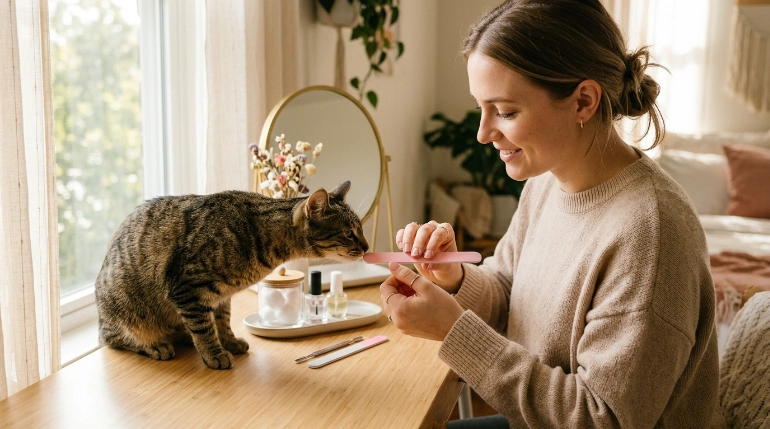
There is no well-established evidence that cats have a specific biological attraction to nail files. Instead, several ordinary cat behaviors can make these little manicure tools unusually interesting.
1. The Rough Texture Feels Interesting
Cats explore objects with their noses, paws, mouths, and whiskers.
An emery board has a gritty surface that feels very different from smooth household objects. A glass or metal file also creates unusual sensations when your cat rubs her face, teeth, or tongue against it.
Your cat may simply be investigating the texture.
That does not mean a nail file makes a safe chew toy. Rough surfaces can irritate the mouth, while broken or chewed pieces may become swallowing hazards.
2. Your Nail File Smells Like You
A used nail file has been handled repeatedly and may carry traces of your natural skin oils, moisturizer, cuticle oil, polish, nail dust, or other manicure products.
Cats depend heavily on scent when investigating their surroundings. Your cat may therefore find a recently used file much more interesting than a brand-new one.
This does not necessarily mean your cat is attracted specifically to fingernail material. In many cases, the tool simply smells familiar and unusual at the same time.
3. Filing Creates Movement and Sound
Think about what a nail file looks like from your cat’s perspective.
You hold a narrow object between your fingers and move it rapidly back and forth. It also makes a scratching sound.
That combination can resemble a small moving object worth investigating or catching.
Cats naturally respond to interesting moving objects, and Cornell University’s discussion of household hazards for curious cats notes that novel, moving household items can attract cats even when those objects are not appropriate toys.
Your manicure routine may accidentally look like playtime.
4. Your Reaction May Reward the Behavior
Imagine this routine:
You start filing your nails.
Your cat grabs the file.
You laugh, talk to her, move the file away, and perhaps wave it around while trying to get it back.
To your cat, that can be a very successful interaction.
Even saying “No!” and pulling the file away may provide attention and movement. Over time, your cat may learn:
Nail file = instant interaction with my person.
This is especially likely if she mainly approaches the file while you are using it.
5. Some Cats Simply Like Chewing Objects
Cats sometimes chew household objects without intending to eat them.
According to VCA Animal Hospitals’ guide to chewing and sucking behavior in cats, cats may chew a variety of non-food household items, and swallowing pieces can sometimes lead to intestinal problems.
A nail file’s shape may be particularly tempting because it is easy to grab and bite.
Young, playful cats may also be more likely to investigate unusual objects with their mouths.
6. Boredom or Under-Stimulation Can Make Odd Objects More Appealing
If your cat repeatedly searches for unusual household objects, she may simply need more appropriate opportunities to hunt, chase, scratch, climb, and explore.
Try offering rotating enrichment options such as:
- Wand toys
- Small cat-safe balls
- Puzzle feeders
- Scratching posts
- Cardboard scratchers
- Climbing furniture
- Short interactive play sessions
The goal is not to punish an interest in nail files. It is to make safer objects more rewarding.
7. Persistent Eating Could Be Pica
Sniffing a file is one thing.
Trying to tear pieces off and swallow them is different.
Pica describes persistent ingestion of non-food objects. VCA’s veterinary overview of pica in cats explains that affected cats may consume materials such as plastic, paper, fabric, string, or thread.
Pica can have behavioral or medical associations, so repeated swallowing attempts deserve veterinary attention rather than being dismissed as a funny habit.
Is It Safe for a Cat to Lick or Chew a Nail File?
It is best not to let your cat use your nail file as a toy.
A quick sniff or accidental lick is unlikely to be the same situation as actively chewing and swallowing pieces. The risk rises when your cat damages the file or when the file has product residue on it.
Potential concerns include:
- Small pieces breaking off
- Abrasive material irritating the mouth
- Swallowed fragments becoming digestive foreign bodies
- Residue from polish, gel, acrylic products, remover, or other cosmetics
- Damage to a reusable glass or metal file
- Contamination of a tool that you later use near delicate nail skin
The FDA recommends following labeled directions and warnings when using nail care products safely. Beauty products are designed for their intended human cosmetic use—not for a pet to lick or chew.
If your cat has actually swallowed part of a nail file, do not try to make her vomit unless a veterinarian specifically tells you to. Contact your veterinarian or an emergency veterinary clinic for guidance.
Which Nail File Types Are Most Concerning Around Cats?
Different nail files create different practical risks.
| Nail File Type | Main Concern Around Cats | Replacement Cost | Best Approach |
|---|---|---|---|
| Disposable emery board | Can be chewed, shredded, or swallowed | Low | Replace if bitten or contaminated |
| Glass file | Can chip or break if dropped or bitten | Moderate | Store in a protective case |
| Metal file | Hard surface may injure teeth or mouth if aggressively bitten | Low to moderate | Keep in a closed manicure kit |
| Electric nail file | Moving bit, cord, dust, and small attachments | Higher | Unplug and store immediately after use |
An inexpensive emery board is usually not worth trying to rescue after your cat has thoroughly chewed it. Replacing it is the simpler hygienic choice.
A reusable glass, metal, or electric tool deserves more careful storage because replacement costs are generally higher.
What Should I Do If My Cat Keeps Stealing My Nail File?
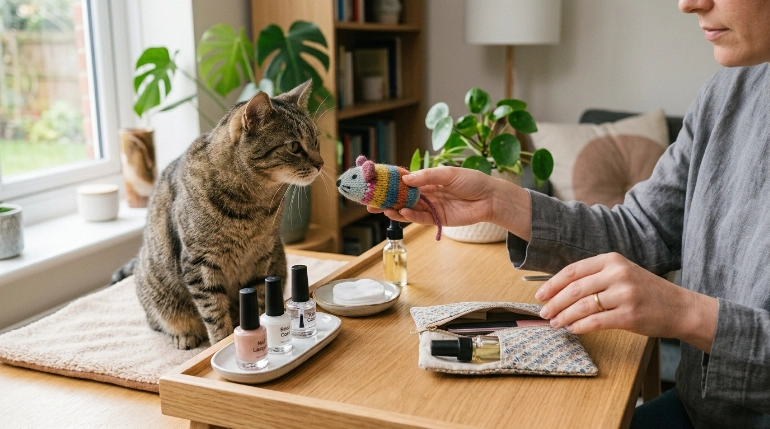
You do not need a complicated training program.
Use a simple routine that makes nail files boring and cat toys rewarding.
1. Stop Using the File as a Teaser Toy
Avoid waving the nail file in front of your cat.
Even if it looks cute, this teaches her that the manicure tool is something she should chase.
2. Put It Away Immediately
When you finish filing, place the file inside:
- A zippered manicure pouch
- A drawer
- A lidded storage box
- A hard protective case
Do not leave it on your bed, vanity, couch, or coffee table.
3. Redirect Instead of Chasing
If your cat grabs the file, avoid turning the situation into a game of chase.
Offer a favorite toy or treat away from the file. Once she moves toward the alternative, calmly remove the manicure tool.
4. Schedule Play Before Your Manicure
If your cat always interrupts your beauty routine, try a short interactive play session first.
A cat that has already had a chance to chase and pounce may be less interested in your moving nail tool.
5. Watch for Actual Ingestion
Pay attention to whether your cat:
- Only sniffs the file
- Rubs her face against it
- Licks it briefly
- Bites without removing material
- Tears pieces from it
- Appears to swallow pieces
The last two behaviors deserve much more attention.
Nail File Hygiene Matters Too
Even when your cat does not swallow anything, letting her repeatedly lick your manicure tools is not ideal hygiene.
The American Academy of Dermatology recommends keeping personal nail tools clean and disinfected because contaminated grooming tools can contribute to nail infections. Its guidance on preventing nail fungus and cleaning nail tools specifically emphasizes not sharing grooming tools and disinfecting reusable equipment.
If your cat has mouthed a disposable emery board, replacing it is often the easiest option.
For a reusable tool, follow the manufacturer’s cleaning instructions. Some glass and metal files tolerate cleaning well, while cushioned, foam, paper, or coated files may not.
Never apply a strong disinfectant and immediately use the file on your nails without following the product’s instructions.
Also avoid filing aggressively around already irritated cuticles or broken skin.
Signs Your Cat Needs Veterinary Attention
Contact a veterinarian if your cat actually swallows part of a nail file or develops concerning symptoms afterward.
Watch for:
- Repeated vomiting
- Loss of appetite
- Unusual tiredness
- Abdominal discomfort
- Repeated gagging or retching
- Difficulty passing stool
- Excessive drooling
- Pawing at the mouth
- Blood around the mouth
- Sudden hiding or behavior changes
Foreign-material ingestion can become more serious if an object becomes stuck in the digestive tract. Cornell’s feline health guidance notes that persistent vomiting, appetite loss, weakness, or lethargy can justify prompt veterinary evaluation.
Do not wait for every symptom to appear if you know a sizeable piece is missing.
Common Mistakes to Avoid
Most nail-file problems are preventable. Try not to make these common mistakes:
- Letting your cat chew the file because it looks funny. Curiosity can turn into a repeated habit.
- Using the file as a toy. Moving it like prey makes it more exciting.
- Leaving used files on the vanity. Store them immediately after your manicure.
- Ignoring missing pieces. If part of a file disappears after chewing, assume swallowing is possible.
- Reusing a heavily licked disposable file. Replacing a cheap emery board is safer and easier.
- Applying bitter sprays or household chemicals to the file. Your cat may ingest the deterrent, and you may later expose your own nails or skin to it.
- Assuming repeated non-food eating is just personality. Persistent ingestion should be discussed with a veterinarian.
- Trying DIY medical treatment after suspected ingestion. Home remedies may make the situation worse.
Expert Tip: Keep a cat-safe toy beside your manicure area. If your cat approaches the nail file, redirect her to the toy before she grabs the file. Consistent redirection works better than letting her play with the file sometimes and stopping her at other times.
When to See a Nail Technician or Dermatologist
Your cat’s behavior itself is a veterinary issue, not something a nail technician or dermatologist can diagnose.
However, professional nail or skin care may be appropriate if the incident has affected your nails.
Consider a qualified nail technician if you simply need help replacing or reshaping a damaged manicure after a cat-related mishap.
Consider a dermatologist or other medical professional if you develop:
- Persistent redness around a nail
- Swelling
- Increasing pain
- Pus or drainage
- Significant nail separation
- Ongoing discoloration
- A skin reaction after using a contaminated product or tool
A nail technician can help with cosmetic nail care, but possible infection, allergic reactions, or significant nail injuries belong with a medical professional.
Likewise, if your cat repeatedly eats non-food objects, consult a veterinarian rather than trying to solve the behavior entirely through DIY training.
How to Keep Nail Files Away From a Curious Cat
The easiest solution is prevention.
Create one dedicated manicure storage area and return every tool to it after use.
A simple setup might include:
- A closed manicure pouch for files and buffers.
- A separate compartment for clippers and cuticle tools.
- Closed bottles for polish and remover.
- A hard case for glass files.
- A secure container for electric-file bits and attachments.
If you own an electric file, unplug it after use and keep loose bits out of reach.
This protects your cat while also keeping your manicure setup cleaner and easier to find.
FAQs
Why does my cat lick my nail file?
Your cat may be investigating the file’s texture, smell, or residue. A brief lick is different from repeated chewing or swallowing. If licking becomes persistent, put the file away and provide a safer object for exploration.
Why does my cat bite nail files?
The rough texture, narrow shape, movement, or attention she receives may make the file appealing. Some cats also simply enjoy chewing household objects. Do not encourage the behavior because pieces can break off.
Is nail dust attractive to cats?
There is not strong evidence showing that cats are specifically attracted to human nail dust. A used file carries a mixture of scents from your hands, nails, skin products, and manicure products, so your cat may simply find the overall smell interesting.
Can my cat get sick from eating a nail file?
Potentially, yes. The concern depends on how much was swallowed, the file material, its size and shape, and whether cosmetic residue was present. Swallowed foreign material can cause digestive problems, so contact a veterinarian if pieces are missing.
Should I throw away a nail file after my cat licks it?
For an inexpensive disposable emery board, replacing it is the simplest hygienic option. Reusable glass or metal files may be cleanable, but follow the manufacturer’s cleaning instructions before using them again.
Does chewing nail files mean my cat has pica?
Not automatically. Occasional chewing may simply be exploration or play. Pica involves persistent ingestion of non-food materials. If your cat repeatedly tries to swallow nail files or other household objects, schedule a veterinary evaluation.
How do I stop my cat from being obsessed with my nail file?
Store the file out of reach, avoid using it as a toy, redirect your cat to an appropriate toy, and provide regular play and enrichment. Most importantly, be consistent—do not encourage nail-file play one day and discourage it the next.
Conclusion
So, why is my cat obsessed with nail files? In most cases, the answer is probably a mix of curiosity, texture, scent, movement, and learned attention.
A cat sniffing or pawing at your file is usually very different from a cat repeatedly chewing and swallowing it. The safest approach is to keep manicure tools out of reach, redirect your cat toward proper toys, and replace or clean contaminated files appropriately.
If pieces are missing, your cat develops symptoms, or she regularly tries to eat non-food objects, contact your veterinarian.
Your nail file belongs in your manicure kit—not your cat’s toy box. Keeping that boundary clear protects both your pet and your nail-care routine.

