
If you have ever caught your cat stealing an emery board from your manicure kit, you may wonder, why do cats like to chew on nail files? It can look funny at first, especially when your cat seems completely fascinated by something as ordinary as a nail file.
In many cases, the attraction comes from the file’s rough texture, interesting smell, easy-to-grab shape, or simple curiosity. Some cats also chew objects when they are bored or looking for sensory stimulation.
However, a nail file is not a safe cat chew toy. Pieces can break off, abrasive surfaces may irritate the mouth, and repeated chewing or swallowing non-food objects can sometimes signal a behavioral or medical problem.
Here is what may be attracting your cat, what risks to watch for, and how to stop the habit safely.
Quick Answer
Cats may chew nail files because they enjoy the rough texture, smell nail dust or skin oils on them, are exploring with their mouths, or are bored and looking for stimulation. However, nail files are not safe chew toys. Repeated chewing or swallowing pieces can also be associated with pica or another behavioral or medical issue.
Why Do Cats Like to Chew on Nail Files?
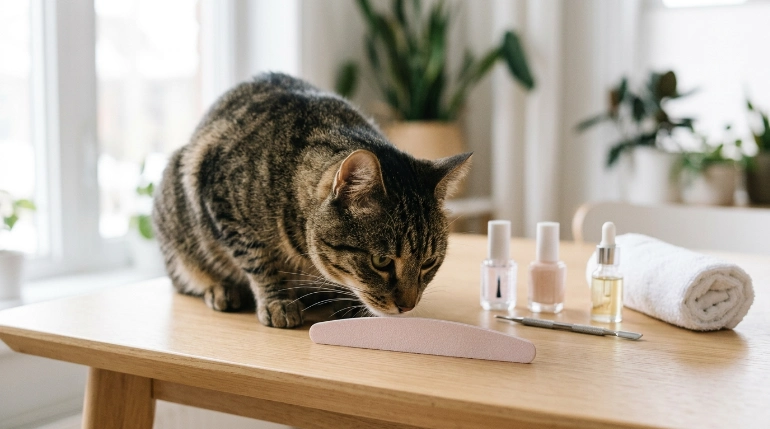
There is no single proven reason every cat becomes interested in nail files. A cat that grabs an emery board occasionally may simply be curious, while a cat that obsessively chews and swallows pieces deserves more attention.
Several factors can make a nail file unusually appealing.
1. The Rough Texture Feels Interesting
A traditional emery board has a gritty, sandpaper-like surface. To a curious cat, that texture is very different from carpet, furniture, toys, or food.
Cats explore their surroundings through their noses, paws, and mouths. Some enjoy biting objects simply because of the sensation against their teeth and gums.
A thin nail file also bends slightly when bitten, creating additional movement and resistance.
That does not mean the texture is good for your cat’s teeth. Something being interesting to chew does not make it safe to chew.
2. Your Nail File Smells Like You
A used nail file can carry tiny traces of:
- Natural skin oils
- Nail dust
- Hand lotion
- Cuticle oil
- Soap or fragrance
- Nail products
- Your normal scent
Cats have an excellent sense of smell, so something that seems odorless to you may still carry plenty of interesting information for them.
If your cat tends to steal nail files shortly after you use them, scent may be part of the attraction.
Avoid intentionally applying lotion, food, catnip, or another substance to a nail file to test this theory. That could encourage your cat to chew it even more.
3. It Has a Fun Shape to Grab and Bite
Think about the shape of a typical emery board. It is narrow, light, easy to pick up, and moves when a cat bats it.
That combination can turn an everyday manicure tool into something that resembles a small piece of prey.
A cat may:
- Bat the file across a table.
- Grab it between the front paws.
- Bite one end.
- Carry it around.
- Kick it with the back feet.
- Chase it if you slide it away.
At that point, chewing may simply be part of play.
4. Your Cat May Be Bored
Some cats start investigating household objects because they do not have enough appropriate outlets for climbing, hunting, chasing, biting, or problem-solving.
Environmental enrichment gives indoor cats safer ways to express these natural behaviors. The ASPCA’s guidance on feline environmental enrichment recommends providing cats with stimulating, safe activities and spaces that help reduce boredom.
If your cat repeatedly steals nail tools while ignoring its toys, try rotating toys instead of leaving the same collection available every day.
Short interactive play sessions can also make a difference.
5. Chewing May Get Your Attention
Cats are good at noticing cause and effect.
Imagine your cat grabs your nail file. You immediately look over, say its name, run toward it, and try to take the file away.
From your cat’s perspective, grabbing that little object just created an exciting game.
Repeatedly chasing your cat around the house can unintentionally strengthen the behavior.
Instead, calmly trade the nail file for an appropriate toy or treat and then store the file somewhere inaccessible.
6. Kittens May Be Especially Mouthy
Young cats frequently explore unfamiliar objects. A nail file can attract a kitten because it is lightweight, textured, and easy to manipulate.
This curiosity does not automatically mean something is medically wrong.
Still, kittens can also swallow surprisingly small objects. Keep manicure tools, thread, hair ties, ribbons, and similar objects out of reach rather than assuming a kitten will simply spit them out.
7. Persistent Chewing Can Sometimes Be Pica
Occasionally chewing an interesting object is different from repeatedly trying to eat non-food materials.
Pica describes persistent ingestion of substances that are not food. According to VCA Animal Hospitals’ overview of pica in cats, cats with pica may chew, suck, or consume inappropriate non-food objects.
Potential contributors can include behavioral factors, stress, compulsive tendencies, or underlying medical problems. You cannot diagnose the cause simply by watching your cat chew a nail file.
If the behavior becomes frequent, intense, or involves actual swallowing, talk with your veterinarian.
Are Nail Files Dangerous for Cats?
Yes. Nail files should be treated as grooming tools rather than cat toys.
The level of risk depends partly on what kind of file you own and whether your cat merely bites it or actually removes and swallows pieces.
| Nail file type | What attracts a cat | Main concern | Best practice |
|---|---|---|---|
| Cardboard/emery board | Rough texture, lightweight shape | Pieces, coating, or fibers may be chewed off | Store in a closed drawer |
| Glass/crystal file | Smooth edges and interesting hard surface | Breakage or mouth injury | Keep completely inaccessible |
| Metal file | Hard surface and strong texture | Tooth or gum injury | Never allow chewing |
| Foam/buffer block | Soft, easy-to-bite material | Pieces may tear off and be swallowed | Store in a closed container |
| Electric nail file | Movement, sound, cord | Injury from moving parts or cord chewing | Unplug and store securely |
Mouth and Tooth Injuries
Abrasive nail files are designed to remove material from human nails. They are not designed for repeated contact with a cat’s mouth.
Aggressive chewing could irritate the gums, tongue, or other delicate oral tissues. Harder metal or glass tools also create a risk of dental injury.
Watch for:
- Drooling
- Blood around the mouth
- Pawing at the face
- Difficulty eating
- Suddenly refusing hard food
- Unusual sensitivity around the mouth
These signs justify a veterinary check, particularly if they appear immediately after your cat chews a hard or broken object.
Swallowing Pieces Is More Concerning
The bigger concern is a cat chewing pieces off and swallowing them.
Foreign objects that cannot pass normally through the digestive system may cause an obstruction. The MSD Veterinary Manual’s guidance on gastrointestinal obstruction notes that cats can develop gastrointestinal obstruction after ingesting foreign material.
Call your veterinarian promptly if you know or strongly suspect that your cat swallowed a significant part of a nail file.
Do not attempt to make your cat vomit unless a veterinarian specifically tells you to do so.
What Should You Do If Your Cat Chews a Nail File?
A single quick bite does not necessarily mean there is an emergency.
Use this simple approach.
Step 1: Remove the Nail File Calmly
Do not chase or frighten your cat.
Offer an appropriate toy or small treat, retrieve the nail file, and place it somewhere secure.
Step 2: Check the File
Look closely at it.
Ask yourself:
- Are chunks missing?
- Is an end torn apart?
- Has a glass file cracked?
- Is a foam buffer missing pieces?
- Did your cat simply leave tooth marks?
If material is missing and you cannot find it nearby, consider the possibility that your cat swallowed it.
Step 3: Look at Your Cat
If your cat allows safe handling, look for obvious bleeding or material caught around the mouth.
Do not force the mouth open or reach deep into the throat.
Step 4: Monitor Behavior
Watch for changes such as:
- Vomiting
- Reduced appetite
- Lethargy
- Repeated gagging
- Drooling
- Abdominal discomfort
- Difficulty passing stool
- Hiding more than usual
Foreign-body problems can require veterinary treatment, so do not wait for severe symptoms if you already know a substantial object was swallowed.
Step 5: Prevent Another Opportunity
Move nail files, buffers, clippers, scissors, cuticle tools, and related products into a drawer, cosmetic case, or closed cabinet after every manicure.
Prevention is easier than repeatedly trying to teach a cat that one particularly fascinating object is off-limits.
Expert Tip: Keep a cat-safe toy beside your manicure area. If your cat approaches your nail tools, redirect it to the toy before it grabs the file. This makes the safer behavior easier to reward.
How to Stop Your Cat From Chewing Nail Files
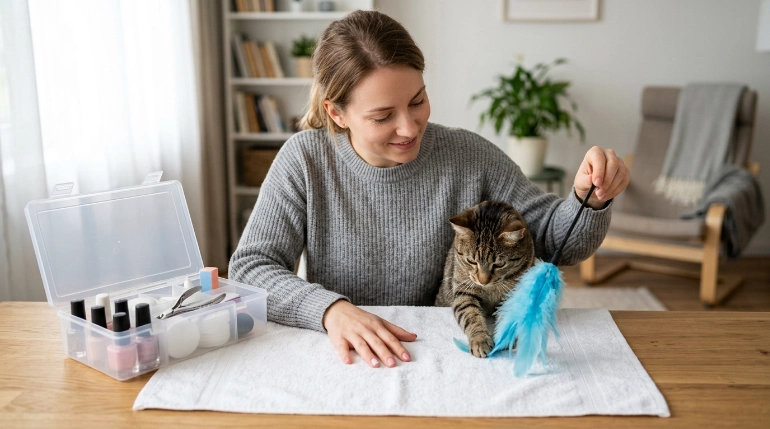
Punishment is rarely the best solution.
You want to make the nail file unavailable while giving your cat something more appropriate to do.
Keep Nail Tools Completely Out of Reach
A cup on a countertop may not be enough. Many cats can jump onto counters or knock containers over.
A closed drawer or cabinet is safer.
Also clean up used disposable files instead of leaving them in an open trash can.
Offer Appropriate Play
Give your cat daily opportunities to chase, stalk, pounce, and manipulate safe toys.
Try:
- Wand-style toys used under supervision
- Cat-sized balls
- Kicker toys
- Puzzle feeders
- Sturdy cat toys with interesting textures
- Cardboard scratching surfaces
The goal is not necessarily to find a “cat nail file.” It is to identify what part of the experience your cat enjoys—texture, movement, chasing, biting, or attention—and provide that experience safely.
Rotate Toys
Cats can lose interest when the same objects remain on the floor continuously.
Put some toys away and rotate them periodically. Novelty can renew interest without constantly buying new products.
Do Not Turn It Into a Chase Game
If grabbing a file makes you jump up and run after your cat, stealing the file can become extremely rewarding.
Stay calm.
Offer a trade, retrieve the object, and put it away.
What Not to Give Your Cat as a Replacement
Do not replace one questionable household object with another.
Avoid giving your cat:
- Old nail files
- Foam buffer blocks
- Cotton swabs
- Dental floss
- Hair ties
- Rubber bands
- Loose string
- Small plastic pieces
- Used manicure accessories
Something does not become a safe cat toy simply because you no longer need it.
Choose toys specifically intended for pets, inspect them regularly, and remove anything that is beginning to break apart.
Hygiene Matters Too
Your nail file and your cat’s mouth should not be sharing the same grooming tool.
Once a cat has chewed or licked a reusable file, clean it according to the manufacturer’s instructions or replace it when proper cleaning is not possible.
Do not continue using a badly chewed file on your nails.
This is especially important if you have:
- Broken skin around your nails
- A torn cuticle
- A hangnail
- Irritated nail folds
- Recent nail damage
Disposable emery boards are inexpensive, so replacing a contaminated one is usually the simplest option.
Common Mistakes to Avoid
- Leaving files on a manicure table. Put everything away as soon as you finish.
- Giving an old nail file to your cat as a toy. It still carries the same chewing and swallowing risks.
- Chasing your cat every time it steals one. This may accidentally turn the behavior into a game.
- Ignoring missing pieces. If part of a file has disappeared, consider possible ingestion.
- Assuming repeated chewing is always boredom. Persistent non-food chewing can deserve veterinary evaluation.
- Using bitter sprays on manicure tools without professional guidance. Preventing access is simpler and avoids adding unknown substances to something your cat may lick.
- Waiting for severe symptoms after known ingestion. Contact your veterinarian for guidance when you believe material has been swallowed.
When to Call a Veterinarian
Call your veterinarian if your cat repeatedly seeks out nail files or other non-food objects, particularly when chewing progresses to swallowing.
VCA’s information on chewing and sucking behavior in cats recommends professional behavioral guidance when persistent chewing, sucking, or ingestion becomes difficult to control.
You should also seek veterinary help if your cat develops:
- Repeated vomiting
- Refusal to eat
- Significant lethargy
- Abdominal pain
- Heavy drooling
- Mouth bleeding
- Difficulty swallowing
- Repeated attempts to vomit
- Major changes in bowel movements
A veterinarian can determine whether the behavior is simply exploratory or whether dental pain, gastrointestinal disease, nutritional concerns, anxiety, pica, or another issue needs investigation.
When to See a Nail Technician or Dermatologist
A nail technician is not the appropriate professional for your cat’s chewing behavior. That belongs with a veterinarian.
However, your own nails and skin may need attention if the incident causes a problem.
Consider a qualified nail professional for cosmetic nail damage that does not involve infection or injury. If the skin around your nail becomes painful, swollen, increasingly red, or otherwise concerning, seek medical advice from an appropriate healthcare professional such as a dermatologist or primary-care clinician rather than trying to cover the problem with polish or artificial nails.
If your cat bites or scratches you and breaks the skin, clean the area promptly and seek medical guidance when appropriate.
DIY Prevention vs. Professional Help
Simple prevention works well when a healthy cat occasionally grabs a nail file out of curiosity.
Professional help becomes more important when the behavior is persistent or involves ingestion.
| Situation | Reasonable next step |
|---|---|
| Cat bats at a file once | Remove and store it |
| Cat occasionally grabs manicure tools | Improve storage and redirect to toys |
| Cat repeatedly hunts for files | Increase enrichment and monitor the pattern |
| Cat chews many types of non-food objects | Discuss the behavior with your veterinarian |
| Cat swallows pieces | Contact your veterinarian |
| Cat vomits or stops eating after ingestion | Seek prompt veterinary attention |
| Behavior is compulsive or difficult to interrupt | Ask about veterinary behavioral evaluation |
FAQs
Why does my cat lick my nail file?
Your cat may be investigating the file’s texture or scent. A used file can also carry skin oils, nail debris, lotion, or other smells. Remove it rather than allowing repeated licking or chewing.
Is it okay for cats to chew emery boards?
No. Emery boards are manicure tools, not cat toys. Their abrasive surfaces can irritate the mouth, and chewed-off pieces may be swallowed.
Why does my cat steal my nail files?
The light, narrow shape can be easy to bat, grab, carry, and bite. Your scent on the file may also make it more interesting.
Does chewing nail files mean my cat has pica?
Not necessarily. An occasional bite can simply be curiosity or play. Pica becomes more concerning when a cat repeatedly seeks, chews, and especially ingests non-food material.
What should I do if my cat ate part of a nail file?
Take the remaining file away and contact your veterinarian for guidance. Tell them what type of file it was, approximately how much is missing, when it happened, and whether your cat has any symptoms.
Can I give my cat an unused nail file instead?
No. An unused file still has an abrasive surface and can break or be swallowed. Give your cat a sturdy, appropriately sized pet toy instead.
How can I keep my cat entertained while I do my nails?
Set up a safe toy, puzzle feeder, or supervised play activity nearby before opening your manicure kit. When you finish, put every nail tool away in a closed container or drawer.
Conclusion
So, why do cats like to chew on nail files? For many cats, the answer is surprisingly simple: nail files have an unusual texture, carry interesting scents, move easily during play, and are just the right size to grab.
The attraction itself may be harmless curiosity, but the object is not harmless enough to become a cat toy.
Keep nail files and manicure tools in closed storage, redirect your cat toward appropriate toys, and pay attention to repeated chewing of non-food objects. If your cat swallows pieces or starts obsessively chewing household items, contact your veterinarian rather than trying to solve the problem entirely at home.
The safest manicure routine is one where your nail tools stay with you—and your cat gets toys designed for cats.
