
Why Do Cats Like to Lick Nail Files? Reasons, Risks, and Safety Tips

You take out an emery board to smooth a chipped nail, and suddenly your cat appears. She sniffs it, rubs against your hand, and starts licking the rough surface as if it is the most interesting thing in the room.
If you have wondered why do cats like to lick nail files, there is no single proven explanation. The unusual texture, scents left on a used file, nail dust, movement, and simple curiosity may all play a part.
An occasional lick is usually very different from chewing or swallowing the file. The important thing is knowing when your cat is simply investigating and when the behavior could become unsafe.
This guide explains the likely reasons cats lick nail files, which file materials deserve extra caution, what to do if your cat chews or swallows a piece, and how to keep your manicure tools hygienic and safely out of reach.
Quick Answer
Cats may like to lick nail files because the rough texture, unfamiliar smell, nail dust, movement, or scents from your hands make them interesting to investigate. Occasional licking does not necessarily mean something is wrong, but chewing or swallowing nail-file material can cause injuries or digestive problems and should be taken seriously.
Why Do Cats Like to Lick Nail Files?
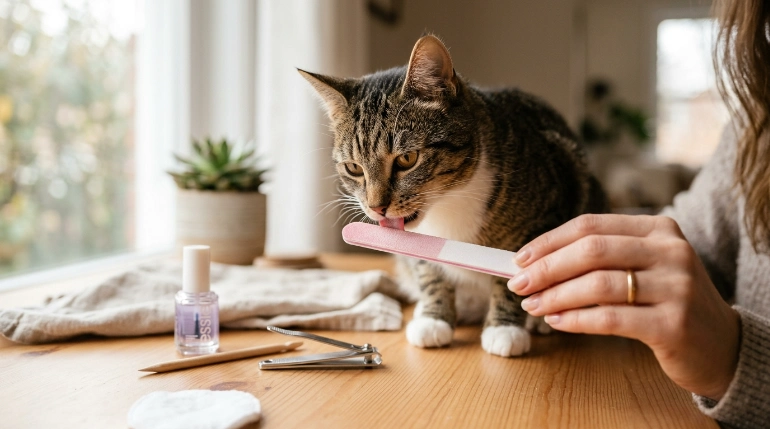
Cats investigate their surroundings with their noses, paws, and mouths. A nail file is unusual enough to attract attention because it combines several sensory features in one small object.
Here are some of the most likely explanations.
1. The Rough Texture Feels Interesting
An emery board has a gritty surface unlike most household objects.
When your cat touches that surface with her tongue, the sensation is very different from licking smooth plastic, fabric, or furniture. That texture alone may be enough to encourage another lick.
Foam buffers can also feel unusual because they are both slightly soft and abrasive.
Interesting does not mean safe to chew. If the abrasive coating or inner material starts coming apart, your cat may accidentally swallow pieces.
2. A Used Nail File Carries Your Scent
A file that you have handled may carry tiny amounts of skin oil, lotion, hand cream, and other familiar scents.
Cats rely heavily on scent when exploring their environment. An object that smells like you but also has an unfamiliar texture can become especially interesting.
Used files may also contain small amounts of nail dust. Although that may contribute to the smell or texture, there is no good evidence that cats lick nail files because they specifically need or crave human nail material.
3. The Filing Motion Can Trigger Curiosity
Think about what your cat sees while you file your nails.
Your hand moves repeatedly. The file travels back and forth. There is a soft scraping sound. Occasionally, your fingers change position quickly.
For a playful cat, all that movement can look much more interesting than a nail file lying still in a drawer.
Your cat may first paw at the file, then sniff or lick it after catching it.
If biting is part of the behavior too, NailPrime’s guide to why cats bite nail files explains the additional risks of allowing the habit to continue.
4. Your Cat Is Investigating Something New
Sometimes the simplest explanation is curiosity.
A nail file may only appear occasionally. You take it from a drawer, use it for a few minutes, and put it away again.
That makes it more novel than furniture, food bowls, or toys your cat sees every day.
A quick sniff or lick can simply be your cat’s way of gathering information about an unfamiliar object.
5. Your Reaction May Make the File More Exciting
Your cat grabs the nail file.
You immediately react.
You reach toward her, say her name, and perhaps follow her when she carries it away.
Without meaning to, you may have turned a boring manicure tool into a game that reliably gets your attention.
This does not mean you should ignore a cat chewing something unsafe. Instead, remove the file calmly and redirect her to an appropriate toy without creating a chase.
Is It Normal for a Cat to Lick a Nail File?
A brief lick or sniff is not automatically a sign of a health or behavioral problem.
The pattern matters more.
A cat that investigates a file once and then walks away is very different from one that searches for files, chews through them, or repeatedly swallows non-food materials.
Pay closer attention if your cat:
- Obsessively seeks out nail files
- Chews through emery boards or foam buffers
- Swallows pieces of files
- Eats cardboard, plastic, fabric, string, or other non-food objects
- Becomes difficult to distract from chewing
- Suddenly develops this behavior when she did not do it before
Persistent ingestion of non-food material may require veterinary evaluation.
Are Nail Files Safe for Cats to Lick?
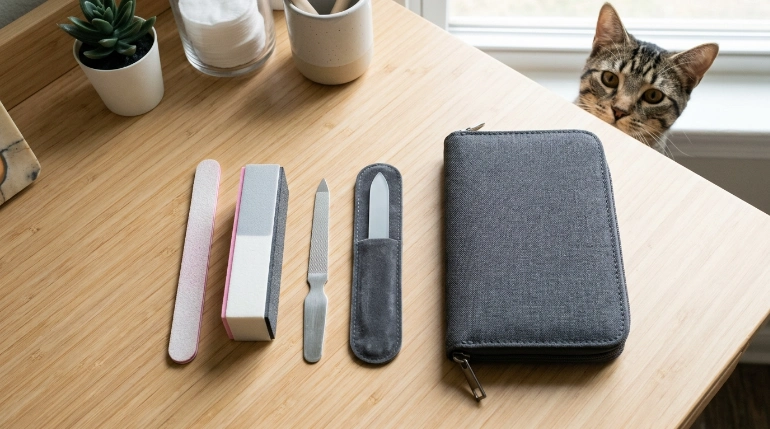
It is better not to intentionally allow your cat to lick nail files.
The abrasive surface can be rough, damaged files can shed material, and used manicure tools may contain residues from products applied to your hands or nails.
The risk also varies by file type.
| Nail File Type | Main Concern | Best Choice After Cat Contact |
|---|---|---|
| Emery board | Porous surface and pieces can tear away | Replace if heavily licked or chewed |
| Foam buffer | Foam can tear into small pieces | Keep completely out of chewing reach |
| Plastic file | Damaged edges may become sharp | Replace if cracked or bitten |
| Metal file | Hard surface can injure teeth or mouth if bitten | Do not let your cat chew it |
| Glass/crystal file | Breakage can create sharp fragments | Store in a protective case |
| File with product residue | Possible exposure to cosmetic chemicals | Remove immediately and assess exposure |
The biggest danger is generally not a single touch of the tongue. The situation becomes more concerning when licking progresses to biting, breaking, or swallowing material.
If you want a deeper material-specific explanation, see are nail files toxic to cats.
What About Nail Polish, Remover, Glue, or Gel Residue?
This deserves extra caution.
A clean, unused emery board is not the same as a file contaminated with nail polish remover, gel products, acrylic products, glue, oils, or other manicure chemicals.
The ASPCA’s information on potentially poisonous household and personal-care products explains that exposure risk varies considerably depending on the product and amount involved.
If your cat licked a file that was noticeably wet or contaminated with a nail product, remove access and identify exactly which product was present.
For a potentially toxic exposure, contact your veterinarian or an animal poison expert rather than guessing from the ingredient list.
The ASPCA Animal Poison Control Center provides 24-hour guidance in the United States; consultation fees may apply.
Could Repeated Nail-File Licking Be Pica?
Possibly—but licking alone does not prove pica.
The more concerning behavior is repeatedly eating or attempting to eat non-food objects.
For example, pay attention if your cat regularly consumes:
- Cardboard
- Plastic
- Fabric
- Foam
- Paper
- Rubber
- Hair ties
- String or thread
- Pieces of nail files
One curious lick is not enough to diagnose anything.
If your cat repeatedly swallows non-food objects, discuss the behavior with your veterinarian. There can be behavioral and medical reasons behind persistent non-food eating, and identifying the cause requires more than watching the cat’s reaction to one nail file.
What Should You Do If Your Cat Licks Your Nail File?
If you catch your cat licking an ordinary nail file, use this simple approach.
1. Calmly Take the File Away
Do not wave it around or turn removal into a game.
Place it somewhere your cat cannot immediately grab it again.
2. Inspect the Nail File
Check whether it is still intact.
Look for:
- Bite marks
- Torn cardboard
- Missing foam
- Cracked plastic
- Chips in a glass file
- Loose abrasive material
- Missing sections
If pieces are missing, treat the situation as possible ingestion rather than simple licking.
3. Check Your Cat
Look for immediate problems such as:
- Excessive drooling
- Pawing at the mouth
- Gagging
- Bleeding
- Difficulty swallowing
- Vomiting
- Sudden distress
Do not force your fingers deep into your cat’s mouth trying to retrieve something you cannot easily see.
4. Think About What Was on the File
Was the file clean?
Or had it recently touched nail polish remover, gel, nail glue, acrylic products, lotion, or another substance?
That distinction matters when deciding whether professional advice is needed.
5. Replace or Clean the Tool Appropriately
A disposable emery board is difficult to thoroughly clean without changing its surface.
If your cat has repeatedly licked or chewed one, replacing it is usually the simplest hygiene choice.
Reusable glass or metal tools may sometimes be cleaned according to the manufacturer’s instructions, provided they are not chipped, cracked, or otherwise damaged.
Never keep using a cracked glass nail file.
What If Your Cat Swallows Part of a Nail File?
This is more serious than licking.
Foreign material can sometimes become lodged in a cat’s digestive tract. VCA Animal Hospitals lists signs of foreign-body ingestion such as vomiting, diarrhea, abdominal pain, reduced appetite, straining to defecate, lethargy, and behavioral changes.
If you saw your cat swallow part of a file, or a noticeable piece is missing, contact your veterinarian.
NailPrime’s detailed guide to what to do when a cat eats a nail file also covers the differences among emery boards, foam, plastic, metal, and glass files.
Do Not Try to Make Your Cat Vomit
Do not attempt to induce vomiting at home unless a veterinarian specifically directs you to do so.
The correct response depends on what was swallowed, its size and shape, when it happened, and your cat’s condition.
Sharp or rigid pieces deserve particularly prompt professional attention.
How to Stop Your Cat From Licking Nail Files
The easiest solution is environmental management.
Keep Files in a Closed Manicure Case
Do not leave files on:
- Bathroom counters
- Vanities
- Nightstands
- Sofas
- Desks
- Open beauty carts
A zippered manicure pouch, closed drawer, or lidded container works much better.
Put the File Away Immediately After Use
Do not leave it beside you because you plan to use it again later.
Cats are excellent at finding interesting objects the moment your attention moves elsewhere.
Give Your Cat an Appropriate Alternative
If movement seems to be the attraction, offer a proper cat toy after you finish your manicure.
Interactive toys can satisfy the desire to chase, bat, and pounce without turning your beauty tools into playthings.
Do Not Encourage Play With Nail Files
Even if your cat looks adorable batting an emery board across the floor, nail files are manicure tools—not cat toys.
For the same reason, a human manicure file should not automatically become your cat’s claw-care tool. NailPrime’s guide on using nail files on cats explains why feline claw care requires a different approach.
Expert Tip: Keep a small closed manicure case exactly where you normally do your nails. Put the file back inside as soon as you finish. Making safe storage effortless is more reliable than repeatedly trying to stop a curious cat from stealing the same tool.
Nail-File Hygiene Matters for You Too
There is another side to this problem: your own nail hygiene.
A file that has been in your cat’s mouth may now have saliva, fur, debris, or dirt on its surface.
That is especially undesirable if you plan to use it near:
- Torn cuticles
- Hangnails
- Cracked skin
- Freshly trimmed cuticles
- Irritated nail folds
- Small cuts
Porous disposable files are generally easier to replace than to thoroughly clean.
Keep personal manicure tools clean, dry, protected, and away from pets.
Common Mistakes to Avoid
A few simple mistakes can turn harmless curiosity into a bigger problem.
- Letting the cat continue because the behavior looks funny. Licking can progress to biting or chewing.
- Leaving the same file on the vanity afterward. Once your cat becomes interested, she may return to it.
- Using a chewed disposable file on your nails. Damage and contamination make replacement the better choice.
- Ignoring missing pieces. A torn or shortened file could mean material was swallowed.
- Chasing your cat around the house. This can accidentally make stealing the file more rewarding.
- Assuming every lick means a nutritional deficiency. There is no basis for diagnosing a deficiency from nail-file licking alone.
- Using punishment. Instead, remove access and redirect your cat to something appropriate.
- Trying home remedies after ingestion. Contact a veterinarian for case-specific guidance.
When to Call a Veterinarian
Contact your veterinarian if you know or strongly suspect your cat swallowed part of a nail file.
Seek prompt veterinary attention if you notice:
- Repeated vomiting
- Loss of appetite
- Significant drooling
- Gagging
- Trouble swallowing
- Abdominal pain
- Severe lethargy
- Difficulty passing stool
- Blood around the mouth
- Sudden unusual hiding or behavior
Foreign-body obstruction can become serious and may require veterinary diagnosis and treatment.
You should also schedule a veterinary visit if your cat repeatedly eats nail files or other non-food objects even when no immediate emergency signs are present.
When to See a Nail Technician or Dermatologist
Your cat’s licking behavior itself belongs with a veterinarian, not a nail technician.
However, think about your own hands too.
A nail technician can help with cosmetic concerns such as reshaping a damaged nail or choosing a fresh, appropriate file.
A dermatologist or other medical professional is more appropriate if you develop persistent:
- Redness
- Swelling
- Pain
- Pus or drainage
- Nail separation
- Significant skin irritation
- Changes around the nail that do not improve
A salon professional should not be expected to diagnose or treat an infection or medical nail condition.
If a cat has heavily licked or chewed a disposable nail file, replacing the tool is generally the simplest choice before your next manicure.
FAQs
Why does my cat lick my nail file after I use it?
A used nail file may carry scents from your hands, skin oils, lotion, and tiny amounts of nail dust. Its rough texture can also make it interesting to investigate. There is no single proven reason that applies to every cat.
Why does my cat lick an emery board?
Emery boards have a gritty surface and lightweight cardboard-like structure that feel unusual in a cat’s mouth. Your cat may be exploring the texture rather than trying to eat it. Do not allow repeated chewing because the board can break apart.
Is it bad for cats to lick nail files?
It is better to prevent it. A quick lick of a clean, intact file is different from chewing or swallowing pieces, but files can carry cosmetic residue and damaged materials can create physical hazards.
Are cats attracted to nail dust?
Nail dust may contribute to the scent of a used file, but there is not enough evidence to say cats specifically seek nail files because they want human nail material. Texture, movement, familiar scents, and curiosity are all reasonable possibilities.
Should I throw away a nail file after my cat licks it?
For a disposable emery board, replacement is often the easiest hygienic option, especially after heavy licking or chewing. Reusable tools should be cleaned according to their manufacturer’s directions and discarded if damaged.
What should I do if my cat chews a nail file?
Take the file away and inspect it for missing pieces. If material appears to have been swallowed, contact your veterinarian. You can also review NailPrime’s guide to cats chewing nail files safely for related prevention advice.
Why is my cat suddenly obsessed with licking non-food objects?
A sudden or persistent pattern deserves attention, especially if your cat actually swallows non-food materials. Record what your cat is licking or eating and how frequently it occurs, then discuss the pattern with your veterinarian.
Conclusion
So, why do cats like to lick nail files?
For many cats, the attraction is probably a combination of texture, unusual smells, movement, familiar human scents, and simple curiosity. A quick investigation is very different from a cat that repeatedly bites or eats the file.
The safest approach is simple. Keep nail files in a closed manicure case, do not encourage your cat to play with them, replace contaminated or damaged disposable files, and watch carefully for chewing or missing pieces.
If your cat actually swallows part of a file or repeatedly eats other non-food items, contact your veterinarian rather than relying on a DIY solution.
You can protect your manicure tools and your curious cat with one easy habit: file your nails, then put the file away immediately.

