Can You Use Nail Files on Cats? Safe Claw Care Guide

If your cat’s claws feel like tiny needles, reaching for the nail file in your manicure kit can seem like an easy fix. You may even wonder whether filing feels gentler than using cat nail clippers.
So, can you use nail files on cats? Yes, in some situations. A fine manual nail file can gently smooth the sharp outer tip of a healthy cat claw. The key is to remove very little, stay far away from the sensitive quick, and stop if your cat becomes stressed.
Filing is best for smoothing. It is not the best way to shorten badly overgrown claws or treat broken, painful, or infected nails.
This guide explains which nail files are safest, how to use one correctly, what mistakes to avoid, and when your cat needs professional help instead.
Quick Answer
Yes, you can use nail files on cats for gentle claw smoothing. Choose a fine manual file, work only on the sharp outer tip, and use light strokes. Never file toward the quick or force a nervous cat to cooperate. Long, damaged, painful, or overgrown claws are better handled with proper clippers or veterinary help.
Can You Really Use a Nail File on a Cat?
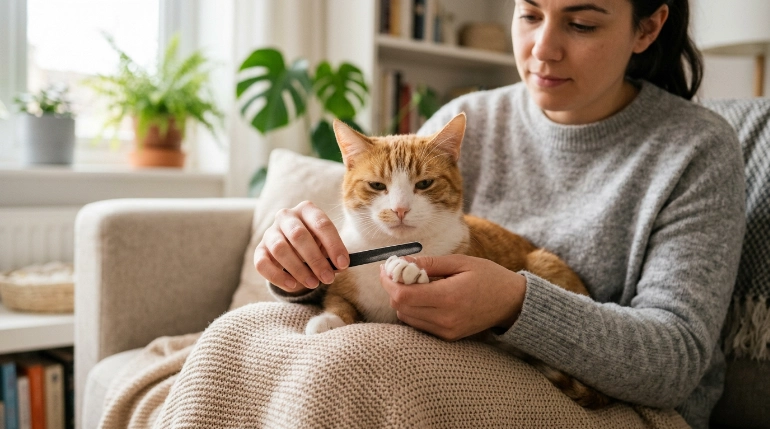
A cat’s claw is not exactly like your fingernail, but the hard outer part can be gently filed.
A file works best when you want to:
- Smooth a sharp point after clipping.
- Take the needle-like edge off one or two claws.
- Fix a slightly rough claw tip.
- Introduce a nervous cat to paw care slowly.
- Make a very small adjustment without clipping.
Washington State University’s guide to clipping a cat’s nails specifically notes that a nail file can be used to smooth the end of a claw after clipping.
That makes a file more of a finishing tool than a full replacement for cat nail clippers.
If you are still deciding whether filing is suitable for your pet, our guide on whether nail files are safe for cats covers the basic safety considerations in more detail.
Understanding the Cat Claw and the Quick
Before you file anything, it helps to know what is inside your cat’s claw.
The hard part you see on the outside protects living tissue called the quick. The quick contains nerves and blood vessels. On many clear or pale claws, you can see it as a pink area closer to the paw.
The ASPCA advises trimming only the white or outer portion of the claw and avoiding the quick because damaging it can cause pain and bleeding.
The same rule applies when filing.
Never try to file deeply into the claw.
You are only trying to dull the needle-sharp point. If you find yourself filing for a long time because you want to remove significant length, a nail file is probably the wrong tool for that job.
What Type of Nail File Can You Use on Cats?
Not every file in your manicure drawer is equally suitable.
For a beginner, a quiet manual tool gives you the most control. You can stop instantly if your cat moves, pulls away, or becomes uncomfortable.
| Tool | Best Use | Main Concern |
|---|---|---|
| Fine emery board | Light tip smoothing | Disposable and wears out |
| Fine manual nail file | Small claw adjustments | Must be used with light pressure |
| Glass file | Gentle smoothing | Harder surface requires steady handling |
| Metal file | Occasional smoothing | Some are too coarse |
| Electric grinder | Larger grooming jobs | Noise, vibration, heat, and stress |
Fine Emery Boards
A simple fine-grit emery board is often one of the easiest choices.
It is lightweight, quiet, inexpensive, and easy to stop using immediately. That matters when working with an animal that can suddenly move its paw.
Avoid very coarse files. You do not need aggressive abrasion for a cat’s sharp tip.
Glass Nail Files
Glass files can create a smooth edge and are easy to clean.
However, they are harder and less flexible than an emery board. Hold the claw gently rather than pushing it firmly against the glass surface.
If your cat suddenly jerks its paw, stop instead of trying to maintain contact.
Metal Nail Files
Metal nail files are durable, but some have fairly aggressive surfaces.
If you already own one, check how rough it feels before putting it near your cat. For a first attempt, I would choose a gentler manual file that gives you more room for error.
What About Electric Nail Files and Grinders?
Powered grinders can remove claw material, but they bring extra challenges.
The buzzing sound and vibration may frighten a cat. The tool may also require you to hold the paw still for longer than a simple manual file would.
Feline-friendly handling guidance emphasizes minimizing restraint and using positive reinforcement during nail care rather than creating a prolonged struggle.
If your cat is afraid of vibrating tools, a powered file is unlikely to make the job easier.
Never hold a struggling cat against a running grinder.
How to File a Cat’s Nails Safely
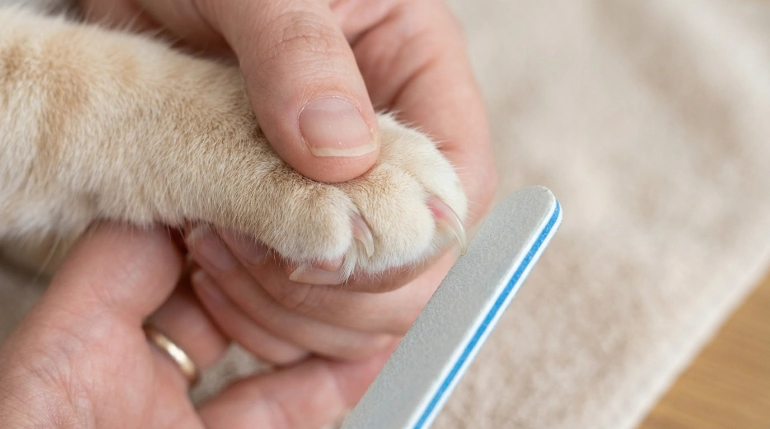
The goal is simple: smooth the sharp point while keeping the whole experience calm.
You do not need to give your cat a perfect “manicure.”
1. Start When Your Cat Is Relaxed
Choose a calm time.
After a nap or during a quiet cuddle session often works better than immediately after energetic play.
Do not begin when your cat is already hiding, growling, swishing its tail aggressively, or trying to avoid you.
2. Let Your Cat Inspect the File
Place the nail file nearby for a moment.
Let your cat smell it if interested. Reward calm behavior with praise or a favorite treat.
Do not let your cat chew the file. Emery boards and other manicure tools are grooming tools, not toys. If your cat is fascinated by them, our guide to cats chewing on nail files explains why they should be stored out of reach.
3. Practice Touching the Paw
Before filing, gently touch one paw.
Massage it for a second or two and release it.
Repeat this during several relaxed sessions if your cat dislikes paw handling. The ASPCA recommends gradually helping cats become comfortable with having their paws touched before attempting a nail trim.
4. Extend One Claw
Hold the paw gently.
Press lightly on the toe pad so the retractable claw extends.
Look at the claw before doing anything else.
If you can see the pink quick inside, make a mental note of its position. You will work only on the pointed outer end, far away from that area.
5. File the Sharp Tip
Touch the file lightly to the tip.
Use two or three short, controlled strokes.
Check the claw.
If the needle-like point has softened, stop there.
More filing does not automatically mean a better result.
6. Watch Your Cat’s Body Language
Stop immediately if your cat:
- Pulls the paw repeatedly.
- Flattens or rotates the ears backward.
- Starts growling or hissing.
- Flicks the tail strongly.
- Tries to bite.
- Becomes unusually tense.
- Attempts to escape.
Veterinary handling guidance recommends taking nail care slowly and avoiding unnecessary restraint when a cat is showing signs of discomfort or fear.
7. Reward and End the Session
Give your cat a treat or calm praise.
You do not need to finish all 18 claws at once.
Doing one or two claws successfully can be much better than turning grooming into a stressful wrestling match.
Expert Tip: Start by filing only one claw. Reward your cat and end the session. Short, positive experiences can make future paw care much easier than trying to finish every claw on day one.
Is Filing Better Than Clipping?
Neither method is automatically better.
They serve different purposes.
| Situation | Better Choice | Why |
|---|---|---|
| One sharp claw tip | File | Removes a tiny amount |
| Rough edge after clipping | File | Smooths the edge |
| Several long claws | Cat clippers | Much faster |
| Severely overgrown claws | Vet or experienced groomer | Safer handling may be needed |
| Cat fears clipping sound | Fine manual file may help | Quiet and gradual |
| Broken or painful claw | Veterinarian | May require medical treatment |
Cat clippers are efficient. One controlled cut can remove the hooked tip in seconds.
A file removes much less material. That makes it useful when precision matters, but frustrating when a claw needs substantial shortening.
For another comparison of these choices, see our guide on whether nail files are okay for cats.
How Often Should You File a Cat’s Nails?
There is no single filing schedule that works for every cat.
Claw growth and natural wear depend on age, activity, scratching habits, lifestyle, and health.
Cornell University recommends regular claw trimming as part of routine cat care and notes that keeping claws appropriately trimmed can also reduce the risk of a nail growing into the paw pad.
You do not need to file simply because a certain number of days has passed.
Check the paws periodically instead.
A light filing session may make sense when a healthy claw has developed an unusually sharp tip. If several claws have become long and hooked, clipping is usually more practical.
Can You Use Your Own Nail File on Your Cat?
Technically, a clean and suitable manual file may work, but sharing manicure tools between yourself and your cat is not ideal.
A dedicated pet file makes hygiene much simpler.
Keep it separate from your beauty tools and store it somewhere your cat cannot chew or play with it.
For reusable files:
- Remove visible debris.
- Clean them according to the material and manufacturer’s directions.
- Allow them to dry completely.
- Store them in a clean, dry place.
Replace disposable emery boards when they become dirty, frayed, soft, or ineffective.
If your cat has a paw infection, open wound, bleeding claw, or discharge, do not file the area and then reuse that tool on yourself.
What Does It Cost to File a Cat’s Nails?
DIY filing is usually inexpensive.
A basic manual emery board or nail file costs only a few dollars, while reusable glass or metal files may cost more initially.
Pet nail grinders cost more and may also require replacement grinding heads or batteries.
Professional trimming costs vary by location and provider. A veterinarian or groomer costs more than DIY care, but professional assistance can be worthwhile if your cat becomes highly stressed or you are worried about hitting the quick.
The cheapest choice is not always the safest one.
A $2 file is poor value if you are trying to use it on a severely overgrown or painful claw that actually requires professional care.
Scratching Posts Still Matter
Filing does not replace scratching.
Scratching is normal feline behavior. It helps cats interact with their environment and maintain their claws.
The American Association of Feline Practitioners’ Claw Friendly resources recommend appropriate scratching surfaces along with routine claw care.
Offer several scratching options if possible.
Some cats prefer tall vertical posts. Others like horizontal cardboard pads or angled surfaces.
A scratching post also allows the cat to control the pressure and movement, which is very different from having a person hold its paw.
What If You Accidentally File Too Far?
Stop immediately.
Watch for:
- Bleeding.
- Sudden vocalization.
- Strong paw withdrawal.
- Limping.
- Visible damage.
- Persistent licking of the toe.
- Pain when the paw is touched.
The quick contains nerves and blood vessels. Injuring it can hurt and cause bleeding. Veterinary guidance on broken claws also warns that exposing the quick is painful and may require first aid or veterinary attention depending on the severity.
If there is persistent bleeding, significant pain, a badly broken claw, or an injury close to the claw base, contact your veterinarian.
Do not try to “fix” an injured claw by filing it shorter.
Common Mistakes to Avoid
A nail file looks harmless, but poor technique can still cause problems.
Avoid these common mistakes:
- Filing too deeply. Work only on the outermost sharp point.
- Using heavy pressure. Filing should be light and controlled.
- Using an extremely coarse file. It removes material faster and gives you less control.
- Trying to shorten badly overgrown claws by filing. Use proper clippers or professional help.
- Ignoring the quick. Never keep filing toward the pink inner area.
- Filing a broken or infected claw. That is no longer simple cosmetic grooming.
- Holding a struggling cat down. Movement increases the chance of injury.
- Trying to finish every paw. Short sessions are often more successful.
- Sharing dirty tools. Keep your pet grooming tools clean and separate.
- Letting your cat play with nail files. Store files safely after use.
- Assuming scratching posts eliminate nail care. Some cats still develop long claws.
When Filing Is Not Enough
A file is useful only for minor grooming.
Skip DIY filing when a claw:
- Is growing toward or into the paw pad.
- Is badly split.
- Is bleeding.
- Has pus or discharge.
- Smells unusual.
- Looks swollen.
- Is discolored in a concerning way.
- Causes limping.
- Seems painful.
- Cannot retract normally.
- Has become extremely long or thick.
Older or less active cats may need extra attention because their claws may receive less natural wear.
If you are not sure whether you are looking at a simple sharp tip or a health problem, have a veterinarian examine it.
DIY Claw Care vs. Professional Help
Simple filing can be reasonable at home when your cat is calm and the claws are healthy.
Professional help makes more sense when safety becomes uncertain.
Consider asking a veterinarian or experienced pet groomer for help if:
- You cannot identify the quick.
- Your cat bites during paw handling.
- Your cat panics when restrained.
- The nails are badly overgrown.
- A claw is growing into the paw pad.
- Your cat has mobility problems.
- Home trimming has caused bleeding before.
- You notice repeated abnormal nail growth.
- You simply do not feel comfortable doing it yourself.
There is nothing wrong with asking your veterinarian to demonstrate safe claw care. Cornell specifically recommends asking a veterinarian for instruction if you are unsure how to clip your cat’s nails.
When to See a Nail Technician or Dermatologist
For a cat, a human nail technician or human dermatologist is not the right professional.
Those professionals work with human nails and skin.
A cat with an abnormal claw or paw problem should be evaluated by a veterinarian.
Call your vet if you notice:
- Persistent bleeding.
- Swelling around a toe.
- Pus or discharge.
- A strong unusual odor.
- Limping.
- Significant pain.
- A claw broken close to its base.
- A claw growing into the paw pad.
- Repeated abnormal growth.
- Changes affecting several claws.
DIY filing is for routine grooming. It cannot diagnose or treat infection, injury, inflammation, or another medical condition.
FAQs
Can I use a human nail file on my cat?
Yes, a fine manual nail file can sometimes be used to gently smooth the very tip of a healthy cat claw. Use light pressure and ideally keep a separate file just for your cat.
Can I use an emery board on cat claws?
A fine emery board can work well for minor smoothing because it is quiet, lightweight, and easy to control. Avoid coarse boards and aggressive filing.
Can I file my cat’s nails instead of clipping them?
You can file small sharp tips, but filing is slow. If several claws need significant shortening, cat nail clippers are usually more practical.
Does filing a cat’s claw hurt?
Light filing of the hard outer tip should not hurt. Filing too deeply toward the quick can cause pain and may lead to bleeding.
Are electric nail files safe for cats?
They can remove claw material, but the noise and vibration may stress some cats. Beginners often have more control with a quiet manual file. Never use a powered grinder on a cat that is struggling.
What if my cat refuses to let me file its claws?
Stop rather than forcing the session. Work gradually on paw handling and reward calm behavior. If safe home grooming remains impossible, ask your veterinarian or groomer for help.
Can my cat play with my nail file?
No. Nail files should be treated as grooming tools, not cat toys. Chewing may damage disposable files and could expose your cat to small pieces or debris. Our guide on whether nail files are toxic to cats explains what to watch for if your cat gets hold of one.
Conclusion
So, can you use nail files on cats? Yes, but think of filing as gentle finishing rather than serious nail shortening.
A fine manual file can smooth the sharp outer tip of a healthy claw. Use only a few light strokes, stay well away from the quick, and stop as soon as the point feels smoother.
Keep sessions short and positive. Maintain clean, pet-only grooming tools and continue providing scratching surfaces for normal feline behavior.
Most importantly, never turn a stressful or painful claw problem into a DIY manicure project. If a claw is overgrown, broken, bleeding, infected, or causing pain, contact your veterinarian instead.
Make your cat’s comfort the priority, and simple claw care can become much easier for both of you.