
You put your nail file down for a minute, and suddenly your cat is sniffing, licking, or biting it like it is the most interesting thing in the room. If this keeps happening, you may be wondering, why does my cat like biting nail files?
In many cases, the answer is simple curiosity. Nail files have an unusual rough texture, carry interesting household scents, and are small enough for a cat to grab and chew. Kittens may also explore objects with their mouths.
Still, a nail file is not a cat toy. Pieces can break off, hard files may hurt teeth, and repeated chewing or swallowing non-food objects can sometimes point to a behavioral or medical problem.
Here is how to understand the behavior, protect your cat, and keep your manicure tools clean and safe.
Quick Answer
If you’re wondering why does my cat like biting nail files, the rough texture, interesting smells, play instinct, boredom, teething, or simple curiosity may be responsible. Occasional sniffing or mouthing is usually less concerning than actually swallowing pieces. Keep nail files out of reach and contact a veterinarian if the behavior becomes persistent.
Why Does My Cat Like Biting Nail Files?
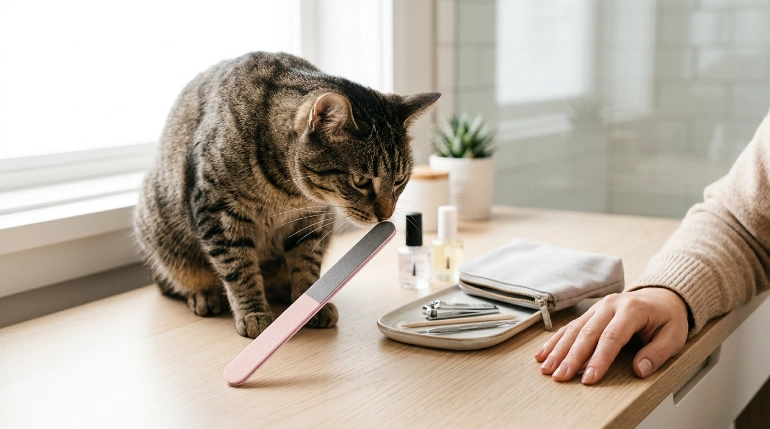
There is no single proven reason that cats specifically love nail files. Instead, several normal cat behaviors can make these small, textured objects surprisingly attractive.
1. The Rough Texture Feels Interesting
A nail file has a surface unlike most objects around your home.
Emery boards are rough and slightly flexible. Buffer blocks have a softer, almost spongy feel. Glass and metal files are hard and textured.
A curious cat may bite an unfamiliar texture simply to investigate it. Cats use their paws, noses, and mouths to explore their surroundings, especially when an object is new or has recently been moved.
Kittens are particularly likely to mouth objects while exploring. Veterinary guidance also notes that chewing can be part of normal investigative and play behavior in younger cats.
2. Your Nail File Smells Like You
A used file can pick up tiny amounts of nail dust, natural skin oils, hand cream, cuticle oil, soap, and other scents from your beauty routine.
Your cat’s interest does not necessarily mean the file tastes good. It may simply smell familiar and unusual at the same time.
That combination can encourage sniffing, licking, pawing, and eventually biting.
If your file has recently been used around polish remover, gel products, adhesives, or other manicure chemicals, do not let your cat lick or chew it. Put the tool away until it has been properly cleaned or discarded according to its manufacturer’s instructions.
3. Your Kitten May Be Teething
If your cat is still a kitten, chewing can increase while adult teeth are developing.
During this stage, kittens may look for objects that provide interesting pressure against their gums. Unfortunately, they do not automatically understand which household items are safe.
Veterinary guidance recommends redirecting kittens from inappropriate objects toward safer things designed for chewing and supervising them so they do not swallow broken pieces.
A nail file should never become the substitute teething toy.
4. It Moves Like a Small Toy
Think about how you use a nail file.
It moves rapidly back and forth between your fingers. You may wave it around while talking. Sometimes it gets left sticking out of a manicure pouch or lying along the edge of a table.
To a playful cat, that movement can make the file look more like prey than a beauty tool.
Cats naturally enjoy activities involving stalking, chasing, pouncing, grabbing, and carrying objects. Appropriate toys give them safer ways to express those instincts.
5. Your Cat Has Learned It Gets Your Attention
Imagine this pattern:
Your cat grabs your nail file.
You immediately say her name.
You rush over.
You take the file away.
Then you pet her, talk to her, or offer a treat to distract her.
From your perspective, you stopped dangerous behavior. From your cat’s perspective, biting the nail file may have produced instant interaction.
Over time, some cats can repeat behaviors that consistently get a response.
Try not to turn nail-file stealing into an exciting game of chase. Calmly remove access and redirect your cat toward an appropriate activity instead.
6. Boredom May Be Making Household Objects More Interesting
A cat without enough stimulation may invent entertainment.
That can include attacking paper, knocking items from counters, chewing cardboard, investigating cosmetics, or stealing your manicure supplies.
Cornell University’s guidance on feline destructive behavior notes that increasing appropriate play and environmental stimulation can help cats that chew inappropriate objects.
Try adding:
- Short interactive play sessions
- Wand toys used under supervision
- Puzzle feeders
- Scratching surfaces
- Climbing spaces
- Safe balls and chase toys
- Toy rotation so everything does not become boring at once
You do not need expensive toys. What matters is giving your cat safe opportunities to investigate, chase, and play.
7. Persistent Chewing Could Be Pica
There is an important difference between a cat that occasionally mouths a nail file and a cat that repeatedly tries to eat non-food objects.
Persistent ingestion of non-food material may be associated with a condition called pica.
According to VCA Animal Hospitals’ guide to pica in cats, potential contributors can include behavioral factors such as anxiety or compulsive behavior as well as underlying medical problems.
Do not diagnose pica based on one incident.
However, contact your veterinarian if your cat regularly tries to eat nail files, plastic, fabric, string, paper, foam, or other non-food materials.
Is It Dangerous for a Cat to Bite a Nail File?
It can be.
The level of risk depends on the file’s material, its condition, and whether your cat actually removes and swallows pieces.
Nail File Material and Risk
| Nail File Type | Main Concern Around Cats | Best Approach |
|---|---|---|
| Emery board | Cardboard or abrasive material can be chewed into pieces | Store in a closed drawer |
| Foam buffer | Soft material may be easy to tear apart | Never leave unattended |
| Metal file | Hard surface may injure teeth or mouth | Keep completely inaccessible |
| Glass/crystal file | Chipped or broken glass can create sharp edges | Store in a protective case |
| Disposable file | May quickly become damaged after chewing | Throw away if compromised |
No nail file is designed to be a chew toy.
Swallowed Pieces Are the Bigger Concern
Chewing becomes more serious if part of the file disappears.
Non-food objects can become lodged in a cat’s digestive tract. Veterinary sources warn that foreign-body obstruction can become serious and may require treatment or surgery.
Contact your veterinarian promptly if you believe your cat swallowed part of a nail file rather than waiting to see whether symptoms appear.
Hard Files Can Damage Teeth
Metal, glass, and other rigid objects can put stress on a cat’s teeth.
VCA specifically advises removing hard objects that a cat persistently chews because hard chewing can contribute to tooth fractures.
Watch for:
- Drooling
- Pawing at the mouth
- Bleeding
- Suddenly refusing hard food
- Chewing only on one side
- Visible chipped or broken teeth
- Unusual bad breath
- Mouth sensitivity
A veterinarian should examine suspected dental injuries.
What Should I Do If My Cat Keeps Biting My Nail File?
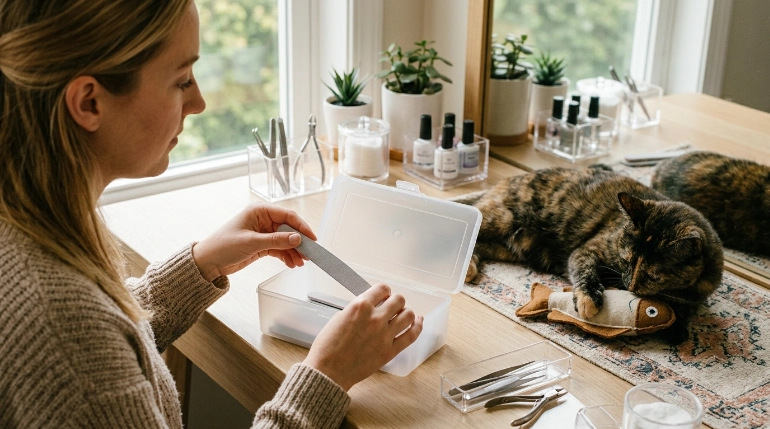
You usually do not need an elaborate training program. The safest strategy is management plus redirection.
1. Remove Access
Place files in:
- A closed drawer
- A manicure case with a secure closure
- A cabinet
- A lidded organizer
- A room your cat cannot access
Do not rely on putting the file farther back on a counter. Cats are excellent climbers.
2. Stay Calm
Avoid yelling, spraying your cat with water, or turning removal into punishment.
Punishment can increase stress and does not teach your cat what she should chew instead. VCA’s behavioral guidance recommends preventing access and providing appropriate outlets rather than relying on punishment.
3. Redirect to a Safe Activity
After removing the file, offer an appropriate cat toy.
Choose something large enough that it cannot easily be swallowed, and check toys regularly for loose pieces.
Cornell’s safe cat toy guidance recommends avoiding toys with small detachable or string-like parts that could be ingested.
4. Increase Daily Enrichment
If nail-file attacks happen when your cat seems restless, increase interactive play.
Even short, consistent sessions can make appropriate toys more rewarding than random household objects.
5. Inspect the File
If your cat has already chewed it, look for:
- Missing chunks
- Cracks
- Splintering
- Frayed cardboard
- Broken glass
- Bent metal
- Loose abrasive material
If anything appears missing, contact your veterinarian.
6. Replace Damaged Manicure Tools
Do not keep using a heavily chewed porous nail file on your own nails.
Emery boards and foam buffers are inexpensive compared with the potential hygiene problems of using a damp, contaminated, or damaged surface.
Reusable glass or metal tools may be cleanable, but always follow the manufacturer’s care directions.
Expert Tip: Store your nail file immediately after every manicure instead of leaving it on your vanity. Removing the temptation is usually easier and safer than repeatedly trying to stop your cat from grabbing it.
Normal Curiosity vs. a Behavior That Needs Attention
An occasional sniff, lick, or attempted bite does not automatically mean your cat is sick.
The pattern matters more.
Usually Less Concerning
Your cat:
- Investigates a new file once or twice
- Bats it around like a toy
- Stops when it is removed
- Eats and drinks normally
- Shows no interest in swallowing pieces
- Does not repeatedly seek other non-food objects
More Concerning
Talk with your veterinarian if your cat:
- Regularly eats non-food objects
- Swallows pieces instead of merely chewing
- Becomes obsessed with one material
- Starts the behavior suddenly as an adult
- Vomits repeatedly
- Stops eating
- Seems lethargic
- Appears painful
- Has difficulty passing stool
- Develops dental problems
VCA notes that pica and swallowed foreign objects can be associated with vomiting, reduced appetite, dental problems, gastrointestinal obstruction, and other health concerns.
When to Call a Veterinarian Immediately
Do not wait for a routine appointment if you know your cat swallowed a significant piece of a nail file or develops concerning symptoms afterward.
Seek veterinary advice promptly for:
- Repeated vomiting
- Refusal to eat
- Severe lethargy
- Abdominal pain
- Trouble swallowing
- Excessive drooling
- Blood from the mouth
- A visibly fractured tooth
- Suspected glass or sharp-object ingestion
According to Cornell’s information on feline vomiting, foreign objects are among the possible causes that veterinarians evaluate when cats develop vomiting.
Never induce vomiting or pull a partially swallowed object from your cat without veterinary instructions.
What About Hygiene for Your Own Nails?
There is another side to the problem: your manicure tools.
A file that has been in your cat’s mouth is no longer in the same condition as a clean tool stored in your manicure kit.
For a disposable emery board or foam buffer, replacement is generally the simplest option.
With a reusable file, follow its manufacturer’s cleaning instructions. Avoid using damaged tools, since cracks, rough edges, or altered surfaces may make filing less controlled.
Also wash your hands after handling anything covered in saliva before touching broken skin around your nails.
The American Academy of Dermatology’s nail-care recommendations emphasize keeping nail-grooming tools clean and using appropriate filing techniques to help protect nails and surrounding skin.
When to See a Nail Technician or Dermatologist
Your cat’s chewing behavior itself belongs with a veterinarian, not a nail technician or dermatologist.
However, professional nail or skin care may become relevant if the incident affects your nails.
A nail technician can help you choose a fresh file and explain appropriate tool care for your manicure system. A nail technician should not diagnose an infection or medical nail condition.
Consider a dermatologist if the skin around your nail becomes increasingly:
- Red
- Swollen
- Painful
- Tender
- Draining
- Discolored
The American Academy of Dermatology notes that redness and swelling around a nail can indicate infection and recommends professional evaluation for concerning nail changes.
If a cat bites or scratches you deeply, seek appropriate medical advice rather than relying on salon treatment.
Common Mistakes to Avoid
A few simple mistakes can turn a harmless habit into a bigger problem.
- Leaving files on the vanity. Put them away immediately after use.
- Letting your cat keep an old file as a toy. A worn-out manicure tool still is not designed for chewing.
- Assuming cardboard pieces are harmless. Any swallowed non-food object can potentially create problems.
- Chasing your cat around the house. This may turn stealing into an exciting game.
- Punishing the cat. Remove access and redirect instead.
- Ignoring missing pieces. If part of a file has disappeared, call your veterinarian for guidance.
- Reusing a badly chewed emery board. Replace disposable porous tools.
- Assuming repeated eating is just quirky behavior. Persistent ingestion of non-food objects deserves veterinary attention.
- Giving your cat tiny substitute toys. Choose appropriately sized toys that cannot easily break apart or be swallowed.
FAQs
Why does my cat lick my nail file?
Your file may have interesting textures and scents from your hands, nail dust, lotion, or other manicure products. Curiosity alone can cause licking. Remove the file rather than encouraging the behavior, especially if chemical residue may be present.
Why does my cat chew emery boards?
Emery boards are lightweight, textured, and easy for a cat to grip. That combination may encourage exploratory chewing or play. Because pieces can tear off, keep emery boards stored securely.
Is a nail file toxic to cats?
A nail file is not intended for consumption, and risk varies by its material and anything on its surface. The bigger concerns include swallowed fragments, sharp pieces, dental injury, and residues from manicure products. Contact your veterinarian if ingestion occurs.
Can cats swallow pieces of a nail file?
Yes. A determined cat can tear pieces from softer files or buffers. Swallowed foreign material can potentially cause gastrointestinal problems, which is why missing pieces should be taken seriously.
Does chewing nail files mean my cat has pica?
Not necessarily. One curious bite does not establish pica. Persistent chewing and ingestion of non-food objects is more concerning. A veterinarian can investigate behavioral and medical causes if the pattern continues.
How can I stop my cat from stealing my nail file?
Keep files in a closed container, calmly remove them when your cat gets one, and offer appropriate toys and regular interactive play. Consistent prevention is usually more effective than repeatedly correcting the behavior.
Should I throw away a nail file my cat chewed?
For a porous disposable emery board or foam buffer, replacing it is the safest and simplest choice. If a reusable glass or metal file has been mouthed, inspect it closely and follow the manufacturer’s cleaning instructions. Discard any file that is cracked, chipped, bent, or otherwise damaged.
Conclusion
So, why does my cat like biting nail files? In most cases, the attraction probably comes from a mixture of texture, scent, curiosity, play behavior, teething, or boredom. Your cat may simply see your manicure tool as one more fascinating household object to investigate.
That does not make nail files safe toys.
Keep them stored in a closed container, replace files that have been damaged or contaminated, and give your cat safer ways to chew, chase, and explore.
Most importantly, pay attention to whether your cat is only playing or actually swallowing material. Repeatedly eating non-food objects, vomiting, appetite changes, mouth pain, or suspected ingestion should be discussed with a veterinarian.
Your manicure routine and your cat can happily share the same home—the nail files just need to stay on the human side of the beauty drawer.
