
If you have ever caught your cat licking, biting, or trying to swallow your manicure tools, you may be wondering, why does my cat want to eat nail files?
It looks strange, but there are several possible explanations. Your cat may be interested in the file’s rough texture, the scent left behind after you use it, or simply the fact that it is an unusual object that moves when you pick it up. Persistent chewing or actually swallowing pieces, however, can point to a behavior called pica.
The important part is keeping curiosity from becoming an injury. Nail files are not cat toys, and pieces of cardboard, foam, abrasive material, glass, or metal can potentially hurt your cat’s mouth or digestive tract.
Below, we’ll look at why cats become fascinated with nail files, which types are most concerning, what to do if your cat bites or swallows one, and how to keep both your cat and your manicure tools safe.
Quick Answer
Why does my cat want to eat nail files? Your cat may like the file’s texture, smell, movement, or the attention they get when grabbing it. Some cats also chew non-food objects because of boredom, stress, or pica. Do not let your cat swallow pieces, since nail file material can cause mouth injuries or digestive blockage.
Why Does My Cat Want to Eat Nail Files?
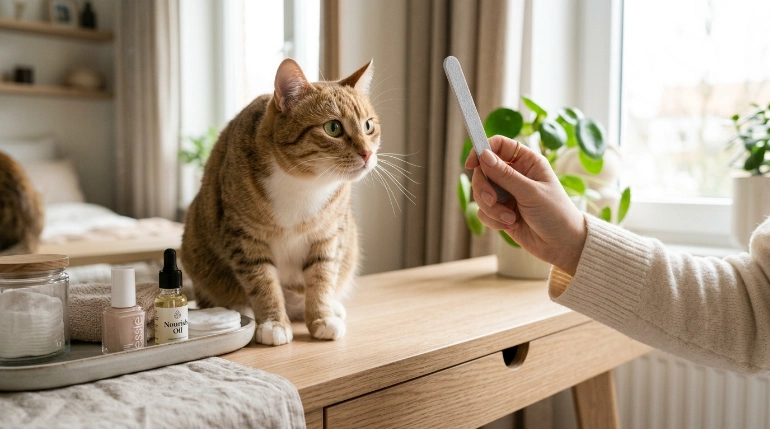
There is no known special feline attraction to nail files specifically. Instead, several ordinary cat behaviors can make a nail file unexpectedly interesting.
A cat that occasionally sniffs or taps your file is probably investigating it. A cat that repeatedly bites, tears, and tries to swallow pieces deserves closer attention.
The Rough Texture May Feel Interesting
Cats investigate objects with their paws, noses, and mouths.
An emery board has a gritty surface unlike most household items. Foam buffers feel soft enough to bite but still offer resistance. Even glass and metal nail files create unusual sensations against a cat’s teeth or tongue.
That texture alone can turn a forgotten manicure tool into something your cat wants to investigate.
The problem starts when curiosity becomes chewing. The VCA Animal Hospitals guide to chewing behavior in cats notes that cats may chew household objects and that swallowed materials can sometimes cause intestinal obstruction.
Your Nail File Smells Like You
A nail file that has just been used can carry tiny amounts of nail dust, skin oils, hand lotion, cuticle oil, polish residue, or other scents from your beauty routine.
Cats have a strong interest in scent. Something you regularly hold may therefore be more attractive than a brand-new object sitting in a drawer.
That does not mean your cat needs anything found on the file. It simply means the familiar smell may encourage further investigation.
The Movement Can Trigger Play
Think about what happens while you file your nails.
The tool moves rapidly back and forth. Your hand moves. The file may occasionally fall onto the floor or slide across a table.
To an energetic cat, that movement can look like a small object worth chasing.
Once your cat catches it, grabbing can quickly turn into biting.
This is especially common when a cat has learned that stealing your manicure tools causes you to react immediately.
Your Cat May Want Attention
Cats are excellent at learning which behaviors make people respond.
If your cat grabs a nail file and you instantly chase them across the room, they may discover that stealing the file starts an exciting game.
Even saying their name loudly and taking the object away can sometimes reinforce the behavior if your cat was looking for interaction.
Try replacing the nail file with an appropriate toy rather than turning retrieval into a chase.
Boredom Can Encourage Chewing
Indoor cats need opportunities to stalk, climb, scratch, explore, and play.
Without enough stimulation, some cats begin investigating objects they would normally ignore. Nail files, hair ties, cords, makeup sponges, cotton swabs, and other small beauty items may become targets.
Providing regular interactive play can help redirect that energy toward safer activities.
Could Eating Nail Files Be Pica?
Possibly.
Pica means repeatedly eating or attempting to eat objects that are not food.
According to VCA Animal Hospitals’ overview of pica in cats, cats with pica may persistently ingest materials such as plastic, paper, fabric, string, or thread. Potential causes can include behavioral problems as well as certain underlying medical conditions.
One isolated attempt to bite an emery board does not automatically mean your cat has pica.
Pay more attention when your cat regularly tries to eat:
- Nail files
- Cardboard
- Plastic bags
- Fabric
- String
- Foam
- Paper
- Hair ties
- Cosmetic applicators
- Other non-food household items
If this happens repeatedly, discussing the behavior with your veterinarian is wiser than simply hiding one particular nail file.
Are Nail Files Dangerous for Cats?
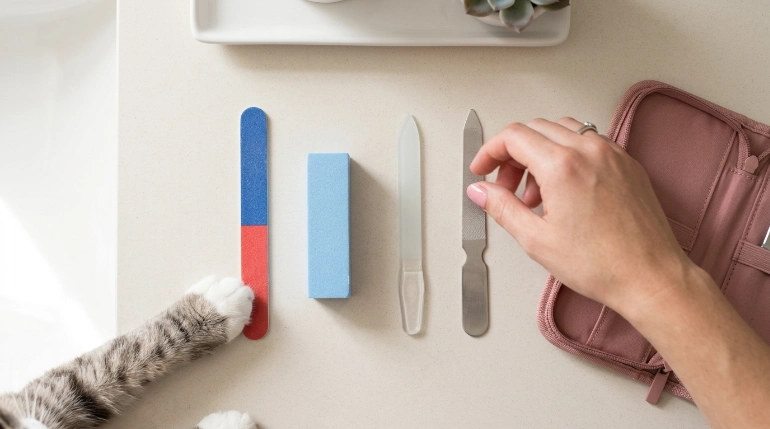
They can be.
The level of risk depends on the type of file, how aggressively your cat bites it, and whether any pieces are swallowed.
| Nail File Type | Possible Concern | What to Do |
|---|---|---|
| Emery board | Cat may tear off cardboard or abrasive material | Replace the file and keep it stored away |
| Foam buffer | Soft material may be easy to bite into pieces | Discard damaged buffers immediately |
| Glass/crystal file | Broken edges may injure the mouth or paws | Keep securely stored and discard if cracked |
| Metal file | Hard surface may hurt teeth or gums | Do not allow chewing; clean before reuse |
| Disposable salon-style file | Porous surface can become contaminated | Replace after your cat mouths or chews it |
Swallowed Pieces Are the Biggest Concern
A small bite mark on a file is very different from a missing piece.
Material that cannot be digested may become stuck somewhere in the digestive tract.
The Merck Veterinary Manual’s information on digestive obstruction in cats lists vomiting, reduced appetite, lethargy, diarrhea, abdominal discomfort, and dehydration among possible signs of an obstruction.
If part of the nail file is missing and you think your cat swallowed it, contact a veterinarian rather than waiting for symptoms to become severe.
Hard Files Can Damage Teeth or Gums
Glass and metal files may not tear apart as easily as cardboard ones, but that does not make them appropriate chew toys.
Repeated biting against a hard object can potentially irritate gums or damage teeth.
Broken glass files create an additional sharp-edge hazard.
Check any file that has been dropped or chewed before using it again.
Nail Product Residue Adds Another Question
A file used around polish, gel, acrylic, remover, cuticle treatments, or other manicure products may have cosmetic residue on its surface.
Because the exact ingredients and amount involved can vary, avoid assuming that licking a contaminated tool is harmless.
If your cat has swallowed a cosmetic product or heavily contaminated file and you are concerned about toxicity, your veterinarian or ASPCA Animal Poison Control can advise you based on the specific product.
What Should I Do If My Cat Chews a Nail File?
Do not panic, but do check what happened.
1. Take the Nail File Away Calmly
Remove it without turning the situation into a chase.
If possible, trade the file for a toy or treat instead of pulling aggressively while your cat is biting it.
2. Inspect the File
Look carefully for:
- Missing pieces
- Torn foam
- Missing cardboard
- Cracks
- Broken glass
- Sharp edges
- Bite marks
Finding an intact file is reassuring. Finding a missing section is a reason to contact your veterinarian.
3. Check Your Cat’s Mouth If It Is Safe
If your cat is calm and comfortable with handling, look for obvious bleeding, cuts, excessive saliva, or a visible piece of material.
Do not put your fingers deep into your cat’s mouth or throat.
A frightened cat can bite, and attempting to pull out a deeply lodged object may cause additional injury.
4. Do Not Try to Make Your Cat Vomit
If your cat swallowed part of a nail file, call your veterinarian for advice.
Do not use hydrogen peroxide or another homemade method to make a cat vomit. The ASPCA specifically warns that hydrogen peroxide should not be given to cats to induce vomiting because it can injure the stomach and esophagus.
5. Watch for Warning Signs
Seek veterinary advice promptly if you notice:
- Vomiting
- Repeated gagging
- Excessive drooling
- Refusing food
- Unusual tiredness
- Abdominal discomfort
- Difficulty passing stool
- Diarrhea
- Repeated swallowing
- Blood from the mouth
- Trouble breathing
Symptoms of digestive obstruction can vary, so the absence of immediate vomiting does not prove that a swallowed object is harmless.
How to Stop Your Cat From Eating Nail Files
Prevention is easier than repeatedly rescuing your manicure tools.
1. Store Your Nail Tools in a Closed Container
A zipped manicure case, drawer, cabinet, or lidded organizer is better than leaving files on a vanity.
Cats can easily knock lightweight files off counters.
2. Clean Up Immediately After Your Manicure
Put away:
- Nail files
- Buffers
- Cotton pads
- Cotton swabs
- Nail clippings
- Orangewood sticks
- Gel removal wraps
- Polish bottles
- Acetone
- Cuticle products
This protects your cat while also keeping your manicure area more hygienic.
3. Offer Better Ways to Play
Try daily play sessions with toys designed for cats.
Good options include toys your cat can safely chase, pounce on, kick, or bat.
Rotate toys rather than leaving every toy out permanently. Changing the selection can make familiar toys feel more interesting.
4. Avoid Rewarding Nail File Theft
If your cat steals a file, do not turn it into a dramatic chase.
Trade for something appropriate, put the file away, and redirect your cat.
Consistency matters.
5. Talk to Your Vet About Persistent Chewing
Repeatedly swallowing non-food items should not be dismissed as a quirky habit.
Veterinary sources note that pica can sometimes be associated with medical or behavioral conditions, so frequent or worsening behavior deserves professional evaluation.
Expert Tip: Keep a small lidded manicure box beside the place where you usually do your nails. Put each tool back as soon as you finish using it instead of waiting until the end of your manicure. This removes the opportunity for a curious cat to grab a file while you are distracted.
Should You Reuse a Nail File After Your Cat Chews It?
Usually, replacing a disposable file is the simplest choice.
Emery boards and many foam files are inexpensive and porous. Once they have been covered in saliva or damaged by teeth, replacing them avoids both hygiene concerns and rough damaged edges.
The American Academy of Dermatology recommends keeping nail-grooming tools sanitary and avoiding shared nail tools as part of reducing nail-infection risk. Its guidance on preventing nail fungus emphasizes proper cleaning of reusable nail tools.
For reusable glass or metal files, follow the manufacturer’s cleaning instructions. Replace the file if it is chipped, cracked, rusted, bent, or otherwise damaged.
A new basic nail file costs far less than dealing with an injured nail, damaged tool, or veterinary emergency, so this is not a good place to stretch a manicure product’s lifespan.
Nail File Hygiene After a Cat Has Touched It
Cats walk through litter boxes, groom themselves, eat, and explore household surfaces.
For that reason, a nail file that has been inside your cat’s mouth should not go immediately back onto your natural nails.
For disposable emery boards or porous foam buffers, throwing them away is generally the easiest solution.
For washable reusable files:
- Remove visible debris.
- Clean the tool according to its manufacturer’s directions.
- Allow it to dry fully.
- Inspect it carefully for cracks or rough damage.
- Store it somewhere your cat cannot access.
Do not continue using a damaged file simply because it still technically works.
When to Call Your Veterinarian
Contact a veterinarian when you know or strongly suspect that your cat swallowed part of a nail file.
You should also seek veterinary advice if chewing household objects is becoming frequent.
More urgent evaluation is appropriate when your cat develops symptoms such as repeated vomiting, reduced appetite, lethargy, abdominal discomfort, gagging, excessive drooling, or difficulty passing stool after chewing something they should not have.
If your cat is struggling to breathe, has severe bleeding, collapses, or appears acutely distressed, treat the situation as an emergency.
When to See a Nail Technician or Dermatologist
Your cat chewing your nail file usually creates a pet-safety issue rather than a human nail emergency.
However, pay attention to your own nails and surrounding skin as well.
Consider seeing an experienced nail technician if you need help choosing or correctly using a file that is less likely to tear, split, or over-thin your nails.
A dermatologist is more appropriate if you develop:
- Persistent redness around the nail
- Swelling
- Pain
- Pus or drainage
- Nail separation
- Significant discoloration
- Repeated fungal-looking changes
- A nail problem that continues despite basic care
A nail technician can improve cosmetic appearance, but a salon cannot diagnose or treat an infection or medical nail disorder. Those concerns belong with a medical professional.
Common Mistakes to Avoid
When cats and manicure supplies share the same home, a few small habits can create unnecessary problems.
Avoid these common mistakes:
- Leaving emery boards on the floor or vanity. They are lightweight and easy for cats to steal.
- Assuming chewing is harmless because your cat has done it before. A piece can eventually break off.
- Continuing to use a saliva-covered disposable file. Replacing it is safer and more hygienic.
- Using a cracked glass file. Small damaged edges can scratch you and may become easier to break.
- Chasing your cat every time they steal a file. Your reaction may make the behavior more entertaining.
- Ignoring repeated eating of non-food objects. Persistent behavior may require a veterinarian’s attention.
- Trying to induce vomiting at home after something is swallowed. Cats require veterinary guidance for foreign-object or toxin ingestion.
- Leaving manicure chemicals within reach. Store polish, remover, acrylic or gel products, and treatments in closed containers.
FAQs
Why does my cat want to eat nail files after I use them?
The file may carry your scent, skin oils, nail dust, lotion, or other familiar smells after use. Its rough texture and the attention you give it may also make it more interesting.
Why does my cat lick my nail file?
Some cats lick unusual household objects simply because they are exploring the texture or scent. Occasional licking is different from repeatedly chewing and swallowing pieces.
Is an emery board toxic to cats?
The larger concern is usually the physical material rather than treating an emery board as food. Cardboard and abrasive pieces are not digestible and could cause irritation or obstruction if swallowed. Contact your veterinarian if a noticeable piece is missing.
Can my cat chew on a glass nail file?
No. Even though a glass file may resist chewing better than cardboard, it can break or develop damaged edges. Hard chewing may also hurt your cat’s teeth or gums.
Why is my cat obsessed with nail files?
Your cat may enjoy the texture, movement, scent, or attention associated with the file. If the obsession includes repeatedly trying to swallow nail files or other non-food items, ask your veterinarian about possible pica.
What should I do if my cat swallowed part of a nail file?
Contact your veterinarian and tell them what type of file it was, approximately how much is missing, and when the incident happened. Do not try to make your cat vomit unless a veterinary professional specifically directs treatment.
Should I throw away a nail file my cat licked?
For a disposable emery board or porous buffer, replacing it is the easiest hygienic choice. Reusable glass or metal files may be cleaned according to their manufacturer’s instructions if they remain completely undamaged.
Conclusion
So, why does my cat want to eat nail files? In many cases, the answer is simple curiosity. The rough texture, interesting scent, quick movement, or attention connected with the file may make it unusually appealing.
The behavior becomes more important when your cat is actually tearing off and swallowing pieces or regularly eating other non-food objects. Those habits can create mouth injuries or digestive problems and may indicate pica.
Keep nail files and manicure products inside closed storage, discard damaged or saliva-covered disposable files, and redirect your cat toward appropriate toys. If any part of a file disappears or your cat develops vomiting, appetite changes, drooling, gagging, or unusual tiredness, contact your veterinarian.
A tidy manicure station protects your nails, your tools, and your curious feline roommate.
