
Are Crystal Nail Files Good for Your Nails? Benefits, Safety, and How to Use Them

If you have ever finished filing your nails only to notice rough edges, peeling layers, or tiny snags a few hours later, your nail file may be part of the problem. Traditional emery boards work well for many people, but they can feel surprisingly harsh on thin, brittle, or peeling nails.
So, are crystal nail files good for your nails? For most people, yes. A quality crystal or glass nail file can be a gentle, precise way to shape natural nails and smooth rough edges when it is used correctly.
Crystal files are also reusable, easy to clean, and usually last much longer than disposable cardboard files. Still, they are not completely mistake-proof. Filing too aggressively, using the wrong technique, or filing an already damaged or infected nail can make things worse.
This guide explains how crystal nail files work, their benefits and limitations, how they compare with other nail tools, and how to use one safely at home.
Quick Answer
Yes, crystal nail files are generally good for your nails when used gently. Their fine abrasive surface can smooth and shape natural nails without the rough feel of many coarse emery boards. They are especially useful for thin or snag-prone nails, but excessive pressure or over-filing can still weaken your nails.
What Is a Crystal Nail File?
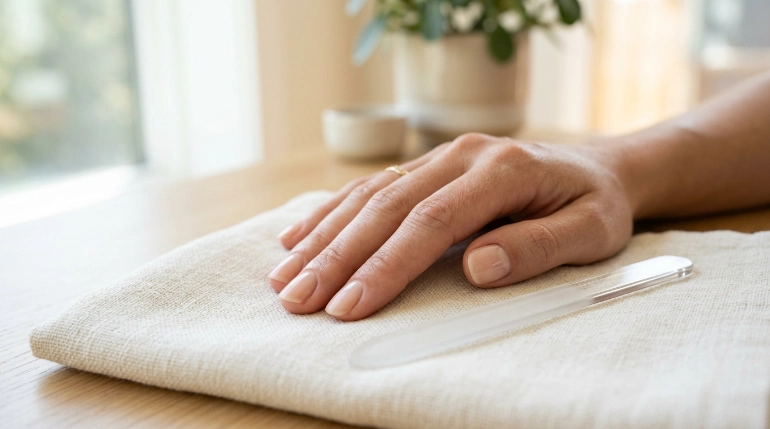
A crystal nail file is a reusable nail-shaping tool made from glass. Products may be labeled crystal file, glass file, or glass nail file.
Many quality versions have a finely textured surface that creates the filing action rather than using a traditional layer of coarse sandpaper-like grit.
That smooth texture is one reason many people prefer crystal files for natural nails. Instead of aggressively grinding away the edge, the file allows you to remove small amounts of nail at a time.
The word “crystal” does not necessarily mean the file is made from a precious crystal. In nail-care products, the term is commonly used for specially manufactured glass files.
Quality can vary between brands, so the material and construction matter more than the word printed on the packaging.
Why Crystal Nail Files Can Be Good for Your Nails
The biggest advantage of a crystal nail file is control. When you can shape your nail gradually, you are less likely to remove more length than you intended.
The American Academy of Dermatology recommends keeping nails shaped and free of snags with a nail file or emery board. Its healthy nail care recommendations also emphasize gentle nail care rather than unnecessary trauma.
Here are the main reasons crystal files are popular.
They Create a Smooth Nail Edge
A finely textured crystal file can leave the free edge of the nail feeling smooth instead of scratchy.
That matters because a rough edge can catch on:
- Hair
- Clothing
- Towels
- Bedding
- Bags and pockets
Once a nail begins catching repeatedly, a tiny rough spot can turn into a larger split or tear.
A smooth edge is especially helpful if you keep natural nails slightly longer.
They Can Feel Gentler on Thin Nails
If your nails peel easily, a very coarse file may remove nail material faster than you expect.
A fine crystal file gives you more control. You can make small adjustments without aggressively sawing at the nail.
That does not mean a crystal file can repair weak nails. It simply gives you a gentler shaping option.
If your nails suddenly become unusually weak, brittle, discolored, painful, or separated from the nail bed, filing is not a substitute for finding out what is causing the change.
They Are Reusable
Disposable emery boards eventually become smooth, bent, dirty, or worn.
A well-made glass file can usually be cleaned and reused many times as long as it remains undamaged and the manufacturer allows washing.
That can make the higher initial cost easier to justify if you regularly maintain your nails at home.
They Are Easy to Keep Clean
Many all-glass nail files can be washed with soap and water.
This is useful because nail dust and skin debris can accumulate on nail tools over time.
However, do not assume every decorative or coated nail file can be soaked or disinfected the same way. Follow the manufacturer’s cleaning instructions.
And avoid sharing nail files with other people, particularly if either person has a suspected fungal infection, wart, or damaged skin around the nail.
Crystal Nail File vs. Emery Board vs. Metal File
There is no single perfect nail file for every manicure.
The best choice depends on your natural nail thickness, what you are filing, and how much material you need to remove.
| Nail Tool | Best For | Main Advantage | Main Limitation |
|---|---|---|---|
| Crystal/glass file | Natural nails, fine shaping, smoothing | Smooth, controlled filing | Can break if dropped |
| Fine emery board | Everyday shaping and travel | Affordable and widely available | Wears out relatively quickly |
| Coarse emery board | Artificial product or significant length reduction | Removes material quickly | May feel too aggressive for thin natural nails |
| Metal file | Occasional shaping | Durable and easy to carry | Can feel harsh when used aggressively |
| Nail buffer | Smoothing the nail surface | Creates a smoother appearance | Over-buffing can thin the nail plate |
The American Academy of Dermatology recommends filing nails to smooth the corners after trimming and advises keeping nails shaped so they do not snag.
For everyday natural-nail maintenance, a fine crystal file is often one of the easier tools to control.
Are Crystal Nail Files Better for Peeling Nails?
They can be a better filing tool, but they are not a treatment for peeling nails.
When layers of your nail are already separating, aggressive filing can make those layers catch and peel farther.
A fine file lets you gently smooth the loose edge instead.
The more important step is figuring out why your nails are peeling.
Repeated exposure to water, cleaning products, acetone, manicure removal, picking, and general nail trauma may all contribute to weak-looking nails. Mayo Clinic recommends keeping fingernails clean and dry, practicing good nail hygiene, and moisturizing the nails and cuticles.
If the peeling is mild, try shortening the nail slightly and smoothing the edge.
If it keeps happening despite gentle care, consider speaking with a dermatologist rather than repeatedly filing away the damaged layers.
How to Use a Crystal Nail File Correctly
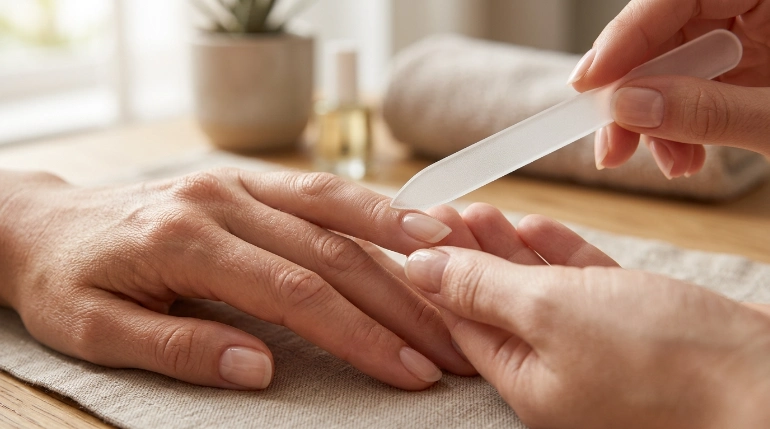
A gentle file can still damage your nails if you use too much pressure.
Use this simple routine.
1. Start With Clean Nails
Remove dirt and make sure you can clearly see the natural nail edge.
If you are filing bare nails, they should not have obvious redness, bleeding, swelling, or painful cracks around them.
2. Decide on Your Shape First
Common natural nail shapes include:
- Round
- Oval
- Squoval
- Square
- Almond
Choosing the shape before you start helps prevent repeatedly filing one side while trying to “fix” the other.
3. File Gradually
Place the crystal file against the free edge of the nail.
Use light pressure.
Remove a small amount of nail at a time rather than trying to reshape the entire nail quickly.
For conservative at-home nail care, using controlled strokes in one direction is a simple way to avoid aggressive sawing. The AAD also advises one-direction filing when teaching nail-care techniques for children because back-and-forth filing can weaken nails.
4. Check the Shape Frequently
After every few strokes, stop and look at your nail from the front.
This prevents over-filing.
Pay particular attention to the sidewalls—the sides of the nail near the fingertip. Filing too deeply into these areas can weaken the nail and change its shape.
5. Smooth Only What Needs Smoothing
Once the rough edge is gone, stop.
Continuing to file because the motion feels satisfying can gradually shorten or thin the edge more than necessary.
6. Finish With Moisturizer
After filing and cleaning away nail dust, apply hand cream or cuticle oil around the nail.
Moisturizing the nails and cuticles is part of the basic healthy-nail routine recommended by Mayo Clinic.
Expert Tip: Use the lightest pressure that still smooths the nail. If you can hear or feel aggressive scraping, reduce the pressure instead of trying to finish faster.
Can You File Back and Forth With a Crystal Nail File?
You may see crystal-file manufacturers advertising that their products can be used in either direction.
However, technique matters more than racing back and forth across the nail.
If your nails are thin, peeling, or damaged, slow controlled strokes are the safer at-home approach.
The AAD specifically recommends pulling a file across the nail in the same direction in its nail-care guidance for children, noting that aggressive back-and-forth filing can weaken nails.
So even if your particular crystal file is designed for multidirectional filing, there is little reason to use a fast sawing motion.
What Type of Nails Benefit Most From Crystal Files?
Crystal files are particularly convenient for people who:
- Maintain natural nails at home
- Frequently develop small snags
- Prefer shorter or medium-length nails
- Have thin nails that dislike coarse files
- Want precise shaping
- Prefer a washable, reusable manicure tool
They are also useful for maintaining a shape between manicures.
For example, if the corner of a squoval nail begins catching on clothing, you may only need two or three gentle strokes rather than completely reshaping the nail.
When a Crystal File May Not Be the Best Tool
Crystal nail files have limits.
Very Thick Toenails
A fine crystal file may take a long time to reduce a thick toenail.
More importantly, unusual thickening can sometimes accompany nail problems that should not simply be filed away.
Heavy Acrylic, Dip, or Builder Gel
Removing significant amounts of artificial product requires a different level of abrasiveness and technique.
Trying to grind off an entire enhancement with a small crystal file is inefficient and may encourage excessive filing near the natural nail.
The AAD notes that artificial-nail removal and frequent touch-ups can contribute to thinning, brittleness, and dryness of the natural nail.
When you are unsure where the enhancement ends and your natural nail begins, professional removal can be the safer choice.
Painful or Infected Nails
Do not aggressively file a nail that is:
- Swollen
- Bleeding
- Warm
- Painful
- Producing drainage
- Separating from the nail bed
- Significantly discolored or thickened
A nail file is a grooming tool, not a treatment for infection.
How to Choose a Good Crystal Nail File
You do not need the most expensive file available, but a few details are worth checking.
Choose a Fine, Even Surface
Run a finger lightly over the file.
The filing area should feel consistent rather than having random sharp patches.
A very rough surface may be unnecessary for routine natural-nail shaping.
Look at How the Abrasive Surface Is Made
Some glass files have a textured surface designed to remain abrasive for a long time, while some inexpensive products may rely on surface coatings that wear down.
Check the manufacturer’s description rather than assuming every glass-looking file performs the same way.
Choose a Comfortable Size
A longer file is convenient for home manicures.
A shorter version may be easier to keep in a purse or travel manicure kit.
Consider a Protective Case
Glass can break.
A sleeve or hard case protects the file in a makeup bag or bathroom drawer and reduces the chance of the file being chipped.
Do not continue using a cracked or chipped glass file. Sharp damaged glass is an injury risk.
How to Clean a Crystal Nail File
Hygiene is one of the most important parts of reusable nail-tool care.
For a washable all-glass file:
- Rinse away visible nail dust.
- Wash the surface using mild soap and water.
- Rinse thoroughly.
- Allow the file to dry completely.
- Store it in a clean protective case.
Always follow the manufacturer’s instructions if your file has decorative coatings, handles, embellishments, or other materials.
Do not casually share personal nail tools.
If a file has been used on a nail with suspected fungus or on an area with a wart, avoid using that same tool on healthy nails without appropriate cleaning or replacement. Dermatologists specifically warn that reusable abrasive tools can spread the virus responsible for warts when moved from an affected area to another part of the body.
Common Mistakes to Avoid
Even a good crystal nail file can give poor results when used incorrectly.
- Filing too aggressively: More pressure does not automatically create a better shape.
- Filing the sidewalls too deeply: This can weaken the structure of the nail.
- Trying to repair peeling by filing the nail thinner: Smooth loose edges, but do not grind away healthy nail.
- Using the file on broken skin: Wait until cuts or irritation have healed.
- Sharing nail files: Personal manicure tools are more hygienic when kept personal.
- Ignoring cracks in the glass: Replace a chipped or cracked file.
- Over-filing artificial enhancements: It is easy to reach the natural nail and thin it accidentally.
- Using filing to hide a nail problem: Persistent discoloration, pain, separation, or thickening deserves proper evaluation.
Are Crystal Nail Files Worth the Cost?
Crystal nail files usually cost more upfront than basic disposable emery boards, although exact prices vary considerably by brand, construction, size, and retailer.
The value comes from reusability.
If you regularly replace disposable files because they bend or lose their grit, a durable glass file can be more convenient over time.
On the other hand, an inexpensive fine-grit emery board may be perfectly adequate if you only file your nails occasionally.
You do not need to switch simply because crystal files are popular.
Choose one if you value:
- A smooth filing feel
- Precise natural-nail shaping
- Washability
- Reusability
- A compact tool for regular maintenance
Crystal File Safety for Sensitive or Damaged Nails
If your nails are already very thin, treat filing as maintenance rather than correction.
Your goal should be to eliminate snags while preserving as much healthy nail as possible.
Avoid filing the top surface of a thin natural nail unless there is a specific reason to do so. A nail file shapes the free edge; a buffer is designed for controlled surface smoothing.
Even buffing should be conservative because repeatedly removing layers from the nail plate can leave it thinner.
Also pay attention to the skin around your nails.
The cuticle forms part of the protective seal around the nail. Dermatologists advise against cutting or removing the cuticle because damaging that area can make it easier for irritation or infection to develop.
DIY Crystal Filing vs. a Professional Manicure
For normal shaping and snag removal, filing at home is usually straightforward.
A professional manicure becomes more useful when the situation involves structural damage, difficult enhancements, or a nail shape you cannot maintain safely yourself.
A nail technician can help with cosmetic shaping, artificial-nail maintenance, and safe product removal within their professional scope.
However, a nail technician is not a replacement for a medical professional when a nail appears infected or diseased.
When to See a Nail Technician or Dermatologist
Consider visiting a nail technician when you need help with:
- Removing acrylic, gel, or dip without over-filing
- Correcting an uneven cosmetic shape
- Maintaining artificial enhancements
- Choosing an appropriate professional filing method
Consider seeing a dermatologist or other qualified healthcare professional if you notice:
- Persistent nail discoloration
- Significant thickening
- Pain or swelling
- Pus or drainage
- Nail separation
- Bleeding without an obvious minor injury
- Changes that continue despite gentle nail care
- A suspected fungal infection
Nail fungus can affect both fingernails and toenails and may require proper diagnosis and treatment rather than cosmetic filing alone. The American Academy of Dermatology provides additional information about nail fungus diagnosis and treatment.
If something about your nail looks unusual or painful, do not keep filing it down hoping the problem will disappear.
FAQs
Are crystal nail files good for thin nails?
Yes, a fine crystal nail file can be a good option for thin nails because it allows controlled, gentle shaping. Use light pressure and stop once the rough edge is smooth.
Do crystal nail files damage nails?
They should not damage healthy nails when used correctly. Over-filing, heavy pressure, or repeatedly filing already peeling areas can still weaken the nail.
Are glass and crystal nail files the same?
The terms are often used interchangeably in beauty products. Many “crystal” nail files are made from specially textured glass. Construction varies, so check the product description.
How long does a crystal nail file last?
A quality file can remain usable much longer than a disposable emery board when properly cleaned and protected. Replace it if it becomes cracked, chipped, unusually smooth, or otherwise damaged.
Can I use a crystal nail file on acrylic nails?
You can make small adjustments with some files, but a fine crystal file is not usually the most efficient choice for removing significant amounts of acrylic or other hard enhancements. Professional help may reduce the risk of filing into the natural nail.
Can crystal nail files be washed?
Many all-glass files can be cleaned with soap and water, but follow the manufacturer’s instructions. Files with coatings, decorations, or attached materials may require different care.
Is a crystal nail file better than an emery board?
Neither is automatically better for everyone. Crystal files are reusable and offer smooth, controlled shaping, while emery boards are inexpensive and available in many grit levels. For gentle maintenance of natural nails, many people find crystal files particularly convenient.
Conclusion
So, are crystal nail files good for your nails? For most people maintaining healthy natural nails, the answer is yes.
A quality crystal file offers smooth, precise shaping, can be gentler than a very coarse file, and is convenient because it can often be washed and reused.
The key is technique. Use light pressure, remove only as much nail as necessary, keep your tool clean, and replace it if the glass becomes damaged.
Most importantly, remember that filing improves nail shape—it does not treat nail disease or repair significant damage. If you notice persistent pain, swelling, discoloration, thickening, or separation, put the file down and get appropriate professional advice.
For everyday maintenance, pair gentle filing with clean, moisturized nails and a little patience. Your goal is not to file more—it is to keep the nail edge smooth while protecting the healthy nail you already have.

