
Kids’ Manicures: Safe Ages, Safer Products, and Precautions That Actually Help

As a licensed nail technician and mom, I get this question constantly: are manicures safe for kids? The short answer is yes for some types, no for others, and “not yet” for a few salon services. The longer answer depends on your child’s age, the product, and who performs the work. This guide breaks down what matters so you can make a confident call without needing a chemistry degree.
Quick Answer: Manicures Can Be Safe for Kids, but Not Every Type at Every Age
Regular air-dry polish and water-based peel-off polish are the most kid-friendly places to start. Gel polish, dip powder, and acrylic enhancements are higher-risk and usually not appropriate for children or young teens, mainly because of chemical exposure, UV curing, and removal damage. Press-on nails can work for short special occasions, but only with a short wear time and careful removal.
If you want a quick decision rule: before age three, avoid nail polish altogether unless it’s a supervised, child-specific peel-off formula and your child is past the hand-to-mouth phase. Most child-friendly polish brands label their products for ages three and up, with extra caution for younger toddlers because of hand-to-mouth contact (Miss Nella). For deeper age-by-service advice, see our full guide on what age kids can get their nails done.
Why Kids’ Nails and Cuticles Need Different Safety Rules
Adult manicure routines do not scale down neatly. Children’s nail plates are thinner and more flexible than adult nails. That means aggressive filing, buffing, or scraping can remove healthy surface layers faster than it would on an adult. Some dermatologists advise keeping children’s nail care simple: clean and trimmed, with no aggressive manipulation of the nail or nail bed. Ask your pediatrician before any service that involves filing the nail surface or pushing cuticles, especially if your child has eczema or sensitive skin.
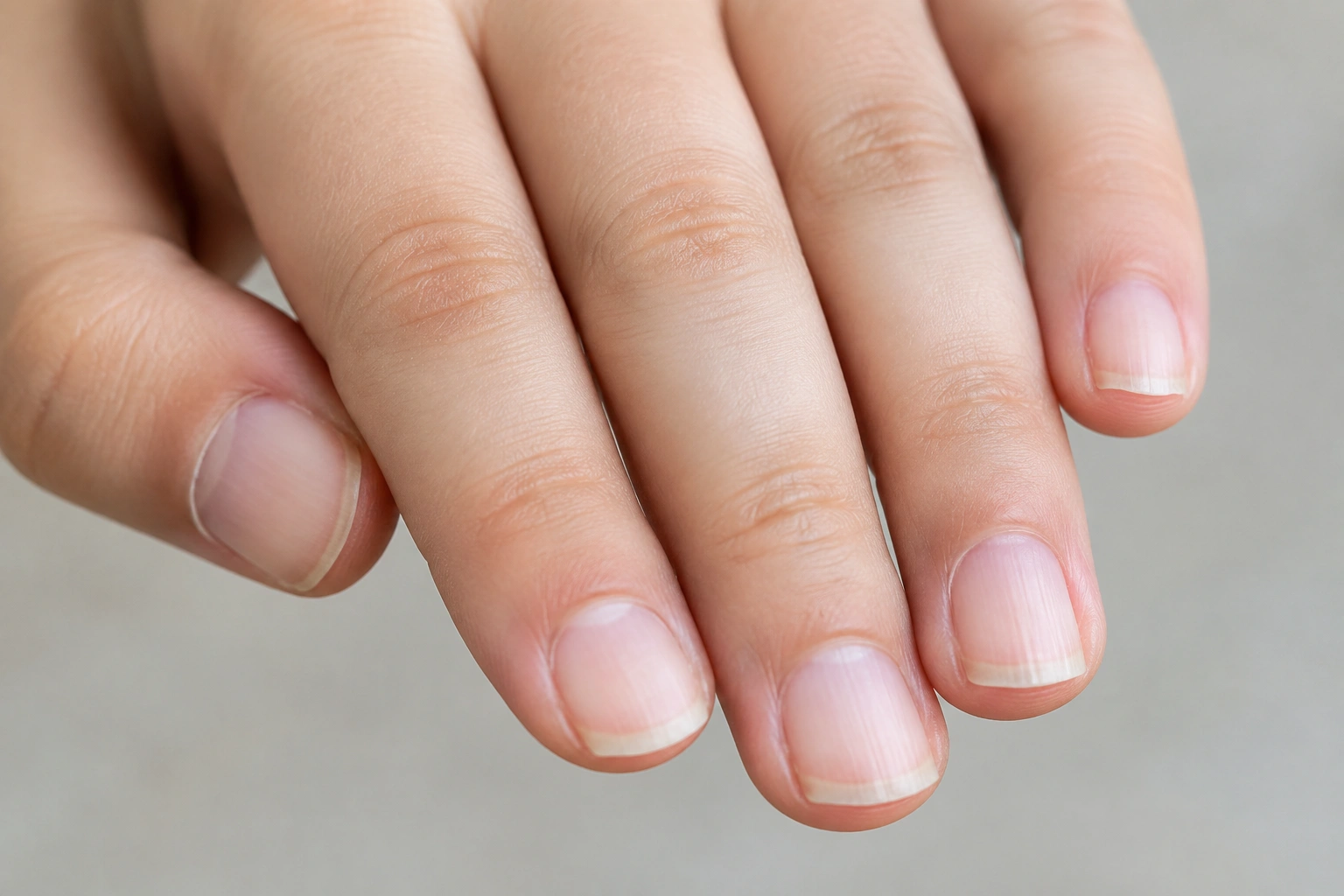
Cuticles are another place where the rules need to change. The cuticle is a protective seal where the nail plate emerges. Cutting or aggressively pushing back a child’s cuticle can open a small door for bacteria or yeast, and kids are already less consistent about hand hygiene. Most nail pros, including me, prefer to leave young cuticles alone or soften them with kid-safe cuticle oil.
Young children also explore the world with their mouths. A toddler who sucks fingers or chews nails may ingest small amounts of polish or flakes, so the product formula matters just as much as the color.
Manicure Type Safety Guide: Regular Polish, Peel-Offs, Press-Ons, Gel, Dip, and Acrylics
The type of manicure matters more than the setting, because each product has a different chemical, curing, and removal profile.
There is no widely cited pediatric organization guideline that sets a specific age cutoff for manicures, so the age ranges below are my pragmatic professional judgment, not a formal medical guideline. If your child has allergies, eczema, or hand-to-mouth behavior, check with your pediatrician before trying any product.
| Option | Typical age to consider | Main risks | Removal and wear reality | Parent verdict |
|---|---|---|---|---|
| Regular air-dry polish | Often around 4–5 and up, when a child can sit still and keep hands away from the mouth | Solvent fumes; possible irritating or sensitizing ingredients; minor nail drying | Removes with remover; may chip quickly | Yes for occasional use with a free-from label |
| Water-based peel-off polish | Most kid brands say 3+ | Lower solvent odor; some formulas include preservatives or colorants; excessive peeling can tug the nail surface | Peels or washes off with warm water; shorter wear | Best first option for young kids |
| Press-on nails | Usually around 6+ for a short special event, if no mouthing or picking | Adhesive can irritate skin; trapped moisture may weaken the nail if left on too long | Wear for 1–3 days in kids, remove at the first sign of lifting | Occasional event option, not daily wear |
| Gel polish | Teen years only, if ever; many dermatologists advise limiting it for children | Acrylate exposure, UV/LED curing, more aggressive removal, roughening before application | Acetone soak plus gentle scraping; can thin nails | Usually skip for kids |
| Dip powder | Older teen only, with careful hygiene review | Shared powder jars can become contaminated; strong chemicals; heavy filing; difficult removal | Long acetone soak; can leave nails weak | Skip or defer |
| Acrylic enhancements | Adult-style extension; not advisable for kids and young teens | Strong monomers, heavy filing, lifting and trauma risk on thin nails | Professional soak-off; high maintenance | Skip for kids |
The trade-off: regular polish chips faster but is much easier to remove; gel and dip last weeks but the chemical and mechanical load is much larger. For most children, shorter wear is a feature, not a bug.
Nail Polish Chemicals to Avoid and How to Read ‘Free-From’ Labels
Parents often ask whether “non-toxic” means the polish is truly kid-safe. It is not a regulated safety claim. The FDA regulates cosmetics but does not pre-approve cosmetic products or ingredients before they go on sale (FDA). That means you still need to read the ingredient panel.
These are the ingredients most frequently flagged in conventional nail polish:
- Toluene: a solvent and respiratory irritant with concerns about repeated exposure.
- Formaldehyde: a preservative and hardener; a known sensitizer and respiratory irritant.
- Dibutyl phthalate (DBP): a plasticizer that has raised endocrine-related concerns.
- Formaldehyde resin: a hardener that can trigger allergic contact dermatitis.
- Camphor: a plasticizer that may irritate the skin and lungs in high concentrations.
- Triphenyl phosphate (TPHP): another plasticizer with hormone-related concerns under study.
Free-from labels give a starting point, but they are not all identical. A 3-free polish typically omits toluene, formaldehyde, and DBP. A 5-free formula often also removes formaldehyde resin and camphor. Seven-free and ten-free labels vary by brand, so the only way to know is to check the actual ingredient list rather than relying on the number. For children, the most practical exposure concerns are solvent fumes during application, skin contact with sensitizing ingredients, and mouthing or ingesting chips from regular polish. That argues for small amounts, good ventilation, and occasional use rather than back-to-back manicures.
Remover choice matters too. Acetone is fast and effective but can be drying. Many acetone-free removers use ethyl acetate or methyl acetate instead; they may be less aggressive for occasional use but can still produce fumes and skin irritation, so they are not automatically risk-free. For children, use the smallest amount that works in a well-ventilated area, wipe rather than soak, and wash hands afterward. Water-based peel-off polishes avoid remover altogether. For a closer ingredient-by-ingredient breakdown, see is nail polish safe for kids?.
UV/LED Lamps and Gel Manicures: What Parents Should Know
Gel polish stays on because it is cured under a UV or LED lamp. That step is where a lot of the risk concentrates. Some dermatologists advise limiting gel manicures for children because of the potential for nail and skin damage, although there is no widely cited pediatric guideline that sets a specific age cutoff.
Nail curing lamps emit primarily UVA radiation. Repeated UVA exposure is a recognized skin-cancer risk factor, and children have more cumulative years ahead of them. However, quantifying the risk of a single salon session is difficult because lamp strength, duration, and hand position vary. Air-dry polish avoids this step entirely, which is one reason regular polish is the safer choice for kids. If an older teen decides to try gel, UV-protective gloves are worth asking about—and if the salon cannot provide them, skipping the service is reasonable.
Salon vs. At-Home Manicures: Hygiene, Licensing, and Red Flags
At home, you control the product, the ventilation, and whether any trimming happens. A salon can feel special, but it also brings shared tools, higher fume concentration, and a person who may not specialize in kids’ nails.
Before booking a child’s salon manicure, call and ask:
- Are files and buffers single-use or disinfected between clients?
- Are metal tools autoclaved or soaked in a hospital-grade disinfectant?
- Do you trim or cut children’s cuticles? The answer you want is no.
- Do you serve children under a certain age, and do you require a parent to stay?
- Is the station well ventilated? A strong chemical smell is a red flag.
- When doing dip services, do you pour the powder into a separate container for each client?
State and local salon age policies vary. Some jurisdictions require parental consent or set minimum ages for certain services; others leave it to salon discretion. Before booking, ask whether the salon serves minors, requires a parent to stay, and has any age-related restrictions for gel, dip, or acrylic services.
Watch for tools that come out of a drawer without being opened from sterile packaging or a clean kit, reused buffers, and techs who trim cuticles before asking. In many states, nail technicians are licensed through a state board of cosmetology, so seeing a current license is a reasonable request. Some salons decline young children because of safety; that is often a sign of a careful shop, not a rejection. For more on salon decision-making, see our guide to kids getting manicures.
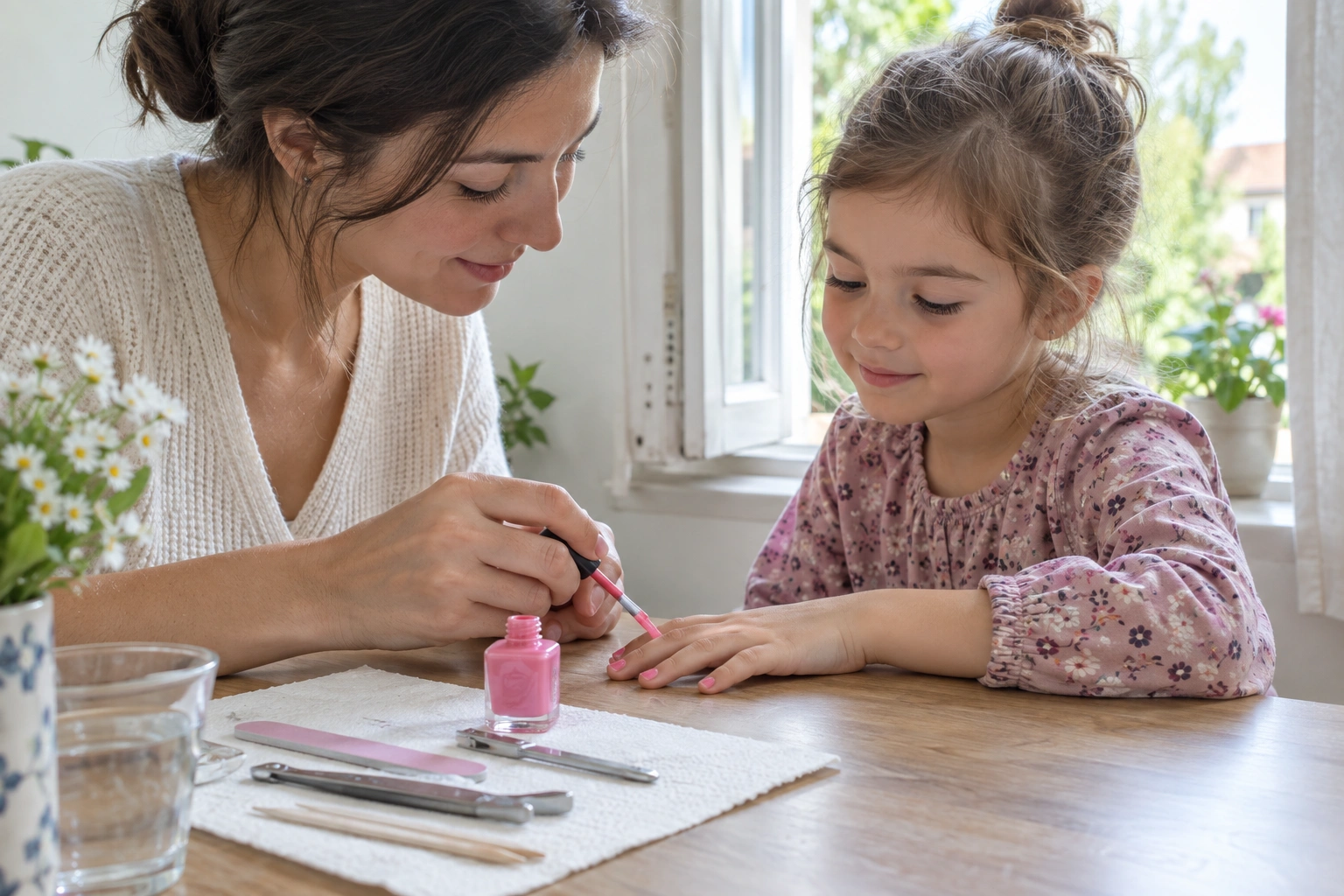
Step-by-Step Safer At-Home Kid Manicure
If you want the lowest-risk route, an at-home polish session with a parent involved is usually the best one.
- Set up in a well-ventilated area and cover the surface with a paper towel.
- Wash hands with mild soap and dry them fully.
- Trim nails to a short, comfortable length. File in one direction with a soft file, but do not over-file the nail surface.
- Apply a small amount of kid-safe cuticle oil if the cuticles look dry. Skip cuticle cutting or aggressive pushing—the protective seal matters, as described above.
- If your child has eczema or sensitive skin, patch-test a new polish by applying a small amount to the inside of the wrist and waiting 10–15 minutes.
- Apply one or two thin coats of polish. Thick layers take longer to dry and are easier to smudge.
- Let nails dry fully away from the face. Remind your child not to blow on wet nails.
- Clean files, clips, and tools after use with soap and water or alcohol.
Kid-Safe Polishes and Temporary Alternatives: Water-Based, Peel-Off, Press-On, and Stickers
Water-based, peel-off polishes are the gentlest place to start. They usually have far less solvent odor and can be removed with warm water or a gentle peel, so you avoid acetone altogether. Look for child-specific formulas that state water-based or peel-off on the front, then confirm on the ingredient list. Brands often marketed as kid-safe include Piggy Paint, Ella + Mila, Suncoat, and Karma Organic—but the label remains more important than the brand name.
Press-on nails can be a better special-event choice than gel because they do not require UV curing or harsh removal. Wear-time guidance is in the comparison table above; the key is short, supervised use and removal at the first sign of lifting. Nail stickers and wraps are also lower-commitment than glue-on sets, but they can become a choking hazard for toddlers if peeled off and mouthed.
Safe Polish Removal and Nail Recovery: Acetone vs. Acetone-Free and Frequency
Acetone is the fastest remover, but it is also drying. For an occasional regular-polish manicure on a child, acetone-free remover may be gentler, even if it takes a little more patience. Check the label: many acetone-free formulas use ethyl acetate or methyl acetate, which still require ventilation and hand washing. Water-based peel-off polishes do not need remover at all.
The method matters as much as the solvent. Soak a cotton ball, press it on the nail for a few seconds, then wipe in one direction. Do not scrape or pick off regular polish, because peeling can lift healthy layers of the nail plate. Wash hands afterward and apply a plain moisturizer or cuticle oil.
Frequency deserves a limit, even with kid-safe products. I like to leave at least a week or two of bare nails between manicures so the nail plate can recover. If nails look chalky, ridged, or peel at the tips, take a break for a few weeks before polishing again.
Warning Signs After a Manicure: Allergy, Nail Damage, or Infection
A little smudging is normal. Redness, itching, swelling, or pain is not. Remove polish right away and monitor if you see:
- Redness or swelling around the nail folds
- Itching, burning, or blisters on the fingers or hands
- Yellow, green, or cloudy drainage near the nail
- Nail lifting away from the nail bed
- Persistent white, yellow, or dark spots under the nail
- Nails that feel excessively thin, brittle, or peel after repeated polish and removal
When to See a Pediatrician or Dermatologist
If any of these symptoms appear, do not reapply polish to cover them up. A pediatrician or dermatologist can tell the difference between contact dermatitis, nail trauma, and a bacterial or fungal infection. The earlier you check, the easier it is to manage.
Parent Decision Checklist: Go, Modify, or Skip
Go ahead when:
- Your child is at least 3 and can follow simple instructions.
- You are using a water-based peel-off polish or a regular polish labeled 3-free or higher.
- The session is occasional, supervised, and in a ventilated space.
- No cuticle cutting, aggressive filing, or UV lamp is involved.
Modify the plan when:
- Your child wants regular polish but has eczema or allergies—patch test first and choose a fragrance-free, free-from formula.
- You are considering a salon—call ahead, ask about single-use tools, and stay for the service.
- Your child is older and asking about gel—swap to a regular polish or press-on option and explain the removal trade-off.
Skip when:
- The request is for gel, dip powder, or acrylic extensions before the teen years.
- A salon wants to trim cuticles or reuse files without visible opening of a clean package.
- Any part of the nail or surrounding skin looks irritated, torn, or infected.
- The polish is chipping and your child is tempted to pick it off.
FAQ: Kids’ Manicure Safety Questions Answered
Can a 3-year-old get a manicure?
Most child-specific water-based polish brands label their products for ages three and up, with extra caution for younger toddlers because of hand-to-mouth contact. A 3-year-old can enjoy a supervised at-home polish session, but a full salon manicure with soaking, filing, and cuticle work is usually unnecessary at that age.
Are gel manicures safe for 10-year-olds?
Some dermatologists advise limiting gel manicures for children because of the potential for nail and skin damage. For a 10-year-old, regular polish or a water-based peel-off polish is the lower-risk choice. Gel polish, dip powder, and acrylics can generally wait until the later teen years, if ever.
What should I look for in kid-safe nail polish?
Choose a water-based peel-off formula when possible, or a regular polish that is 3-free or higher—meaning it omits toluene, formaldehyde, and DBP. Do not treat “non-toxic” or “natural” as a guarantee; read the full ingredient panel and watch for added fragrance if your child has sensitive skin.
How often is too often for a child to get a manicure?
Occasional is safest. Leaving at least a week or two of bare nails between manicures gives the nail plate time to recover. If nails look dull, chalky, peeled, or brittle, take a longer break.
Are press-on nails safer than gel for kids?
Press-on nails avoid UV curing and harsh soak-off, so they can be a lower-removal-risk option for a short special event. Keep wear time brief and supervised—see the comparison table for the recommended age and wear window—and remove at the first sign of lifting.

