
Are Nail Files and Sandpaper the Same? What’s the Difference?

If you have ever looked closely at an emery board and a sheet of sandpaper, you may have wondered: are nail files and sandpaper the same? They can certainly look and feel similar. Both have a rough surface, both remove material through friction, and some disposable nail files are even made with abrasive particles attached to a flexible backing.
But they are not the same product.
Nail files are designed specifically for shaping, shortening, and smoothing nails. Sandpaper is primarily manufactured for sanding materials such as wood, paint, metal, plastic, and other hard surfaces. The abrasive technology can overlap, but the backing, grit choices, construction, cleanliness, and intended use can be very different.
Below, we’ll break down how they compare, whether sandpaper can safely replace a nail file, which nail-file materials are best for different situations, and how to avoid damaging your natural nails.
Quick Answer
Are nail files and sandpaper the same? No. Both use abrasive surfaces to wear material away, but nail files are specifically made for nails, while sandpaper is designed mainly for sanding harder surfaces. Some emery boards use sandpaper-like abrasive material, but their grit, backing, shape, and intended use make them better suited to nail care.
Why Nail Files and Sandpaper Look So Similar
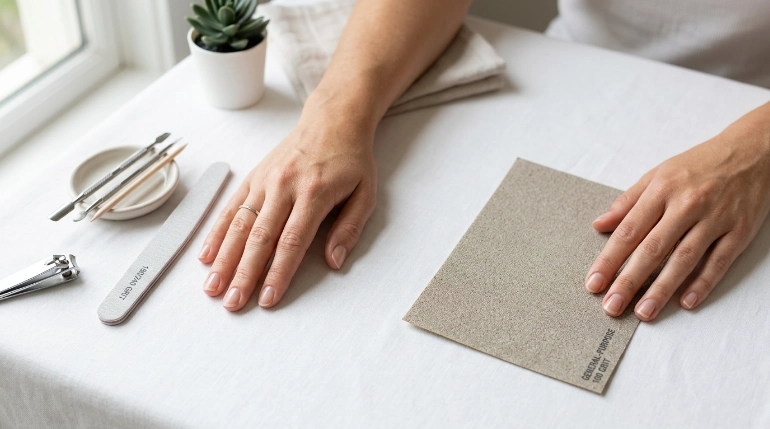
The confusion makes sense because both products work through the same basic idea: abrasion.
An abrasive surface contains tiny hard particles. When you rub that surface against another material, those particles gradually remove small amounts of it.
A nail file uses this process to smooth or reshape the free edge of your nail. Sandpaper uses it for sanding, finishing, deburring, or preparing surfaces. For example, 3M describes its sandpaper sheets and rolls as paper-backed abrasive products intended for sanding, grinding, deburring, and finishing applications.
So, while the mechanism is similar, the products are designed for very different jobs.
Nail File vs. Sandpaper: Key Differences
| Feature | Nail File | Sandpaper |
|---|---|---|
| Main purpose | Shaping and smoothing nails | Sanding wood, paint, metal, plastic, and other materials |
| Typical design | Emery board, cushioned file, glass, ceramic, or metal | Abrasive sheet, disc, roll, belt, or block |
| Grit options | Selected for natural or artificial nails | Extremely wide range for industrial and DIY surfaces |
| Shape | Easy to hold around fingernails and toenails | Usually designed for larger work surfaces or sanding tools |
| Backing | Cardboard, foam, plastic, glass, ceramic, or metal | Paper, cloth, film, mesh, or similar backing |
| Hygiene | Some types are disposable; others can be cleaned | Not generally manufactured as a personal-care tool |
| Best choice for nails | Yes | Generally no |
The biggest practical difference is control. A nail file gives you a narrow, manageable surface that can follow the edge of the nail without constantly touching the surrounding skin.
What Is a Nail File Made Of?
“Nail file” actually describes several different tools rather than one specific material.
Emery Boards
An emery board is probably the closest nail-care equivalent to sandpaper.
It usually has abrasive particles attached to a cardboard, wooden, plastic, or cushioned backing. This gives it the familiar rough texture most people associate with nail files.
Emery boards are popular because they are:
- Lightweight
- Inexpensive
- Easy to control
- Available in different grits
- Convenient for travel
- Easy to replace
Because the surface gradually wears down and can collect nail debris, disposable emery boards are best replaced when they become worn, dirty, or difficult to clean.
Glass or Crystal Nail Files
Glass files use a textured or etched glass surface instead of a layer of abrasive paper.
They tend to feel smoother and more controlled than inexpensive coarse emery boards. They are also reusable when the manufacturer’s cleaning instructions allow it.
For someone with natural nails that split or snag easily, a fine glass file can be a comfortable option because it allows precise shaping without requiring aggressive pressure.
Metal Nail Files
Metal files are durable, but some can feel relatively aggressive on thin or fragile natural nails.
They may be useful for certain thicker nails, but pressure still matters. A durable tool does not automatically mean it is the gentlest choice.
Ceramic Files
Ceramic files are another reusable option. Like glass files, they can offer a relatively smooth filing experience depending on the texture of the specific tool.
The important point is that not all nail files are basically little pieces of sandpaper. Nail files can be made from several completely different materials.
What Is Sandpaper Made Of?
Modern sandpaper does not necessarily contain actual sand.
Instead, manufacturers use abrasive particles bonded to backing materials such as paper, cloth, film, or mesh. Different products are designed to remove paint, level filler, smooth wood, finish metal, or prepare other materials. 3M’s abrasive ranges, for example, include many different formats and grades for specific surface-finishing jobs.
That means a random sheet of sandpaper from a garage or workshop can be very different from the abrasive surface on a manicure file.
Its:
- Abrasive material
- Particle size
- Backing
- Flexibility
- Durability
- Surface coating
- Intended application
may all differ.
That is one reason matching two products only by how rough they feel isn’t reliable.
How Nail File Grit Works
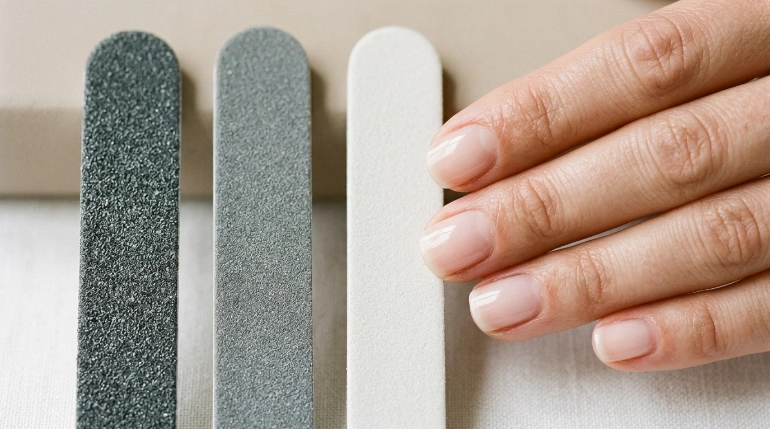
Grit tells you how coarse or fine an abrasive surface is.
As a general rule, a lower grit number means a more aggressive surface, while a higher number means a finer surface. OPI currently offers nail files in multiple grit levels, including 180, 220, and 240, for different nail-service purposes.
You may commonly see nail files such as:
- 100/180 grit
- 180/240 grit
- 220 grit
- 240 grit
- Finer smoothing or finishing surfaces
However, don’t assume that a piece of hardware-store sandpaper with a similar number automatically behaves exactly like a nail file.
The abrasive particle, coating, backing, pressure, and intended surface can affect how the tool performs.
Natural Nails Need a Gentler Approach
Natural nails are made of layers of keratin and can become thin, rough, peeling, or split when they are repeatedly over-filed.
The American Academy of Dermatology recommends smoothing rough nail edges with a nail file or emery board. Its guide to trimming and filing nails also recommends gentle filing rather than aggressive sawing.
More abrasive is not automatically better.
If a file removes nail material extremely quickly, use less pressure and make sure the grit is appropriate for what you’re filing.
Can You Use Sandpaper as a Nail File?
Technically, an abrasive surface can remove material from a nail.
That does not make ordinary sandpaper the best substitute for a purpose-made nail file.
For routine manicures, use a nail file instead.
Workshop sandpaper may be:
- Too coarse
- Difficult to control
- Dirty or contaminated
- Previously exposed to paint, wood dust, metal particles, chemicals, or other materials
- Uncomfortable against the surrounding skin
- Made for a completely different level of abrasion
Even unused sandpaper may not be ideal because it wasn’t selected and shaped specifically for nail care.
If you simply have one small snag and no file available, clipping the loose edge carefully with clean nail clippers is generally a more predictable choice than reaching for an unknown piece of workshop sandpaper.
Why Coarse Sandpaper Can Damage Natural Nails
Natural nails aren’t blocks of wood.
Aggressive sanding can remove too much of the nail plate. Repeated thinning may leave nails feeling sensitive, flexible, weak, or prone to peeling.
This is especially important if you’re filing the top surface of the nail rather than just shaping the free edge.
The American Academy of Dermatology notes that filing the natural nail surface for artificial-nail application makes the nail thinner and weaker.
Possible signs that you’re being too aggressive include:
- Burning or heat while filing
- Tenderness afterward
- Visible thinning
- Peeling layers
- Increased bending
- Red or irritated surrounding skin
- Pain when pressure is applied
Stop filing if it hurts. Nail shaping should not require filing until your nail plate feels sore.
Is an Emery Board Basically Sandpaper?
This is where the answer becomes a little more nuanced.
An emery board and sandpaper can be constructed using a similar concept: abrasive particles fixed to a backing.
So an emery board can reasonably be described as sandpaper-like.
But that doesn’t mean an emery board and a sheet of general-purpose sandpaper are interchangeable.
Think of it this way: facial exfoliating products and household scouring pads both create friction, but they’re designed for very different surfaces.
Purpose matters.
An emery board is sized, shaped, and graded for nail work. Ordinary sandpaper is manufactured around the demands of material finishing.
Nail Files vs. Sandpaper for Acrylic or Gel Nails
Artificial nails are harder than natural nails, so nail technicians may use coarser nail files when shaping enhancements.
OPI’s professional guidance, for example, includes the use of a 180-grit file when refining certain acrylic tip applications.
That still doesn’t mean you should replace a professional nail file with construction sandpaper.
A nail file gives you better:
- Grip
- Edge control
- Nail-by-nail precision
- Access around sidewalls
- Pressure control
If you’re removing gel, dip, acrylic, or another enhancement at home, avoid aggressively filing until you reach bare natural nail.
Once you reach the natural nail plate, continuing with a coarse abrasive can thin it surprisingly quickly.
How to File Natural Nails Safely
A simple technique is usually enough for an at-home manicure.
- Start with clean hands and a clean file.
Don’t use a file that has been sitting uncovered around workshop dust, dirt, or chemicals. - Trim excessive length first if necessary.
If your nails are much longer than you want, nail clippers can remove most of the length before filing. - Choose a nail file intended for natural nails.
Avoid grabbing the roughest file simply because it works faster. - Use light pressure.
Let the abrasive surface do the work. - Smooth rough edges gradually.
The AAD recommends using a nail file or emery board to smooth uneven or rough edges. - Check the shape frequently.
It is easier to remove a little more than to fix a nail you accidentally filed too short. - Stop if you feel heat, soreness, or discomfort.
Those are signs that you may be over-filing. - Moisturize afterward if your hands and cuticles feel dry.
Regular nail and skin care helps keep the area comfortable.
What About Filing Back and Forth?
You may have seen people rapidly saw a nail file from side to side.
For natural nails, a gentler technique is a better choice.
The AAD’s healthy nail-care recommendations encourage keeping nails shaped and snag-free with an emery board, while its nail-trimming guidance recommends filing in the same direction rather than aggressively moving back and forth.
If your nails already peel easily, slow down even more. More strokes and more pressure don’t necessarily produce a better manicure.
Hygiene Matters More Than You Might Think
A nail file comes into contact with keratin debris, skin, and sometimes damaged areas around the nail.
That makes hygiene important.
For Disposable Files
Replace a disposable emery board if it is:
- Visibly dirty
- Worn smooth
- Bent or damaged
- Contaminated with blood
- Used on a suspicious or infected-looking nail
Avoid casually sharing disposable nail files between people.
For Reusable Files
Glass, ceramic, and some other reusable files may be cleaned according to the manufacturer’s instructions.
Don’t automatically soak or disinfect every tool the same way. Materials react differently to disinfectants, water, and heat.
If you’re getting a manicure professionally, salon cleanliness matters as well. The AAD’s manicure and pedicure safety advice emphasizes infection-prevention practices when receiving nail services.
What If Your Nails Are Thin or Sensitive?
If your nails are already fragile, choose the gentler option.
Avoid:
- Coarse industrial sandpaper
- Heavy pressure
- Repeatedly filing the top surface
- Trying to grind away discoloration
- Filing painful areas
- Filing damaged surrounding skin
If one nail keeps splitting in the same place, the solution may not simply be “file it more.”
You may need to shorten the nail, reduce exposure to irritating products, change your manicure habits, or have the nail evaluated if the problem persists.
Expert Tip: If you’re unsure whether a file is too rough for your natural nails, start with a finer nail file and light pressure. Taking an extra minute to shape a nail is better than removing too much nail plate in a few aggressive strokes.
Cost and Convenience: Which Makes More Sense?
Sandpaper may already be sitting in your garage, but convenience alone doesn’t make it the smarter manicure tool.
Nail files are available in disposable and reusable styles, with cost varying by material, brand, and construction.
Disposable emery boards are usually the simplest option for occasional use. Reusable glass or ceramic files may make more sense if you regularly maintain natural nails and prefer a tool that can be cleaned according to its care instructions.
For most people, there is little practical reason to substitute general-purpose sandpaper for a tool specifically designed for nails.
Common Mistakes to Avoid
- Using workshop sandpaper on your nails. It may contain dirt, chemicals, paint residue, wood dust, or metal particles.
- Choosing the coarsest abrasive possible. Faster material removal isn’t necessarily safer.
- Filing through pain. Burning, soreness, and sensitivity are reasons to stop.
- Over-filing the nail surface. This can make natural nails thinner and weaker.
- Sharing dirty nail files. Nail-care tools can collect debris and should be handled with hygiene in mind.
- Trying to file away a nail infection. Filing alone does not eliminate nail fungus because the infection can exist within the nail and underlying tissue.
- Using one file for every purpose. A grit suitable for an artificial enhancement may be unnecessarily aggressive for a thin natural nail.
When to See a Nail Technician or Dermatologist
A nail technician can help when your main concern is cosmetic, such as choosing the appropriate file for an enhancement, reshaping acrylic nails, or correcting a manicure without unnecessarily thinning the natural nail.
A dermatologist is more appropriate when the issue may involve nail health rather than appearance.
Consider medical evaluation if you notice persistent:
- Nail pain
- Swelling
- Redness around the nail
- Drainage or pus
- Thickening
- Significant discoloration
- Nail separation
- Repeated unexplained splitting
- A new or changing dark streak
- Changes in nail shape or texture
The American Academy of Dermatology explains in its guide to nail changes a dermatologist should examine that changes in nail color, texture, or shape can sometimes warrant professional evaluation.
Don’t try to sand away a persistent nail problem. If something looks infected, painful, or unusually different, filing harder can hide the appearance temporarily while leaving the underlying cause untreated.
FAQs
Are nail files made from sandpaper?
Some disposable emery boards use abrasive particles bonded to a flexible backing, making their construction similar to sandpaper. Other nail files are made from glass, ceramic, metal, or cushioned materials, so not every nail file is sandpaper-like.
Can I use 240-grit sandpaper on my nails?
A similar grit number does not guarantee that general-purpose sandpaper will behave exactly like a nail file. The abrasive type and backing can differ. A purpose-made fine nail file is the safer and more controllable choice.
Is sandpaper too rough for fingernails?
Some sandpaper is extremely coarse and can remove natural nail material quickly. Even finer sandpaper is designed primarily for other surfaces, so it is better to use an abrasive specifically intended for nails.
Is an emery board the same as a nail file?
An emery board is one type of nail file. Nail files can also be made from glass, ceramic, metal, foam-backed abrasives, and other materials.
Can sandpaper remove gel or acrylic nails?
An abrasive can remove enhancement material, but ordinary sandpaper is not the preferred tool. Nail files designed for gel or acrylic offer better control. Be especially careful as you approach the natural nail because over-filing can thin and weaken it.
What is the best nail file for natural nails?
For most at-home users, a fine purpose-made nail file, emery board, or suitable glass file is easier to control than a coarse file. If your nails are thin or prone to peeling, err on the gentler side and avoid heavy pressure.
Can filing your nails make them weaker?
Yes, particularly when you repeatedly over-file the nail surface or use an unnecessarily aggressive abrasive. Dermatologists note that filing the natural nail surface can thin it, which is why gentle technique matters.
Final Thoughts
So, are nail files and sandpaper the same? No—but they are related in the way they work.
Both rely on abrasive surfaces to remove material. Some emery boards even have a construction that looks very similar to sandpaper. The difference is that nail files are purpose-built for controlling abrasion on a small, delicate part of your body, while sandpaper is designed mainly for finishing harder materials.
For everyday manicures, the smarter choice is simple: use a clean nail file with an appropriate grit rather than improvising with workshop sandpaper.
Keep the pressure light, stop if filing causes discomfort, and don’t try to grind away discoloration, infection, or unexplained nail changes. When a nail problem goes beyond basic shaping and smoothing, a qualified nail technician or dermatologist is a better next step.

