
How Long Regular Nail Polish Takes to Dry Completely

If you’ve ever painted your nails, thought they were dry, and then still dented one on a zipper or smudged it with a sock, you’re not alone. Regular nail polish has a tricky middle stage: it can feel dry on the surface long before it is truly ready for normal use.
Quick answer: for a beginner at home, regular nail polish is often dry to the touch in about 10 to 20 minutes, safe for very light use after about 20 to 30 minutes, and closer to fully dry after about 1 to 2 hours. Thicker coats, more layers, and humid conditions can stretch that longer.
The short answer is that regular nail polish usually becomes dry to the touch first, then takes longer to fully dry underneath. For many beginner at-home manicures, that means you may be able to lightly touch the surface after a little while, but you should still give your nails more time before using your hands normally. Thickness, number of coats, and room conditions all change the timing.
If you want a deeper breakdown of the whole drying process, this guide on how long nail polish takes to dry completely is a helpful companion read.
Quick Answer: How Long Regular Nail Polish Takes to Dry
Here’s the simplest beginner-friendly way to think about it:
| Drying stage | What it means | Practical use |
|---|---|---|
| Surface-dry | The top no longer feels wet or sticky | Light touch only |
| Safe for light use | The polish is less likely to smudge from gentle movement | Careful typing, holding a phone, very light tasks |
| Fully dry | The polish has hardened enough for normal use | Grabbing items, getting dressed, putting on shoes |
For many beginners, a thin regular manicure is surface-dry in about 10 to 20 minutes, safe for light use in about 20 to 30 minutes, and fully dry in about 1 to 2 hours. If you apply thick coats or several layers, expect the total drying time to stretch out.
For a broader overview of the timing question, see how long does nail polish take to dry.
Dry to the Touch vs Fully Dry
This is the part that confuses most beginners.
Dry to the touch means the surface has set enough that a very light tap may not leave a wet mark. That does not mean the polish is strong enough for normal activity. The layers underneath can still be soft, which is why a manicure can dent when you press on it, bump it, or slide a sock over it.
Fully dry means the polish has hardened much more evenly through the layers. At that point, it is less likely to smudge from normal movement.
A simple example: you paint your nails, wait until they no longer feel sticky, and then reach into your bag for keys. If the polish is only surface-dry, that quick grab can still leave a mark. The finish may look fine until something presses against it.
This is also why “feels dry” is not a perfect test. Your nails can seem ready while the polish is still soft underneath.
What Changes Drying Time
Regular nail polish does not dry at the same speed every time. A few practical factors make a big difference.

Coat thickness matters most
Thin coats dry faster than thick coats. A thick coat may look more opaque right away, but it traps more solvent and stays soft longer.
More coats mean more total drying time
A base coat, two color coats, and a top coat all add layers that need time to settle. Even if each coat seems thin, the full manicure still takes longer than a single layer would.
Formula and brand make a difference
Some regular polishes are naturally a bit faster or slower depending on the formula. That’s one reason you may notice one bottle dries quickly while another stays soft longer, even when you apply them the same way.
If you’re curious about whether polish age affects performance, this guide on opened nail polish shelf life can help.
Room conditions matter too
Warm, dry air usually helps polish set more comfortably than cold, damp air. Humidity can slow things down because the polish has a harder time losing its solvents. A cool room can also make the process feel longer.
Your application technique matters
Shaking the bottle too aggressively, loading too much polish on the brush, or flooding the nail with product can all make drying slower. A cleaner, thinner application is usually easier to live with afterward.
How Long to Wait Between Coats
For beginners, the safest rule is to wait until the previous coat is no longer visibly wet before adding the next one. You do not need to wait until the nail is fully hardened between every layer, but you do want each coat to settle first.
A practical routine looks like this:
- Apply a thin base coat.
- Wait until it looks set, not glossy-wet.
- Add a thin first color coat.
- Wait again before the second color coat.
- Finish with top coat after the color layers have settled.
If you rush this step, the next coat can drag through the one below it. That creates streaks, bubbles, and a manicure that takes longer to fully dry overall.
For beginners, a little patience between coats usually gives a better result than trying to finish fast.
When It Is Safe to Use Your Hands Normally
This is the real-life question most people care about: when can you go back to normal?
A good beginner rule is this:
- Light use: after about 20 to 30 minutes, once the surface is dry and the polish no longer feels tacky
- Careful use: after about 45 to 60 minutes, for gentle movement that does not press on the nails
- Normal use: after about 1 to 2 hours, when the manicure feels hardened rather than soft or rubbery
That means you may be able to do something very gentle, like holding your phone carefully, before the polish is fully dry. But tasks that press on the nail—pulling on clothes, opening a tight jar, digging in a bag, or putting on shoes—should wait longer.
If you need to get dressed soon after painting, choose loose clothing and avoid anything that rubs directly across the nails. Socks and snug sleeves are common causes of dents.
A simple way to tell whether your nails are fully dry is to check whether they still feel soft when you gently move your hands and whether they can handle light pressure without leaving a mark. If the polish still dents easily, it needs more time.
For a related drying question, this page on does UV light dry regular nail polish explains why normal polish does not work the same way as gel.
How to Make Regular Nail Polish Dry Faster
You do not need salon equipment to help polish set more quickly. A few simple habits make a big difference.
Use thinner coats
This is the most useful step. Thin coats dry faster, look neater, and are less likely to trap softness underneath.
Give each layer a little breathing room
Even a short pause between coats helps prevent dragging and wrinkling. If the polish still looks wet and heavy, it probably needs a bit more time.
Keep your hands still after finishing
The first few minutes matter. Try to avoid tapping, testing, or fanning your nails too much. Movement can create tiny dents before the polish has had time to settle.
Use cool air from a fan or hair dryer on the cool setting
A gentle flow of cool air can help speed surface drying without the heat that can make polish behave unpredictably. Keep the airflow light and avoid blasting the nails.
Choose a quick-dry top coat if you need speed
A quick-dry top coat can reduce waiting time compared with a standard finish. It is especially useful when you need your manicure to hold up sooner.
Follow product directions for drying aids
Drying drops or sprays can help, but they work best when used exactly as directed. More is not always better. A heavy application can make the manicure messier instead of faster.
If you want to compare product options, a quick-dry formula may be worth it for busy days, while regular polish is fine when you have more time to wait.
Common Mistakes That Cause Smudges and Dents
Most nail-polish problems after application come from a few avoidable habits.
Applying polish too thickly
A thick coat looks polished at first, but it stays soft longer and dents more easily.
Testing the nails too soon
Pressing a fingernail, tapping it, or checking it against your lips or another finger can leave a mark before the polish is ready.
Putting on socks or tight clothing too early
This is one of the most common reasons a manicure gets ruined after it seems fine. Fabric pressure can leave a print even when the top feels dry.
Grabbing items with the nail tips
If you hook a zipper, pry open a lid, or dig through a purse, the nail edge can catch and smudge.
Skipping enough time after the last coat
The final coat needs real settling time. Even if the color looked good after the second coat, the top layer still needs to harden.
If your polish keeps denting long after application, it may also help to check whether the bottle is still in good shape. This article on how long unopened nail polish lasts covers storage and freshness basics.
Regular Polish vs Quick-Dry Polish
Regular polish and quick-dry polish both create a manicure, but they are not equally convenient.
Regular nail polish
– Usually gives you more familiar application and finish options
– Often needs more patience
– Works well if you have time to let it set
Quick-dry polish
– Designed to reduce waiting time
– Can be helpful for beginners who smudge easily
– May be a better fit when you need your manicure ready sooner
If you paint your nails when you’re in a rush, quick-dry products can be worth it. If you usually do your nails when you can sit still for a while, regular polish may be perfectly fine.
Simple Drying Checklist
Use this quick check before you go back to normal activities:
- The polish is no longer visibly wet.
- The surface does not feel sticky.
- You have waited long enough after the last coat.
- You can lightly move your hands without bumping the nails.
- You have not pressed, tapped, or tested the polish repeatedly.
- You are avoiding tight clothing, socks, and heavy hand use for a bit longer.
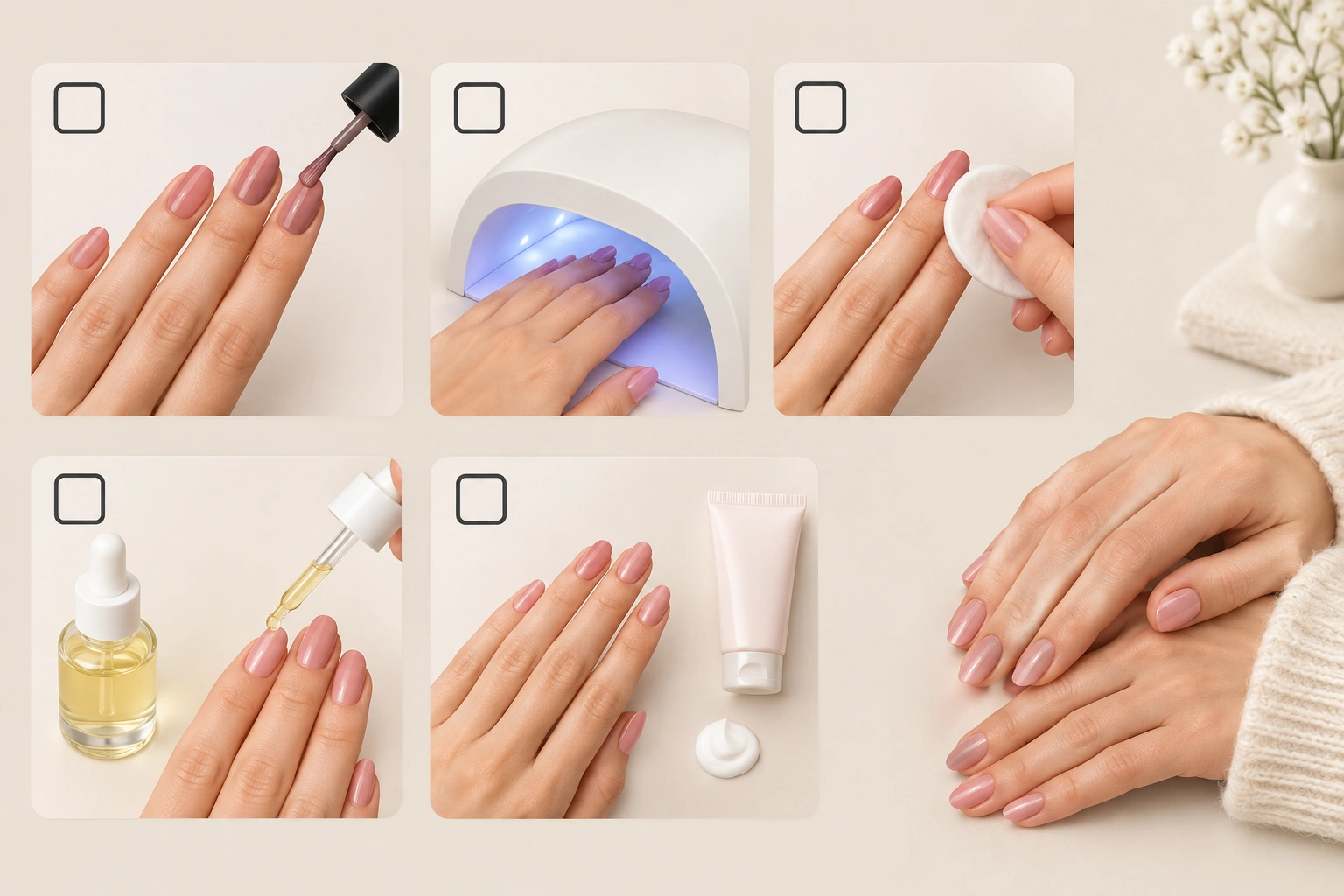
If all of those are true, your manicure is probably in a safer place. If not, give it more time.
When to See a Nail Technician or Dermatologist
If your polish never seems to dry properly, even when you apply thin coats and wait patiently, a nail technician can help you troubleshoot application problems. Sometimes the issue is the product, the layering, or the way the polish is being applied.
If you notice nail changes that go beyond polish performance—such as persistent discoloration, pain, lifting, or irritation around the nail—check with a dermatologist. Drying problems alone are usually a technique issue, but ongoing nail changes deserve a closer look.
Final Takeaway
Regular nail polish usually has two stages: it can become dry to the touch first, then take longer to fully dry underneath. For beginners, a practical rule is to expect about 10 to 20 minutes for surface-dry, 20 to 30 minutes for light use, and 1 to 2 hours for fully dry. The safest way to avoid smudges is to use thin coats, wait between layers, and give the final coat enough time before returning to normal hand use. If you remember one thing, make it this: surface-dry is not the same as ready-for-everything dry.

