
Why Are Cats Attracted to Nail Files? 7 Likely Reasons

If your cat suddenly appears the moment you start filing your nails, you are not imagining it. Some cats sniff nail files, rub their faces against them, lick the rough surface, or even try to steal the file from your hand.
So, why are cats attracted to nail files?
There is no single proven reason. In most cases, the attraction probably comes from a mix of texture, smell, movement, nail dust, curiosity, and normal feline play behavior.
The important part is knowing when harmless curiosity turns into chewing or swallowing. Nail files are human grooming tools, not cat toys, so a little prevention can keep an odd habit from becoming a safety problem.
Quick Answer
Why are cats attracted to nail files? Cats may enjoy their rough texture, your scent, nail residue, light movement, or the interesting scratching sound they make. Some cats simply treat an emery board like a small toy. However, chewing or swallowing pieces can be risky, so nail files should be stored away after use.
Why Do Cats Like Nail Files So Much?
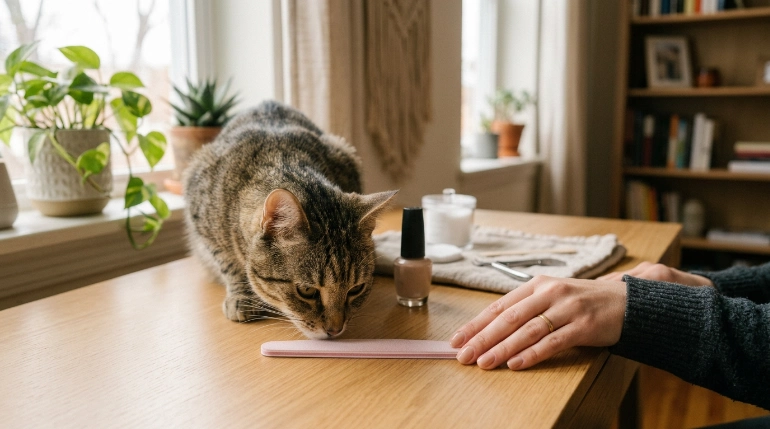
A nail file seems boring to us. To a cat, however, it can combine several interesting things in one small object.
An emery board is lightweight. It slides across a table. It makes a scratchy sound. It smells like your hands and nails after use. Its rough surface also feels very different from most objects in the home.
Those qualities can make it surprisingly attractive to a curious cat.
It is also worth remembering that not every cat cares about nail files. One cat may ignore an emery board completely, while another may appear every time you open your manicure kit.
There has been little scientific research specifically examining cats and nail files, so many explanations are still reasonable theories rather than proven facts. Veterinary-reviewed discussions of the behavior also note that several explanations are possible rather than one confirmed cause.
1. The Rough Texture May Feel Interesting
Texture is one of the simplest explanations.
An emery board has a dry, rough, gritty surface. Cats naturally investigate unusual textures with their paws, noses, mouths, and faces.
Some cats may enjoy rubbing their cheeks against the file. Others lick it or gently bite the edge.
The texture may provide sensory stimulation that feels interesting or satisfying.
That does not mean your cat needs a nail file for grooming. Cats already have natural ways to care for their claws, including scratching surfaces and shedding old claw layers.
If your cat loves rough surfaces, a proper scratching pad or scratching post is a much safer option.
2. Your Nail File Smells Like You
A used nail file carries more than nail dust.
It may also hold traces of:
- Skin oils
- Sweat
- Hand cream
- Nail products
- Your natural body scent
- Tiny pieces of nail material
Cats have a strong sense of smell and often investigate objects that smell like people they know.
That may explain why a cat ignores a brand-new file but becomes interested after you have used it several times.
If this sounds like your cat, the attraction may have less to do with the file itself and more to do with what is left on its surface.
3. Nail Dust May Be Part of the Attraction
Fingernails are made mainly from keratin, a tough structural protein.
When you file your nails, tiny particles are removed and can collect on the abrasive surface.
Some cats appear especially interested in used nail files rather than clean ones. This has led to the theory that nail residue contributes to the attraction.
However, it is important not to turn this theory into a diagnosis.
There is not strong evidence showing that cats lick nail files because they need minerals or nutrients. Claims about mineral deficiency are often repeated online, but the behavior alone does not prove your cat is deficient in anything.
If your cat eats a complete and balanced diet and behaves normally, occasional interest in a nail file is more likely to reflect curiosity than a nutritional emergency.
4. The File Moves Like a Tiny Toy
An emery board has another feature cats often love: movement.
Put one near the edge of a table and it can:
- Slide when tapped
- Flip over
- Spin slightly
- Fall to the floor
- Make a scraping noise
- Fit between a cat’s paws
That combination can trigger play behavior.
To your cat, the nail file may behave a little like a small piece of prey. It moves when touched, so the cat bats it again. The movement becomes its own reward.
This is also why chasing your cat after she steals a nail file can accidentally make the habit more exciting.
If your cat regularly turns your manicure tools into toys, NailPrime’s guide on whether cats can play with nail files explains why safer toys are the better choice.
5. The Scratching Sound May Get Your Cat’s Attention
Think about the sound an emery board makes while you file your nails.
It is repetitive, dry, and scratchy.
A cat sitting across the room may hear that sound before noticing the file itself.
Once the cat walks over to investigate, the combination of motion, scent, and texture can keep her interested.
Some cats are much more sensitive to small household sounds than others. This may be why one cat comes running during your manicure while another sleeps through the whole thing.
6. Your Cat May Be Seeking Attention
Sometimes the explanation is less mysterious.
Your cat may have learned that touching your nail file gets an immediate reaction.
Maybe you:
- Say her name.
- Pull the file away.
- Laugh.
- Pick her up.
- Chase her.
- Offer a toy or treat.
From your cat’s point of view, stealing the file may have become an easy way to start an interaction.
This does not mean your cat is being “bad.” She may simply be repeating a behavior that reliably gets attention.
Calm redirection usually works better than turning the situation into a chase.
7. Repeated Chewing Could Be More Than Curiosity
Occasional sniffing, pawing, or licking is different from repeatedly trying to eat the file.
A pattern of eating non-food objects is often called pica.
Cats with pica may chew or swallow things such as fabric, plastic, rubber, paper, or other household materials. Cornell University has discussed fabric-eating and other non-food ingestion behaviors in cats as a behavioral problem that can involve many materials.
If your cat regularly tries to eat nail files or other non-food objects, speak with your veterinarian.
Possible behavioral or medical factors may need to be ruled out rather than assuming the cat simply likes the taste.
Is It True That Cats Like Fish Glue in Nail Files?
You may have seen claims that cats are attracted to emery boards because some nail files contain fish-based glue.
This explanation is frequently repeated online.
Historically, animal-derived adhesives have existed, and some articles suggest that certain emery boards may contain adhesives with an odor cats find attractive. However, modern nail files are made by many manufacturers using different materials.
There is no good reason to assume that every nail file contains fish glue.
If you are concerned about a specific file, check its packaging or ask the manufacturer about its materials rather than relying on the fish-glue theory.
Are Cats Attracted to Nail Files Because of a Mineral Deficiency?
Probably not in most cases.
Another common theory says cats lick nail files because nail dust contains minerals.
The problem is that attraction to a nail file is not a reliable test for nutritional deficiency.
Cats can investigate strange smells and textures even when they are perfectly healthy.
If your cat eats a complete diet, maintains a normal weight, has a healthy coat, and is otherwise acting normally, interest in an emery board by itself is not enough to conclude that something is missing from her diet.
However, repeated eating of non-food objects deserves veterinary attention, especially when combined with weight loss, vomiting, poor appetite, lethargy, or other changes.
Is It Safe to Let a Cat Lick a Nail File?
It is better not to encourage it.
A brief lick of an intact file is very different from chewing it apart, but nail files were not made for a cat’s mouth.
A used file may contain:
- Nail dust
- Polish residue
- Gel or acrylic dust
- Skin debris
- Oils
- Adhesive
- Abrasive particles
- Dirt or cosmetic residue
The abrasive surface can also irritate sensitive tissue if your cat repeatedly licks or bites it.
If you are worried about the material itself, see our guide on whether nail files are toxic to cats.
What Happens If a Cat Chews a Nail File?
Chewing is more concerning than sniffing or pawing.
Different file materials create different risks.
| Nail file type | Why a cat may like it | Main concern |
|---|---|---|
| Emery board | Light, rough, easy to grab | Fraying or swallowed pieces |
| Foam buffer | Soft and easy to bite | Foam or coating may break off |
| Glass file | Smooth handle and interesting shape | Cracks, chips, sharp fragments |
| Metal file | Firm texture | Mouth or tooth injury |
| Disposable file | Lightweight and easy to bat | Shredding and ingestion |
No type should be used as a regular cat toy.
If chewing is your cat’s main habit, our guide to cats chewing on nail files covers the risks in more detail.
Why Swallowing Pieces Is the Bigger Risk
The biggest safety concern is not simply that your cat likes the file.
It is what happens if part of it disappears.
Foreign objects can become stuck in a cat’s gastrointestinal tract. The Merck Veterinary Manual’s guidance on gastrointestinal obstruction notes that signs may include loss of appetite, vomiting, diarrhea, lethargy, and other symptoms depending on the obstruction.
A hard or sharp fragment may create additional risk.
Do not assume that a missing piece will safely pass through your cat’s body.
If you suspect your cat actually swallowed part of a file, contact a veterinarian and explain what type of file was involved.
NailPrime also has a detailed guide on what to do if a cat eats part of a nail file.
Warning Signs After Your Cat Chews a Nail File
Watch more carefully if the file is damaged or a piece cannot be found.
Possible warning signs include:
- Vomiting
- Repeated gagging
- Drooling
- Refusing food
- Reduced appetite
- Unusual tiredness
- Abdominal discomfort
- Straining to pass stool
- Diarrhea
- Difficulty swallowing
- Hiding more than usual
- Pawing at the mouth
The ASPCA warns that swallowed household objects can create digestive problems and that items cats ingest during play can sometimes require emergency treatment.
If your cat swallowed a sharp glass or metal piece, is repeatedly vomiting, has trouble breathing, collapses, or appears to be in severe pain, seek urgent veterinary care.
What to Do When Your Cat Steals Your Nail File
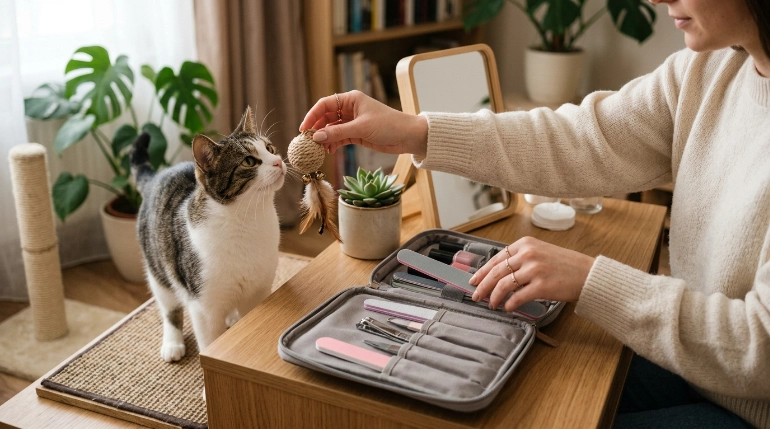
You usually do not need to panic if your cat simply grabs an intact emery board.
Use these steps instead.
1. Take the File Away Calmly
Avoid chasing your cat around the house.
Calmly trade the file for a safe toy or treat.
2. Inspect the File
Look for:
- Bite marks
- Missing corners
- Peeling layers
- Torn foam
- Cracks
- Chips
- Broken pieces
If something is missing, consider possible ingestion.
3. Check Your Cat’s Mouth Only If It Is Safe
Do not force your fingers into a frightened cat’s mouth.
If you can safely see a loose piece near the front of the mouth, contact your veterinarian for guidance.
4. Clean Up Loose Pieces
Check the floor, sofa, bedding, and nearby surfaces.
A small missing fragment may have fallen rather than been swallowed.
5. Put the File Away
Store manicure tools in a closed drawer, hard case, zippered bag, or organizer.
6. Redirect the Behavior
Offer something designed for feline play, such as:
- A sturdy ball
- Kicker toy
- Scratching pad
- Stuffed cat toy
- Interactive wand used with supervision
- Puzzle feeder
This gives your cat something appropriate to chase, scratch, or bite.
Expert Tip: Keep one favorite cat toy near the place where you normally do your nails. When your cat approaches the file, redirect her immediately. This is easier than trying to break the habit after she has already stolen it.
Nail File Hygiene Matters Too
There is another issue that nail lovers should remember: hygiene.
If your cat puts a nail file in her mouth, saliva and debris can end up on the surface.
For a cheap disposable emery board, replacing it is usually simpler than trying to clean it thoroughly.
Reusable glass or metal files may be washable, depending on the manufacturer’s instructions.
However, cleaning does not fix physical damage.
Replace any nail file that is cracked, badly scratched, peeling, bent, or heavily chewed.
Do not continue using a damaged manicure tool simply because you disinfected it.
Common Mistakes to Avoid
- Leaving nail files on the floor or vanity. Lightweight emery boards are very easy for cats to steal.
- Treating the behavior as harmless because it looks cute. Pawing is one thing; chewing pieces off is another.
- Assuming every cat is attracted by a nutritional deficiency. The behavior alone cannot diagnose one.
- Believing every emery board contains fish glue. Materials vary by manufacturer.
- Giving your cat a glass file because she cannot chew it easily. Glass can crack or break.
- Continuing to use a file after your cat chews it. Damage and contamination make replacement the safer choice.
- Ignoring a missing piece. A swallowed foreign object can become serious.
- Turning theft into a chase game. Attention may make the behavior more rewarding.
- Trying home remedies after suspected ingestion. A veterinarian should guide you when a foreign object may have been swallowed.
When to See a Nail Technician or Dermatologist
For problems involving your cat, a veterinarian is the correct professional—not a nail technician or dermatologist.
Call your veterinarian if your cat repeatedly eats non-food objects, swallows part of a nail file, vomits, stops eating, develops abdominal pain, becomes unusually tired, or shows difficulty swallowing.
A nail technician may help you choose hygienic manicure tools or explain whether a damaged reusable file should be replaced.
A dermatologist is appropriate for your own persistent skin or nail problem, such as inflammation, infection, unusual nail changes, or irritation after using a contaminated grooming tool.
DIY care has limits. When an animal has swallowed an object or a person has signs of infection, professional evaluation is safer than trying to solve the problem with home remedies.
How to Keep Your Cat Away From Nail Files
A simple storage routine prevents most problems.
Try these habits:
- File your nails at a table rather than on the floor.
- Put the file away as soon as you finish.
- Throw nail clippings into a closed trash bin.
- Keep gel, acrylic, polish, acetone, and nail glue away from pets.
- Store electric-file bits and small nail-art pieces in closed containers.
- Keep cat toys near your manicure area for quick redirection.
- Replace damaged disposable files instead of leaving them lying around.
The goal is not to punish your cat for being curious.
You simply want to make the safer option easier.
FAQs
Why does my cat lick my nail file?
Your cat may like the texture, your scent, or residue left after filing. There is no single proven reason. A quick sniff or lick is less concerning than repeated chewing, but it is still best to put the file away.
Why does my cat rub her face on nail files?
The rough surface may feel interesting, or the file may carry familiar scents. Cats also commonly rub against objects while exploring their environment.
Are cats attracted to the smell of fingernails?
Possibly. A used file contains nail dust as well as traces of skin oils and your natural scent. That combination may be more interesting to some cats than a clean, unused file.
Do nail files contain something cats like?
Different files contain different materials. Claims about fish-based glue are sometimes repeated, but you should not assume all emery boards contain it. Texture, movement, scent, and residue are also possible reasons for the attraction.
Is licking a nail file a sign of mineral deficiency?
Not by itself. There is not enough evidence to diagnose a mineral deficiency because a cat likes nail files. If your cat repeatedly eats non-food objects or develops other health changes, ask your veterinarian.
What should I do if my cat ate an emery board?
Remove the remaining file and check how much is missing. Save the damaged file or packaging and contact your veterinarian for advice. Watch for vomiting, loss of appetite, lethargy, drooling, abdominal discomfort, or difficulty passing stool.
Can I let my cat use a nail file as a toy?
It is better not to. Emery boards can shred, foam can tear, metal may injure the mouth, and glass may break. A cat-safe toy or scratching pad provides similar stimulation with fewer risks.
Conclusion
So, why are cats attracted to nail files? The most likely answer is that nail files combine several things cats find interesting: rough texture, familiar scent, nail residue, movement, sound, and the chance to play with a small object.
There is no strong evidence that every cat who loves an emery board has a mineral deficiency or is reacting to fish glue.
For most cats, the behavior is simply curiosity.
The safest response is still to keep manicure tools out of reach. Let your cat sniff from a distance, redirect playful behavior to a proper toy, and replace any file that becomes damaged or heavily chewed.
If a piece is missing or your cat develops vomiting, poor appetite, pain, lethargy, or trouble swallowing, contact your veterinarian.
Your nail file belongs in your manicure kit. Your cat will be much safer with a toy made for her.

