
Does a Fan Dry Nail Polish Faster? A Beginner’s Practical Guide

If you’ve just painted your nails and want them dry sooner, a fan can help a little — but it is not a magic fix. For regular polish, a fan can modestly speed up surface drying. It helps most when the polish is applied in thin coats and the room has still air, but it does not make the manicure hard all the way through. If you are using gel polish, a fan does not help much at all because gel needs a UV or LED lamp to cure.
That matters because many beginners think “dry” means the manicure is ready for normal use. Often, it only means the top feels dry while the layers underneath are still soft. That’s why a fan can reduce some waiting time, but it cannot replace thin coats, patience, or the right drying product when you need better results.
How Nail Polish Dries: Evaporation vs. Curing
Regular nail polish dries mainly by evaporation. The liquid parts of the polish leave the surface over time, and the coating slowly becomes firm. Airflow can help that process because moving air carries those evaporating solvents away from the nail instead of letting them linger.
Gel polish works differently. It does not dry just because air moves around it. Gel polish needs to cure under a UV or LED lamp, which is a separate process from regular polish drying. If you try to dry gel polish with a fan, it may still stay tacky or soft because the lamp step is what makes it set.
If you want a simple reference for drying times with regular polish, you may also find this guide on how long regular nail polish takes to dry useful, along with this one on when polish is fully dry.
Surface-dry is not the same as fully dry
This is the part that trips people up most often. A manicure can feel dry to a light touch while still denting if you press it, bump it, or use your hands too soon. The top layer may seem set, but the polish underneath can still be soft.
That is why a fan can feel helpful without actually solving the whole problem. It may improve the surface faster than still air, but it does not guarantee the polish is ready for keys, zippers, or phone handling.
What a Fan Actually Does to Fresh Nail Polish
A fan helps by moving air across the nail surface. That airflow can speed evaporation a bit, especially in still indoor air. In practical terms, that means the polish may stop feeling wet on top sooner than it would if you just sat with your hands still.

What a fan does not do is harden polish instantly from top to bottom. It also does not fix thick coats. If you applied too much polish, the outside may dry while the inside stays soft for a long time.
A fan can also bring dust or lint toward wet nails if the area is dirty. So the benefit is real, but small and conditional. Think of a fan as a gentle helper, not the main drying method.
When a Fan Is Worth Using and When It Is Not
A fan makes the most sense when you are using regular nail polish and want a simple, low-cost way to encourage airflow. It is especially useful if you already painted thin coats and just want the surface to set a bit sooner.
A fan is less useful if:
– you applied thick coats
– you used multiple layers without enough time between them
– the room is dusty
– you are trying to dry gel polish
– you want the fastest possible result
For quick-dry polish, a fan may still help a little, but the polish formula itself is doing more of the work. In that case, the fan is more of a bonus than the main drying tool.
For gel polish, a fan is not the right tool. Gel needs a UV/LED lamp, not airflow. If you use gel at home, follow the product instructions and use the lamp designed for it.
If you want to compare drying methods for regular polish, this guide on making nail polish dry faster is a helpful next step.
How to Use a Fan Without Ruining the Manicure
You do not need a powerful fan. Gentle, steady airflow is enough for beginners.
Use cool or room-temperature air
Cool air is the safer choice for fresh polish. Warm or hot air can create problems like bubbles, uneven drying, or a surface that seems set while the layers underneath stay soft longer. A regular desk fan or room fan is usually better than heat.
Keep the fan at a safe distance
For a beginner, place a small fan about 12 to 18 inches away from your nails and use it on low or medium. That gives you airflow without blasting the polish directly. If the polish looks like it is moving or rippling, the fan is too close.
Let the polish settle first
Right after painting, give the polish a short moment to level out before putting your hands in front of a fan. That helps reduce streaks and tiny ripples in the finish.
Use it for a short drying window
A practical beginner rule is to fan regular polish for about 5 to 10 minutes after each coat, then let it sit. That can help the surface set sooner, but it does not make the manicure fully safe for normal use right away.
Keep your hands clean and the area dust-free
Fresh polish acts like a magnet for lint. If the fan is dusty, clean it first. If the room is dusty, move to a cleaner spot before drying. A neat drying area matters more than people realize.
Apply thinner coats
Thin coats dry more evenly and respond better to airflow. Thick coats stay soft longer, no matter how much air you move over them.
Fan Drying vs. Other Faster Drying Methods
A fan is simple, but it is not always the best option. Here’s how it compares with other common methods.
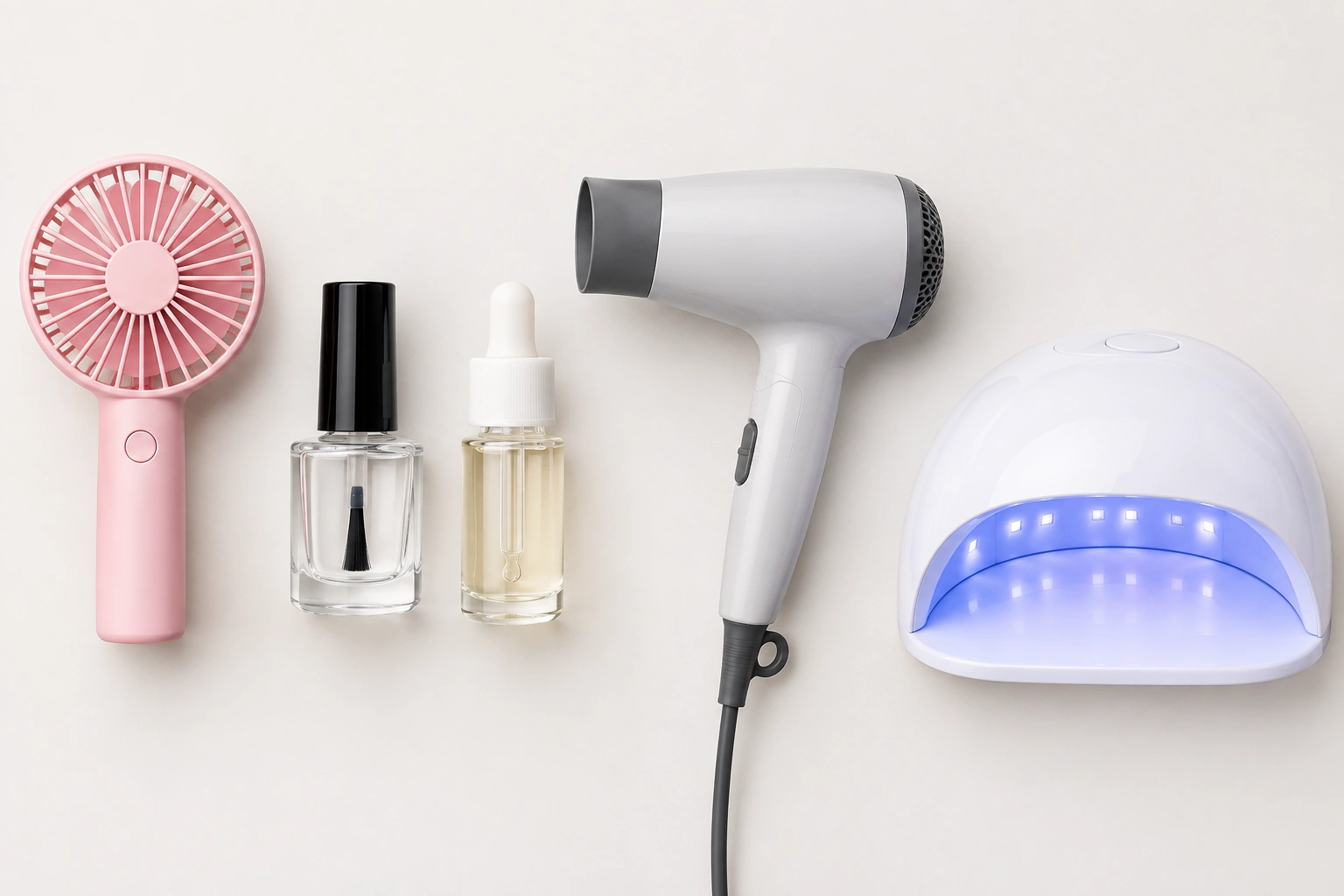
| Method | Best for | Main benefit | Main drawback |
|---|---|---|---|
| Fan | Regular polish | Cheap, easy airflow | Only modest speed-up |
| Quick-dry top coat | Regular polish | Better overall drying help | Requires buying a product |
| Quick-dry drops | Regular polish | Often more effective than airflow alone | Extra step, product needed |
| Cold air from a hair dryer | Regular polish | Stronger airflow than a fan | Must use carefully to avoid mess |
| UV/LED lamp | Gel polish | Required for curing gel | Does not work for regular polish |
Fan vs. quick-dry top coat
If your goal is better drying performance, a quick-dry top coat usually beats a fan alone. It is designed to help the manicure set faster and often gives a smoother finish too. The trade-off is that it is another product to buy and apply.
Fan vs. quick-dry drops
Quick-dry drops are often a stronger drying aid than airflow alone. They can be a smart choice if you regularly paint your nails at home and want a more reliable result. A fan is simpler, but drops tend to do more of the work.
Fan vs. cold air from a hair dryer
Cold air from a hair dryer can move more air than a fan, but it also needs more care. If the airflow is too strong, it can push wet polish around or kick up dust. If you use this method, keep it on cool air only and hold it at a safe distance.
Fan vs. UV/LED lamp for gel polish
This comparison is simple: a fan is not a substitute for a lamp. Gel polish needs the curing process a lamp provides. Air movement may make the surface feel less sticky, but it will not properly cure the product.
How to Tell When Polish Is Dry Enough to Use Your Hands
The easiest mistake to make is assuming the manicure is ready because it no longer looks shiny-wet.
A better test is to be cautious with pressure. If the polish is still soft, even light contact can leave a mark. That means you should avoid:
– pressing nails against anything
– digging in a bag
– fastening buttons
– opening cans or tight lids
A simple beginner rule:
– After one thin coat of regular polish, you can usually do very light movement with care, but avoid using your hands normally.
– After multiple coats, wait longer because the layers need more time to firm up.
– After a quick-dry top coat, the surface may be ready sooner, but treat the nails gently for a while.
– If you used a fan, expect a modest speed-up, not instant full dryness.
For everyday use, it is usually safest to wait until the polish feels dry to a light touch and then give it extra time before doing anything that presses on the nails. If you are unsure, assume the manicure is still vulnerable underneath.
Common Mistakes That Make Polish Dry Slower
Some problems matter more than the fan itself.
Thick coats
This is the biggest one. Thick polish looks bold at first, but it dries slowly and unevenly. A fan cannot fully solve that.
Warm air
Heat is not your friend here. It can cause bubbling or make the polish behave unpredictably. Cool air is the safer choice.
Touching too soon
If you test the polish too early, you can leave fingerprints, dents, or smears. Even if the surface feels dry, the manicure may still be vulnerable.
Dusty environments
A fan in a dusty room can blow tiny particles onto wet nails. That can leave the finish rough or speckled. Clean surroundings help more than stronger airflow.
Skipping the right product for the polish type
If you want faster drying with regular polish, quick-dry top coats or drops usually help more than a fan alone. If you use gel, you need a lamp. Choosing the right tool for the polish matters.
For more practical drying tips, this article on how to dry nail polish faster covers a few beginner-friendly approaches.
When to See a Nail Technician or Dermatologist
If your polish keeps bubbling, peeling, or never seems to dry properly, a nail technician can help you spot application issues like thick layers, poor prep, or the wrong product pairing.
If you notice persistent nail changes, pain, or skin irritation around the nails, a dermatologist is the better person to ask. That is separate from normal polish drying, but it matters if your nails or skin react badly to products.
Simple Bottom Line for Beginners
So, does a fan dry nail polish faster? Yes — a fan can help regular polish dry a little faster by increasing airflow, but it is a modest improvement, not a miracle fix.
Use a fan if you want a simple, low-cost helper for regular polish. Use cool air, keep the airflow gentle, and apply thin coats. If you want better results, a quick-dry top coat or quick-dry drops usually works better. And if you are wearing gel polish, skip the fan and use the proper UV/LED lamp instead.
The safest beginner approach is simple: paint thin coats, give the polish time, and use airflow as support rather than the whole solution.

