
Can You Use Acetone Instead of Nail Dehydrator? What to Know Before Nail Prep

You are ready to do your gel, acrylic, builder gel, or press-on nails, but then realize your nail dehydrator is missing or empty. If you already have a bottle of acetone nearby, the obvious question is: Can you use acetone instead of nail dehydrator?
In some nail systems, 100% pure acetone can be used to cleanse and temporarily dehydrate the natural nail plate. In fact, some professional product instructions specifically use pure acetone during nail prep. However, that does not mean every bottle labeled “nail polish remover” is a good substitute, or that acetone should automatically replace the dehydrator recommended for your particular manicure system.
The right choice depends on the type of acetone, your nail and skin condition, and the gel, acrylic, dip, or adhesive system you plan to apply.
Quick Answer
Yes, you can sometimes use 100% pure acetone instead of nail dehydrator because it removes surface oils and moisture from the nail. However, it can be more drying and irritating, and regular nail polish remover may leave residue. For the most predictable adhesion, follow your nail product manufacturer’s recommended prep system.
What Does a Nail Dehydrator Actually Do?
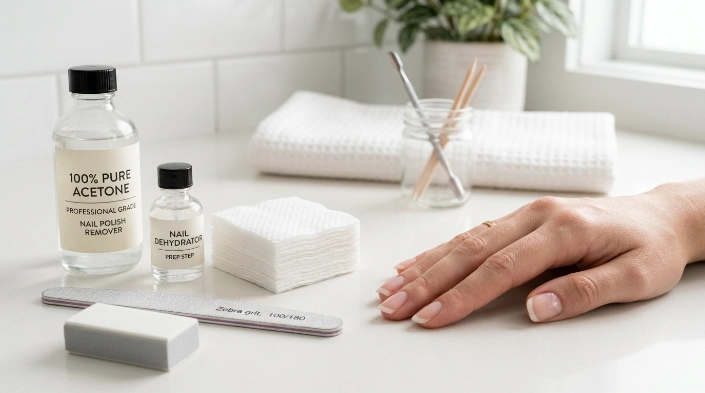
A nail dehydrator is used during manicure prep to create a clean, dry surface before gel, acrylic, dip powder, nail glue, or another enhancement is applied.
Your natural nail plate can hold tiny amounts of:
- Skin oil
- Moisture
- Lotion residue
- Soap residue
- Dust from filing
- Other contaminants picked up during preparation
These can interfere with adhesion.
A dehydrator temporarily removes or reduces that moisture and oil so your base coat, adhesive, or enhancement can grip the nail more effectively.
A dehydrator is not the same thing as nail primer.
Dehydrator prepares and cleans the nail surface. Primer or bonding products are typically used afterward to improve adhesion between the natural nail and the enhancement system.
Manufacturers may formulate prep products differently. For example, OPI’s Bond Aid pH Balancing Agent contains ethyl acetate, water, and ammonium hydroxide and is intended to prepare the natural nail for improved adhesion. This is one reason a branded prep product should not automatically be assumed to work exactly like straight acetone.
Does Acetone Dehydrate the Nail?
Yes. Pure acetone is a powerful solvent that evaporates quickly and can remove oils from the nail surface.
That is why acetone can leave your nails and the surrounding skin feeling very dry.
This drying effect is also why pure acetone can function as a nail-prep cleanser in some manicure systems.
There is real professional guidance supporting this use. The The GelBottle HEMA-Free BIAB application guide specifically instructs users to cleanse and dehydrate the nail plate with 100% pure acetone during nail preparation.
That is an important distinction: acetone can work as a dehydrating prep solution, but whether you should use it depends on the product system you are applying afterward.
Acetone vs. Nail Dehydrator
Here is an easy comparison.
| Feature | 100% Pure Acetone | Nail Dehydrator |
|---|---|---|
| Removes surface oil | Yes | Yes |
| Removes moisture temporarily | Yes | Yes |
| Dries quickly | Yes | Usually |
| Designed specifically for nail prep | Not always | Yes |
| Can dry surrounding skin | More likely | Possible |
| Formula varies | Pure acetone should contain only acetone | Depends on brand |
| Works with every gel/acrylic system | Not guaranteed | Check manufacturer compatibility |
| Useful for polish/enhancement removal | Yes | Usually no |
| Best choice for regular nail prep | Sometimes | Usually |
The main advantage of a dedicated dehydrator is predictability. It was created for nail preparation and may be part of a manufacturer’s tested application system.
Acetone has more than one job. It is commonly used to dissolve products during removal, but pure acetone can also clean and degrease a nail plate.
When You Can Use Acetone Instead of Nail Dehydrator
Using acetone makes the most sense when all of the following are true:
- You have 100% pure acetone
- Your natural nail is healthy and intact
- Your skin is not already cracked or irritated
- Your manicure system allows acetone during prep
- You use only a small amount
- You keep it mostly on the nail plate rather than soaking the skin
For example, imagine you are preparing healthy natural nails for a builder gel whose manufacturer specifically instructs you to wipe the nail with pure acetone. In that situation, acetone is not really a DIY improvisation—it is part of the recommended prep procedure.
The answer becomes less certain when you are substituting acetone for a dehydrator in a completely different system whose directions call for its own cleanser, dehydrator, or pH-balancing solution.
Manufacturer directions should win over generic nail advice.
The FDA’s nail care product safety guidance recommends reading nail-product labels carefully and following their warnings and directions. Nail products can cause irritation or allergic reactions when used incorrectly.
Do Not Substitute Regular Nail Polish Remover Without Checking the Label
This is where many at-home manicures go wrong.
100% pure acetone and acetone-based nail polish remover are not necessarily the same product.
A nail polish remover may include ingredients such as:
- Water
- Fragrance
- Oils
- Moisturizing ingredients
- Coloring agents
- Other solvents
Those additions may make the remover more pleasant for taking off regular polish, but they may not be ideal immediately before applying a product that needs a perfectly clean nail plate.
A remover containing moisturizing oils is particularly questionable for prep because you are trying to remove oil before applying gel, glue, or acrylic.
If you want to use acetone as a temporary dehydrator substitute, look for a product clearly labeled 100% acetone rather than assuming any nail polish remover will work.
How to Use Pure Acetone for Nail Prep

If your manicure system permits pure acetone for preparation, use it carefully rather than soaking the entire fingertip.
1. Wash and completely dry your hands
Remove obvious dirt first. Your hands and nails should be fully dry before you begin the rest of the prep.
2. Push back excess cuticle gently
The thin, non-living cuticle tissue that remains attached to the nail plate can contribute to lifting if product is applied over it.
Do not aggressively cut or scrape living skin.
3. Shape the nails
Use an appropriate nail file to create the shape you want.
Keep your pressure controlled. There is no benefit to aggressively filing the natural nail.
4. Lightly buff only if your product requires it
Some gel, acrylic, and enhancement systems call for removing surface shine.
Do not keep filing until the nail becomes visibly thin.
Over-filing can make nails sore, flexible, sensitive, and more vulnerable to damage.
5. Remove all filing dust
Use a clean nail brush or lint-free pad.
Dust trapped under a gel or enhancement can interfere with smooth application and adhesion.
6. Apply a small amount of 100% acetone
Dampen a lint-free wipe and wipe each nail plate.
You do not need to soak your fingertips.
Allow the acetone to evaporate completely. The nail should look clean and temporarily matte or dry.
7. Avoid touching the prepared nail
Once you have cleaned the nail plate, avoid touching it with your fingertips.
Your skin can immediately transfer oils back onto the prepared surface.
8. Continue with your manicure system
Apply the primer, bonder, base coat, adhesive, or other product specified by the manufacturer.
Do not invent extra prep steps simply because they seem stronger. More dehydration, more filing, and more primer do not automatically mean better adhesion.
Expert Tip: After dehydrating the nail, hold your fingers by the sides rather than touching the nail surface. Accidentally rubbing a freshly prepared nail with your thumb can transfer skin oil straight back onto it.
Is Acetone Too Harsh for Natural Nails?
Acetone is effective, but it is drying.
The CDC’s acetone safety information notes that skin contact with acetone can cause dryness, irritation, and cracking.
That does not mean a brief, careful nail wipe is automatically dangerous. It does mean you should avoid repeatedly flooding your cuticles and fingertips with acetone when a small amount on the nail plate is enough.
This matters especially if you already have:
- Dry or peeling cuticles
- Cracked skin
- Hangnails
- Eczema or very sensitive skin
- Cuts around the nails
- Nails that already feel thin or sore
If your skin burns, becomes unusually red, or continues feeling irritated, wash the area and stop using the product.
Acetone and Skin Sensitivity
People sometimes focus entirely on whether acetone damages the nail, but the surrounding skin deserves equal attention.
When removing gel polish, the American Academy of Dermatology recommends limiting acetone exposure primarily to the nails rather than unnecessarily soaking the whole hand or finger. The AAD’s gel manicure guidance also recommends moisturizing between manicures because acetone exposure can contribute to dryness.
For simple nail prep, you need far less acetone than you would for soaking off gel or acrylic.
A damp lint-free wipe is usually enough when acetone is appropriate for the system.
What Is Better for Gel, Acrylic, Dip, and Press-On Nails?
The answer varies because adhesion systems are not identical.
Gel polish and builder gel
Some gel systems allow or specifically recommend 100% acetone during prep. Others have a dedicated cleanser, dehydrator, or pH-balancing product.
Follow the instructions for your base gel rather than assuming one prep routine works for every brand.
Acrylic nails
Acrylic adhesion can be sensitive to moisture, oil, improper filing, cuticle residue, and incorrect primer application.
If your acrylic system includes a dehydrator and primer, using the complete system is generally the more predictable choice.
Dip powder
Dip systems often include several preparation and bonding liquids. Introducing an unlisted prep product can change how the system performs.
Follow your dip manufacturer’s sequence.
Press-on nails
For press-ons, removing surface oil before applying glue or adhesive tabs can improve grip.
However, over-preparing the natural nail can cause more harm than good. You generally do not need aggressive filing plus repeated acetone plus strong primer merely to wear press-ons.
Acetone vs. Alcohol for Nail Prep
Another common DIY question is whether alcohol is better than acetone.
Both can help clean a nail surface, but they are not universally interchangeable.
Isopropyl alcohol is commonly used as a cleansing product in nail services. Acetone is a stronger solvent and is particularly effective at dissolving many nail products and removing oils.
Which one you should use depends on what your gel, acrylic, or other nail system requires.
Do not combine multiple solvents just because you want the nail to feel “extra dry.”
A properly prepared nail needs to be clean and ready for adhesion—not repeatedly stripped.
Does More Dehydration Make a Manicure Last Longer?
Not necessarily.
If your manicure keeps lifting, it is easy to assume you need stronger chemicals. The real problem may be somewhere else.
Common causes of lifting include:
- Product touching the cuticle or sidewalls
- Dead cuticle left on the nail plate
- Filing dust remaining on the nail
- Touching the nail after prep
- Incorrect curing
- Applying layers too thickly
- Using incompatible products
- Poorly fitted press-ons or tips
- Excessive water exposure before application
- Incorrect primer use
So if acetone does not magically stop lifting, do not keep applying more.
Correct preparation and correct application matter more than making your nail as dry as possible.
Hygiene and Safety Considerations
Acetone is highly flammable, so keep it away from flames, cigarettes, candles, heaters, and other ignition sources. Good ventilation is also sensible when using volatile nail products. FDA guidance recommends adequate ventilation when using nail products, while OSHA identifies acetone as a chemical that can irritate the eyes, skin, and throat.
For hygienic at-home nail prep:
- Use clean tools.
- Do not share contaminated nail files.
- Use fresh lint-free wipes.
- Keep product bottles tightly closed.
- Avoid returning used liquid to the original bottle.
- Do not apply enhancement products over an obviously infected or injured nail.
- Keep chemicals away from children and pets.
If you accidentally get acetone in your eyes or swallow it, treat that as a chemical exposure rather than a manicure problem and seek appropriate medical or poison-control guidance.
Cost and Convenience: Which Makes More Sense?
Pure acetone is versatile. One bottle may be useful for polish removal, enhancement removal, cleaning certain nail-product residues, and—when the system allows it—nail prep.
A dedicated dehydrator has a narrower job, but you normally use only a tiny amount for each manicure, so one small bottle can last through many applications.
For occasional DIY nails, buying another prep product may feel unnecessary if your specific gel system already allows pure acetone.
For regular manicures, acrylic sets, or clients, a dedicated and system-compatible dehydrator is often worth having because it makes your prep routine more consistent.
Common Mistakes to Avoid
- Using moisturizing polish remover instead of pure acetone. Oils or additives may leave residue.
- Soaking the fingers for nail prep. A light wipe is usually enough.
- Assuming acetone replaces primer. Dehydrator and primer perform different jobs.
- Using acetone on broken or irritated skin. This can sting and worsen dryness.
- Aggressively filing before acetone. Over-filing weakens the nail instead of improving adhesion.
- Touching nails after cleaning them. Your fingertips can transfer oil straight back onto the nail.
- Ignoring manufacturer instructions. One brand may recommend acetone while another uses its own prep system.
- Repeatedly dehydrating a lifting nail. Lifting can have many causes besides surface oil.
- Applying product over a suspicious nail. Covering pain, discoloration, swelling, or infection is not a safe fix.
DIY Acetone Prep vs. a Professional Nail Service
DIY nail prep is reasonable when your nails are healthy, you understand the product system, and you can follow the application instructions carefully.
A licensed nail technician may be a better choice if:
- Your enhancements repeatedly lift
- You are unsure how much natural nail to file
- Your nail plate is already thin or damaged
- You regularly experience burning during services
- You have difficulty keeping gel or acrylic off your skin
- You are unsure which prep chemicals are compatible
A professional service can help with technique and product application. However, a nail technician is not a substitute for medical diagnosis when a nail or surrounding skin appears infected or diseased.
When to See a Nail Technician or Dermatologist
Stop DIY application and consider professional advice if you develop persistent pain, swelling, significant redness, drainage, a spreading rash, nail separation, unusual discoloration, or ongoing skin reactions.
A nail technician can help with routine application problems, shaping, product removal, and determining whether your manicure technique is contributing to lifting or mechanical damage.
A dermatologist or other healthcare professional is more appropriate when you have persistent inflammation, possible infection, unexplained nail changes, or a suspected allergic reaction.
Do not simply cover a painful or abnormal-looking nail with gel, acrylic, dip, or a press-on and hope the problem disappears.
FAQs
Can you use acetone instead of nail dehydrator for gel nails?
Sometimes. Some gel systems specifically allow 100% pure acetone to cleanse and dehydrate the nail plate. Other brands recommend their own cleanser or dehydrator. Follow the instructions for the gel system you are using.
Is nail dehydrator just acetone?
No. Nail dehydrator formulas vary by brand and may contain different solvents or pH-balancing ingredients. Some professional systems use pure acetone for dehydration, but that does not make every dehydrator identical to acetone.
Can nail polish remover replace nail dehydrator?
Not always. Nail polish remover may contain water, fragrance, oils, or conditioning ingredients that can leave residue. If acetone is allowed for your nail system, 100% pure acetone is a more appropriate choice than assuming any polish remover will work.
Can I use acetone before press-on nails?
You can use a small amount of pure acetone to remove surface oil when appropriate, but it is not required for every press-on system. Check the adhesive manufacturer’s instructions and avoid repeatedly drying or aggressively buffing your natural nails.
Do I still need primer after using acetone?
If your nail system requires primer, yes. Acetone cleans and dehydrates the surface; it does not automatically perform the same bonding function as a primer.
Is alcohol better than acetone for dehydrating nails?
Neither is universally “better.” Both may be used for cleansing in different nail systems. The best option is the cleanser or dehydrator specified by the manufacturer of the products you are applying.
Can too much acetone damage nails?
Frequent or prolonged exposure can leave nails and surrounding skin very dry, and repeated exposure may contribute to brittleness or irritation. Use only the amount required and moisturize your hands and cuticles after the manicure or removal process is complete.
Conclusion
So, can you use acetone instead of nail dehydrator? Yes—100% pure acetone can work as a cleansing and dehydrating step in some nail systems, and some professional application guides specifically recommend it.
But it is not a universal replacement for every dehydrator.
Avoid substituting regular nail polish remover without checking its ingredients, keep acetone off irritated skin, use only a small amount, and never assume extra filing or extra dehydration will automatically make a manicure last longer.
For the safest and most reliable result, check your gel, acrylic, dip, or adhesive manufacturer’s prep instructions first. If pure acetone is approved, use it carefully. If the system calls for a dedicated dehydrator or bonding product, sticking with that system is the smarter choice.
Choose the prep method that gives you clean nails, healthy skin, and reliable adhesion—not simply the strongest chemical available.
