
You are ready to do your gel nails, press-ons, acrylics, or another long-wear manicure—and then you realize your nail dehydrator bottle is empty. If you already have rubbing alcohol at home, the obvious question is: can you use alcohol instead of nail dehydrator?
In many at-home situations, yes. High-percentage isopropyl alcohol can help clean oil, dust, and residue from the natural nail before product application. However, alcohol and a professional nail dehydrator are not always identical, and choosing the wrong alcohol concentration can affect adhesion.
Below, you will learn which alcohol works best, when it is a reasonable substitute, how to apply it safely, and when a dedicated nail dehydrator is the smarter choice.
Quick Answer
Yes, you can use alcohol instead of nail dehydrator for basic nail prep, especially 90% to 99% isopropyl alcohol. It removes surface oil and residue and evaporates quickly. However, professional dehydrators may contain additional fast-evaporating solvents, so alcohol may not provide the same adhesion for every gel, acrylic, or extension system.
What Does a Nail Dehydrator Actually Do?
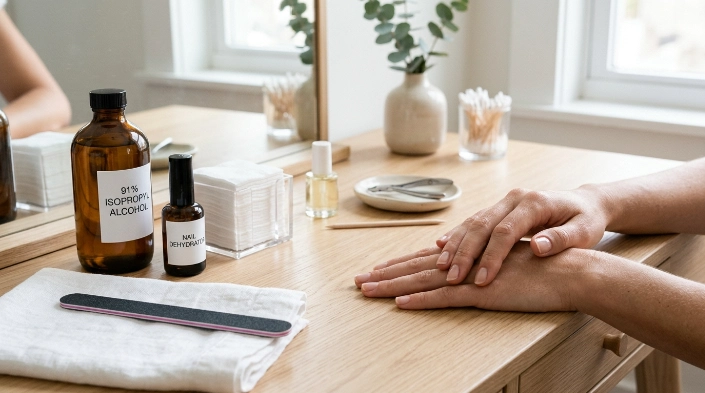
A nail dehydrator is used during manicure preparation to temporarily remove moisture and natural oils from the surface of the nail plate.
That matters because gel, acrylic, builder gel, dip products, and nail adhesives generally stick better to a clean, dry surface.
Think of nail prep like painting a wall. Paint will not grip as well if the wall is oily or dusty. Nail products can behave similarly.
A dehydrator helps remove:
- Natural surface oils
- Small amounts of moisture
- Filing and buffing residue
- Oils transferred from your fingers
- Some cosmetic residue left after nail prep
Professional dehydrators also tend to evaporate quickly so you can move on to primer, base coat, or another product without leaving the nail wet.
For example, the manufacturer information for Kinetics Nail Dehydrator lists isopropyl alcohol together with ethyl acetate and isobutyl acetate. Those additional solvents help explain why a formulated dehydrator may behave differently from household rubbing alcohol alone.
Can You Use Alcohol Instead of Nail Dehydrator?
Yes, alcohol can work as a temporary or simple substitute for nail dehydrator, particularly for at-home manicures.
The important detail is the type and concentration.
High-percentage isopropyl alcohol removes surface oils and evaporates quickly. That makes it useful immediately before applying a nail product.
However, a dedicated dehydrator may be more effective when you:
- Have naturally oily nail plates
- Frequently experience lifting
- Wear long extensions
- Use builder gel or hard gel
- Do acrylic nails
- Need maximum retention
- Are following a professional product system that specifically requires its own dehydrator
If your gel or extension manufacturer gives specific preparation instructions, those directions should take priority over a DIY substitution.
70% vs. 90% vs. 99% Alcohol for Nail Prep
Not all bottles labeled “rubbing alcohol” work equally well for nail preparation.
| Product | Good for nail dehydration? | Main consideration |
|---|---|---|
| 70% isopropyl alcohol | Fair | Contains more water and may take longer to evaporate |
| 90–91% isopropyl alcohol | Good | Less water and effective for most DIY nail prep |
| 99% isopropyl alcohol | Very good | Fast evaporation and very little water |
| Dedicated nail dehydrator | Best for demanding systems | Formulated specifically for nail prep |
| Hand sanitizer | No | Often contains water, moisturizers, gels, or fragrances |
Is 70% Rubbing Alcohol Okay?
You can clean nails with 70% isopropyl alcohol, but it is not my first choice when the goal is maximum dehydration.
A bottle containing 70% alcohol also contains a substantial amount of water and other ingredients depending on the product.
That is useful for many household and hygiene applications, but it is less ideal when you are deliberately trying to leave the nail plate as dry and oil-free as possible before applying a long-wear manicure.
If 70% is all you have, use a small amount and allow the nails to dry completely before continuing.
Is 90% or 91% Alcohol Better?
Yes. 90% or 91% isopropyl alcohol is a more practical nail-dehydrator substitute.
It contains less water and evaporates quickly. For a basic DIY gel manicure, press-on application, or similar service, it is usually the concentration I would choose if a dedicated dehydrator is unavailable.
What About 99% Isopropyl Alcohol?
99% isopropyl alcohol is another good option because it leaves very little water behind.
You do not need to soak your nails, though. A light wipe across the nail plate is enough.
More alcohol does not automatically mean better prep.
Why Professional Nail Dehydrator Can Work Better
Alcohol is only one possible ingredient in a nail dehydrator.
Several commercially available dehydrators use a combination such as:
- Isopropyl alcohol
- Ethyl acetate
- Isobutyl acetate
These fast-evaporating solvents are designed to clean and degrease the nail surface before enhancements. Manufacturer ingredient information confirms that professional formulas can contain this combination rather than isopropyl alcohol alone.
That is why saying “nail dehydrator is just rubbing alcohol” is too simplistic.
For a regular manicure, alcohol may be enough.
For an enhancement system where lifting, strength, and retention matter, the purpose-made product can be more reliable.
How to Use Alcohol Instead of Nail Dehydrator
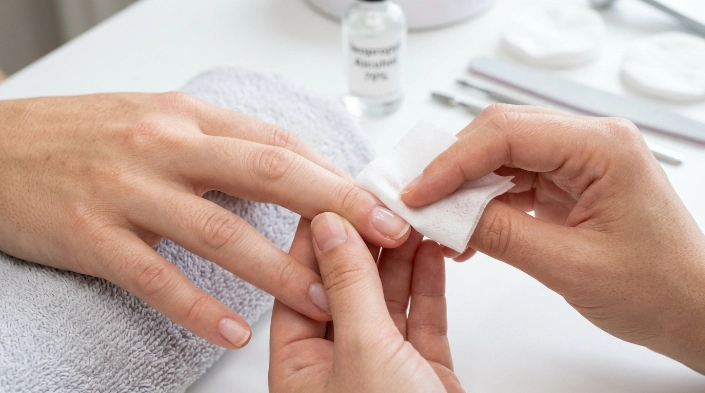
If you decide to use isopropyl alcohol, proper application matters just as much as the concentration.
1. Wash and Dry Your Hands
Start with clean hands.
Dry them thoroughly. You do not want visible water around the nails immediately before applying gel or another enhancement.
2. Shape the Nails
Trim or file your nails before dehydration.
Use a gentle file appropriate for your nail type. Avoid aggressively sawing the natural nail or thinning the nail plate.
The American Academy of Dermatology’s nail-trimming guidance recommends smoothing rough nail edges carefully and also emphasizes keeping nail tools clean.
3. Complete Any Required Surface Prep
If your manicure system requires light buffing, use a suitable fine-grit buffer and very gentle pressure.
Your goal is normally to remove surface shine—not layers of healthy natural nail.
Do not aggressively file the nail just because you are worried about lifting.
Over-filing can leave nails thin, tender, and weak.
4. Remove All Dust
Brush away filing dust carefully.
Check the sidewalls and area near the cuticle because dust can hide there.
5. Put Alcohol on a Lint-Free Wipe
Use 90–99% isopropyl alcohol if available.
Lightly dampen a lint-free nail wipe. It should not be dripping.
6. Wipe Each Nail
Wipe from the cuticle area toward the free edge without soaking the surrounding skin.
Pay particular attention to the sidewalls, where oil and dust often remain.
7. Let the Nail Air-Dry
Wait until the alcohol has completely evaporated.
The nail should look dry before the next step.
8. Avoid Touching Your Nails
After cleansing, do not run your fingers over the nail plate to check whether it feels clean.
Touching it can immediately transfer skin oils back onto the nail.
Continue directly with primer, bonder, base coat, adhesive, or whatever your manicure system specifies.
Professional manicure systems also commonly include a dedicated cleansing step before bonding products. For example, OPI’s professional nail-prep procedure includes cleansing the prepared nail before applying its bonding product.
Alcohol vs. Nail Dehydrator: Which Should You Choose?
For a simple DIY manicure, you do not necessarily need to buy another product every time.
But the better choice depends on what you are applying.
Choose Alcohol When:
- You are doing a basic at-home manicure
- You already have 90–99% isopropyl alcohol
- Your nail system does not specifically require a dehydrator
- You rarely have lifting problems
- You need a temporary substitute
- You are applying press-ons and need to remove surface oil
Choose a Nail Dehydrator When:
- Your enhancements repeatedly lift
- Your nails are naturally oily
- You are applying acrylic, hard gel, or long extensions
- Retention is especially important
- Your product manufacturer recommends one
- You want a predictable professional prep routine
A small bottle of nail dehydrator commonly costs only a few dollars more than rubbing alcohol, so if you regularly do gel or enhancement manicures, buying the purpose-made product can be worthwhile.
Expert Tip: After dehydrating your nails, treat the nail plate as a clean surface you do not want to contaminate. Do not touch your hair, face, phone, or skin before applying the next nail product.
Can Alcohol Replace Both Dehydrator and Primer?
No.
A dehydrator and primer perform different jobs.
A dehydrator mainly cleans and temporarily removes surface moisture and oil.
A primer or bonder is designed to improve the connection between the natural nail and the enhancement system.
So using alcohol does not automatically mean you can skip primer if your gel, acrylic, or builder system requires one.
A typical order may look like:
- Shape and prepare the nail.
- Remove dust.
- Dehydrate or cleanse.
- Allow the nail to dry.
- Apply primer or bonder if required.
- Apply the base or enhancement product.
Always check the instructions for your particular brand because nail systems are not all formulated the same way.
What Should You Not Use Instead of Nail Dehydrator?
Some common household products seem similar but are poor choices.
Hand Sanitizer
Avoid using hand sanitizer as nail dehydrator.
Many sanitizers contain water, glycerin, aloe, fragrances, thickeners, or moisturizing ingredients.
Those are useful for skin comfort but are exactly the types of residues you generally do not want underneath gel or adhesive.
Vodka or Drinking Alcohol
Do not use vodka as a nail-prep shortcut.
Its alcohol concentration is usually much lower than high-percentage isopropyl alcohol, and the remaining liquid is largely water.
Perfume or Body Spray
These products may contain alcohol, but they also contain fragrance and other ingredients that can leave residue.
Acetone Without Checking Your Nail System
Pure acetone can remove oil and moisture very effectively, but it is also extremely drying and is not automatically interchangeable with every manufacturer’s prep product.
Follow the instructions for your manicure system instead of assuming stronger solvent equals better preparation.
Is Using Alcohol on Your Nails Safe?
Occasional use of isopropyl alcohol on the nail plate is generally straightforward, but repeated exposure can dry your nails and surrounding skin.
Avoid deliberately flooding your cuticle area.
Stop if you develop:
- Burning
- Persistent redness
- Swelling
- Cracked or painful skin
- Rash
- Unusual tenderness
Alcohol is also flammable, so keep it away from candles, cigarettes, sparks, heaters, and open flames.
The FDA’s guidance on nail-care products advises consumers to follow nail-product directions and warnings, use products with appropriate ventilation, and pay attention to reactions such as irritation or allergy.
After your manicure is complete, moisturizing the surrounding skin and cuticle area can help counter everyday dryness.
What If Your Gel Nails Still Lift After Using Alcohol?
If your manicure lifts quickly even with careful alcohol prep, do not automatically add more alcohol.
Lifting can have several causes.
Check whether you are:
- Leaving invisible cuticle tissue on the nail plate
- Touching the nail after cleansing
- Using the wrong lamp for your gel system
- Applying layers too thickly
- Getting gel or base coat onto the skin
- Skipping a required primer
- Using incompatible products
- Filing too aggressively or too little for the specific system
- Curing for the wrong amount of time
People with naturally oily or moisture-prone nails may simply get better retention from a professional dehydrator plus the recommended primer.
Hygiene Matters Too
Good adhesion is not the only goal of nail preparation.
Keep reusable manicure tools clean, and do not casually share files, buffers, or other porous tools between people.
The American Academy of Dermatology advises cleaning nail tools and notes that damaged cuticles can make it easier for germs to enter and cause infection.
If you are doing another person’s nails at home, use appropriate hygiene practices instead of treating a quick alcohol wipe as a substitute for proper tool sanitation.
Common Mistakes to Avoid
- Using hand sanitizer instead of isopropyl alcohol. Moisturizers and thickeners can leave residue.
- Using too much alcohol. The nail only needs to be wiped, not soaked.
- Touching the nail afterward. This transfers oil straight back to the prepared surface.
- Using 70% alcohol when a stronger concentration is available. Higher-percentage IPA is usually better suited to dehydration.
- Flooding the cuticle and skin. Keep prep products mainly on the nail plate.
- Assuming alcohol replaces primer. They perform different functions.
- Ignoring manufacturer instructions. A complete professional system may require its own prep products.
- Over-buffing to compensate for lifting. Removing more natural nail is not a safe solution.
- Applying product before the alcohol evaporates. Let the nail dry completely.
- Continuing through irritation or pain. Stop and assess the nail or skin instead.
When to See a Nail Technician or Dermatologist
A DIY substitution is reasonable when your nails and surrounding skin are healthy.
It is not the right solution for every nail problem.
Consider seeing an experienced nail technician if your extensions continually lift despite proper prep. A technician can look at your preparation technique, product compatibility, application thickness, and curing routine.
See a dermatologist or other qualified healthcare professional if you notice:
- Increasing redness or swelling
- Pus or drainage
- Significant pain
- Green, yellow, brown, or black nail discoloration
- A nail separating from the nail bed
- Persistent rash around several fingers
- Severe itching after gel or acrylic products
- Nail changes that continue even after removing enhancements
Do not cover a suspicious nail with another artificial enhancement simply to hide it.
FAQs
Can I use 70% alcohol instead of nail dehydrator?
Yes, but it is not ideal for maximum dehydration because 70% alcohol contains more water. If possible, use 90–99% isopropyl alcohol and let it evaporate completely before applying your nail product.
Can I use 91% alcohol as a nail dehydrator?
Yes. 91% isopropyl alcohol is one of the better household substitutes for a nail dehydrator because it removes surface oil and evaporates quickly.
Can I use 99% alcohol before gel nails?
Yes, provided your gel manufacturer’s instructions do not require a different preparation method. Apply a small amount with a lint-free wipe and let it fully evaporate.
Is nail dehydrator the same as rubbing alcohol?
Not necessarily. Some nail dehydrators contain isopropyl alcohol, but professional formulations may also contain solvents such as ethyl acetate and isobutyl acetate.
Can alcohol prevent gel lifting?
It can help when surface oil or residue is contributing to lifting, but it cannot fix every cause. Application technique, curing, cuticle preparation, product compatibility, and primer requirements also matter.
Can I use acetone instead of nail dehydrator?
Acetone can remove oil and moisture, but it is more drying and is not the recommended substitute for every system. Use the nail manufacturer’s preparation instructions whenever possible.
Do I need dehydrator for press-on nails?
Not always, but removing surface oil before applying nail glue or adhesive tabs can improve adhesion. High-percentage isopropyl alcohol is a convenient option for this type of prep.
Conclusion
So, can you use alcohol instead of nail dehydrator? Yes—especially when you use 90% to 99% isopropyl alcohol for a simple at-home manicure.
It can remove surface oils and residue, dries quickly, and is an affordable backup when you do not have a dedicated dehydrator.
However, alcohol is not an exact replacement for every professional formula. If you regularly wear acrylics, builder gel, hard gel, or long extensions—or constantly struggle with lifting—a nail dehydrator made for your system is usually the better choice.
Whichever option you use, keep the process simple: prepare gently, remove dust, cleanse the nail, let it dry completely, avoid touching it, and follow the instructions for your nail products.
Healthy nail prep should improve your manicure without sacrificing the health of your natural nails or surrounding skin.