
Why Do Toenails Have White Lines? Common Causes and When to Worry

You look down after removing your nail polish and suddenly notice a white line running across one of your toenails. Maybe it is thin and faint. Maybe several nails have similar marks. Either way, it is natural to wonder: Why do toenails have white lines, and does it mean something is wrong?
In many cases, white lines or white marks on toenails are linked to minor nail trauma, pressure from shoes, or an old injury that is simply growing out. However, fungal infections and certain health conditions can also change the color or appearance of a toenail.
The important part is looking at the whole picture: whether the line is on one nail or several, whether the nail is thick or crumbly, whether you have pain or swelling, and whether the mark moves toward the tip as the nail grows.
This guide explains the common causes, what different white lines can look like, what you can safely do at home, and when it is smarter to have the nail checked professionally.
Quick Answer
Why do toenails have white lines? Most harmless white lines develop after minor trauma or repeated pressure on the nail, such as tight shoes, stubbing a toe, or aggressive pedicures. Fungal infections can also cause white discoloration. Less commonly, white bands across several nails can be associated with medications or underlying health problems.
What Do White Lines on Toenails Actually Mean?
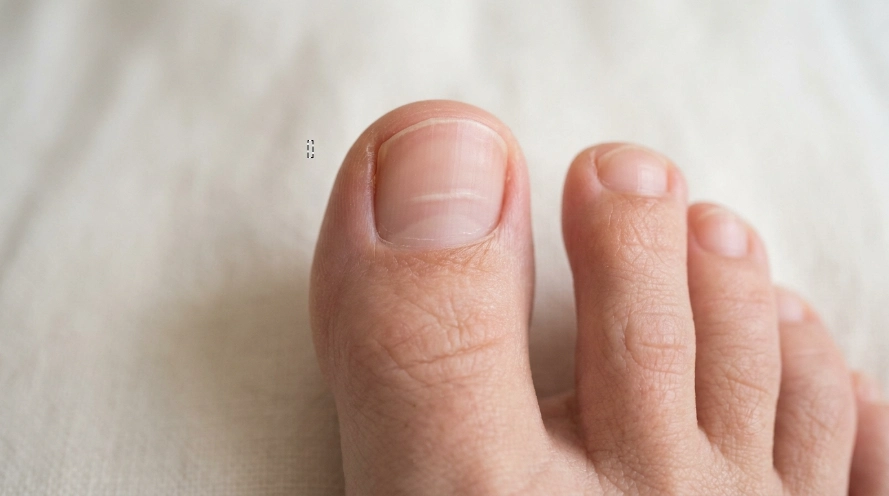
A white mark on a nail is often described medically as leukonychia, which simply refers to white discoloration of the nail.
That does not automatically mean you have a disease.
Small areas of leukonychia commonly develop after the nail has been injured. Mayo Clinic notes that white lines or spots can occur after nail injuries and gradually grow out with the nail. Mayo Clinic nail-care guidance
Toenails are especially vulnerable because they regularly experience pressure from shoes, walking, running, exercise, accidental bumps, pedicures, and trimming.
The appearance of the white line gives you useful clues.
| What You Notice | Possible Explanation | What to Do |
|---|---|---|
| Small white line or spot on one toenail | Minor trauma or pressure | Watch it as the nail grows |
| White mark after tight shoes or toe injury | Nail-matrix trauma | Avoid pressure and allow it to grow out |
| White, chalky or powdery surface | Possible fungal infection | Consider medical evaluation |
| White nail plus thickening or crumbling | Fungal infection becomes more likely | See a dermatologist, podiatrist, or healthcare provider |
| Horizontal white band across most/all of the nail | Could be a type of leukonychia such as Mees’ lines | Discuss with a healthcare professional |
| Similar white bands on several nails | Possible systemic or medication-related cause | Medical evaluation is appropriate |
| White discoloration with pain, redness, swelling, or drainage | Infection or injury | Seek professional care |
The pattern matters more than the color alone.
1. Minor Nail Trauma Is a Common Cause
One of the simplest explanations for a white toenail line is an injury you may not even remember.
The part of the nail responsible for producing new nail cells is called the nail matrix. Trauma around this area can temporarily disrupt how the nail forms, leaving a white mark that becomes visible later.
Common triggers include:
- Stubbing your toe
- Dropping something on your foot
- Wearing shoes that press against the toenails
- Running or hiking in poorly fitting footwear
- Cutting or filing the nail aggressively
- Heavy buffing during a pedicure
- Pushing or cutting around the cuticle too forcefully
- Repeated pressure from athletic shoes
Because toenails grow slowly, the white line may appear well after the original irritation happened.
That is why someone may see a mark and say, “But I didn’t injure my toe.”
You may simply not remember the minor pressure that caused it.
What Happens to a Trauma-Related White Line?
Usually, nothing dramatic.
As the toenail grows, the mark should slowly move toward the free edge of the nail until you can eventually trim it away.
Toenails grow much more slowly than fingernails. Cleveland Clinic reports that toenails typically grow about 1.5 millimeters per month and may take approximately 12 to 18 months to completely regrow.
So do not expect a harmless white line to disappear in a week.
2. Tight Shoes Can Be the Hidden Problem
If white lines keep appearing on the same toenail, take a look at your footwear.
Shoes with a short or narrow toe box can repeatedly press the toenail against the inside of the shoe. This is especially common with:
- Running shoes
- High heels
- Pointed-toe shoes
- Hiking boots
- Work boots
- Shoes that are simply too small
The big toenail and second toenail often take the most pressure.
Your shoes should give your toes enough space to move without your toenails repeatedly hitting the front.
Do not try to buff away a deep white line caused by trauma. Aggressive buffing only removes healthy layers from the nail plate and can leave the toenail thinner and more vulnerable.
Expert Tip
Expert Tip: If the same toenail repeatedly develops white marks, inspect your shoes before reaching for a nail treatment. Persistent pressure from footwear can keep recreating the problem even when your nail-care routine is otherwise excellent.
3. Could White Toenail Lines Be Nail Fungus?
Sometimes.
A fungal nail infection, or onychomycosis, can turn toenails white, yellow, brown, or another color.
According to the American Academy of Dermatology’s nail-fungus guidance, fungal toenails may become discolored, thickened, brittle, cracked, crumbly, misshapen, or separated from the nail bed. Some fungal infections create a white, dry, powdery appearance on the nail surface. American Academy of Dermatology nail-fungus symptoms guide
That means a thin white line by itself does not prove you have fungus.
Fungus becomes more suspicious when the white discoloration appears with other changes such as:
- Increasing nail thickness
- Yellow or brown areas
- Crumbling edges
- A rough or powdery surface
- Debris underneath the nail
- Nail lifting
- Several affected toenails
- Athlete’s foot or flaky skin nearby
The NHS similarly notes that fungal nail infections commonly make toenails thicker, discolored, brittle, or crumbly. NHS fungal nail infection guidance
Don’t Automatically Treat Every White Line as Fungus
This is a common DIY mistake.
Using antifungal products when you do not actually have a fungal infection may waste money and delay getting the correct diagnosis.
A dermatologist, podiatrist, or other healthcare professional can examine the nail and, when necessary, take a nail sample to help determine whether fungus is actually present.
4. What Are Mees’ Lines?
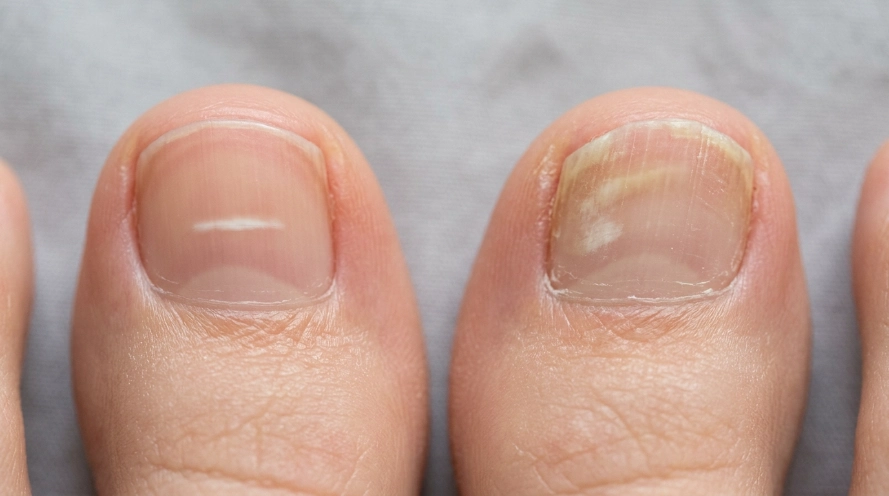
Mees’ lines are white horizontal bands that run across the nail.
Unlike a tiny white mark caused by ordinary trauma, a classic Mees’ line usually extends across much or all of the width of the nail and moves toward the tip as the nail grows.
Cleveland Clinic explains that Mees’ lines can occur on fingernails or toenails and may sometimes be associated with significant illness, medications such as chemotherapy, or exposure to certain toxic substances. Cleveland Clinic guide to Mees’ lines
Merck Manual also notes that transverse white lines can occur after trauma but that true Mees’ lines can have other medical associations.
This does not mean that every horizontal white line is evidence of a serious illness.
Appearance alone is not enough for you to diagnose Mees’ lines at home.
However, if you suddenly develop prominent horizontal white bands across several nails without an obvious injury, bring them to the attention of a healthcare professional.
5. What About Muehrcke Lines?
Another pattern occasionally confused with Mees’ lines is Muehrcke lines.
These usually appear as two or more pale horizontal bands. Unlike a mark formed inside the hard nail plate, Muehrcke lines are associated with changes underneath the nail.
One characteristic is that they may temporarily fade when pressure is applied and do not travel outward with nail growth. Cleveland Clinic notes that they can be associated with low blood albumin and certain underlying medical conditions.
This distinction is interesting, but it should not be used as an at-home diagnostic test.
If several nails develop unexplained horizontal bands, professional evaluation is safer than trying to identify the exact medical type yourself.
6. Are White Toenail Lines Caused by Vitamin Deficiency?
This question comes up constantly.
It is tempting to assume that every nail change means you need more calcium, zinc, iron, or another supplement. Nail changes can occur alongside nutritional problems, but the appearance of a white line alone cannot tell you which nutrient you are missing — or whether you are deficient at all.
So avoid diagnosing yourself from a toenail and buying several supplements “just in case.”
Taking unnecessary supplements can also have downsides.
If white lines affect multiple nails and you also have symptoms such as unusual fatigue, unexplained weight changes, significant skin or hair changes, or another health concern, talk with your healthcare provider. They can decide whether examination or laboratory testing is appropriate.
7. Can Nail Polish Cause White Marks?
Sometimes the timing can make polish seem responsible even when another issue is underneath.
Removing dark polish may simply reveal a white mark that had been hidden for weeks.
Repeated polish removal, aggressive filing, scraping, buffing, artificial nail products, or pedicure procedures can also put stress on the nail plate and surrounding tissue.
If your toenails look dry or damaged:
- Take a temporary break from aggressive cosmetic treatments.
- Keep the nail comfortably trimmed.
- Avoid scraping the white area.
- Moisturize the skin around your toenails.
- Wear comfortable, breathable shoes.
- Watch whether healthier-looking nail grows from the base.
Remember that cosmetic products cannot correct a white line that is already embedded in the nail plate. You generally have to wait for damaged nail to grow forward.
How to Care for White Lines on Toenails at Home
If the line is small, painless, limited to one nail, and you remember recent pressure or injury, observation may be reasonable.
1. Keep the Toenail Trimmed
Cut your toenails straight across without digging deeply into the corners.
Avoid cutting the nail extremely short.
2. Stop Aggressive Buffing
A buffer cannot erase damage deep inside the nail.
Thinning the nail too much may create additional weakness.
3. Check Your Shoes
Make sure your toes have enough room.
Pay particular attention to footwear you use for running, gym workouts, long walks, or work.
4. Keep Your Feet Clean and Dry
Moist environments can encourage fungal growth.
Dry between the toes after bathing and change damp socks promptly.
5. Don’t Share Nail Tools
Sharing clippers or files can spread microorganisms between people.
Clean reusable tools according to their manufacturer’s instructions and replace disposable files when appropriate.
6. Watch the Direction of Growth
Take a clear photo today.
Compare it again several weeks later.
If the white mark slowly moves toward the tip while normal-looking nail grows from the base, that pattern can be reassuring after minor trauma.
If the discoloration spreads instead, or the nail becomes thicker, brittle, painful, or detached, have it checked.
DIY Care vs. Professional Evaluation
For a tiny mark after obvious shoe pressure, you probably do not need an expensive product or salon treatment.
DIY care has limits, however.
A nail technician can help with cosmetic nail care and careful trimming, but a nail technician should not be expected to diagnose fungal infections, nutritional deficiencies, or medical diseases.
If the problem appears medical, a dermatologist, podiatrist, or other qualified healthcare professional is the better choice.
Avoid covering a suspicious nail repeatedly with polish simply because you dislike how it looks. Covering the discoloration does not identify or treat its cause.
Common Mistakes to Avoid
- Assuming every white line means calcium deficiency. A nail line cannot diagnose a nutrient deficiency by itself.
- Immediately treating it as fungus. White discoloration has several possible causes.
- Buffing aggressively. Removing too much nail can make a healthy toenail thin and fragile.
- Picking or scraping the white area. This can damage the nail further.
- Continuing to wear tight shoes. Repeated pressure can keep injuring the nail.
- Sharing files or clippers. Nail tools can transfer microorganisms.
- Ignoring pain or swelling. Those symptoms deserve more attention than a simple cosmetic white line.
- Hiding a changing nail under polish for months. You need to be able to monitor whether the nail is improving or worsening.
- Trying to diagnose serious conditions from internet photos. Many nail disorders can look similar.
When to See a Nail Technician or Dermatologist
A nail technician may be appropriate when the toenail is otherwise healthy and you simply want help with gentle cosmetic maintenance.
For unexplained nail changes, however, consider a dermatologist, podiatrist, or healthcare provider, especially if:
- Several toenails suddenly develop white bands
- You cannot identify a likely injury or pressure source
- The nail becomes thick, brittle, or crumbly
- White discoloration spreads
- The nail begins lifting away from the skin
- The surrounding skin is red or swollen
- You notice drainage or significant pain
- The nail changes shape dramatically
- You have diabetes or problems with circulation
- You have a weakened immune system
- The change persists instead of growing out normally
The American Academy of Dermatology advises having meaningful changes in nail color, texture, or shape examined because some are harmless while others can be associated with nail or medical conditions. American Academy of Dermatology nail-change guidance
Seek medical advice rather than relying on DIY nail care if you suspect infection or an underlying health problem.
FAQs
Why do I suddenly have a white line on my big toenail?
Minor trauma is one possible explanation. Tight footwear, running, stubbing your toe, or a pedicure can injure the nail as it forms. If the mark gradually moves toward the tip as your nail grows and there are no other symptoms, it may simply be growing out.
Do white lines on toenails mean calcium deficiency?
Not necessarily. A white line alone cannot diagnose calcium or any other nutritional deficiency. Avoid starting supplements based only on the appearance of your toenails. If you are concerned about nutrition, discuss your diet and symptoms with a healthcare professional.
Can toenail fungus cause white lines?
Yes, fungal nail infections can produce white discoloration. However, fungal nails often develop additional changes such as thickening, brittleness, crumbling, roughness, yellow discoloration, or separation from the nail bed.
Will a white line on my toenail go away?
If it resulted from an old injury to the growing nail, it may gradually move forward and disappear as the nail grows out. Toenails grow slowly, so this can take many months.
Should I buff white lines off my toenails?
Usually not. If the discoloration is inside the nail plate, buffing will not solve the underlying problem and can unnecessarily thin your nail. Gentle filing of a rough edge is different from repeatedly grinding down the nail surface.
When should I worry about horizontal white lines on toenails?
Consider medical evaluation if prominent horizontal bands appear across several nails, develop without an obvious injury, repeatedly return, or occur with other nail or health changes. You should also seek advice for pain, swelling, nail separation, or signs of infection.
Conclusion
So, why do toenails have white lines? Very often, the explanation is much less dramatic than it first appears. Minor injury, shoe pressure, or pedicure-related trauma can leave white marks that slowly grow toward the end of the nail.
Fungal infection is another possibility, particularly when the nail is also thick, brittle, powdery, crumbly, yellow, or lifting.
More distinctive horizontal bands — especially those affecting several nails — deserve closer attention because some patterns can occur alongside medications or underlying health conditions.
Instead of trying to diagnose your health from one nail mark, watch the pattern, protect the nail, avoid unnecessary treatments, and pay attention to additional symptoms.
Take a photo so you can track the line as your toenail grows. If it spreads, becomes painful, affects several nails, or comes with significant changes in nail texture or shape, make an appointment with a dermatologist, podiatrist, or healthcare provider.

