
How to Clean Under Your Toenails Safely: Step-by-Step Guide

Dirt, dead skin, sock lint, and other debris can collect beneath your toenails even when you wash your feet regularly. Seeing dark or whitish buildup under a nail can make you want to reach for the nearest sharp tool and scrape it out.
That is usually not the safest approach.
Learning how to clean under your toenails is really about removing loose debris without damaging the sensitive skin beneath the nail or separating the nail plate from the nail bed. For most healthy toenails, warm water, mild soap, a soft nail brush, clean clippers, and careful drying are all you need.
This guide explains the safest step-by-step method, which tools work best, what stubborn buildup may mean, common mistakes to avoid, and when what looks like ordinary dirt should be checked by a professional.
Quick Answer
To clean under your toenails safely, soak or wash your feet with warm water and mild soap, gently brush around the nail and beneath the visible free edge, rinse well, and dry completely. Avoid digging deeply with sharp tools because this can injure the nail bed and increase the risk of irritation or infection.
Why Does Dirt Collect Under Toenails?
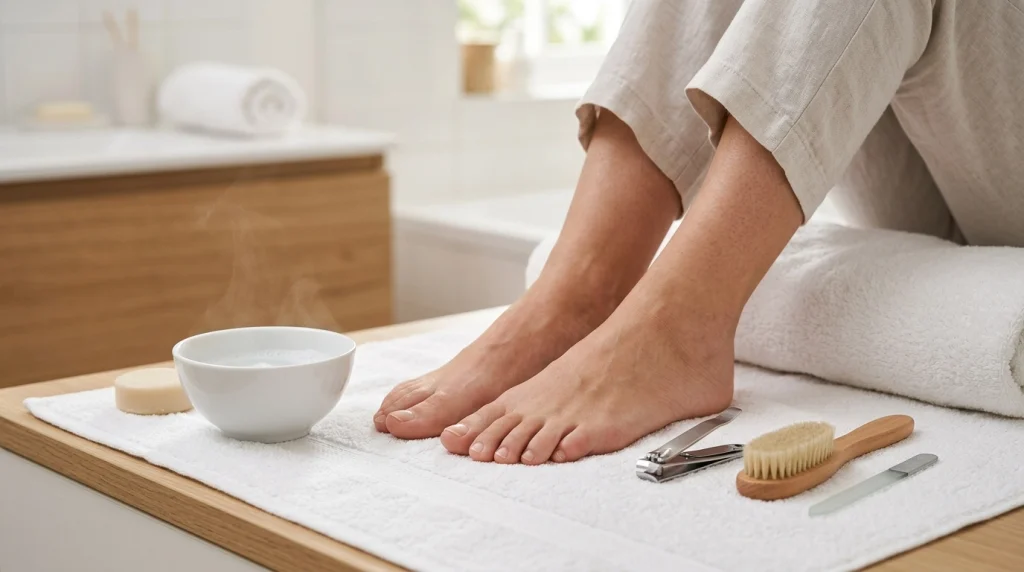
The space beneath the free edge of a toenail is easy to overlook during a normal shower.
Several things can collect there, including:
- Dead skin cells
- Sock fibers and lint
- Dust and everyday dirt
- Sweat and body oils
- Lotion or foot-care product residue
- Small amounts of keratin, the protein that makes up nails and skin
- Debris trapped after exercise or wearing closed shoes
Your feet spend hours inside socks and shoes, often in a warm environment. That makes regular cleaning useful, especially if your feet sweat heavily.
However, not everything underneath a toenail is removable dirt.
A thick yellow, white, or crumbly material beneath a nail can sometimes be associated with a fungal nail infection rather than simple debris. Mayo Clinic notes that nail fungus can cause toenails to become discolored, thickened, brittle, misshapen, or separated from the nail bed.
That distinction matters because repeatedly scraping an abnormal nail will not treat the underlying problem.
What You Need to Clean Under Your Toenails
You do not need an expensive pedicure kit.
A basic at-home setup can include:
| Tool | Best Use | What to Look For |
|---|---|---|
| Mild soap | Loosening sweat and everyday debris | Gentle, non-irritating formula |
| Soft nail brush | Cleaning nail surfaces and free edges | Soft or medium-soft bristles |
| Toenail clippers | Keeping nails at a manageable length | Sharp, clean stainless-steel blades |
| Nail file | Smoothing rough edges | Fine or medium grit |
| Clean towel | Thorough drying | Fresh and absorbent |
| Wooden manicure stick | Very light cleaning at the visible free edge | Smooth, rounded tip |
Avoid using needles, safety pins, knives, scissors, metal picks, or other sharp household objects underneath your nails.
The skin beneath your nail is more delicate than it looks. A tiny puncture or tear can become painful and create an opening for bacteria or fungi.
The American Academy of Dermatology recommends keeping nails clean and dry and trimming toenails regularly as part of healthy nail care. healthy nail-care recommendations from the American Academy of Dermatology
How to Clean Under Your Toenails Step by Step
1. Wash Your Hands and Clean Your Tools
Before touching your feet, wash your hands.
If you are using clippers, a nail brush, or another reusable tool, make sure it is clean too.
This step can feel unnecessary when you are only removing dirt, but nail tools can transfer microorganisms from one nail to another.
Do not share toenail clippers, brushes, files, or other personal grooming tools with family members.
The American Academy of Dermatology specifically advises against sharing nail-grooming tools and recommends cleaning and disinfecting nail clippers regularly.
2. Soften the Debris With Warm Water
Wash your feet in warm water with mild soap.
You can do this during a shower, bath, or short foot soak. The goal is simply to soften dried debris and make it easier to remove.
You generally do not need a long soak.
If your toenails are unusually thick and difficult to trim, the American Academy of Dermatology suggests that soaking can help soften them before clipping.
Avoid extremely hot water, especially if your skin is dry, sensitive, cracked, or easily irritated.
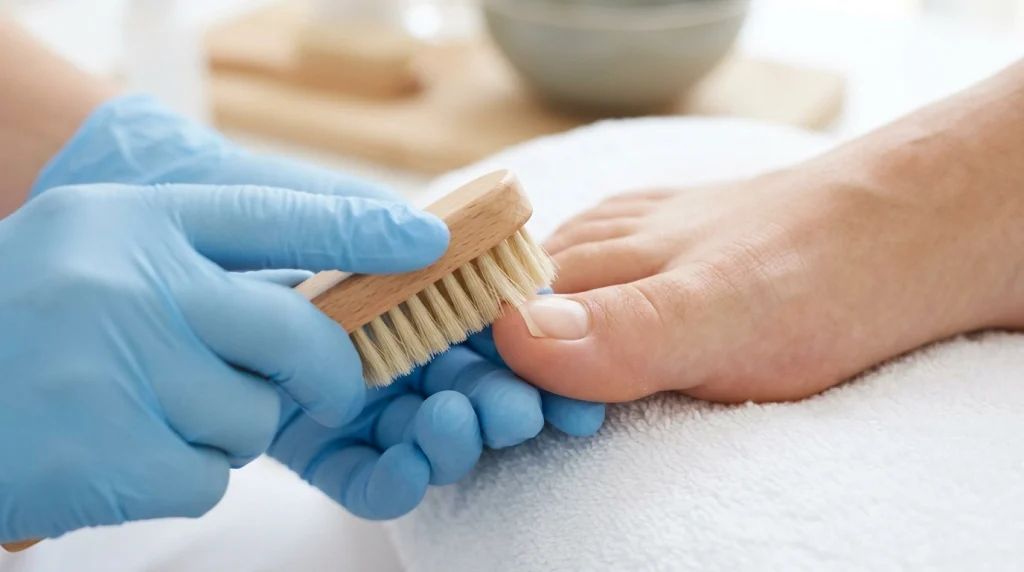
3. Gently Brush the Nail Surface
Apply a little mild soap to a clean, soft nail brush.
Brush:
- Across the top of the toenail
- Around the nail edges
- Across the tip
- Very gently beneath the visible free edge
Use small strokes rather than aggressive scrubbing.
You are trying to loosen debris, not polish the nail through friction.
If your skin begins to sting, turn red, or feel sore, stop.
4. Clean Only Beneath the Accessible Free Edge
The free edge is the portion of the toenail that extends beyond the skin at the tip of your toe.
If loose dirt remains visible there, you can gently remove it using your soft nail brush.
A smooth wooden manicure stick can also be used cautiously along the very accessible edge, but do not push the tool deeply beneath the attached nail.
You should not need to force anything.
If debris will not come out with gentle cleaning, leave it alone for the moment rather than digging harder.
5. Trim Long Toenails if Needed
Long toenails can create more space for debris to collect.
After the nail has softened slightly, trim it with clean toenail clippers.
Cut mostly straight across instead of carving deeply into the corners. This can help reduce irritation around the nail edges.
Do not cut the nail extremely short.
Leaving a small visible free edge protects the sensitive skin beneath the nail.
6. Smooth Rough Edges
If trimming leaves a rough or sharp corner, use a nail file to smooth it gently.
Filing can prevent the nail from catching on socks and may make routine cleaning easier.
There is no need to aggressively file the surface or underside of a healthy toenail.
7. Rinse Your Feet Thoroughly
Rinse away soap, loosened debris, and skin particles.
Check the sides and tips of the nails afterward.
If most visible dirt is gone, your cleaning session is finished. Perfectly scraping every tiny speck from beneath the nail is unnecessary.
8. Dry Your Feet Completely
This is one of the most important steps.
Dry:
- The toenail surface
- Around each nail
- Under the visible nail tip if moisture remains
- Between every toe
Fungi tend to thrive in warm, damp environments. Both the NHS and American Academy of Dermatology recommend keeping feet clean and dry as part of preventing fungal nail problems.
Put on clean socks only after your feet are dry.
Expert Tip: Clean beneath the nail only as far as you can reach comfortably without pressure. If you have to dig, scrape, or force a tool underneath the nail, you are going too far.
How Often Should You Clean Under Your Toenails?
For most people, washing the feet daily and gently brushing the nails during regular bathing is enough.
A more focused toenail-cleaning session may be useful once or twice a week, depending on your routine.
You may need more frequent attention if you:
- Exercise regularly
- Wear work boots for long periods
- Have sweaty feet
- Spend time barefoot outdoors
- Wear closed shoes most of the day
- Frequently use foot creams or heavy moisturizers
- Notice sock lint collecting under the nail tips
More cleaning is not automatically better.
Daily aggressive scraping can irritate the nail bed and skin. Consistent gentle hygiene is safer than occasionally trying to deep-clean the nails.
What if the Dirt Under Your Toenail Will Not Come Out?
First, do not assume that stubborn material is ordinary dirt.
Look at the nail as a whole.
It May Be Compact Dead Skin or Keratin
Small amounts of keratin and dead skin can accumulate beneath a nail, particularly if the nail is thick.
Warm water and gentle brushing may gradually remove loose material.
Do not force out material that appears firmly attached.
The Nail May Have Lifted
When part of a toenail separates from the nail bed, a larger space can develop underneath it.
That space can collect debris more easily.
A lifted nail may occur after:
- Repeated pressure
- Tight shoes
- Stubbing the toe
- Sports-related trauma
- Nail infection
- Certain skin conditions
Avoid inserting tools deeply beneath a lifted section. Doing so can worsen the separation.
It Could Be Nail Fungus
Fungal nail infections often involve more than dirt.
Possible signs include:
- Yellow, white, or brown discoloration
- Nail thickening
- Crumbling edges
- Brittle texture
- Nail distortion
- Separation from the nail bed
- Persistent odor
The NHS describes thickened, discolored, brittle, or crumbly nails as common signs of a fungal nail infection. NHS guidance on fungal nail infections
Cleaning may improve surface hygiene, but it does not cure nail fungus.
If these changes continue, consider speaking with a dermatologist, podiatrist, or other healthcare professional.
Can You Use a Nail Tool to Scrape Under Toenails?
A tool is not automatically unsafe. The problem is how deeply and forcefully it is used.
Using a smooth tool very gently along an accessible free edge may help move loose debris.
Digging underneath the attached portion of the nail is different.
Aggressive scraping can:
- Irritate sensitive skin
- Cause small cuts
- Create soreness
- Make the nail separate further
- Introduce bacteria
- Cause bleeding
- Make an existing infection more uncomfortable
A pointed metal cleaner can also be harder to control than a soft brush.
For routine cleaning, the gentlest effective tool is usually the better choice.
Should You Clean Under Toenails Before or After a Shower?
After or during a shower is usually easiest.
Warm water softens:
- Toenails
- Dead skin
- Dried sweat
- Dirt
- Sock fibers
That means you are less likely to feel tempted to scrape aggressively.
Cleaning completely dry toenails is possible, but hardened debris can be more difficult to remove safely.
Hygiene Habits That Keep Toenails Cleaner
Cleaning your nails is only one part of the routine.
Change Socks Regularly
Wear clean socks each day.
If your socks become very sweaty after exercise or work, change them rather than leaving your feet damp for hours.
Let Shoes Dry
Rotating between pairs can give damp shoes more time to dry.
The American Academy of Dermatology recommends keeping feet dry and allowing shoes time to dry as part of nail-fungus prevention.
Wear Properly Fitting Shoes
Shoes that repeatedly press against your toenails can cause trauma.
That may lead to:
- Thickening
- Discoloration
- Lifting
- Broken nails
- Soreness around the nail
Leave enough room for your toes to move comfortably.
Keep Nail Tools Personal
Do not share clippers, files, cuticle tools, or nail brushes.
Clean reusable equipment after use and allow it to dry completely before storing it.
Be Careful at Salons
A professional pedicure can make nail maintenance easier, but hygiene matters.
Look for clean workstations and properly sanitized reusable tools. The American Academy of Dermatology’s manicure and pedicure safety guidance recommends paying attention to sanitation practices and avoiding aggressive cuticle removal.
DIY Cleaning vs. Professional Pedicure
Both options can make sense.
| Consideration | DIY Cleaning | Professional Pedicure |
|---|---|---|
| Cost | Usually low after buying basic tools | Ongoing service cost |
| Convenience | Can be done at home | Requires appointment or salon visit |
| Routine dirt | Usually easy to manage | Easily handled |
| Thick nails | Can be difficult | Technician may help with cosmetic maintenance |
| Tool hygiene | You control it | Depends on salon procedures |
| Suspected infection | Not appropriate for diagnosis | Nail tech should not replace medical evaluation |
| Pain or swelling | Stop DIY treatment | Medical assessment may be needed |
For normal, healthy toenails, home care is usually perfectly reasonable.
A nail technician can help with grooming, trimming, shaping, and cosmetic maintenance, but a salon visit is not a substitute for medical care when infection, injury, or disease may be involved.
Sensitive Skin and Toenail Cleaning
If your skin becomes irritated easily, simplify your routine.
Choose:
- Fragrance-free or mild soap
- Lukewarm rather than hot water
- A very soft brush
- Gentle drying instead of rubbing
- Minimal use of tools beneath the nails
Avoid putting harsh household disinfectants directly on the skin or beneath your toenails.
If a particular product consistently causes burning, itching, peeling, redness, or swelling, stop using it.
Common Mistakes to Avoid
- Digging deeply beneath the toenail. This can injure the nail bed and make the problem worse.
- Using sharp household objects. Needles, pins, knives, and pointed scissors do not belong underneath your nails.
- Cutting toenails extremely short. This can leave sensitive skin exposed and contribute to discomfort.
- Ignoring moisture. Putting socks over damp feet creates a warm environment where microorganisms can thrive.
- Sharing nail tools. Clippers and files can transfer fungal or other infections.
- Assuming every dark area is dirt. Nail discoloration can have many causes.
- Scraping thickened nails repeatedly. Thick or crumbly material may need professional evaluation rather than stronger cleaning.
- Cutting into painful nail corners. If you suspect an ingrown toenail, aggressive DIY digging may worsen inflammation.
- Covering a changing nail with polish indefinitely. Polish can make it harder to monitor changes in color, thickness, or separation.
When to See a Nail Technician or Dermatologist
A nail technician is appropriate when your toenails are healthy but you want help with routine grooming, shaping, polish removal, or cosmetic maintenance.
A dermatologist, podiatrist, or healthcare provider is the better choice when the issue appears medical.
Arrange professional evaluation if you notice:
- Increasing pain
- Swelling around the nail
- Redness that spreads
- Pus or drainage
- Bleeding
- A persistently thick nail
- Significant yellow, brown, green, or black discoloration
- Crumbling
- A nail separating from the skin
- Changes affecting several nails
- Persistent odor with nail changes
- Difficulty walking because of the nail
Mayo Clinic advises seeking medical care when nail changes become increasingly discolored, thickened, or misshapen, and particularly when there is bleeding, swelling, pain, or difficulty walking.
People with diabetes, poor circulation, or a weakened immune system should be especially cautious with foot problems and should avoid aggressive self-treatment. The American Academy of Dermatology also advises people with diabetes or poor circulation to seek professional help for nail problems.
FAQs
What is the safest way to clean underneath toenails?
Wash or soak your feet in warm water with mild soap, then gently use a soft nail brush around and beneath the accessible free edge. Rinse and dry thoroughly. Avoid forcing tools deep under the nail.
Can I use a toothpick to clean under my toenails?
It is better to use a soft nail brush. A toothpick is pointed and can accidentally puncture or scratch the skin beneath the nail if you push too far.
Why is there white stuff under my toenails?
White material may be dead skin, keratin, product residue, or other debris. If it is accompanied by thickening, crumbling, discoloration, lifting, or persistent changes, fungal infection or another nail condition may need to be ruled out.
Why is the dirt under my toenail dark?
Dark material can sometimes be ordinary debris, but discoloration may also result from dried blood after an injury or changes in the nail itself. A new or unexplained dark area that does not grow out deserves professional evaluation.
How often should I clean under my toenails?
Daily foot washing is usually sufficient, with gentle nail brushing as needed. A more detailed cleaning once or twice a week is adequate for many people. Avoid aggressive daily scraping.
Should I clean underneath a lifted toenail?
You can gently rinse and clean the accessible area, but do not insert tools deeply beneath a lifted nail. Nail separation can have several causes, and repeated scraping can make it worse.
Can toenail fungus look like dirt?
Yes. Fungal nail infections can create discoloration, thickening, crumbling, and material beneath the nail that may initially look like dirt. If gentle washing does not resolve the buildup and the nail itself is changing, seek professional advice.
Final Thoughts
Knowing how to clean under your toenails does not require aggressive scraping or complicated pedicure tools.
For healthy nails, keep the routine simple: wash your feet, soften debris with warm water, brush gently around the nail and visible free edge, trim appropriately, rinse, and dry everything thoroughly.
The most important rule is knowing when to stop.
If something underneath your toenail will not come away with gentle cleaning, or the nail is thick, painful, discolored, crumbly, swollen, or lifting, treating it as stubborn dirt may do more harm than good.
Keep your routine gentle and consistent, maintain clean tools, socks, and shoes, and have persistent nail changes professionally examined rather than repeatedly digging underneath the nail.
SEO METADATA (do not paste into the article):
Meta Title: How to Clean Under Your Toenails Safely
Meta Description: Learn how to clean under your toenails safely, remove dirt gently, choose the right tools, and know when nail changes need professional care.
URL Slug: how-to-clean-under-your-toenails
Focus Keyword: How to Clean Under Your Toenails
Secondary Keywords: how to clean under your toenails, clean dirt under toenails, toenail cleaning, how to clean toenails safely, debris under toenails, toenail hygiene

