
How Long Does Top Coat Take to Dry? A Beginner’s Guide to Safer, Smudge-Free Nails

If you’ve ever painted your nails, waited a few minutes, and still ended up with a dent, you’re not alone. The short answer is that top coat often feels dry before it is fully set, so the safest approach is to give it more time than your fingertips suggest.
For beginners, the most useful rule is this: a top coat may be dry to the touch fairly quickly, but fully dry can take much longer. In practical terms, that means the surface may feel okay for very light contact, while the polish underneath can still dent if you press, grip, or bump it. Drying time depends on the formula, how thickly you applied it, and the room conditions. If your manicure is for an event, work shift, or anything where you’ll use your hands a lot, plan for extra waiting time rather than testing it too soon.
Quick Answer: How Long Top Coat Usually Takes to Dry
Top coat drying time varies, but here’s the practical version for beginners on natural nails:
- Regular air-dried top coat: often feels dry to the touch in about 10 to 20 minutes, but it is usually safer to wait 30 to 60 minutes before using your hands normally.
- Quick-dry top coat: often feels dry to the touch in about 5 to 10 minutes, with a more realistic wait of 15 to 30 minutes before light everyday use.
- Gel top coat: does not air-dry in the same way; it needs a UV/LED lamp to cure, and the manicure should be handled only after curing is complete.
These are approximate beginner-friendly ranges, not exact rules. A thin, even coat will usually set more reliably than a thick one, and a manicure that seems dry on top can still be soft underneath.
If you want a simple beginner rule, treat the manicure as fragile until it has had enough time to set fully. A surface that feels dry can still dent if you press it, grip a phone tightly, or bump it against a hard edge.
For a related breakdown of the base layer, see how long base coat takes to dry. Base coat and top coat both need time, but base coat is usually about creating a stable layer for polish to stick to, while top coat is the protective finish on top. If you want the full polish timeline, this guide on regular nail polish drying time can help you plan the whole manicure.
Dry to the Touch vs Fully Dry or Cured
These terms sound similar, but they are not the same.
Dry to the touch
This means the top surface no longer feels wet. You may be able to lightly tap it without leaving an obvious mark. That does not mean the polish underneath is ready for normal use.
Fully dry
This means the polish has set through more completely. At this stage, it is less likely to dent, smudge, or pick up texture from fabric or pressure.
Fully cured
This term is usually used for gel polish and gel top coat. Curing happens under a UV or LED lamp, which is different from air-drying. A gel top coat can feel different from a regular top coat because it is designed to harden under light, not just in the open air.
The easiest beginner mistake is assuming “feels dry” equals “finished.” It often does not. If you want your manicure to last, give it more time than the surface alone suggests.
What Changes Top Coat Drying Time
A top coat does not dry at one fixed speed. Several things can slow it down or speed it up.
Formula
Different formulas behave differently. A quick-dry top coat is made to set faster than a standard top coat, which is why it is helpful when you need to get moving sooner. Regular formulas may give you a familiar finish, but they usually ask for more patience.
Coat thickness
A thick layer takes longer to dry than a thin one. It can also trap softer polish underneath, which makes the manicure easier to dent. If your top coat still feels tacky after waiting, thickness is one of the first things to check.
Humidity and airflow
A warm, humid room can slow drying. Better airflow usually helps the surface set more evenly. A fan can help move air around the nails, but keep it gentle. Strong heat is not the answer; it can create bubbles or a patchy finish.
Application method
If you go back and forth over the nail too many times, you may leave the coat uneven. That can make the finish look smooth at first but dry more slowly in the center or near the edges.
For a full look at polish timing, you may also find how long nail polish takes to dry completely useful when you’re planning a full manicure from base coat to top coat.
Regular Top Coat vs Quick-Dry Top Coat vs Gel Top Coat
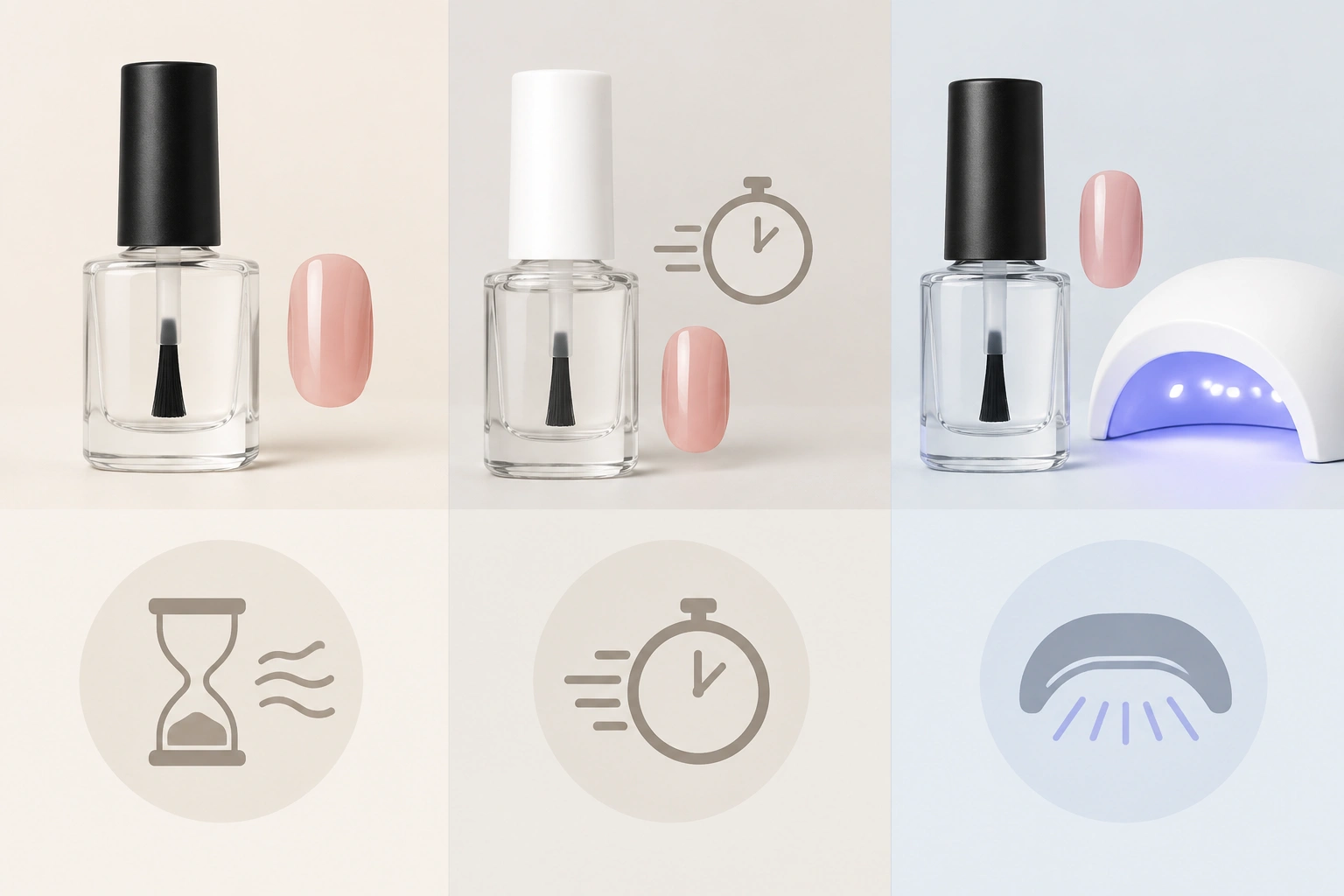
Here’s a simple comparison to help you choose the right type.
| Type | How it dries | Best for | Trade-off |
|---|---|---|---|
| Regular top coat | Air-dries over time | Everyday manicures, casual pace | Slower, easier to smudge if rushed |
| Quick-dry top coat | Air-dries faster than standard formulas | Busy schedules, beginners who want less waiting | May require quicker application |
| Gel top coat | Cures under UV/LED lamp | Longer-wear manicures with curing equipment | Not an air-dry product |
The main decision point is simple: if speed matters most, quick-dry is usually the easier choice. If you already use gel polish and have the right lamp, gel top coat follows a different process altogether. If you are happy to wait, a regular top coat can still work well.
How Thick Coat Application Affects Drying

Thin coats dry more evenly than thick ones. That matters because polish often seems dry on top while staying soft underneath.
A beginner-friendly way to apply top coat is to load the brush lightly, then use one smooth pass down the center of the nail and one on each side. You want coverage, not a heavy layer. If the polish looks pooled at the tip or cuticle, there is probably too much on the brush.
A thick coat may look glossy right away, but it usually comes with a cost: more waiting, more risk of dents, and a greater chance of wrinkling if you move too soon.
How to Make Top Coat Dry Faster Safely
You do not need fancy tools to improve drying time. A few small habits make a real difference.
Use a thin, even layer
This is the simplest fix. If you want faster drying, apply less product rather than trying to “dry harder” later.
Give it gentle airflow
A fan can help move air around the nails. Keep it gentle. The goal is to encourage drying, not blast the polish with heat or force. If you use airflow, room-temperature or cool air is the safer choice; avoid warm air, which can make the finish less reliable.
Try drying drops if your product supports them
Drying drops can help some manicures set more efficiently. Follow the product directions and avoid using them as a way to rescue a very thick coat.
Keep your hands still for a little longer than feels necessary
This sounds basic, but it prevents the most common smudges. Many dents happen because the nails are moved, tested, or pressed against something before the polish has fully settled.
If you are choosing between formulas, quick-dry top coat is usually the best answer when time is tight. For a related timing guide on the polish layer underneath, this page on how long regular nail polish takes to fully dry is worth a look.
When It Is Safe to Resume Normal Activities
The safest answer is: later than you think.
Typing
As a rough rule of thumb, light typing is usually safer once the top coat is dry to the touch and has had at least a short waiting period. For regular top coat, that often means around 30 minutes or more; for quick-dry top coat, 15 to 30 minutes is a more realistic starting point. Heavy typing is better left until the manicure has had longer to set.
Showering
Water and steam can be risky before the manicure has had enough time to set. A top coat that seems dry can still soften or dent if exposed too soon. If your schedule allows it, wait longer before showering — ideally until the manicure feels fully set rather than just surface-dry.
Picking up objects
This is one of the easiest ways to ruin a fresh manicure. Keys, bags, cans, and phone edges can all press into polish that has not fully settled. Try to wait until the finish is more stable before picking up heavier or harder objects.
A simple rule: if the task involves pressure, friction, or moisture, give the manicure extra time first. If you are unsure, wait longer rather than testing it.
Why Top Coat May Stay Tacky or Soft
If your top coat still feels sticky after waiting, it usually points to one of a few common causes.
The coat was too thick
This is the most common reason. More product means more time needed for the finish to settle.
The room was humid
Moisture in the air can slow drying and leave the surface feeling softer for longer.
The formula is not a quick-dry type
Some formulas are simply slower. That does not mean something went wrong; it may just be the product’s normal behavior.
The polish underneath was still soft
Top coat does not fix an underlayer that was rushed. If the color polish below was not ready, the top coat may seem tacky longer than expected.
If tackiness is a regular problem, the easiest fix is usually not more waiting — it is a thinner application and a faster-drying product.
What to do right away if the top coat is still tacky
- Stop testing it with your fingers.
- Avoid water, pressure, and heavy hand use.
- Let it sit longer in gentle airflow.
- If it was applied thickly, plan to use a thinner coat next time.
- If the formula is slow, switch to a quick-dry top coat.
Common Mistakes That Cause Smudging
A few beginner habits make drying problems worse.
- Applying a heavy top coat to save time
- Touching the nails repeatedly to “check” them
- Using hot air or strong heat
- Rushing back into normal tasks too soon
- Layering polish before the coat beneath has settled
The biggest trap is the idea that more product equals more protection. With top coat, that is usually backwards. A thinner finish is often smoother, harder to dent, and easier to live with.
When to See a Nail Technician or Dermatologist
If your polish consistently stays soft despite careful application, a nail technician can help you troubleshoot your technique or formula choice. That is especially useful if you are unsure whether the issue is the product, the coat thickness, or the way you are layering polish.
If you notice ongoing nail or skin concerns around the nails, a dermatologist is the right professional to ask. Nail polish drying problems are usually about product and application, but persistent changes to the nail itself should be checked separately.
Simple Takeaway for Choosing the Right Top Coat
If you want the shortest answer possible, here it is:
- Choose quick-dry top coat if speed matters most.
- Choose regular top coat if you can wait longer and prefer that formula.
- Choose gel top coat only if you are using a UV/LED system and following the curing instructions.
- Apply thin coats if you want better drying and fewer smudges.
- Treat dry to the touch as only the first step, not the finish line.
If your manicure keeps getting marked, the fix is usually not more force or more heat. It is a thinner coat, a little more patience, and the right product for how fast you need your nails to be ready.

