
You pull out a nail file to smooth a chipped nail, set it down for a moment, and suddenly your cat is licking it like it is the most interesting thing in the room.
So, why does my cat lick nail files?
There is no well-established veterinary explanation specific to nail files. Your cat may simply be investigating the rough texture, unfamiliar smell, or residue left on a used file. Repeated licking or chewing of non-food objects can also be connected with boredom, stress, or a behavior called pica.
The important part is knowing the difference between an occasional curious lick and a cat that repeatedly chews or swallows pieces of a nail file.
Here is what may be happening, what the real risks are, and how to keep both your cat and your manicure tools safe.
Quick Answer
Your cat may lick nail files because of their unusual texture, scent, or residue from your hands and nails. Curiosity and learned attention can also play a role. If your cat repeatedly chews or swallows nail files or other non-food objects, talk with a veterinarian because persistent non-food eating can be associated with pica.
Why Does My Cat Lick Nail Files?
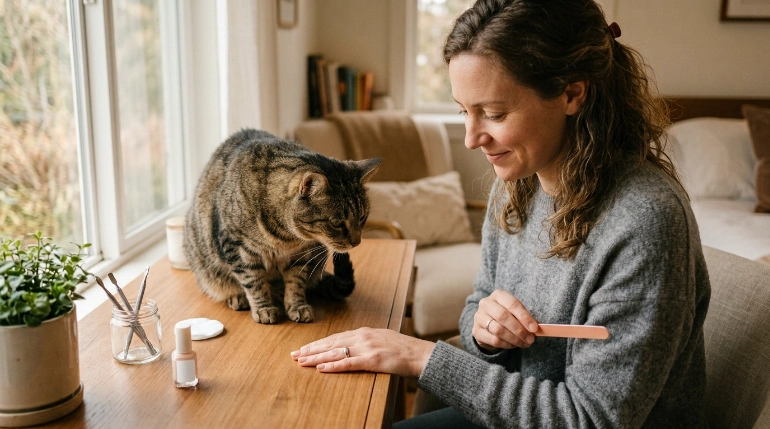
Veterinary resources discuss cats licking, chewing, and eating non-food objects in general, but there is little evidence showing that cats have a specific biological attraction to nail files.
That means several explanations are possible rather than one proven reason.
1. The Rough Texture Is Interesting
A typical emery board feels completely different from most household objects.
Its abrasive surface can be:
- Rough
- Grainy
- Scratchy
- Slightly flexible
- Easy to grip with the teeth
That unusual texture may be enough to encourage an inquisitive cat to sniff or lick it.
Cats naturally explore their surroundings. Some investigate new objects with their paws and noses, while others use their mouths.
However, curiosity does not mean a nail file is a safe chew toy.
2. A Used Nail File Has Interesting Smells
A file you have already used may carry tiny amounts of material from your beauty routine, including:
- Natural nail dust
- Skin oils
- Hand cream
- Cuticle oil
- Nail polish residue
- Soap or sanitizer residue
Your cat has a much different sensory experience than you do. An object that seems odorless to you may still deserve a thorough feline inspection.
It is reasonable to suspect that these scents can contribute to your cat’s interest, but there is no strong evidence that cats specifically crave human nail keratin or nail dust.
So, if your cat runs over every time you finish filing your nails, think of scent as a possible attraction rather than a proven explanation.
3. Your Cat May Have Learned That the File Gets Attention
Cats are excellent at learning routines.
Imagine this pattern:
You start filing your nails. Your cat approaches the file. You immediately talk to her, pick her up, move the file, or offer a toy.
From your cat’s point of view, touching the nail file just produced a lot of attention.
After several repetitions, licking the file can become part of the routine.
This does not necessarily indicate a medical problem. Your cat may simply have discovered a reliable way to get you to react.
4. Boredom or Stress Can Encourage Unusual Chewing
Repeated interest in non-food objects can sometimes occur when a cat needs more stimulation.
The UC Davis School of Veterinary Medicine’s guidance on abnormal eating habits in cats notes that boredom, inadequate enrichment, anxiety, and compulsive behavior can contribute to abnormal chewing or consumption of non-food objects.
Watch for patterns.
Does your cat bother your nail files more when:
- You have been away all day?
- Playtime has decreased?
- A new pet has entered the home?
- Your normal routine changes?
- She is left alone?
- She seems restless?
The timing may tell you more than the nail file itself.
5. Persistent Chewing or Eating Could Be Pica
Pica deserves more attention than occasional curiosity.
UC Davis defines pica as persistent chewing and consumption of non-nutritional substances. It also notes that medical and behavioral factors can contribute and that pica can lead to dental problems, poisoning, or gastrointestinal obstruction.
Licking a nail file once does not automatically mean your cat has pica.
The behavior becomes more concerning when your cat repeatedly:
- Bites pieces from nail files
- Swallows cardboard, foam, or abrasive material
- Eats plastic
- Chews fabric
- Swallows string or rubber
- Seeks out multiple non-food objects
If that describes your cat, a veterinarian should help determine what is driving the behavior.
Are Nail Files Dangerous for Cats?
Nail files are made for human nail care, not feline play.
The level of concern depends heavily on the material and what your cat actually does with it.
| Nail File Type | Main Concern Around Cats | What to Do |
|---|---|---|
| Disposable emery board | Can fray or break into small pieces; porous surface holds residue | Replace it if heavily licked or chewed |
| Foam buffer | Soft enough for a cat to bite pieces off | Store completely out of reach |
| Glass/crystal file | Hard and reusable but can chip or break | Inspect carefully and discard if damaged |
| Metal file | Hard surface and edges may injure the mouth if aggressively bitten | Keep stored in a closed case |
| Electric nail file | Rotating parts, cords, small attachments, and nail dust add hazards | Turn off, unplug, and store after use |
The abrasive surface is another reason not to deliberately let your cat chew the file.
A used file may also contain cosmetic residue. If you have been working with polish, gel, acrylic products, remover, primer, or other chemicals, keeping the tool away from pets becomes even more important.
Do not assume a product is safe for your cat simply because it is safe to use on human nails.
What Should I Do If My Cat Licks My Nail File?
If you catch your cat licking a file, avoid turning it into a game.
1. Remove the File Calmly
Take the nail file away without chasing, yelling, or creating a big reaction.
Then put it somewhere your cat cannot reach.
2. Check Whether Anything Is Missing
Look closely at the file.
Ask:
- Are there bite marks?
- Is the edge torn?
- Is foam missing?
- Did the abrasive coating come loose?
- Is a glass file chipped?
- Could your cat have swallowed a piece?
If the file is damaged and you cannot account for the missing material, contact your veterinarian for advice.
3. Consider What Was on the File
A clean, dry file presents a different situation from one covered with manicure-product residue.
If your cat may have swallowed a chemical or toxic substance, the ASPCA’s cat-care guidance recommends contacting your veterinarian or animal poison-control professionals when poisoning is suspected.
Do not induce vomiting or give medication unless a veterinary professional specifically tells you to do so.
4. Clean or Replace the Tool
For a disposable emery board, replacement is usually the simplest choice after significant licking or chewing.
Reusable glass or metal files may be washable depending on the manufacturer’s care directions. Inspect them carefully before using them again.
Never continue using a chipped glass file or another tool with a damaged edge.
What If My Cat Ate Part of a Nail File?
Swallowing material is more concerning than licking it.
Foreign objects can interfere with the digestive tract. The MSD Veterinary Manual’s information on gastrointestinal obstruction in cats explains that foreign objects can cause gastrointestinal obstruction and potentially serious complications.
Contact your veterinarian promptly if you know or strongly suspect that your cat swallowed part of a file, particularly glass, metal, foam, or a sizable piece of an emery board.
Watch for signs such as:
- Vomiting
- Reduced appetite
- Unusual tiredness
- Abdominal discomfort
- Difficulty passing stool
- Excessive drooling
- Gagging
- Repeated attempts to vomit
- Sudden behavioral changes
A cat with vomiting plus lethargy, weakness, or decreased appetite should be evaluated promptly.
Do not wait for a serious symptom if you know your cat swallowed a sharp object.
How to Stop Your Cat From Licking Nail Files
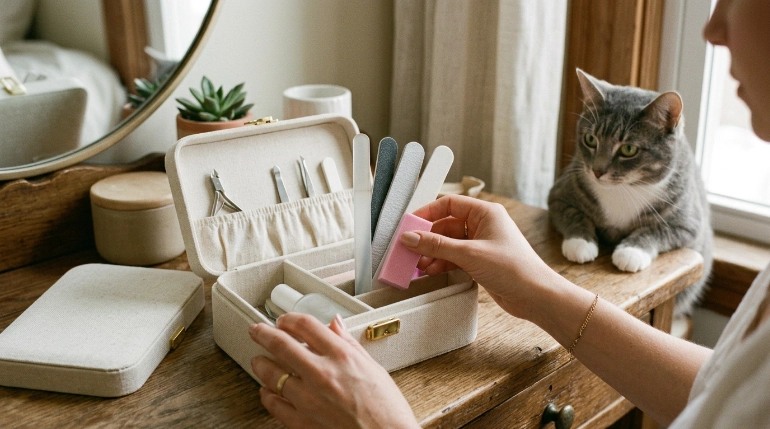
The easiest solution is usually environmental management.
1. Use Closed Storage
Do not leave nail files loose on:
- Bathroom counters
- Bedside tables
- Desks
- Vanities
- Open manicure trays
Keep them in a closed drawer, cosmetic case, or manicure box.
This is especially useful if your cat likes sneaking onto counters when nobody is watching.
2. Put the File Away Immediately After Use
Many incidents happen because the tool sits unattended after a manicure.
Build one simple habit:
Finish filing, clean up, and store the file immediately.
That removes the opportunity before the behavior begins.
3. Give Your Cat a Better Outlet
If boredom seems to trigger the behavior, provide safe alternatives.
Try:
- Interactive wand toys
- Puzzle feeders
- Cat trees
- Scratching posts
- Cardboard scratching pads
- Short daily play sessions
- Food-hunting games
UC Davis recommends environmental enrichment and redirecting a cat toward appropriate activities when abnormal non-food chewing is occurring.
The ASPCA’s general cat-care recommendations also encourage appropriate scratching surfaces and interactive toys.
4. Avoid Punishment
Yelling, spraying your cat with water, or frightening her may increase stress without solving the reason she is interested in the file.
Instead, remove access and redirect her toward an appropriate activity.
If the behavior appears compulsive, frequent, or difficult to interrupt, involve your veterinarian.
Expert Tip: Keep a small lidded manicure case next to the place where you normally do your nails. The easier your file is to put away immediately, the less likely you are to leave it within paw’s reach.
Nail File Hygiene After Your Cat Licks It
There is also a human hygiene issue to consider.
Cat saliva is not something you want transferred repeatedly to manicure tools, especially if you have broken skin around the nail or cuticle.
The CDC’s guidance for staying healthy around cats recommends washing your hands after contact with cat saliva because cats can carry germs even when they appear healthy.
For your manicure kit:
- Porous emery board: Replace it after significant contamination.
- Foam buffer: Replace it if saliva soaked into it or the surface was damaged.
- Glass file: Wash according to the manufacturer’s directions and inspect for chips.
- Metal file: Clean according to its care instructions and make sure it is completely dry before storage.
Do not share a contaminated disposable file with another person.
Disposable vs. Reusable Files
Cost does not determine whether a nail file is safe around pets.
Inexpensive disposable emery boards are convenient because you can simply replace a contaminated one.
Glass and some metal files generally cost more upfront but can be reused and may be easier to clean when their manufacturers allow washing.
However, a reusable file is only useful if it remains intact.
A chipped or cracked tool should be replaced regardless of what it cost.
DIY Manicures vs. Salon Visits
You do not need to stop doing your nails at home simply because your cat likes your files.
Good storage and hygiene usually solve the practical problem.
A professional salon can provide clean manicure tools and nail-care guidance, but a nail technician cannot diagnose why your cat is eating non-food objects. That part belongs with a veterinarian.
When to See a Nail Technician or Dermatologist
For your own nails, a nail technician can help you choose the right file, grit, and filing technique if you are experiencing repeated splitting or damage.
A dermatologist is the more appropriate professional if you develop:
- Persistent redness or swelling around a nail
- Pain
- Pus or drainage
- Unexplained discoloration
- A nail that changes significantly in shape or texture
- A recurring nail or skin problem
Do not ask a nail technician to diagnose a suspected infection or medical nail condition.
And if the concern is your cat’s persistent licking or chewing behavior, contact a veterinarian instead.
When to Call a Veterinarian
Arrange veterinary advice if your cat:
- Repeatedly eats non-food objects
- Starts chewing nail files frequently
- Swallows pieces of a file
- Suddenly develops this behavior
- Shows changes in appetite or weight
- Vomits repeatedly
- Seems unusually tired
- Has abdominal discomfort
- Develops other unusual behaviors
Pica can have behavioral or medical contributors, so simply hiding the nail file may stop access without addressing the underlying reason. UC Davis specifically recommends veterinary guidance when abnormal eating habits are a concern.
Common Mistakes to Avoid
- Letting your cat chew the file because it looks harmless. Human manicure tools are not designed as cat toys.
- Assuming every cat that licks a file has pica. Occasional licking and persistent consumption are not the same thing.
- Ignoring missing pieces. A damaged file may mean material was swallowed.
- Leaving files on the bathroom counter. Prevention is easier than repeatedly stopping the behavior.
- Reusing a dirty disposable file. Porous tools can be difficult to clean thoroughly.
- Using a cracked glass file. Discard damaged glass tools.
- Punishing your cat. Redirect the behavior and control access instead.
- Ignoring repeated non-food eating. Frequent chewing or swallowing deserves veterinary attention.
- Assuming a nutritional supplement will fix pica. Do not add supplements without veterinary guidance.
FAQs
Why does my cat like the smell of nail files?
A used nail file can carry scents from your nails, skin oils, lotion, cuticle products, or other manicure products. Those odors may encourage investigation. However, there is no strong evidence showing that cats are specifically attracted to nail keratin or that nail files have one particular scent cats universally enjoy.
Is an emery board toxic to cats?
An emery board should not be treated as something safe for a cat to ingest. Its abrasive surface, adhesive, backing material, and any cosmetic residue were not designed for consumption. If your cat swallows pieces, contact your veterinarian for advice.
Does licking a nail file mean my cat has pica?
Not necessarily. Pica generally involves persistent chewing or consumption of non-food substances. One curious lick does not establish that diagnosis. Repeated chewing, swallowing, or seeking multiple non-food objects is much more concerning.
Why does my cat bite my nail file after licking it?
The texture may encourage further exploration, or biting may have become a learned habit. If your cat regularly bites pieces off files or other objects, remove access and discuss the behavior with your veterinarian.
Can I still use a nail file after my cat licks it?
For a disposable emery board or foam buffer, replacing it is the simplest hygienic option. A reusable glass or metal file may be cleaned according to the manufacturer’s instructions, provided it has not been chipped, cracked, or otherwise damaged.
How do I stop my cat from stealing my nail file?
Use a closed manicure case or drawer and put the tool away immediately after every use. If your cat seems bored, add regular interactive play, puzzle feeding, climbing opportunities, and appropriate scratching surfaces.
Should I take my cat to the vet for licking nail files?
An occasional lick without chewing or swallowing may simply reflect curiosity. Veterinary advice becomes more important if the behavior is frequent, suddenly appears, involves swallowing material, extends to other non-food objects, or occurs with vomiting, appetite changes, lethargy, weight changes, or other symptoms.
Conclusion
So, why does my cat lick nail files? There probably is not one universal explanation.
The rough texture and unusual smells may attract a curious cat, while attention, boredom, stress, or a broader pattern of non-food chewing can also contribute.
The safest approach is simple: do not allow nail files to become cat toys.
Store your manicure tools in a closed container, replace contaminated disposable files, inspect reusable tools for damage, and provide your cat with safer ways to play and explore.
Most importantly, pay attention to what happens after the licking. If your cat repeatedly chews or swallows nail files or other non-food objects, contact your veterinarian instead of treating it as a quirky habit.
Keeping your nail tools stored safely protects your manicure routine—and keeps curious paws and mouths out of trouble.
