If your cat runs away, stares intensely, swats, bites, hisses, or suddenly appears whenever you start filing your nails, you may wonder, why does my cat hate nail files?
The reaction can seem strangely specific. Your cat may ignore clippers, polish bottles, and other manicure tools but become upset the moment an emery board starts scraping across a nail.
In many cases, the problem is not the nail file itself. The scratching sound, rough movement, unfamiliar smell, vibration, or a previous unpleasant association may be what bothers your cat.
This guide explains the most likely reasons, how to recognize genuine fear or irritation, and what you can do without forcing your cat to tolerate something that makes them uncomfortable.
Quick Answer
If you’re wondering why does my cat hate nail files, the most likely reasons are the rough scraping sound, sudden movement, unfamiliar texture, or a negative association with the object. Cats have sensitive hearing, so filing may sound much harsher to them than it does to you. Give your cat space and gradually create positive associations.
Why Do Some Cats Hate the Sound of Nail Files?
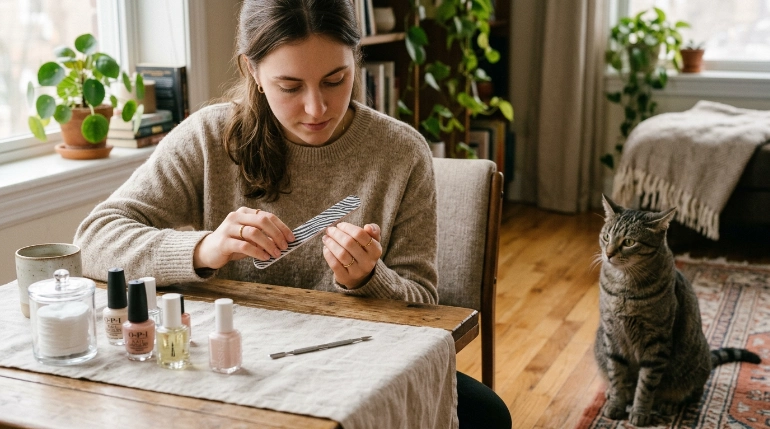
The sound is one of the strongest explanations.
A traditional emery board creates a dry, repetitive scraping noise as its abrasive surface moves over the nail. Glass and metal files can produce different tones, but they may still create sharp or unusual sounds.
Cats are particularly sensitive to sound. The Merck Veterinary Manual’s explanation of feline hearing notes that cats can hear a wider frequency range than humans. A noise that seems mild to you may therefore be much more noticeable to your cat.
That doesn’t mean every cat considers nail filing painful to hear. Individual reactions vary considerably.
Your cat may simply think:
- The sound is unfamiliar.
- The scraping starts suddenly.
- The noise repeats unpredictably.
- The file is moving close to you or the cat.
- Similar noises have frightened them before.
Some cats leave the room. Others investigate. A particularly nervous cat may swat at the object because making it disappear seems like the easiest solution.
Common Reasons Your Cat May Hate Your Nail File
Your cat cannot tell you exactly what is wrong, so look at the whole situation rather than assuming there is one universal cause.
| Possible reason | What you may notice | What to do |
|---|---|---|
| Scraping sound | Ears turn back, cat leaves when filing begins | File farther away or in another room |
| Fast movement | Staring, stalking, swatting at the file | Keep movements slow and predictable |
| Fear of unfamiliar objects | Hiding or approaching cautiously | Leave the unused file nearby without forcing interaction |
| Negative association | Immediate fear when the file appears | Reintroduce it gradually with treats |
| Interesting texture | Sniffing, licking, chewing, grabbing | Keep used files out of reach |
| Sensitivity to handling | Reaction when paws are touched | Stop handling and use gradual conditioning |
| General stress | Hiding, tense posture, reduced interest in treats | Remove the trigger and let the cat settle |
1. The Scraping Noise May Be Unpleasant
For many cats, sound is probably the simplest explanation.
Think about how unpleasant fingernails scraping against certain surfaces can feel to a person. A cat may experience its own version of an irritating or startling sound when an abrasive file moves repeatedly over a nail.
Watch your cat’s ears.
If they rotate backward, flatten, or repeatedly twitch while you file, the noise may be contributing to the reaction.
2. The File Moves Like Something Worth Watching
Cats are visually tuned to movement.
A narrow nail file moving rapidly backward and forward can become surprisingly interesting. Your cat may stare, crouch, follow your hand, or attempt to grab the moving end.
This behavior doesn’t necessarily mean your cat hates the file.
Sometimes what looks like aggression is actually overstimulated play or hunting behavior.
The difference often becomes clearer through body language.
A playful cat may:
- Stalk the file.
- Bat at it without hissing.
- Follow it when it stops moving.
- Have a relatively loose body posture.
A frightened cat is more likely to:
- Flatten the ears.
- Crouch tightly.
- Hiss or growl.
- Run away.
- Puff the tail.
- Strike defensively when approached.
Cornell’s discussion of fear-related behavior in cats describes reactions such as crouching, flattened ears, hissing, and defensive aggression when cats encounter unfamiliar or unpleasant stimuli.
3. Your Cat May Dislike the Texture
Nail files are strange objects from a cat’s perspective.
An emery board has a gritty surface. A glass file feels completely different. Metal files can be cool, hard, and reflective.
Some cats avoid these textures. Others become fascinated by them.
Your cat may sniff, rub against, lick, bite, or paw at the file instead of retreating.
That behavior is important because a nail file should not become a cat toy.
Small pieces can break off disposable files, and a heavily used file may contain nail dust, skin debris, polish residue, oils, or cosmetic products.
Store files where your cat cannot chew them.
4. Your Cat May Associate the File With Something Unpleasant
Cats learn associations quickly.
Suppose your cat was startled by a nail file dropping onto the floor. Maybe someone tried filing the cat’s claws with it. Perhaps the file was present during an uncomfortable grooming session.
The file can then become a warning signal.
The object appears, and your cat anticipates something unpleasant.
This is especially likely when your cat reacts before you even start filing.
5. Your Cat May Not Like Paw Handling
This matters if you’re trying to use a nail file on your cat rather than simply filing your own nails nearby.
Many cats dislike having their paws restrained.
The ASPCA’s cat grooming guidance recommends gradually getting cats comfortable with paw touching and stopping rather than squeezing when the cat pulls away. It also recommends familiarizing cats with grooming sounds before attempting a nail trim.
If your cat objects when you hold a paw, switching from a clipper to a nail file probably won’t solve the underlying problem.
The problem may be restraint rather than the tool.
Does My Cat Really Hate Nail Files?
Not necessarily.
“Hate” is a convenient human description, but several emotions can produce similar behavior.
Your cat could be:
- Afraid.
- Annoyed.
- Curious.
- Overstimulated.
- Playful.
- Territorial about a nearby space.
- Trying to stop an unfamiliar sound.
Pay attention to what happens immediately before and after the reaction.
For example, if your cat sleeps peacefully beside you until the scratching sound begins, noise is a strong possibility.
If your cat approaches the file even when it is completely still, curiosity or texture may play a bigger role.
If the reaction happens only when you touch your cat’s paws, handling sensitivity is more likely.
Signs Your Cat Is Actually Frightened
Stop what you’re doing if your cat shows clear signs of distress.
Watch for:
- Flattened ears.
- A tucked or puffed tail.
- Hiding.
- Crouching.
- Hissing.
- Growling.
- Dilated pupils.
- Attempts to escape.
- Defensive swatting.
- Biting.
- Refusing treats they normally love.
Fear can escalate when an animal cannot escape the trigger. Forcing the file closer because you want the cat to “get used to it” can therefore make the association worse rather than better.
Do not punish a frightened cat for hissing, running away, or swatting. Those behaviors are communication.
How to Help a Cat That Hates Nail Files
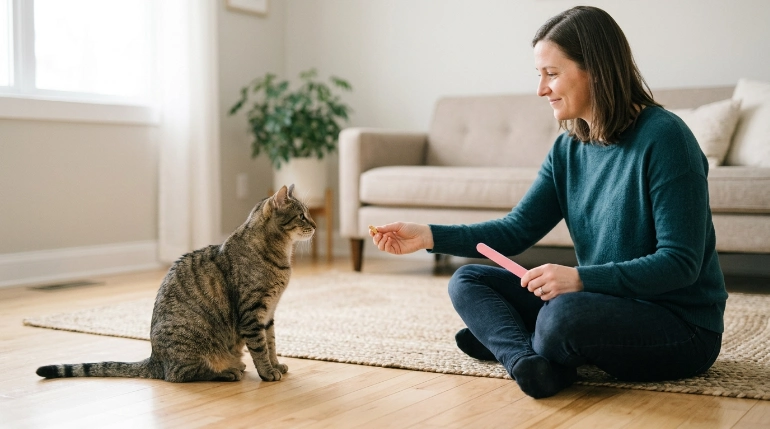
You usually don’t need your cat to love your manicure tools.
If you’re only filing your own nails, the easiest solution may simply be giving the cat more distance.
If you need the cat to tolerate the object because of grooming, use gradual exposure.
Step 1: Stop Using the File Near Your Cat
Begin by lowering the intensity of the trigger.
Don’t sit beside your cat and immediately start vigorous filing.
Move farther away or use the file in another room.
The goal is to prevent repeated frightening experiences while you’re working on the problem.
Step 2: Let Your Cat See the File Without Hearing It
Place a clean file several feet away while your cat is relaxed.
Don’t push it toward their face.
Don’t hold your cat beside it.
Simply allow the file to exist in the environment.
If your cat looks at it calmly, reward that calm behavior with a small treat.
Step 3: Pair the File With Something Positive
Once your cat can comfortably see the object, begin building a better association.
For example:
- Show the file from a comfortable distance.
- Give your cat a favorite treat.
- Put the file away.
- Repeat during another short session.
Your cat should remain relaxed.
This process is related to desensitization and counterconditioning—gradually exposing an animal to a low-intensity version of a trigger while pairing it with something positive. Veterinary behavior guidance emphasizes starting below the animal’s fear threshold and increasing exposure gradually.
Step 4: Introduce a Very Small Amount of Sound
When the stationary file no longer creates concern, make one gentle filing movement at a distance.
Then stop.
Reward calm behavior.
Don’t jump straight from silence to several minutes of vigorous filing.
If your cat stops accepting treats, hides, hisses, or tries to escape, you’ve probably progressed too quickly.
Go back to an easier stage.
Step 5: Keep Sessions Short
A few calm seconds can be more productive than a long stressful training session.
End while your cat is still comfortable.
You are trying to teach:
Nail file appears → nothing bad happens.
Not:
Nail file appears → I become trapped until I stop resisting.
Expert Tip
Expert Tip: If your cat becomes tense enough to stop eating a favorite treat, increase the distance from the nail file or end the session. Calm exposure works better than forcing your cat to remain beside a trigger.
Should You Use a Human Nail File on a Cat?
A human nail file may technically smooth a sharp claw edge, but that doesn’t mean every cat will tolerate it.
Cats’ claws aren’t simply miniature human fingernails. Their claws have a different shape and structure, and most routine claw maintenance is done with appropriate cat nail clippers.
If a veterinarian or professional groomer has recommended smoothing a rough claw edge, follow their advice about the tool and technique.
Never aggressively saw at a cat’s claw.
Stop immediately if the cat struggles strongly, cries, bites, or shows pain.
Nail File Material Matters
Different files create different sensations.
Emery boards
Lightweight and inexpensive, but abrasive and disposable. They may create a noticeable scratching sound and can fray when chewed.
Glass files
Smoother and washable, but breakable. A shattered glass file is obviously unsafe around pets.
Metal files
Durable and easy to clean, but harder and potentially uncomfortable if used roughly.
Electric nail files or grinders
They introduce motor noise and vibration in addition to filing. A cat already frightened by a manual file may react even more strongly to an electric device.
For normal human manicures, choose your file based on your own nails. You usually don’t need to buy a different file simply because your cat dislikes yours—use it away from your cat instead.
Hygiene and Safety Around Cats
Don’t allow your cat to regularly lick or chew used manicure tools.
A used nail file can contain nail dust and residue from products on your hands.
Good habits include:
- Put nail files away after use.
- Replace damaged disposable files.
- Wash reusable files according to their material and manufacturer instructions.
- Don’t share a visibly dirty file.
- Keep glass tools somewhere they cannot fall and break.
- Keep acetone, polish remover, gel products, adhesives, and other manicure chemicals away from pets.
- Wash your hands after handling products before touching your cat’s face or food.
If your cat bites or scratches you while reacting to a nail file, clean the injury promptly. The CDC’s guidance for cat bites and scratches recommends washing wounds with warm soapy water and seeking medical attention for serious wounds or signs such as increasing redness, warmth, pain, or swelling.
When Is a Nail-File Reaction a Veterinary Concern?
A cat simply leaving the room when you file your nails usually isn’t a medical emergency.
However, speak with your veterinarian if your cat develops a new or unusually intense sensitivity to sound, especially if you also notice:
- Repeated head shaking.
- Scratching at an ear.
- Ear discharge or odor.
- Head tilting.
- Problems with balance.
- Sudden aggression when the head or ears are touched.
- Major behavioral changes.
- Signs of pain.
Ear discomfort can make sounds or handling harder for a cat to tolerate. Merck notes that ear disorders can produce signs including head shaking, ear scratching, redness, discharge, pain, or balance changes depending on the condition.
A veterinarian—not a nail technician—is the right professional for these symptoms.
When to See a Nail Technician or Dermatologist
Because the main issue here concerns your cat, a veterinarian should be your first professional contact for persistent feline fear, pain, ear symptoms, or aggression.
A nail technician can help if the issue involves your own manicure routine—for example, choosing a smoother or quieter manual file for your nails. However, a nail technician shouldn’t diagnose your cat or treat an injury.
See a doctor or dermatologist if a cat scratch or bite causes worsening redness, swelling, warmth, drainage, persistent pain, or another concerning skin reaction.
DIY care has limits. Don’t use beauty tools to investigate or treat what appears to be a medical problem in either you or your cat.
Common Mistakes to Avoid
- Forcing the file toward your cat’s face. Let the cat control the distance.
- Holding the cat down during exposure. Restraint may strengthen the fear association.
- Punishing hissing or swatting. These are warning signals.
- Moving too quickly. Calm progress matters more than fast progress.
- Using treats while continuing to overwhelm the cat. The trigger still needs to stay at a tolerable intensity.
- Letting your cat chew the file. Files are grooming tools, not toys.
- Assuming every reaction means fear. Curiosity and hunting behavior can look surprisingly intense.
- Using a human file aggressively on cat claws. Ask a vet or experienced groomer for appropriate claw-care guidance.
- Ignoring a sudden behavioral change. New sound sensitivity plus ear or balance symptoms deserves veterinary attention.
What If My Cat Attacks the Nail File?
Stop moving it.
Rapid movement may encourage continued chasing or swatting.
Put the tool away once you can do so safely and allow your cat to settle.
Don’t turn the encounter into a game by repeatedly waving the file in front of the cat. That can strengthen the habit of attacking manicure tools.
If your cat frequently attacks hands, grooming tools, or other objects with intense aggression, talk to your veterinarian. Pain, fear, stress, and learned behavior can all influence aggressive responses.
What If My Cat Is Fascinated Instead of Afraid?
Some cats do the opposite.
They come running as soon as they hear a nail file.
They may sniff it, rub against it, paw at it, or try to bite it.
That doesn’t necessarily mean the file is beneficial or that your cat should be allowed to chew it.
The rough texture, movement, smell, or sound may simply be stimulating.
Redirect the cat toward a safe toy rather than encouraging interaction with the manicure tool.
FAQs
Why does my cat hate nail files but not nail clippers?
The two tools produce different sounds and movements. The repetitive scraping of a file may be more irritating or unusual to your cat than a quick clipping sound.
Why does my cat come running when I file my nails?
Your cat may be curious about the scraping sound or repetitive movement. Coming closer doesn’t automatically mean the cat likes the file. Watch their body language to determine whether they’re curious, playful, or irritated.
Why does my cat try to bite my nail file?
Movement and texture may trigger exploration or hunting behavior. Some cats also bite objects they want removed. Don’t let your cat chew a file because pieces or residue could be swallowed.
Can the sound of a nail file hurt a cat’s ears?
There isn’t good evidence that normal manual nail filing physically damages a healthy cat’s hearing. However, cats are highly sensitive to sound, so the scraping noise may be unpleasant or frightening to some individuals.
Can I train my cat not to fear nail files?
Often, yes. Begin with the file at a comfortable distance and gradually pair its presence and mild sound with treats. Stop if the cat becomes frightened. Desensitization should move at the cat’s pace.
Is it safe to file my cat’s claws?
Light smoothing may sometimes be appropriate, but many cats dislike the process. Don’t aggressively file or restrain your cat. Ask your veterinarian or professional groomer if you’re unsure how to manage a rough or damaged claw.
Should I worry if my cat suddenly becomes afraid of ordinary sounds?
A sudden major change deserves attention, especially when accompanied by ear scratching, head shaking, balance problems, pain, or other behavioral changes. Contact your veterinarian for guidance.
Conclusion
So, why does my cat hate nail files?
Most likely, something about the file’s scraping sound, movement, texture, or previous association makes your cat uncomfortable. In other cases, your cat may actually be curious or overstimulated rather than afraid.
You don’t need to force your cat to accept the tool. If you’re filing your own nails, creating more distance may solve the problem immediately. If grooming requires your cat to tolerate a similar object or sound, introduce it slowly and pair calm exposure with positive rewards.
Most importantly, respect your cat’s warning signals. Stop when fear escalates, keep manicure tools safely stored, and contact a veterinarian if the reaction suddenly becomes severe or appears alongside pain, ear problems, or other behavioral changes.
A calmer manicure routine is better for both you and your cat.