
Why Do Toenails Change Color? Common Causes, Warning Signs, and What to Do

You remove your nail polish, look down at your feet, and notice that one toenail is yellow, white, brown, green, or even dark purple. It is natural to wonder whether it is simply staining or something you should worry about.
So, why do toenails change color? Toenail discoloration can happen for many reasons, including nail polish stains, repeated pressure from shoes, minor injuries, fungal infections, bacterial infections, and certain skin or health conditions.
The color alone does not always tell you the cause. What matters is how the nail changed, whether its thickness or texture also changed, how long the discoloration has been there, and whether you have pain, swelling, drainage, or nail lifting.
This guide explains the most common toenail colors, what they may mean, what you can safely do at home, and when it is better to get professional advice.
Quick Answer
Toenails can change color because of nail polish staining, shoe pressure, injuries, fungal or bacterial infections, nail lifting, or certain health conditions. Yellow and white changes are common with fungal infections, while dark discoloration may follow trauma. New, unexplained, painful, spreading, or persistent color changes should be professionally evaluated.
Is Toenail Discoloration Always a Problem?
No. A discolored toenail does not automatically mean something is wrong.
Sometimes the explanation is surprisingly simple. For example, dark red polish can leave a yellow-orange stain on the nail plate. A long walk in tight shoes may create pressure under a toenail. Stubbing your toe can cause blood to collect underneath the nail.
However, color changes deserve more attention when they are accompanied by:
- Thickening or distortion
- Brittle or crumbly edges
- Nail lifting
- Pain or tenderness
- Red or swollen skin
- Drainage or an unpleasant odor
- A new dark streak
- Discoloration that continues spreading
- Several nails changing at the same time
The American Academy of Dermatology notes that changes in nail color, texture, or shape can sometimes be harmless but can also signal conditions that need medical attention. Its guidance on nail changes a dermatologist should examine is especially useful when a nail change is new or unexplained. (AAD)
What Different Toenail Colors May Mean
The appearance of the entire nail gives you more information than color alone.
| Toenail color | Common possibilities | What else to look for |
|---|---|---|
| Yellow | Polish staining, fungal infection, repeated trauma | Thickening, crumbling, lifting |
| White | Nail lifting, surface damage, fungal infection | Chalky areas, separation |
| Green | Bacterial growth, especially under a lifted nail | Odor, moisture, nail separation |
| Brown or black | Bruising, pigment, infection, occasionally a more serious condition | Pain, dark streak, changing pigment |
| Red or purple | Recent injury or blood beneath the nail | Tenderness, pressure, bruising |
| Blue | Cold exposure, circulation or oxygen-related issues | Changes affecting multiple nails or skin |
| Mixed colors | More than one cause may be involved | Texture, thickness, pain, progression |
A color chart can help you know what questions to ask, but it cannot diagnose the cause by itself.
Why Do Toenails Turn Yellow?

Yellow is probably one of the most noticeable toenail color changes.
Nail Polish Staining
If your toenails look yellow after you remove polish, especially red, burgundy, black, navy, or another highly pigmented shade, the pigment may simply have stained the nail plate.
This type of discoloration usually:
- Appears after polish removal
- Affects the surface more than the nail structure
- Does not usually cause swelling or pain
- Does not make the nail crumble
- Gradually grows out with the nail
Using a base coat before dark polish may reduce future staining.
Do not aggressively buff away yellow color. Excessive buffing can thin the nail plate and leave it more sensitive.
Fungal Nail Infection
A fungal nail infection, also called onychomycosis, is another common reason toenails become yellow or yellow-brown.
According to the Mayo Clinic’s information about nail fungus symptoms and causes, an infection may begin as a white or yellow-brown spot before causing increasing discoloration, thickening, crumbling, or separation from the nail bed. (Mayo Clinic)
Fungus becomes more suspicious when yellowing occurs along with:
- Thick toenails
- Brittle or crumbly edges
- An unusual shape
- Nail lifting
- Debris under the nail
- Several nails becoming affected
The NHS also notes that fungal nail infections often make nails thicker, brittle, or discolored and can take months to treat successfully. NHS fungal nail infection guidance (nhs.uk)
Do not assume every yellow toenail is fungus. Trauma and polish staining can look surprisingly similar.
Why Do Toenails Turn White?
White toenails can have several appearances.
You may notice tiny spots, a chalky surface, a white area near the edge, or a larger portion of the nail appearing pale.
One common reason is onycholysis, which means the nail has separated from the nail bed. Because air gets underneath the separated nail, the area may look white.
Nail lifting can occur after:
- Repeated pressure from shoes
- Injury
- Aggressive pedicures
- Infection
- Certain skin conditions
Fungal infections can also create white patches or discoloration.
If only a tiny white mark appears after you bump the nail, watching it grow outward may be reasonable. A large area that continues spreading or lifting deserves more attention.
Why Is My Toenail Green?
A green tint is different from ordinary polish staining.
Certain bacteria can grow in moist spaces between a nail and the skin beneath it, particularly when the nail has already lifted. Bacterial nail infections may produce green or dark discoloration; Mayo Clinic notes that bacterial infection can sometimes cause green or black nail discoloration. (Mayo Clinic)
Do not keep painting over a persistently green nail.
Keep the area clean and dry, avoid digging underneath the nail, and get professional advice if the discoloration persists, spreads, smells unusual, or is accompanied by redness or pain.
Why Do Toenails Turn Black, Brown, or Purple?
Dark nails often cause the most worry, but there are several possible explanations.
Injury and Bruising
Running, hiking, dropping something on your toe, stubbing it, or wearing shoes that repeatedly push the toes forward can cause blood to collect beneath the nail.
This is sometimes called a subungual hematoma, essentially a bruise under the nail.
The area may appear:
- Dark red
- Purple
- Brown
- Black
If you clearly remember an injury and the dark area slowly moves toward the nail tip as the nail grows, trauma may be responsible.
However, significant throbbing pain, major swelling, or a severe injury should be medically assessed.
A New Dark Streak
A dark line that appears without an obvious injury deserves more caution.
The American Academy of Dermatology recommends having a new or changing dark streak in a fingernail or toenail evaluated because, although many dark streaks are not cancer, melanoma can occasionally develop beneath a nail. (AAD)
Do not try to buff, scrape, bleach, or polish over an unexplained dark streak to see whether it disappears.
Professional examination is the safer next step.
Can Tight Shoes Change Toenail Color?
Yes.
Your toenails repeatedly hit the inside of your shoes while walking, exercising, or running. Shoes with a short or narrow toe box can create ongoing pressure.
Over time, you may notice:
- Small dark bruises
- Yellowing
- Nail thickening
- Ridges
- Nail lifting
- Broken edges
If discoloration repeatedly appears after workouts, check your footwear.
Your toes should have enough room to move without sliding aggressively forward.
Can a Pedicure Cause Toenail Discoloration?
A pedicure itself should not normally discolor a healthy nail, but some habits around pedicures can contribute.
Problems may occur if the nail is:
- Filed too aggressively
- Buffed until extremely thin
- Cut into the corners
- Injured while cleaning underneath
- Covered continuously with polish
- Exposed to poorly cleaned tools
Minor surface damage may create temporary white patches or uneven color.
More importantly, damaged skin and nails can make infection easier to develop.
If you visit a salon, choose one that follows proper sanitation procedures and uses appropriately cleaned or disinfected equipment.
What Should You Do When a Toenail Changes Color?
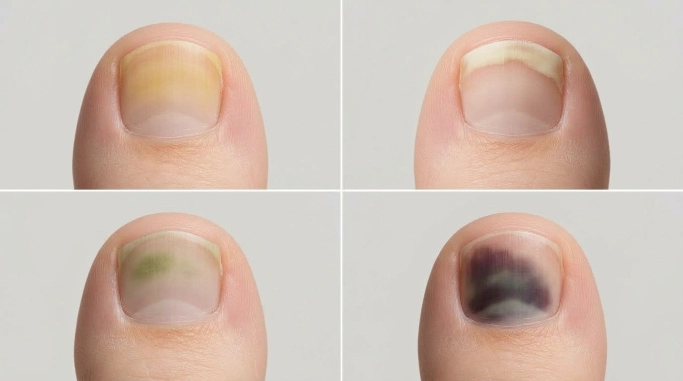
Before reaching for a treatment, take a closer look.
1. Remove Nail Polish
If the nail is painted, remove the polish gently so you can see the actual nail.
Do not immediately repaint it if you are trying to understand a new color change.
2. Compare Your Toenails
Ask yourself:
- Is one nail affected or several?
- Is the color on the surface or underneath?
- Has the nail become thicker?
- Is it lifting?
- Is it painful?
- Did you recently injure the toe?
- Have you been wearing tight shoes?
These clues can be more useful than the color alone.
3. Keep Your Feet Clean and Dry
Moist environments encourage some fungal and bacterial organisms to grow.
Wash your feet normally and dry carefully, particularly between your toes.
Change damp socks after exercise and allow shoes to dry before wearing them again.
4. Trim Carefully
Use clean, sharp toenail clippers and trim the nail mostly straight across rather than digging deeply into the corners.
If an edge is rough, a clean fine-grit nail file can gently smooth it.
Do not aggressively thin, scrape, drill, or cut into a discolored nail when you do not know the cause.
5. Monitor the Nail
Toenails grow slowly, so improvement is rarely immediate.
Taking a clear photo every few weeks under similar lighting can help you see whether the discoloration is moving outward, spreading, or staying unchanged.
Tools, Hygiene, and Nail Sensitivity
Basic nail care does not need to be expensive.
A simple home kit may include:
- Stainless-steel toenail clippers
- A fine or medium-grit nail file
- Soap and water for cleaning
- Clean towels
- Moisturizer for surrounding dry skin
Quality clippers and files can usually be reused for a long time when properly maintained, making basic home care inexpensive.
However, the cheapest tool is not always the safest choice. Dull clippers may crush thick nails instead of creating a clean cut, while extremely coarse files can remove too much nail.
Clean reusable tools after use and allow them to dry fully.
Avoid sharing nail clippers and files when infection is suspected.
People with very thin, irritated, damaged, or sensitive nails should use especially gentle pressure.
Expert Tip: If you cannot explain a new toenail color, photograph it before trying treatments. Tracking how the color changes as the nail grows can give a dermatologist or other healthcare professional useful information.
DIY Care vs. Professional Help
Simple care is reasonable when the change clearly follows minor trauma or temporary polish staining and there are no warning signs.
DIY care has limits, though.
A nail technician can help with cosmetic grooming and safe nail maintenance, but a nail technician should not be expected to diagnose an infection, melanoma, or another medical condition.
A dermatologist, podiatrist, or other qualified healthcare professional is the better choice when the cause is uncertain or symptoms suggest disease.
When to See a Nail Technician or Dermatologist
Consider a qualified nail technician when your nail is healthy but you need help with routine trimming, shaping, polish application, or cosmetic care.
Consider a dermatologist, podiatrist, or other healthcare professional when you notice:
- A new or changing dark streak
- Unexplained black or brown pigment
- Increasing yellowing and thickening
- Significant nail lifting
- Bleeding
- Pus or drainage
- Redness or swelling around the nail
- Persistent pain
- Difficulty walking
- Discoloration that continues getting worse
- Several nails changing without an obvious explanation
Mayo Clinic recommends medical evaluation when a suspected fungal nail problem continues worsening despite self-care, or when discoloration occurs with problems such as bleeding, swelling, pain, or difficulty walking. (Mayo Clinic)
If you have diabetes, poor circulation, or a weakened immune system, be more cautious about DIY treatment of foot or toenail problems. The NHS specifically advises people with diabetes or weakened immunity to seek medical guidance for fungal nail infections because foot problems may carry greater risks. (nhs.uk)
Common Mistakes to Avoid
When a toenail changes color, avoid these common reactions:
- Covering it immediately with dark polish. You may hide changes you should be monitoring.
- Assuming every yellow nail is fungus. Polish staining and trauma can also cause yellowing.
- Using antifungal products without considering other causes. A product cannot help if fungus is not the problem.
- Aggressively filing a thick or discolored nail. Excessive filing can damage the nail plate or nearby skin.
- Cutting underneath a lifted nail. This can injure sensitive tissue and increase infection risk.
- Sharing nail tools. Clippers and files may carry organisms between people.
- Ignoring pain, swelling, drainage, or spreading redness.
- Ignoring an unexplained dark streak. Get it professionally assessed instead of waiting indefinitely.
- Expecting overnight improvement. Toenails grow slowly, so healthy new nail can take months to become obvious.
FAQs
Can toenail color change because of nail polish?
Yes. Highly pigmented shades such as red, black, burgundy, purple, and navy can leave yellow, orange, or brownish surface staining, particularly when worn frequently without a base coat.
Does a yellow toenail always mean fungus?
No. Fungus is one possibility, especially if the nail is also thick, brittle, crumbly, or lifting. Polish staining, repeated pressure, and old injuries can also make toenails look yellow.
Why is only one toenail discolored?
When only one nail changes, a local cause such as pressure, trauma, polish staining, or infection may be involved. Look for recent injuries, shoe pressure, lifting, thickening, or pain.
Should I remove polish if my toenail changes color?
Yes, if practical. Removing polish lets you see the nail clearly and monitor whether the discoloration is changing. Avoid repeatedly covering an unexplained change until you understand what is happening.
How long does toenail discoloration take to disappear?
It depends on the cause. A surface stain may fade or grow out, while discoloration caused by an injury can remain visible until the damaged portion of nail grows forward. Infections may require months of treatment and healthy nail regrowth. The NHS notes that fungal nail treatment commonly takes many months. (nhs.uk)
Can I file away a discolored toenail?
Lightly smoothing a rough edge can be reasonable, but aggressively filing away discoloration is not recommended. You could thin or damage the nail without treating the underlying cause.
When should I worry about a dark toenail?
Seek professional evaluation if a dark area appeared without a clear injury, forms a new or changing streak, spreads, affects the surrounding skin, or does not behave like a bruise growing outward with the nail.
Conclusion
So, why do toenails change color? Sometimes the explanation is harmless, such as polish staining or a minor shoe-related injury. Other changes can be linked to fungal or bacterial infections, nail separation, repeated trauma, or conditions that deserve medical attention.
Look beyond color alone. Pay attention to thickness, texture, pain, lifting, swelling, drainage, and whether the discoloration is changing over time.
For mild cosmetic changes, gentle nail care and monitoring may be enough. But avoid trying to diagnose every nail change yourself. A new dark streak, persistent discoloration, worsening thickening, pain, bleeding, or signs of infection are good reasons to stop DIY care and get professional advice.
Your next step is simple: remove any polish, examine the nail in good light, take a photo for comparison, and choose care based on what the whole nail is telling you—not just its color.

