
What Can Cause Sudden Toenail Color Changes?

You take off your polish, step out of the shower, or glance down while getting dressed—and suddenly one of your toenails looks yellow, white, green, purple, brown, or even black.
It is easy to panic when a toenail changes color unexpectedly. But what can cause sudden toenail color changes ranges from something as simple as shoe pressure or polish staining to fungal infection, injury, or, less commonly, a condition that needs medical attention.
The color itself gives useful clues, but it does not provide a diagnosis. What matters most is how quickly the change appeared, whether the nail hurts, whether its texture changed, and whether the discoloration moves as the nail grows.
This guide explains the most common causes, what different colors may mean, what you can safely do at home, and when it is better to stop DIY nail care and see a professional.
Quick Answer
Sudden toenail color changes can be caused by trauma, tight shoes, fungal or bacterial infections, nail polish staining, nail separation, psoriasis, medications, or certain health conditions. A new unexplained dark streak, worsening pain, swelling, drainage, or discoloration that does not grow out with the nail should be checked by a healthcare professional.
Why Can a Toenail Seem to Change Color So Suddenly?
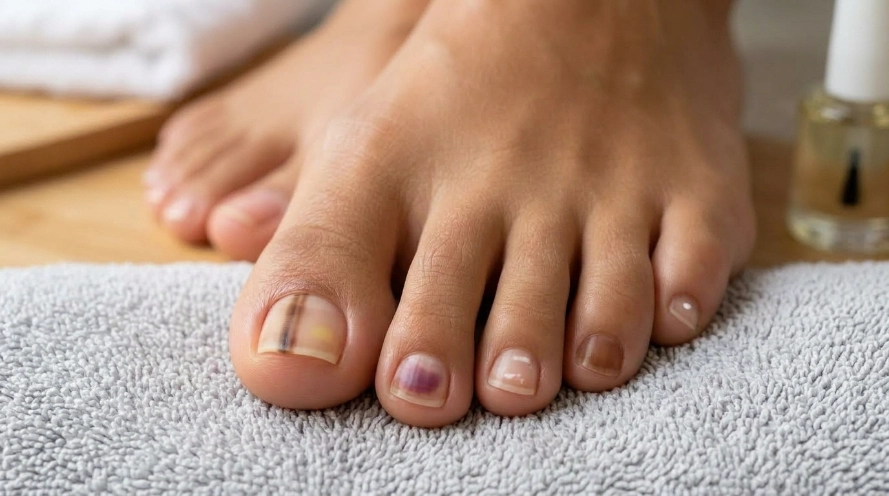
Toenails grow slowly, so many changes are actually developing before you notice them.
For example, discoloration can remain hidden underneath dark nail polish for weeks. A bruise may become dramatically darker a day or two after an injury. Fungal changes can also start in a small corner before becoming obvious.
That means “sudden” can describe when you noticed the color change rather than when the problem actually started.
Before assuming something serious is wrong, ask yourself:
- Did you recently stub your toe?
- Have you been running, hiking, or wearing tight shoes?
- Did you recently remove dark nail polish?
- Is the nail thicker, brittle, crumbly, or lifting?
- Is there redness or swelling around it?
- Does the discoloration look like a spot, streak, or whole-nail change?
- Is only one toenail affected, or are several changing?
Those details can help narrow down the possibilities.
1. Trauma or Bruising Under the Toenail
One of the most common explanations for a suddenly dark toenail is blood trapped beneath the nail after an injury, known as a subungual hematoma.
The injury does not always have to be dramatic. You might remember dropping something on your toe, but repetitive pressure from running or shoes that are too short can also irritate the nail.
A bruised toenail may look:
- Red at first
- Purple or blue
- Dark brown
- Black
It can also feel tender or throbbing.
Cleveland Clinic explains that trauma or repeated pressure can damage tiny blood vessels beneath the nail, allowing blood to collect underneath it. Cleveland Clinic’s guide to bruising under the nail
What You Can Do
If the discomfort is mild and the toe otherwise looks normal, reduce pressure on the area and wear shoes with enough room around your toes.
Do not drill, burn, puncture, or cut through the nail yourself to release trapped blood. If pressure under the nail causes significant pain, a healthcare professional can decide whether drainage is appropriate.
As the nail grows, an ordinary bruise should gradually move toward the tip.
If the dark area stays near the nail base, changes shape, or appeared without an injury you remember, have it evaluated.
2. Fungal Toenail Infection
Fungal infection is another frequent cause of toenail discoloration.
It usually develops gradually, but it can appear sudden if you first notice it after removing polish or when the infection reaches a more visible stage.
According to the American Academy of Dermatology, nail fungus can make toenails yellow, white, brown, orange, greenish-black, or black. The nail may also become thick, brittle, crumbly, misshapen, or partially detached. American Academy of Dermatology’s nail fungus symptoms guide
Signs that point more toward fungus include:
- Yellow or brown discoloration beginning near the edge
- Increasing nail thickness
- A brittle or crumbly texture
- Debris beneath the nail
- Separation from the nail bed
- More than one toenail gradually becoming affected
Should You Treat It Yourself?
Keeping feet clean and dry is useful, but nail fungus can be difficult to confirm by appearance alone.
Psoriasis, previous injury, nail separation, and other conditions can sometimes look surprisingly similar.
If discoloration persists or the nail becomes thick and damaged, a dermatologist or other healthcare professional can examine it and, when needed, test a nail sample before recommending treatment.
3. Bacterial Infection
A green or greenish-black toenail deserves attention, especially when the nail is lifting or the surrounding skin is sore.
The American Academy of Dermatology notes that a bacterial nail infection can create a greenish-black color. AAD’s guide to nail changes that need examination
Moisture trapped around a damaged or lifted nail can create an environment where bacteria thrive.
Possible accompanying signs include:
- Tenderness
- Redness
- Swelling
- Warmth
- Drainage
- An unpleasant odor
Do not simply cover a green or painful nail with polish or an artificial nail. Cosmetic covering can make it harder to monitor the area and may trap additional moisture.
4. Nail Polish or Product Staining
Sometimes the nail itself is healthy and the color is cosmetic.
Dark red, burgundy, orange, blue, and other heavily pigmented polishes can leave temporary yellowish or orange staining, especially when worn repeatedly without a protective base coat.
This tends to be more likely when:
- Several nails have similar discoloration
- There is no pain
- The nail remains smooth
- There is no swelling or debris
- The discoloration becomes visible immediately after polish removal
Give the toenails a break from color and watch what happens as new nail grows from the base.
Avoid aggressively buffing away the stain. Over-buffing thins the nail plate, which can make toenails weaker and more sensitive.
5. Nail Lifting From the Nail Bed
A toenail can turn partly white when it begins separating from the skin underneath.
This separation is called onycholysis.
The lifted area looks lighter because air replaces the normal pink appearance underneath the nail.
Possible triggers include:
- Repeated pressure or trauma
- Aggressive nail cleaning
- Fungal infection
- Psoriasis
- Irritation from nail products
A lifted nail should not be pulled off.
Keep it reasonably short, avoid digging underneath it with metal tools, and protect it from further pressure.
If the separation continues toward the cuticle or develops alongside pain, odor, drainage, or unusual discoloration, professional evaluation is safer than trying to repair the nail cosmetically.
6. Nail Psoriasis and Other Skin Conditions
Psoriasis does not affect only skin. It can also change fingernails and toenails.
Nail psoriasis may produce:
- Yellow, white, or brown discoloration
- Small pits or dents
- Crumbling
- Nail lifting
- Buildup beneath the nail
These changes can resemble fungus. In fact, visual similarities are one reason self-diagnosing toenail discoloration can be difficult.
If you already have psoriasis—or notice nail changes together with persistent scaly skin or other symptoms—mention that history when seeing a dermatologist.
7. Changes Related to Health Conditions
Occasionally, nail color changes are associated with health problems elsewhere in the body.
For example, the American Academy of Dermatology lists associations between certain nail appearances and conditions involving oxygen levels, anemia, the liver, kidneys, lungs, or other systems.
However, this is important:
A toenail color is not a diagnostic test.
A pale, white, blue, or yellow nail does not automatically mean you have a serious disease. Lighting, polish, injury, nail thickness, infection, and normal variation can all affect color.
Changes affecting many nails at once, especially when accompanied by symptoms elsewhere in the body, are more appropriate for medical evaluation than DIY treatment.
8. A New Brown or Black Streak
A dark toenail often turns out to be a bruise, especially after an obvious injury.
But a new or changing brown or black streak within a nail should not automatically be treated as a bruise or fungus.
The American Academy of Dermatology recommends having new or changing dark nail streaks examined because melanoma can develop beneath or around a nail.
Warning signs can include:
- A new brown or black vertical band
- A streak becoming wider or darker
- Pigment extending onto the surrounding skin
- Nail splitting or lifting without a clear injury
- A bump underneath the nail
- Dark discoloration that does not appear to move outward as the nail grows
Not every dark streak is melanoma. Many are harmless.
The key point is that an unexplained or changing streak deserves professional examination rather than home treatment.
What Different Toenail Colors May Suggest
| Toenail appearance | Possible explanations | What to watch for |
|---|---|---|
| Yellow | Polish staining, fungus, thickened nail, other nail conditions | Thickening, crumbling, spread to other nails |
| White | Nail lifting, surface fungal changes, trauma | Separation, powdery surface, increasing area |
| Green or green-black | Bacterial infection or sometimes other nail changes | Moisture, lifting, tenderness, odor, drainage |
| Red or purple | Recent trauma or bleeding beneath the nail | Throbbing pain or swelling |
| Brown or black | Bruise, fungal discoloration, pigmentation, less commonly melanoma | No known injury, changing streak, pigment around nail |
| Blue | Bruising or, when multiple nails/skin appear blue, possible circulation or oxygen concerns | Breathing difficulty or broader color change |
| Pale | Normal variation or possible systemic causes when multiple nails are affected | Fatigue or other unexplained symptoms |
This table is a starting point, not a diagnosis. Color needs to be interpreted together with texture, pain, nail growth, and your health history.
How to Check a Discolored Toenail at Home
A simple inspection can help you decide whether to monitor the nail or make an appointment.
1. Remove Nail Polish Carefully
If polish is present, remove it gently so you can see the entire nail plate.
Do not scrape the nail with a sharp tool.
2. Look at the Color Pattern
Ask whether the discoloration:
- Covers the whole nail
- Begins at the tip
- Forms a spot
- Forms a vertical streak
- Sits beneath the nail like a bruise
Pattern matters just as much as color.
3. Check the Nail Texture
Compare the nail with your unaffected toes.
Look for:
- Thickening
- Crumbling
- Pitting
- Splitting
- Lifting
- Buildup underneath
4. Check the Surrounding Skin
Redness, warmth, swelling, tenderness, or drainage can point toward inflammation or infection.
5. Think About Recent Pressure or Injury
Consider your footwear and activities from the past several weeks.
Long walks, running, hiking, sports, and narrow-toe shoes can repeatedly push toenails against footwear even if you never had one obvious accident.
6. Take a Clear Photo
Photograph the nail in natural light.
If you decide to monitor it briefly, another photo later can help you see whether the discoloration is actually moving outward with nail growth or changing shape.
Expert Tip: When monitoring a dark area after a known injury, focus on its position, not just its color. A normal bruise should gradually move toward the free edge as fresh nail grows behind it. If a dark streak remains fixed near the base or changes noticeably, get it checked.
What Can You Safely Do at Home?
For a minor color change with no major warning signs, basic nail care is often the best first step.
- Keep feet clean and dry.
- Trim toenails straight across.
- Wear shoes with enough toe room.
- Change damp socks promptly.
- Avoid picking underneath a lifted nail.
- Disinfect reusable nail tools appropriately.
- Do not share clippers or files.
- Give stained nails a break from polish.
- Avoid covering an unexplained abnormal nail with gel, acrylic, or press-ons until you know what is happening.
If fungus is suspected, remember that appearance alone cannot always confirm it. The NHS also advises seeking medical help when a nail changes color or shape without a known reason. NHS guidance on nail problems
DIY Care vs. Salon or Medical Care
| Situation | Best starting point | Typical cost level | Why |
|---|---|---|---|
| Mild polish staining | Home care | Low | Usually cosmetic and can be monitored |
| Minor bruise after known pressure | Home monitoring or healthcare if painful | Low to moderate | Many grow out naturally |
| Cosmetic shaping of a healthy nail | Nail technician | Moderate | Appropriate for appearance and routine maintenance |
| Thick, crumbly, persistently yellow nail | Healthcare professional | Moderate or higher | Fungus and other nail disorders can look alike |
| Painful green nail or drainage | Healthcare professional | Moderate or higher | Infection may require treatment |
| New unexplained dark streak | Dermatologist | Moderate or higher | Needs diagnosis rather than cosmetic covering |
| Severe injury or intense throbbing | Urgent care/medical professional | Varies | There may be bleeding or deeper injury |
Costs vary widely depending on insurance, location, testing, medication, and the type of professional involved.
When to See a Nail Technician or Dermatologist

A nail technician can help with cosmetic care of an otherwise healthy toenail, such as trimming, shaping, polish removal, or maintaining a pedicure.
A nail technician should not be expected to diagnose fungal infections, melanoma, circulation problems, or other medical conditions.
Consider seeing a dermatologist, podiatrist, primary care professional, or urgent-care clinician when you notice:
- A new unexplained brown or black streak
- A dark streak that widens or changes
- Pigment spreading onto nearby skin
- Persistent green or green-black discoloration
- Pus or drainage
- Increasing redness, warmth, or swelling
- Severe or throbbing pain
- A nail lifting significantly
- A toenail becoming progressively thicker or more damaged
- Discoloration that does not grow outward after an apparent injury
- Several nails changing without an obvious cosmetic reason
You should also seek professional advice sooner if you have diabetes, significant circulation problems, or a weakened immune system because seemingly minor foot problems may require more careful management.
Common Mistakes to Avoid
- Assuming every yellow nail is fungus. Polish staining, injury, psoriasis, and other nail conditions can look similar.
- Assuming every black nail is only a bruise. An unexplained or changing dark streak needs examination.
- Drilling into a painful nail yourself. Home drainage can lead to burns, injury, or infection.
- Buffing aggressively. This can thin and weaken the nail plate.
- Digging underneath a lifted nail. Sharp tools can damage the nail bed and introduce bacteria.
- Covering an abnormal nail immediately. Gel, acrylic, or dark polish can make it harder to monitor changes.
- Sharing nail tools. Clippers and files can spread microorganisms between people.
- Ignoring surrounding skin. Swelling, heat, drainage, or increasing redness can be more important than the nail color itself.
FAQs
Can toenails change color overnight?
A toenail may appear to change overnight after trauma, bleeding beneath the nail, or when you first notice discoloration after removing polish. Many infections and nail disorders actually develop gradually even if the change seems sudden.
Why did my toenail suddenly turn black?
A black toenail commonly follows trauma or repeated pressure from tight footwear, running, or hiking. However, unexplained black or brown pigmentation—especially a new vertical streak—should be evaluated rather than automatically assumed to be bruising.
Why is my toenail yellow but not thick?
Yellowing without thickening may come from nail polish staining or an early nail change. Fungus is another possibility, but color alone is not enough to confirm it. Monitor the nail for thickening, crumbling, lifting, or spreading discoloration.
Can nail polish cause permanent yellow toenails?
Polish staining is usually temporary and should gradually disappear as fresh nail grows. If yellow discoloration continues despite leaving the nail bare or the nail becomes thick, brittle, or distorted, another cause should be considered.
Does a green toenail always mean fungus?
No. Green or greenish-black discoloration may occur with bacterial nail infection, particularly when a nail has lifted and moisture becomes trapped underneath. Persistent green discoloration should be evaluated rather than automatically treated as fungus.
How do I know if a dark toenail is a bruise or something more serious?
A bruise usually follows trauma or repeated pressure and gradually grows toward the nail tip. A dark streak with no clear injury, pigment that changes or widens, or discoloration that remains near the nail base should be examined by a dermatologist.
Should I get a pedicure if my toenail has suddenly changed color?
It is better to postpone cosmetic services when the cause is unclear, especially if you have pain, swelling, drainage, lifting, green discoloration, or a new dark streak. Find out what is happening first so the nail can be treated safely if necessary.
Conclusion
So, what can cause sudden toenail color changes? The answer can be as simple as pressure from shoes, an old bruise, or nail polish staining, but fungal infection, bacterial infection, nail separation, psoriasis, and other health conditions can also change the appearance of a toenail.
The most useful approach is to look beyond the color.
Check for pain, swelling, nail thickness, crumbling, lifting, drainage, recent trauma, and whether the discoloration moves as the nail grows.
For mild changes with an obvious cause, careful monitoring and gentle nail care may be enough. But do not try to diagnose or cosmetically hide an unexplained dark streak, painful infection, or worsening nail change.
When in doubt, take a clear photo, leave the nail uncovered, and arrange an evaluation with an appropriate healthcare professional. Catching a genuine nail problem early is much smarter than covering it with another coat of polish.

