
Can You Use Nail Cleanser Instead of Dehydrator? A Simple Nail Prep Guide

You are ready to start your gel, acrylic, dip, or press-on manicure when you realize you are missing one product: nail dehydrator. There is a bottle of nail cleanser sitting nearby, so naturally you wonder, can you use nail cleanser instead of dehydrator?
Sometimes you can use nail cleanser as a temporary nail-prep option, especially if it is an alcohol-based formula that removes surface oil. But cleanser and dehydrator are not automatically interchangeable.
The difference matters most when you want gel, acrylic, dip, or extensions to stay attached without lifting. Below, we will break down what each product actually does, when substitution may work, when it probably will not, and how to prep your nails safely at home.
Quick Answer
Can you use nail cleanser instead of dehydrator? Sometimes, but it is not a perfect substitute. An alcohol-based nail cleanser can remove surface oil and residue, while a nail dehydrator is specifically designed to temporarily remove moisture and oils from the natural nail. For long-wear gel, acrylic, or extensions, use the dehydrator recommended for your system when possible.
Nail Cleanser vs. Nail Dehydrator: What Is the Difference?
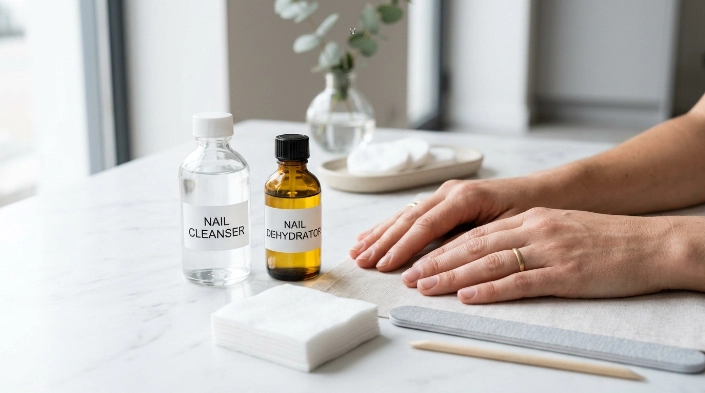
These products can look almost identical on your manicure table. Both are usually clear liquids, and both may be used somewhere during a nail service.
Their jobs, however, are different.
What Nail Cleanser Does
A nail cleanser is generally designed to clean the surface of the nail.
Depending on the formula, it may remove:
- Nail dust
- Surface oils
- Sticky gel residue
- Light product residue
- Fingerprints
- Debris left after filing or buffing
Many nail cleansers contain alcohol, which evaporates quickly and can temporarily leave the nail surface feeling dry.
However, not every nail cleanser is intended as a pre-application dehydrating product. Some are primarily designed to remove the sticky inhibition layer that remains after curing certain gel products.
Always read the product label rather than assuming every bottle labeled “cleanser” works the same way.
What Nail Dehydrator Does
A nail dehydrator is specifically made for the preparation stage of a manicure.
Its purpose is to temporarily reduce surface moisture and oils on the natural nail plate so that gel, acrylic, dip, tips, or other enhancement products can create a more reliable bond.
Think of it this way:
Cleanser = cleans the surface.
Dehydrator = prepares the natural nail for adhesion by reducing moisture and oil.
They overlap slightly, but they are not necessarily the same product.
Nail Cleanser vs. Dehydrator Comparison
| Feature | Nail Cleanser | Nail Dehydrator |
|---|---|---|
| Main purpose | Removes residue, oil, dust, or sticky gel layer | Temporarily removes surface moisture and oil |
| Used before application | Sometimes | Usually |
| Used after gel curing | Often, depending on gel system | No |
| Helps with adhesion | May help | Specifically designed to help nail prep |
| Best for oily nails | May not be enough | Usually the better choice |
| Can replace the other? | Sometimes in a pinch | Not necessary for cleansing cured gel residue |
| Typical cost | Usually inexpensive | Usually inexpensive |
| Best approach | Follow label directions | Follow your manicure system’s directions |
The biggest lesson is simple: choose products according to their intended purpose rather than their appearance.
So, Can You Really Use Nail Cleanser Instead of Dehydrator?
For some basic manicures, possibly.
If your nail cleanser contains a high percentage of fast-evaporating alcohol and does not contain moisturizing ingredients or oils, it may remove enough surface oil to help with preparation.
That does not mean it will behave exactly like a dedicated dehydrator.
A true nail dehydrator is formulated for the pre-application stage. If your gel, acrylic, dip, builder gel, or extension system specifically tells you to use its dehydrator or prep solution, following those instructions gives you the most predictable result.
The FDA’s guidance on nail care products also recommends reading nail-product labels carefully and following their directions and warnings. Nail products can contain very different ingredients even when the bottles seem to perform similar jobs.
When Nail Cleanser May Work as a Temporary Substitute
Using cleanser instead of dehydrator is more reasonable when:
- You are doing a simple manicure rather than a complex enhancement service.
- Your cleanser is specifically suitable for natural-nail preparation.
- The formula contains alcohol and dries quickly.
- It does not leave an oily or conditioning film.
- Your nails are naturally fairly dry rather than very oily.
- The nail system you are using does not specifically require a separate dehydrator.
For example, if you are applying regular nail polish, thoroughly cleaning the nail plate may be enough preparation.
The expectations become different with long-wear enhancements.
When You Should Use a Real Nail Dehydrator
A dedicated dehydrator makes more sense if you are applying:
- Gel extensions
- Builder gel
- Acrylic nails
- Dip powder
- Full-cover tips
- Long-wear gel polish
- Nail enhancements that frequently lift
It can also be helpful if your natural nail plate becomes oily quickly.
If your manicures regularly start lifting around the cuticle or sidewalls despite correct application, improving your prep routine may help.
However, do not assume that every lifting problem is caused by moisture. Product touching the skin, incomplete curing, improper cuticle preparation, incompatible products, damaged nails, incorrect lamp use, or poor application technique can also contribute.
What About Using Alcohol Instead of Nail Dehydrator?
This is another common DIY question.
Isopropyl alcohol is often used to clean and degrease surfaces, and many nail cleansers contain it. For some manicure systems, an alcohol wipe may be adequate for cleaning the natural nail before application.
But again, that does not make alcohol universally equivalent to a professional dehydrator.
If the manufacturer gives you a specific preparation sequence, use that sequence.
You should also avoid repeatedly soaking your nails and surrounding skin in strong solvents. Excessive exposure can leave the skin feeling dry or irritated.
Is Acetone a Nail Dehydrator Substitute?
Acetone removes oils very effectively and evaporates quickly, which is why people sometimes use it during nail preparation.
However, it can also be very drying.
Using acetone occasionally on the nail plate is different from repeatedly soaking your nails and skin in it. The American Academy of Dermatology’s artificial-nail guidance notes that artificial nail services and removal processes can leave natural nails thin, brittle, and dry.
If your nails are already peeling, fragile, irritated, or extremely dry, adding more aggressive prep is not always the smartest solution.
How to Prep Nails If You Do Not Have Dehydrator
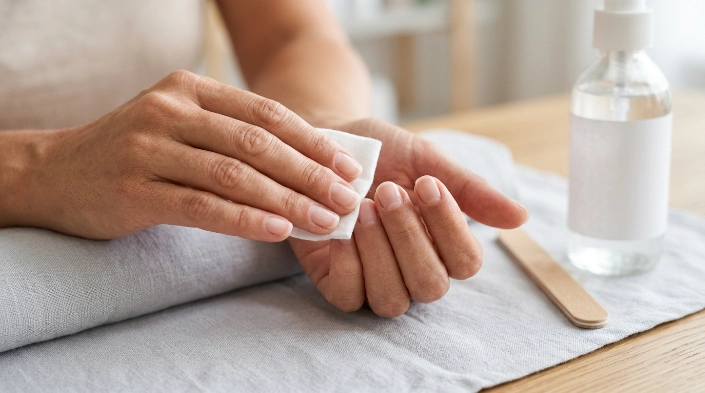
If you have run out of dehydrator and your manicure system allows basic cleansing as preparation, use a careful routine instead of adding random household chemicals.
1. Start With Clean Hands
Wash your hands and dry them thoroughly.
You do not want lotion, hand cream, cuticle oil, or soap residue sitting on the nail plate.
Avoid applying cuticle oil immediately before your manicure.
2. Shape the Free Edge
Use an appropriate nail file to create the shape and length you want.
Avoid unnecessarily aggressive filing on natural nails. Filing too much can thin the nail plate and make it tender.
3. Clean the Nail Plate Carefully
Gently remove loose nail dust and debris.
Do not aggressively scrape or cut living skin around the nail.
Cuticles and surrounding skin help protect the nail area. The American Academy of Dermatology’s healthy nail recommendations advise against removing the cuticle and recommend keeping nails clean and dry.
4. Use a Lint-Free Wipe
Apply your appropriate nail cleanser to a clean lint-free wipe.
Wipe each nail thoroughly, including near the sidewalls.
Try not to repeatedly touch the cleaned nail with your fingers afterward because your fingertips naturally contain oils.
5. Let the Nail Dry Completely
Give the cleanser time to evaporate.
Do not apply product over a nail that still looks wet.
6. Continue With Your Nail System
Apply primer, base coat, builder gel, acrylic, dip, adhesive, or other product only according to the directions for your specific system.
Do not automatically add extra prep products simply because more seems better.
Over-prepping can create its own problems.
Expert Tip: Prep products work best as a system. If a gel, acrylic, or extension brand recommends a particular cleanser, dehydrator, primer, base coat, and lamp combination, staying within that system is usually more predictable than mixing several unrelated products.
Dehydrator Is Not the Same as Nail Primer
Another easy mistake is confusing dehydrator with primer.
They perform different jobs.
A dehydrator prepares the nail by temporarily removing moisture and oil.
Primer is generally used afterward to improve the bond between the nail and enhancement product.
Depending on the manicure system, primer may be:
- Acid-based
- Acid-free
- Required
- Optional
- Built into another prep product
Never assume more primer means better adhesion.
Some professional primers contain stronger ingredients and require especially careful application. The FDA notes that methacrylic acid has been used in some nail primers and that certain products require specific safety precautions.
Keep prep and primer products off the surrounding skin unless the manufacturer specifically says otherwise.
Which Option Is Best for Different Manicures?
Regular Nail Polish
For ordinary polish, you may not need a specialized dehydrator at all.
A clean, dry, oil-free nail surface and a compatible base coat are often the main priorities.
Gel Polish
Gel polish usually benefits from careful surface preparation.
Some gel systems use cleanser followed by dehydrator. Others have their own preparation solution.
Follow the brand’s instructions, especially for curing time and lamp compatibility.
Acrylic Nails
Acrylic adhesion depends heavily on preparation.
A dedicated nail dehydrator and the appropriate primer are generally more reliable than treating a generic cleanser as an identical substitute.
Dip Powder
Proper prep can reduce lifting with dip systems as well.
Because dip systems use bonding liquids and powders, avoid adding random products that the manufacturer does not recommend.
Press-On Nails
For short-term press-ons, cleaning oil from the natural nail can significantly improve adhesive contact.
An alcohol-based prep wipe supplied with the press-ons may be all the manufacturer requires.
For longer wear, follow the adhesive instructions instead of aggressively dehydrating the natural nail.
What to Consider If You Have Sensitive or Dry Nails
People with dry, peeling, thin, or sensitive nails should be particularly careful with repetitive chemical preparation.
Watch for:
- Burning
- Persistent redness
- Itching
- Swelling
- Peeling skin
- Cracking around the nail
- Increasing nail tenderness
Nail chemicals can cause irritation or allergic reactions in some people. The FDA advises using nail products in a well-ventilated area, avoiding inappropriate exposure, and paying attention to product warnings.
If a product burns or causes significant irritation, stop using it rather than trying to “push through” the reaction.
Hygiene Matters Too
Good adhesion is important, but hygiene matters more.
Keep cleanser and dehydrator bottles closed when you are not using them. Use clean wipes instead of repeatedly dipping a contaminated brush or applicator into products when the system is not designed for that.
Do not share contaminated nail files, buffers, or manicure tools.
If you perform frequent manicures, periodically check your tools for residue, wear, cracks, or surfaces that are difficult to clean.
And if you suspect a nail infection, avoid covering the problem with gel, acrylic, or press-ons simply to hide it.
Common Mistakes to Avoid
Even a good dehydrator cannot compensate for poor preparation. Avoid these common mistakes:
- Using cleanser with oils or conditioning ingredients. A residue-producing cleanser may work against adhesion.
- Applying lotion immediately before nail prep. Moisturizers can leave oil on the nail plate.
- Touching nails after cleaning them. Your fingers can transfer oil back onto the nail.
- Using too much dehydrator. More product is not automatically better.
- Getting primer or enhancement product on the skin. Repeated skin exposure can increase irritation and sensitization risk.
- Aggressively buffing natural nails. The goal is proper preparation, not thinning the nail plate.
- Using acetone repeatedly because the nail does not look “dry enough.” Excessive solvent exposure can make nails and skin feel very dry.
- Mixing random nail systems. Products from unrelated systems may not be designed to work together.
- Ignoring lifting. Moisture can become trapped beneath lifted enhancement material.
- Covering painful or discolored nails. Nail changes should be evaluated instead of hidden.
DIY vs. Professional Nail Prep
| Situation | DIY Prep May Be Fine | Professional Help Is Better |
|---|---|---|
| Healthy natural nails | Yes | Optional |
| Simple gel polish | Often | If lifting keeps happening |
| Occasional press-ons | Usually | Rarely necessary |
| Acrylic extensions | Possible with experience | Helpful for beginners |
| Nails repeatedly lifting | Troubleshoot carefully | Recommended |
| Painful or damaged nail | Avoid enhancements | Nail tech or dermatologist |
| Suspected infection | No | Medical evaluation |
| Persistent allergic reaction | No | Dermatologist |
DIY nail care can be convenient and budget-friendly, but persistent problems should not be solved by continually adding stronger chemicals.
When to See a Nail Technician or Dermatologist
A licensed nail technician can help when your manicure technique is the problem.
Consider professional nail-service advice if:
- Gel or acrylic repeatedly lifts despite proper prep.
- You are unsure which dehydrator and primer work with your system.
- You keep over-filing your natural nails.
- Extensions crack or separate soon after application.
- You cannot tell whether your preparation technique is too aggressive.
A dermatologist is the better choice when you notice symptoms that may involve your nail or skin health.
Seek medical advice for:
- Persistent redness or swelling
- Significant pain
- Pus or drainage
- A nail separating from the nail bed
- Ongoing itching or rash
- Unusual nail discoloration
- Thickening or distortion
- Skin reactions that continue after the product is removed
The American Academy of Dermatology advises paying attention to unusual changes in the nail and surrounding skin rather than simply covering them with artificial nails.
FAQs
Can nail cleanser and dehydrator be the same product?
Sometimes a manufacturer may sell a multipurpose preparation solution, but you should not assume all cleansers and dehydrators are identical. Check the label and directions to see exactly what the product is designed to do.
Can you use nail cleanser instead of dehydrator for gel nails?
You may be able to use an alcohol-based cleanser for basic nail preparation if your gel system allows it. However, a dedicated dehydrator is usually more reliable when the manufacturer specifically recommends one.
What can I use if I do not have nail dehydrator?
An appropriate alcohol-based nail cleanser or prep wipe may work temporarily for some manicure systems. Avoid experimenting with unrelated household cleaners or harsh chemicals.
Do you need nail dehydrator before every gel manicure?
Not necessarily. Requirements vary by product system and by your natural nails. Some brands include a dehydrating step, while others use a different prep solution. Follow the instructions for your specific gel system.
Does nail dehydrator damage natural nails?
Normal, occasional use according to product directions should not automatically damage healthy nails. However, excessive filing, repeated solvent exposure, improper removal, and overly aggressive preparation can contribute to dryness and weakness.
Should dehydrator go before or after primer?
In systems that use both, dehydrator normally goes before primer. The dehydrator prepares the nail surface, while the primer supports adhesion. Always confirm the order on your product instructions.
Why does my gel still lift even after using dehydrator?
The problem may not be dehydration. Lifting can also happen because of cuticle residue on the nail plate, product touching the skin, incorrect curing, poor application, incompatible products, nail flexibility, or improper removal and preparation.
Conclusion
So, can you use nail cleanser instead of dehydrator? In some situations, yes. An alcohol-based nail cleanser may remove enough surface oil and residue for basic nail preparation, especially when you are doing a simple manicure.
But cleanser and dehydrator are not automatically interchangeable.
If you are applying gel extensions, acrylic, dip powder, builder gel, or another long-wear enhancement, the safer and more predictable approach is to use the preparation products recommended for that specific system.
Keep your nails clean, avoid aggressive filing, protect the surrounding skin, and pay attention to irritation or unusual nail changes.
A beautiful manicure should never require sacrificing healthy nails. When in doubt, choose gentler preparation, follow the product directions, and get professional help if your nails are painful, damaged, or repeatedly lifting.

