
Does UV Light at Nail Salons Cause Cancer? What Clients Should Know

If you get gel manicures, the short answer is this: UV light from nail salon lamps may add a small amount of cancer risk over time, but a single manicure is not considered a major risk for most people. The concern is cumulative exposure, not one appointment.
That distinction matters. A lot of headlines make nail lamps sound either harmless or terrifying. The reality is more practical: salon lamps mainly emit UVA, and repeated exposure can contribute to skin damage. At the same time, the dose from one visit is much lower than from stronger UV sources like tanning beds, and experts at MD Anderson note that even the highest-wattage lamps studied did not appear to make a single visit a serious concern. Their summary is a helpful reality check if you want the big picture without the scare tactics.
For most clients, the decision is not “never use gel again.” It is “how often do I use these lamps, and do I want to reduce exposure where I can?”
How Nail Salon UV and LED Lamps Work
Gel polish needs light to harden. That is why salons use curing lamps. The lamp triggers a chemical reaction in the gel so it sets quickly and stays glossy longer than regular polish.
Here is the part many people miss: both UV lamps and LED lamps can emit ultraviolet radiation. The naming is confusing. “LED” does not automatically mean “UV-free.” According to the Skin Cancer Foundation, these lamps predominantly produce UVA rays, which are linked to premature skin aging and skin cancer risk. Their explanation is useful because it separates the marketing label from the actual light exposure.
Why UVA matters more here
UVA is the main concern with nail lamps because it penetrates deeper into the skin than UVB. That does not mean it is the most intense form of UV you will ever encounter, but it does mean repeated exposure is not meaningless. Over time, UVA can contribute to DNA damage in skin cells.
That is why the question is not whether the lamp is “hot” or feels strong. UV damage is invisible in the moment. You can leave a salon with no redness and still have received a dose that adds up over many visits.
How Much Exposure You Actually Get During a Manicure
The practical risk comes down to dose, frequency, and your own skin sensitivity.
A single gel manicure usually means a short period under the lamp, but the exact exposure varies by salon, lamp type, wattage, curing time, and the specific curing protocol. In other words, there is no precise universal number that fits every appointment. Some research and expert summaries suggest that one visit is typically a relatively small UV dose, but the total can vary enough that the better takeaway is this: the exact exposure depends on the device and how it is used.
A useful way to think about it
- Occasional gel client: likely low risk in real-world terms.
- Frequent gel client: exposure can become more relevant because UV adds up.
- Very frequent client with other risk factors: worth taking more precautions or considering alternatives.
If you get gel nails once in a while, the lamp is probably not the deciding factor in your overall skin cancer risk. If you get them every 2 to 3 weeks for years, the cumulative exposure deserves more attention.
For readers comparing manicure choices, our guide on what a fill means at a nail salon can help you understand how often you may be returning for upkeep, which affects total exposure over time.
UV Nail Lamps vs Sunlight vs Tanning Beds
A lot of anxiety comes from comparing a nail lamp to “the sun” without context. The better comparison is total UV dose and how often you receive it.
| Source | Main UV concern | Real-world takeaway |
|---|---|---|
| Nail salon UV/LED lamp | Mostly UVA | Short sessions, but repeated exposure can add up |
| Sunlight | UVA and UVB | Daily exposure can be much larger overall |
| Tanning bed | Strong UVA, sometimes UVB | Much higher concern than nail lamps |
What this means in practice
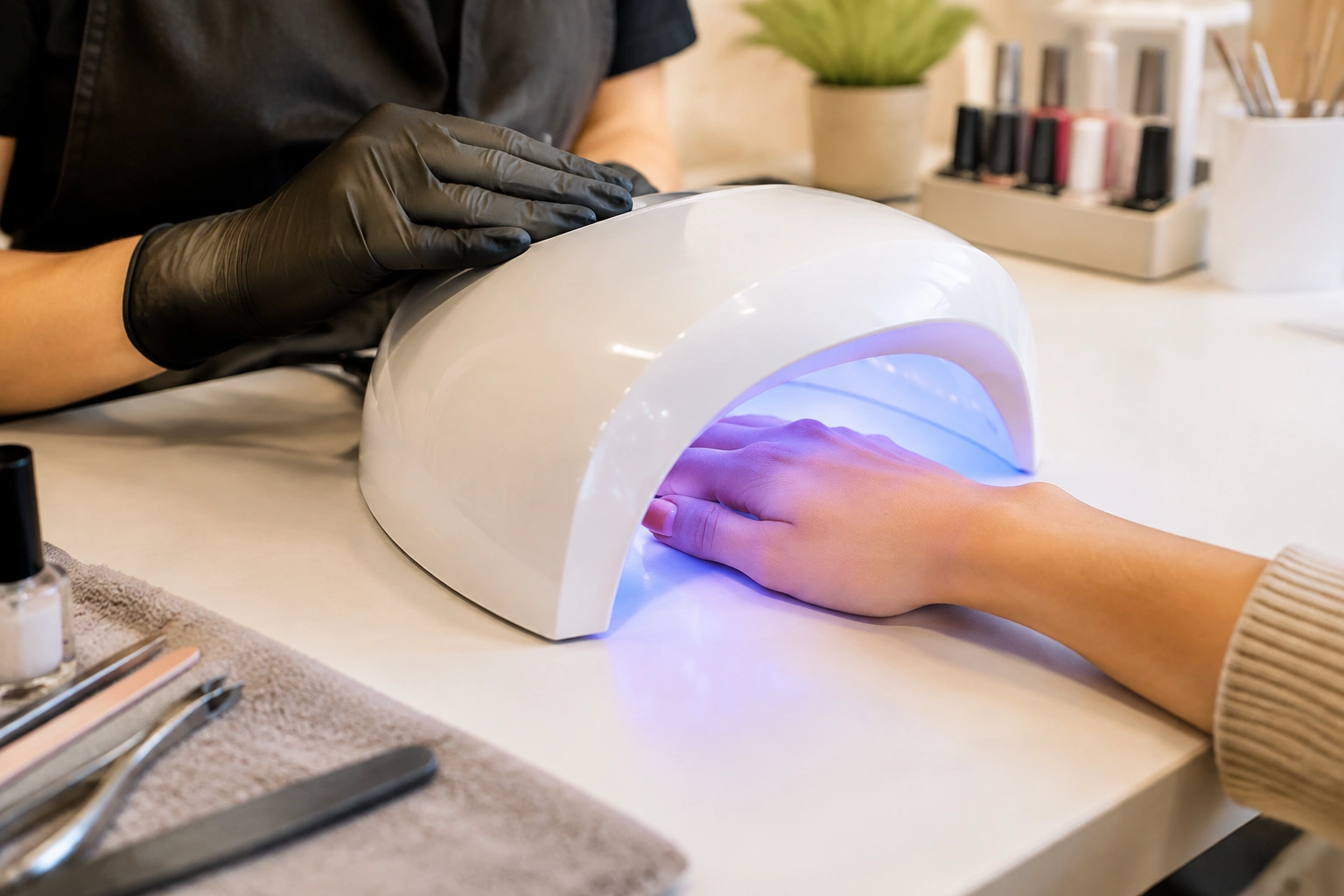
A manicure lamp is not the same as lying in a tanning bed. Tanning beds are a far more concerning UV source because they deliver much stronger intentional exposure. Nail lamps are more limited, but they are still a UV source.
Sunlight is also important in this comparison. A few minutes under a nail lamp is not equivalent to a whole day outdoors. But if you already get substantial sun exposure, the lamp becomes an additional, avoidable dose rather than your only exposure.
For general UV safety guidance, the FDA’s consumer information on UV radiation is a good reference point for understanding why repeated UV exposure matters even when it seems brief.
Is LED Nail Light Safer Than UV Light?
Sometimes, but not automatically.
LED lamps are often marketed as the “better” choice because they may cure gel faster than older UV lamps. Faster curing can mean less time under the lamp. That is a real advantage. But LED does not guarantee zero UV output, and it does not erase exposure entirely.
The decision rule I use with clients
- If an LED lamp cures your gel in less time than a traditional UV lamp, that may reduce exposure.
- If the salon calls it LED but it still emits UVA, there is still some UV concern.
- If you are choosing purely for safety, lower exposure time is better than a label alone.
So yes, LED-cured services may be a reasonable step down in exposure compared with older UV-only lamps. Just do not assume “LED” means “safe enough to ignore.”
What the Research Says About Cancer Risk
This is where nuance matters most.
Human evidence, lab evidence, and risk estimates do not all mean the same thing, and it helps to separate them clearly.
- Lab studies can show that UV nail lamp exposure may damage DNA in skin cells under controlled conditions. That supports biological plausibility, but it does not prove that typical salon use causes cancer in real people.
- Case reports describe individual people who developed skin cancers or precancerous lesions on the hands after extensive UV nail lamp exposure. These reports are important warnings, but they cannot show how common the problem is or whether the lamp was the only cause.
- Human risk estimates and reviews try to judge the likely real-world risk across larger groups. The overall picture remains cautious: repeated exposure may raise risk, but the evidence is still limited and not strong enough to quantify the danger precisely for the average client.
Some reviews have suggested that prolonged and repeated use may pose a low risk, but that conclusion should be read as a cautious estimate rather than a proven cause-and-effect finding. In other words, the evidence supports concern, not panic.
How to read the evidence without overreacting
- Short-term, occasional use: likely low concern.
- Repeated use over years: more relevant because risk is cumulative.
- Case reports: important warning signs, but they do not tell us how common the problem is.
- Lab studies: show biological plausibility, but they are not the same as proving real-world cancer rates.
If you prefer a conservative take, the evidence supports this: UV nail lamps are probably a low-risk exposure for most occasional users, but not a zero-risk exposure, especially with frequent use.
Who Should Be More Cautious
Some people should think more carefully before making gel manicures a regular habit.
Higher-caution groups include:
- People with a personal history of skin cancer
- People with a strong family history of skin cancer
- People with very fair skin or high UV sensitivity
- Anyone taking photosensitizing medications
- People who have unusual reactions to light or a history of significant sun sensitivity
If you fall into one of those groups, the question is less “Is the risk huge?” and more “Is the convenience worth adding another avoidable UV exposure?”
A realistic example
A client who gets gel nails every few months and has no major skin cancer risk factors may reasonably decide the exposure is acceptable. A client with prior skin cancer who gets gel every two weeks may reasonably decide the trade-off is not worth it.
That is not fear-based thinking. It is personal risk management.
How to Reduce UV Exposure During Gel Manicures
If you want the durability of gel but also want to lower exposure, a few simple steps help more than wishful thinking.
What matters most
- Wear fingerless UV-protective gloves
- This is one of the most direct ways to reduce lamp exposure because it physically blocks UV from most of the hand.
-
If you want the biggest practical reduction, this is the strongest option.
-
Limit how often you book light-cured services
- Fewer visits mean less cumulative exposure.
-
This is especially important if you get gel every 2 to 3 weeks.
-
Ask your salon what lamp and curing protocol they use
- Faster-curing devices or shorter cure times may reduce exposure somewhat.
- The exact benefit depends on the lamp and the service.
Helpful, but more supplemental
- Use broad-spectrum sunscreen on the backs of your hands
- Apply it before your appointment.
- Focus on the backs of the hands and fingers, since that is where the lamp exposure hits.
- Sunscreen can help, but it is usually less protective than a physical barrier like gloves.
What protection does and does not do
Sunscreen and gloves can lower exposure, but they do not make UV exposure disappear completely. Think of them as risk reducers, not magic shields.
If you want a deeper look at manicure maintenance choices that may reduce how often you need a fresh set, what a nail salon fill is can help you plan a lower-maintenance routine.
Pedicures, Acrylic Nails, and Other Services: Do They Raise the Same UV Concerns?
Not always.
The main UV concern applies when a service uses a UV-cured or LED-cured lamp to harden gel products. That is why gel manicures get the most attention.
Pedicures
Pedicures are not automatically the same as manicures from a UV-exposure standpoint. A pedicure only raises the same lamp concern if the salon is curing gel polish on the toes under a UV or LED lamp. A basic pedicure with regular polish does not involve the same curing-light exposure.
Acrylic nails
Traditional acrylic nails are different from gel systems. Acrylic enhancement usually hardens through a chemical process rather than a UV curing lamp. That means acrylic services generally do not involve the same lamp exposure concern as gel manicures, unless gel polish or another light-cured product is added on top.
Hybrid or dual-cure systems
Some salons use hybrid products or dual-cure lamps, and the exact exposure depends on the specific device, product, and curing protocol. So it is better to ask what is being cured, not just what the service is called.
Safer Alternatives to UV-Cured Nail Services
If you decide you do not want the UV trade-off, you still have options.
Lower-exposure alternatives
- Regular polish
- No curing lamp needed.
- Usually less durable than gel.
-
Good if you prefer lower exposure and do not mind more frequent touch-ups.
-
Non-UV manicure services
- Some salons offer classic manicures with air-dried polish or quick-dry top coats.
-
These reduce UV concern, though wear time may be shorter.
-
Shorter-wear routines
- If you only need polished nails for an event, regular polish can be a sensible compromise.
Trade-off to keep in mind
Gel gives you durability, shine, and fewer chips. Regular polish gives you lower UV exposure. Neither is “best” for everyone. The better choice is the one that matches your priorities and your risk tolerance.
If you are comparing salon services more broadly, our guide to what pink and white means at a nail salon can help you understand other manicure options that may fit different maintenance goals.
When to See a Nail Technician or Dermatologist
See a dermatologist if you have a personal history of skin cancer, take photosensitizing medication, or notice unusual changes on the hands or around the nails after repeated lamp exposure.
Signs worth checking
- A spot that does not heal
- A rough, scaly patch that keeps returning
- A new growth or sore on the back of the hand
- Redness, burning, or unusual sensitivity after lamp use
A nail technician can help with practical service choices, but a dermatologist is the right person if you are worried about skin changes or your individual risk profile. If you are unsure whether gel is a good idea for you, that is a reasonable question to bring up before your next appointment.
FAQ: UV Nail Lamps and Cancer Risk
Do nail salon UV lamps cause cancer?
They may contribute to skin cancer risk with repeated exposure, but the current evidence suggests the risk is low for most occasional users. The concern is cumulative exposure over time.
Are LED nail lamps completely safe?
No. LED lamps can still emit UV radiation, usually UVA. They may reduce exposure time if they cure faster, but they are not automatically UV-free.
Is one gel manicure dangerous?
A single manicure is not generally considered a major cancer concern. The bigger issue is repeated use over months or years.
Should I stop getting gel nails?
Not necessarily. If you get them occasionally and have no major risk factors, you may decide the convenience is worth it. If you have higher risk factors, avoiding UV-cured services may be the better choice.
Does sunscreen fully protect my hands during a manicure?
No. Broad-spectrum sunscreen can reduce exposure, but it does not eliminate it. Fingerless UV-protective gloves provide more direct shielding.
Are nail lamps worse than sunlight?
Usually not in the same way. Sunlight can deliver far more total UV over a day, while nail lamps are shorter exposures. But nail lamps are still an avoidable UV source.
If you want the safest practical answer, think in terms of how often you use the lamp, what your skin risk looks like, and whether you can reduce exposure without giving up the manicure style you like. That is the balanced way to make the decision.

