
How to Choose Shoes to Help Prevent Ingrown Toenails

If your big toe feels sore every time you put on sneakers, flats, heels, or work shoes, your footwear may be part of the problem. Ingrown toenails can develop for several reasons, but repeated pressure around the nail is an important one.
Learning how to choose shoes to help prevent ingrown toenails is therefore more than a comfort issue. The right shoes give your toes enough room to sit naturally instead of squeezing the nail edges into the surrounding skin.
That does not mean you need orthopedic-looking footwear or sandals every day. You mainly need to pay attention to toe-box shape, width, length, heel height, activity, and how the shoe actually feels after several minutes of walking.
This guide explains what to look for, which shoe styles deserve extra caution, how socks and nail care fit into the picture, and when a painful toenail needs professional attention rather than another DIY fix.
Quick Answer
To help prevent ingrown toenails, choose shoes that fit securely without squeezing your toes. Look for a roomy toe box, enough length for your toes to lie naturally, and a shape that does not push the big toe inward. Avoid consistently wearing tight, narrow, or sharply pointed shoes.
Why Your Shoes Can Affect Ingrown Toenails
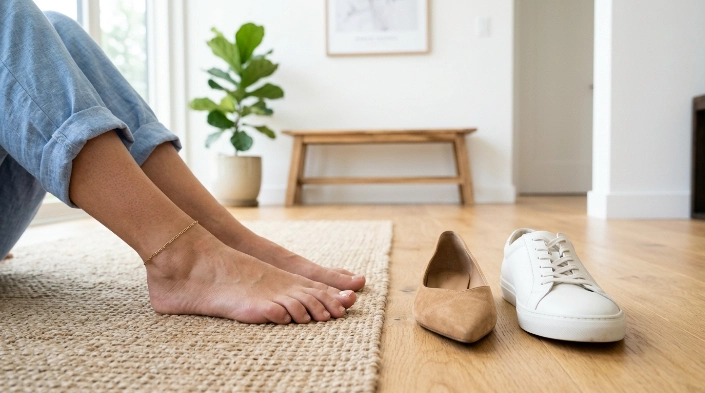
An ingrown toenail happens when the side or corner of the nail presses or grows into the skin beside it. The big toe is affected most often.
Footwear is not the only possible cause. Toenails cut too short, rounded nail corners, injuries, naturally curved nails, and some medical conditions can also contribute.
However, shoes can create repeated pressure against the nail and surrounding skin. The Mayo Clinic’s guidance on ingrown toenails specifically lists shoes that crowd the toenails as a cause and recommends properly fitting footwear as a preventive step.
Think about what happens inside a narrow shoe. Your toes are pushed together, the big toe can press against the upper or side of the shoe, and the skin beside the nail may stay under pressure for hours.
That pressure can become particularly noticeable when you walk, run, exercise, or stand all day.
What to Look for in Shoes That Are Kinder to Your Toenails
1. Choose a Roomy Toe Box
The toe box is the front portion of the shoe where your toes sit.
For ingrown-toenail prevention, this is one of the most important areas to check.
Your toes should be able to rest in a natural position rather than being squeezed together. You should also have enough room to gently wiggle them.
A shoe can technically be your usual size and still have a toe box that is too narrow for your foot shape.
The American Academy of Dermatology also recommends properly fitting shoes and notes that a wide toe box can help prevent rubbing and nail injury. AAD advice on preventing nail injuries
2. Check the Width, Not Just the Size Number
Many people focus entirely on shoe length.
Width matters just as much.
If the sides of the shoe press tightly against your big toe or little toe, the fit may be wrong even when your heel and overall length feel acceptable.
Signs a shoe may be too narrow include:
- Your toes overlap or feel pushed together.
- Your big toe presses firmly against the side of the shoe.
- You see red pressure marks after taking the shoes off.
- Your toenails feel tender after walking.
- You feel relief as soon as you remove the shoes.
If this keeps happening, consider trying a wider fitting rather than automatically buying a longer shoe.
3. Make Sure the Shoe Is Long Enough
Your toes should not repeatedly hit the front of the shoe as you walk.
This is especially important in running shoes, hiking shoes, work shoes, and any footwear used for long periods.
MedlinePlus notes that poorly fitting shoes and extra pressure on the toes can contribute to ingrown toenails, especially for people who walk frequently or play sports. MedlinePlus information about ingrown toenails
At the same time, dramatically oversized shoes are not automatically better. A shoe should hold your foot securely enough that your foot is not constantly sliding forward.
The goal is room without uncontrolled movement.
4. Pay Attention to the Shape of the Shoe
Look at the shoe from above.
Does the front taper sharply inward?
If so, your toes may be forced into that same narrow shape.
Rounded, foot-shaped, or more generous toe boxes generally provide more room than dramatically pointed styles.
This does not mean you can never wear pointed dress shoes. But if you are prone to ingrown toenails, wearing them for many hours or very frequently may increase unnecessary pressure around your toes.
5. Be Careful With High Heels
Higher heels can shift more of your body weight toward the front of the shoe.
If the shoe also has a narrow toe box, your toes may become compressed.
For occasional events, a properly fitting heel may not cause a problem for everyone. But if you repeatedly notice big-toe tenderness after wearing heels, treat that discomfort as useful feedback.
Consider a lower heel, a wider toe box, or a different shoe shape.
A Simple Shoe-Fitting Check Before You Buy

Do not judge a shoe while sitting down for ten seconds.
Try this process instead:
- Put on the socks or hosiery you normally wear with the shoe.
- Stand up fully. Your foot spreads slightly under your body weight.
- Check your toes. They should not be crushed together or forced into an unnatural position.
- Walk around. Notice whether your foot slides forward or your big toe hits the front.
- Check both feet. One foot may fit slightly differently from the other.
- Pay attention to pressure rather than hoping the shoe will stretch. A painfully tight toe area is not a good starting fit.
- Recheck your toes after several minutes. New rubbing, tingling, pressure, or nail tenderness is a warning sign.
Expert Tip: If your first thought is, “These are a little tight around my toes, but they’ll probably break in,” try another width or shape before buying. Shoes can soften with wear, but your toenails should not have to tolerate repeated pressure while that happens.
Which Shoe Types Need the Most Attention?
No single shoe category automatically causes or prevents ingrown toenails. Fit matters more than the label.
| Shoe Type | What to Look For | Possible Problem |
|---|---|---|
| Everyday sneakers | Roomy toe box and secure heel | Narrow athletic styles can squeeze toes |
| Running shoes | Enough front space without excessive sliding | Toe impact during repetitive movement |
| Flats | Broad front shape and comfortable width | Some flats taper sharply at the toes |
| High heels | Lower heel and wider front when possible | Feet may slide forward into a narrow toe box |
| Boots | Adequate width with your normal socks | Thick socks can make an otherwise good fit tight |
| Work shoes | Secure fit and sufficient toe room | Protective footwear may feel restrictive if poorly sized |
| Sandals | Stable straps and no toe squeezing | Loose sandals may allow excessive sliding |
| Hiking shoes | Toe room plus secure midfoot and heel | Toes can repeatedly hit the front during descents |
Running and Workout Shoes
Exercise deserves special attention because repeated steps magnify small fit problems.
Your shoe should hold your foot securely while leaving enough room at the front for comfortable toe movement.
If your toenail hurts after every run, do not assume that pain is simply part of exercise. Reassess the fit.
Work Shoes and Protective Footwear
Some jobs require protective shoes.
Protection is important, so do not remove required safety footwear simply to create more room.
Instead, look for an appropriately sized model with a toe area that does not compress your toenails. If necessary, ask about different approved widths or fits.
Dress Shoes and Heels
If you love dress shoes, prevention does not necessarily require giving them up completely.
A practical approach is to limit the amount of time spent in very narrow styles, choose less tapered options when possible, and change into roomier shoes when you no longer need the formal pair.
Socks Matter Too
Perfectly fitting shoes can suddenly become tight if you wear much thicker socks than you used when trying them on.
This is especially common with boots and winter footwear.
Your socks should fit smoothly rather than bunching around your toes. Damp feet can also make the skin around a toenail softer and more vulnerable to irritation, so change out of sweaty socks after exercise.
If your shoes feel noticeably tighter with a particular pair of socks, reconsider the combination.
Shoe Choice Is Only Part of Prevention
Even excellent footwear cannot compensate for poor toenail trimming.
The NHS guidance on ingrown toenails recommends avoiding shoes that are too tight and cutting toenails straight across rather than cutting down the edges.
Try to keep these habits together:
- Trim toenails straight across rather than deeply rounding the corners.
- Avoid cutting nails extremely short.
- Do not dig aggressively into the sides of the nail.
- Keep feet clean and dry.
- Use clean personal nail tools.
- Check painful or irritated toes instead of repeatedly covering the problem with polish.
If you get professional pedicures, you can also ask your nail technician not to cut deeply down the sides of your toenails.
What If Your Toenail Is Already Sore?
Changing footwear may reduce pressure, but it does not automatically treat every ingrown toenail.
If the toe is mildly tender, switching temporarily to roomy footwear can make daily walking more comfortable.
The NHS specifically suggests wide, comfortable shoes or sandals for an ingrown toenail and advises against tight, pointed footwear.
However, do not keep squeezing a swollen or painful toe into a tight shoe because you want to “wear the shoe in.”
Also avoid aggressively cutting, digging, or picking at a painful nail edge.
If the problem is worsening rather than improving, professional evaluation is safer than repeated DIY manipulation.
Common Mistakes to Avoid
Buying shoes based only on your usual size. Different shoe shapes can fit very differently even when the printed size is identical.
Assuming discomfort is normal during break-in. Slight stiffness is different from concentrated pressure directly on your toenail.
Choosing extremely pointed shoes for all-day wear. Frequent toe compression can be especially troublesome if you already get ingrown nails.
Wearing thick socks in shoes that barely fit. This reduces the space available around your toes.
Ignoring sports-related toe pressure. Repeated contact with the front of an athletic shoe can irritate the nail area.
Cutting the nail extremely short to stop it touching the shoe. This can backfire. Mayo Clinic advises keeping toenails at a moderate length because very short nails combined with shoe pressure may encourage the nail to grow into surrounding tissue.
Digging out a painful nail corner. The American Academy of Dermatology advises against digging out an ingrown toenail, especially when it is sore or infected.
When to See a Nail Technician or Dermatologist
A nail technician can help with cosmetic nail care and can avoid trimming toenails too short or digging into the corners.
But an active, painful, swollen, or infected ingrown toenail is not simply a salon problem.
A dermatologist, podiatrist, or other qualified health professional is more appropriate when you notice:
- Increasing pain or swelling
- Pus or drainage
- Redness that appears to be spreading
- Significant warmth around the toe
- Difficulty walking because of the pain
- A recurring ingrown toenail
- A nail that has become badly embedded in the skin
Seek medical advice promptly if you have diabetes, poor circulation, nerve damage in your feet, or another condition that makes foot wounds more serious.
Mayo Clinic recommends medical care for severe discomfort, pus, spreading inflammation, and foot sores or infections in people with diabetes or impaired circulation.
A salon professional should not be expected to diagnose an infection or perform medical treatment.
FAQs
Can tight shoes really cause ingrown toenails?
Tight or poorly fitting shoes are one recognized contributor. They can place pressure on the toenail and surrounding skin, particularly around the big toe. Nail trimming technique, injury, nail shape, and other factors can also contribute.
Are wide shoes always better for preventing ingrown toenails?
Not automatically. The goal is a properly fitting shoe with enough toe room. A shoe that is excessively loose may let your foot slide around. Look for comfortable width combined with a secure overall fit.
Are pointed shoes bad for ingrown toenails?
Pointed shoes are more likely to compress your toes if the toe box narrows significantly. If you are prone to ingrown toenails, choose pointed styles carefully and avoid pairs that squeeze the sides of your big toe.
Can I still wear high heels if I get ingrown toenails?
Possibly, but fit and frequency matter. Look for heels that provide more space in the toe box and avoid pairs that force your toes tightly forward. If a certain pair consistently causes nail tenderness, consider limiting or replacing it.
Should my toes touch the front of my shoes?
Your toes should not be repeatedly jammed against the front during normal walking. This is particularly important during running, hiking, or other repetitive activity where your foot may move forward inside the shoe.
Should I buy shoes one size larger?
Not necessarily. A larger shoe can create too much movement while still failing to solve a narrow toe-box problem. Trying a wider size or a different shoe shape may be more useful than simply increasing length.
Can better shoes cure an existing ingrown toenail?
Better-fitting shoes can reduce pressure and may make a mild problem more comfortable, but footwear alone cannot treat every ingrown toenail. Persistent pain, significant swelling, pus, spreading redness, or recurring problems should be evaluated by a qualified health professional.
Conclusion
Learning how to choose shoes to help prevent ingrown toenails comes down to giving your toes enough space without allowing your foot to slide around excessively.
Prioritize a roomy toe box, appropriate width, comfortable length, and a shape that follows your foot instead of squeezing it. Be especially careful with narrow dress shoes, high heels, workout shoes, boots worn with thick socks, and any pair that repeatedly leaves your big toe sore.
Combine good footwear with straight-across toenail trimming, reasonable nail length, clean tools, dry feet, and attention to early warning signs.
Most importantly, listen to discomfort. A shoe that repeatedly hurts your toenail is giving you useful information about its fit. Choose footwear that lets your toes feel comfortable now rather than waiting for a painful nail problem to make the decision for you.
