
What Causes Blue Toenails? Common Reasons and When to Worry

Noticing a blue, purple, or dark-looking toenail can be unsettling, especially when you do not remember hurting your toe. Sometimes the explanation is simple, such as pressure from tight shoes or a minor injury. In other cases, a blue color can point to a circulation or health problem that deserves medical attention.
So, what causes blue toenails? The answer depends on whether one nail or several nails are affected, whether there is pain, how quickly the color appeared, and whether you have other symptoms.
Below, we will go through the most common causes, what you can safely do at home, warning signs to watch for, and when it is better to see a dermatologist or another healthcare professional.
Quick Answer
Blue toenails are commonly caused by bruising or trapped blood beneath the nail after an injury or repeated shoe pressure. Cold temperatures and poor circulation can also make toes look bluish. If several nails suddenly turn blue, especially with shortness of breath, chest pain, dizziness, or blue lips, seek medical care promptly.
Why Can a Toenail Turn Blue?

Your toenail itself is a hard, partly transparent plate made mostly of keratin. The color you see often comes from the nail bed, which is the skin and tissue underneath it.
A toenail can appear blue or purple when:
- Blood becomes trapped beneath the nail.
- Blood circulation to the toe is temporarily reduced.
- The tissues are not receiving enough oxygen.
- Pigment or staining changes the appearance of the nail.
- A less common nail or skin condition develops beneath the nail.
The pattern matters. One suddenly dark toenail after hitting your toe is very different from several blue nails appearing without an injury.
1. A Bruised Toenail or Subungual Hematoma
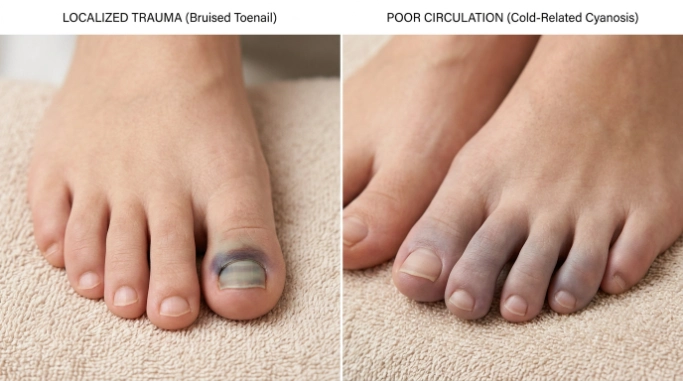
One of the most common explanations for a blue or dark-purple toenail is a subungual hematoma. This simply means blood has collected beneath the nail.
It can happen after:
- Dropping something on your toe
- Stubbing your toe against furniture
- Running or hiking for long distances
- Wearing shoes that repeatedly press against the nail
- Playing sports involving sudden stops or downhill movement
The trapped blood can make the nail look blue, purple, reddish-black, or almost black. It may also feel tender or throb because pressure is building under the nail.
Cleveland Clinic explains that subungual hematomas usually develop after sudden trauma or repeated pressure and can cause pain, tenderness, discoloration, and sometimes lifting of the nail plate.
What should you do?
If the injury is mild and the pain is manageable:
- Remove tight shoes.
- Rest the foot.
- Apply a wrapped cold pack for short periods during the first day.
- Keep the nail clean and dry.
- Wear roomy shoes while it heals.
The discolored area usually moves forward gradually as the nail grows.
Do not try to burn, drill, poke, or cut a hole through your toenail at home. Draining trapped blood should be done by a healthcare professional when necessary because DIY drainage can lead to infection or additional injury.
The American Academy of Dermatology also recommends professional evaluation when an injured nail is very painful, badly discolored, or significantly damaged.
2. Repeated Pressure From Tight Shoes
You do not always need a dramatic accident to end up with a blue toenail.
Shoes with a short toe box can repeatedly push your toes forward. Over time, tiny blood vessels beneath the nail may become damaged.
This is common with:
- Running shoes that are too small
- High heels
- Hiking boots
- Tight pointed-toe shoes
- Shoes worn with thick socks that reduce toe space
You may notice the discoloration after exercising even though you cannot remember a specific injury.
Check your shoe fit
When standing, your toes should not be jammed against the front of the shoe. They should also have enough width to move naturally.
If the same nail keeps bruising, changing your footwear may be more useful than repeatedly treating the nail after the damage has already happened.
Expert Tip: If you repeatedly develop dark or blue toenails after walking, running, or workouts, check the length and width of your shoes. Repeated nail bruising is often a sign that your toes do not have enough room.
3. Cold Temperatures and Reduced Circulation
Cold temperatures cause small blood vessels near the skin to narrow. Your toes may temporarily look pale, bluish, or purple because less warm blood is reaching them.
The color should generally improve as your feet warm up.
Some people also experience stronger circulation changes in their fingers and toes, including conditions such as Raynaud’s phenomenon.
When it may be more than just cold feet
Pay closer attention if your toes repeatedly become:
- Blue or purple
- Very pale
- Numb
- Painful
- Cold compared with the rest of your foot
Recurring color changes deserve a discussion with a healthcare professional, especially if they happen without obvious cold exposure.
4. Low Oxygen Levels or Cyanosis
A more serious reason nails can appear blue is cyanosis, which refers to bluish or gray discoloration caused by inadequate oxygen in the blood or problems with circulation.
The NHS notes that blue or gray fingers, toes, hands, or feet may occur with circulation problems, while sudden blue or gray coloring involving the lips, tongue, or face can signal a serious medical problem.
MedlinePlus similarly explains that low oxygen levels can produce a bluish appearance in the skin and nail beds.
This is different from having one bruised toenail.
Seek urgent medical help if blue nails occur with:
- Shortness of breath
- Difficulty breathing
- Chest pain
- Confusion
- Severe dizziness
- Blue or gray lips
- Blue tongue or face
- Sudden widespread discoloration
Do not treat these symptoms as a cosmetic nail problem.
A nail technician cannot determine whether your blood oxygen or circulation is normal. These symptoms require medical evaluation.
5. A Dark Nail Change That Is Not a Bruise
Not every dark-colored toenail is caused by trapped blood.
Although uncommon, melanoma can develop under or around a toenail. Nail melanoma more often appears as a brown or black line, streak, or pigment change rather than a typical blue bruise.
The American Academy of Dermatology recommends having a new or changing dark streak beneath a nail examined because melanoma can occur under fingernails and toenails.
Warning signs that deserve professional evaluation include:
- A new dark stripe without an injury
- Pigment that becomes wider
- Color extending into the surrounding skin
- Nail splitting or lifting
- Bleeding without a clear injury
- A bump beneath the nail
- A dark area that does not appear to grow outward with the nail
These symptoms do not automatically mean cancer. Injuries and other harmless conditions can cause similar changes. However, guessing at home is not a good idea.
6. Nail Polish or Cosmetic Staining
Sometimes the color is actually on or within the nail plate rather than underneath it.
Dark blue, purple, black, or highly pigmented nail polishes can leave temporary staining, particularly when polish is worn repeatedly without a base coat.
A cosmetic stain usually:
- Appears on the nail surface
- Is not painful
- Does not make the surrounding skin blue
- Gradually grows out or fades
- May affect several nails where the same polish was applied
Avoid aggressively filing or buffing the nail to remove the color. Over-buffing can thin the nail plate and make it more fragile.
If you are unsure whether the color is staining or something under the nail, remove the polish gently and examine the nail in good lighting.
One Blue Toenail vs. Several Blue Toenails
The number of nails affected can provide an important clue.
| What You Notice | Possible Explanation | Best Next Step |
|---|---|---|
| One blue or purple nail after an injury | Bruise or subungual hematoma | Protect it and monitor |
| One dark nail after running or hiking | Repeated shoe pressure | Check shoe fit and monitor |
| Several bluish toes after being cold | Temporary circulation change | Warm feet gradually |
| Repeated blue or pale toes | Possible circulation issue | Discuss with a healthcare professional |
| Several blue nails plus blue lips or breathing trouble | Possible low oxygen level | Seek urgent medical care |
| New dark stripe without clear injury | Needs professional assessment | See a dermatologist |
| Surface discoloration after dark polish | Cosmetic staining | Remove polish gently and monitor |
How to Care for a Mild Bruised Toenail at Home
If you clearly injured your toe and the symptoms are mild, basic care is usually all you need.
Step 1: Remove pressure
Switch to open, roomy, or wide-toe footwear. Avoid shoes that rub directly against the injured nail.
Step 2: Keep the area clean
Wash the foot gently with soap and water and dry it thoroughly.
If the skin around the nail is broken, be especially careful about hygiene.
Step 3: Do not pull off the nail
A damaged nail may loosen as it grows. Do not force it off.
If a completely detached sharp edge is catching on socks, carefully trimming only the loose portion with clean nail clippers may help.
Step 4: Use clean tools
If trimming becomes necessary, use a clean, sharp nail clipper. Stainless-steel tools are practical because they are durable and easy to clean.
Do not share personal nail tools with other people.
Step 5: Watch the nail as it grows
Toenails grow slowly, so discoloration can remain visible for months.
With a typical bruise, the dark patch should gradually move toward the end of the toe as the nail grows.
If it stays in exactly the same position, changes shape, or becomes larger, arrange an evaluation.
Should You Cover a Blue Toenail With Polish?
If the nail is simply stained and otherwise healthy, polish is usually a cosmetic choice.
If the nail is bruised, painful, lifting, infected-looking, or changing for an unknown reason, it is better to leave it visible until you understand what is happening.
Covering a suspicious change with dark polish can make it harder to monitor.
You should also avoid applying polish, glue, gel, acrylic, or press-on products over broken skin or a damaged nail that may be infected.
For sensitive skin, harsh removers and repeated acetone exposure can also irritate the skin around an injured nail.
DIY Care vs. Professional Care
Mild bruising often costs little to manage at home because you may only need clean clippers, comfortable footwear, and basic foot care.
Professional care becomes more important when there is severe pain, suspected infection, a major injury, or an unexplained nail change. Medical costs vary widely depending on your location, insurance coverage, testing, and whether treatment is provided by urgent care, primary care, or a dermatologist.
A salon service is not a substitute for medical diagnosis.
A nail technician can help with cosmetic nail care on healthy nails, but unexplained discoloration, bleeding, severe pain, infection, or suspicious pigment changes should be assessed medically.
When to See a Nail Technician or Dermatologist
A nail technician may be appropriate when:
- The discoloration is clearly cosmetic staining.
- The nail and surrounding skin are healthy.
- You need help maintaining nail length safely.
- You want advice about avoiding pressure from pedicure shaping or cosmetic products.
Tell your technician about any previous injury before a pedicure.
See a dermatologist or healthcare professional when:
- You cannot remember injuring the nail.
- A dark area keeps getting larger.
- A dark streak develops.
- Pigment spreads onto nearby skin.
- The nail lifts or splits unexpectedly.
- Pain is severe or worsening.
- There is swelling, pus, warmth, or increasing redness.
- You have diabetes, poor circulation, or another condition that makes foot injuries harder to heal.
Seek urgent medical care when:
Blue nails or toes appear together with breathing difficulty, chest pain, confusion, significant dizziness, blue lips, or blue facial skin.
Those symptoms may involve oxygen levels or circulation and should not be handled as a DIY nail-care issue.
Signs of Infection Around a Blue Toenail
A bruised nail itself is not necessarily infected.
However, seek medical advice if you notice:
- Increasing redness
- Warm skin
- Swelling
- Pus or cloudy drainage
- A bad smell
- Increasing pain instead of improvement
- Fever
- Red streaking spreading away from the toe
Avoid cutting the cuticle or digging underneath the nail. The cuticle helps seal the space between the skin and nail, and damaging it can make it easier for germs to enter.
Common Mistakes to Avoid
When a toenail suddenly turns blue or dark, avoid these common DIY mistakes:
- Do not drill through the nail yourself. At-home drainage can cause burns, infection, or additional damage.
- Do not assume every dark nail is a bruise. Unexplained pigment changes should be checked.
- Do not rip off a loose toenail. Let attached portions remain in place.
- Do not keep wearing the shoes that caused the problem. Continued pressure can make the injury worse.
- Do not hide an unexplained nail change under polish for months. You need to be able to monitor it.
- Do not aggressively buff discoloration away. The color may be underneath the nail, and excessive filing weakens the nail plate.
- Do not share nail clippers or files. Personal nail tools should be kept clean and separate.
- Do not ask a salon to diagnose a medical nail change. Nail technicians provide cosmetic services, not medical diagnosis.
How to Help Prevent Blue Toenails
Not every nail injury can be prevented, but a few habits can reduce your risk.
Wear correctly fitted shoes
Choose shoes with enough room in the toe box. Your toes should not repeatedly hit the front.
Keep toenails at a practical length
Very long toenails may receive more pressure from footwear.
Trim mostly straight across rather than cutting deeply into the corners.
Increase exercise gradually
Suddenly increasing running, hiking, or walking distance can expose your toes to much more repetitive pressure than usual.
Keep personal nail tools clean
Wash and dry reusable tools after use and avoid sharing them.
Pay attention to repeated changes
If the same toenail keeps turning dark despite changing your footwear, do not simply accept it as normal. Repeated trauma or an underlying nail problem may need evaluation.
FAQs
Why is my toenail blue if I did not hit it?
Repeated pressure from tight shoes can cause small amounts of bleeding even without an obvious accident. Cold temperatures, circulation problems, cosmetic staining, and other nail conditions are also possible. An unexplained color change that persists or worsens should be professionally evaluated.
How do I know if a blue toenail is bruised?
A bruise often appears after trauma or repeated shoe pressure and may initially feel tender or throbbing. As the nail grows, the discolored area usually moves toward the nail tip. If the discoloration does not move, changes shape, or appeared without an injury, get it checked.
How long does a bruised blue toenail take to go away?
The soreness may improve much sooner than the color. Because toenails grow slowly, discoloration can take several months to completely grow out.
Can tight shoes turn toenails blue?
Yes. Repeated pressure against the front or top of a shoe can damage tiny blood vessels beneath the nail and cause a dark blue, purple, or black appearance.
Can poor circulation cause blue toenails?
Reduced blood flow can cause toes and nail beds to look bluish, particularly when the feet are cold. Repeated or unexplained blue coloration should be discussed with a healthcare professional.
Are blue toenails dangerous?
A single bruised nail after an obvious injury is often minor. However, several blue nails, unexplained changes, severe pain, infection symptoms, or blue nails accompanied by breathing problems or blue lips require medical attention.
Should I go to a salon for a blue toenail?
A salon may help with cosmetic care only when the nail is healthy and the cause is clearly cosmetic. Painful, injured, infected, unexplained, or changing discoloration should be evaluated by a healthcare professional rather than treated as a pedicure issue.
Conclusion
So, what causes blue toenails? In many cases, the reason is simple: a bruise caused by stubbing your toe, exercise, or shoes that put too much pressure on the nail. Cold temperatures and temporary circulation changes can also affect nail color.
The important part is knowing when a blue toenail does not fit the pattern of an ordinary bruise.
If you notice unexplained discoloration, a changing dark streak, increasing pain, signs of infection, or repeated blue toes, arrange a professional evaluation. And if blue nails appear with breathing difficulty, chest pain, confusion, or blue lips, seek urgent medical care.
For everyday nail care, keep your toenails clean, avoid unnecessary pressure, wear properly fitting shoes, use clean tools, and pay attention when your nails suddenly look different. Your nails can provide useful clues, and noticing changes early is one of the simplest ways to make safer nail-care decisions.

