
What Causes White Spots on Toenails?

You take off your polish, look down at your toes, and suddenly notice one or more little white marks on a toenail. Naturally, you may wonder: What causes white spots on toenails, and should I be worried?
In many cases, a small white spot is simply the result of minor nail trauma — something as ordinary as stubbing your toe, wearing tight shoes, or putting repeated pressure on the nail during a pedicure. Sometimes, though, white discoloration can be connected to a fungal nail infection or another nail condition.
The appearance, texture, number of affected nails, and whether the spot moves as the nail grows can all provide useful clues.
Below, we’ll break down the most common causes, what you can safely do at home, how nail files fit into your care routine, and when it’s better to have the nail checked professionally.
Quick Answer
What causes white spots on toenails? Most small white spots are related to minor injury or pressure on the nail as it grows. Fungal infection can also cause white patches, especially when the nail becomes rough, powdery, thick, brittle, or discolored. Less commonly, medications, skin conditions, or other health problems may be involved.
What Are White Spots on Toenails?

White spots or streaks on nails are often described as leukonychia.
Leukonychia isn’t one single disease. It simply describes white discoloration involving the nail.
According to the Cleveland Clinic’s overview of white spots on nails, white spots can develop from nail trauma, fungal infection, allergic reactions, certain medications, and — much less commonly — systemic conditions.
The location of the white color matters, too.
A spot can develop:
- Within the hard nail plate itself.
- On the nail surface.
- Under the nail when part of it separates from the nail bed.
- As a line or larger area involving several nails.
For everyday nail care, you don’t need to memorize the medical categories. The important question is whether the spot behaves like a harmless injury or comes with other nail changes.
What Causes White Spots on Toenails Most Often?
1. Minor Trauma to the Toenail
Minor injury is one of the most common reasons a healthy-looking nail develops an isolated white spot.
The frustrating part is that you may not remember injuring the toe.
Toenails grow slowly, so the white spot you see today can reflect something that happened weeks earlier.
Common sources of repeated trauma include:
- Stubbing your toe.
- Dropping something lightweight on the foot.
- Wearing shoes with a narrow toe box.
- Running or hiking in shoes that let the toes hit the front.
- Aggressive pedicure filing or buffing.
- Pushing or cutting around the nail too forcefully.
- Repeated pressure from sports or exercise.
The American Academy of Dermatology’s guidance on nail injuries notes that stubbing a toe and wearing poorly fitting shoes are common ways nails become injured.
A trauma-related white spot is more reassuring when the nail otherwise feels normal: no thickening, crumbling, swelling, significant pain, or spreading discoloration.
As the nail grows, the spot should gradually move toward the tip until you can trim it away.
2. Toenail Fungus
White discoloration can also be caused by a fungal nail infection, medically known as onychomycosis.
Fungus deserves special attention because it can look quite subtle in the beginning.
The American Academy of Dermatology’s nail fungus guide explains that fungal nails may turn white, yellow, brown, or other colors. One type can create white discoloration directly on the nail surface, sometimes with a soft, dry, or powdery texture.
Watch for additional changes such as:
- A white or yellow patch getting larger.
- Rough or powdery areas.
- Thickened toenails.
- Brittle or crumbly edges.
- Debris collecting underneath the nail.
- Nail lifting.
- Changes affecting more than one toe.
- Athlete’s foot between the toes.
- An unusual odor.
The NHS also notes that fungal infections commonly cause toenails to become discolored, brittle, or thicker than usual. See the NHS fungal nail infection guidance.
Don’t assume every white spot is fungus. Nail injury, psoriasis, and other nail changes can sometimes resemble an infection.
3. Pressure From Tight Shoes
Your favorite heels, pointed-toe shoes, work shoes, or running sneakers can affect your toenails even when they don’t cause obvious pain.
Repeated pressure can irritate the nail-producing area or repeatedly push the nail against the shoe.
That may leave small white areas as the nail grows.
Check your shoes if the same toes repeatedly develop spots.
Ideally, your toes should have enough room to lie naturally without being squeezed together or constantly touching the front of the shoe.
4. Pedicure or Nail-File Trauma
A nail file can improve the shape of a toenail, but more filing is not automatically better.
Aggressively filing the surface of the nail can thin and damage the nail plate. Heavy buffing may also make already-weakened nails more vulnerable.
If you notice white marks after a pedicure, consider whether the nail was heavily filed, buffed, scraped, or pushed around the cuticle area.
Never try to “erase” a mysterious white spot by aggressively filing deeper into the nail.
If fungus is possible, scraping the surface yourself is especially questionable. The AAD notes that professional nail abrasion may sometimes be used for certain fungal infections, but it should not be confused with aggressively scraping an undiagnosed nail at home.
5. Nail Products or Irritation
Nail polish, removers, artificial nail products, adhesives, and other chemicals can occasionally irritate the nail or surrounding skin.
If white marks appeared after introducing a new pedicure product, give the nails a break and watch for other symptoms.
Redness, itching, burning, swelling, peeling skin, or repeated reactions after using the same product are stronger reasons to stop using it.
Don’t continue applying polish just to hide a nail that seems irritated or unhealthy.
6. Nail Lifting
A nail can look white when it separates slightly from the skin underneath.
This is called onycholysis.
The whiteness isn’t necessarily a white spot inside the nail. Instead, air underneath the separated area changes how the nail looks.
Nail lifting can happen after trauma, but infections and skin conditions can also contribute.
If the detached area is expanding, don’t keep cutting deeply underneath it or trying to glue it back down.
7. Less Common Medical Causes
Most isolated white dots are not evidence of a serious disease.
However, extensive white changes, horizontal white lines, or changes affecting many nails can have different causes.
Certain medications and health conditions may occasionally be associated with white nail changes. Cleveland Clinic also notes that the cause depends heavily on the type and pattern of leukonychia.
That is one reason it’s better not to diagnose yourself based on nail color alone.
If several nails suddenly change or you have other unexplained symptoms, a healthcare professional can look at the bigger picture.
Does a Calcium or Zinc Deficiency Cause White Toenail Spots?
You’ve probably heard that white spots mean you need more calcium.
That explanation is not reliable enough to use as a diagnosis.
Research has not established a simple rule that an occasional white nail spot means you’re deficient in calcium, zinc, or another specific nutrient. Cleveland Clinic notes that experts aren’t certain whether mineral or vitamin deficiencies directly cause typical leukonychia.
So don’t start high-dose supplements simply because you noticed a couple of white dots.
If you have concerns about your nutrition or symptoms of a possible deficiency, discuss them with a healthcare professional instead.
Trauma vs. Fungus: What Does Your Toenail Look Like?
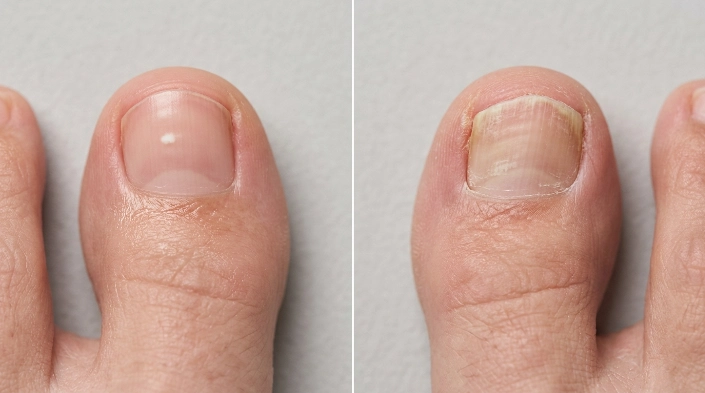
This comparison can help you decide what deserves closer attention.
| What you notice | Minor trauma is more likely | Fungus may be more likely |
|---|---|---|
| One small white spot | Common | Possible |
| Nail remains smooth | Common | Less typical as infection progresses |
| White area gradually grows outward with nail | Common | Can change or spread |
| Powdery/chalky surface | Less typical | Possible |
| Nail getting thicker | Less typical | Common |
| Crumbling or brittle edge | Less typical | Common |
| Several nails affected | Less typical | Possible |
| Nail lifting | Can happen after injury | Can occur |
| Athlete’s foot present | Unrelated | Raises suspicion |
| Increasing discoloration | Less typical after minor trauma | Worth checking |
This table is only a guide.
A visual inspection cannot always confirm fungus. Dermatologists may examine nail clippings or debris under a microscope or perform other testing because conditions such as nail psoriasis and trauma can resemble fungal infection.
What Should You Do About a Small White Spot?
If you have one or two small spots and the toenail is otherwise healthy, a conservative approach is usually sensible.
1. Leave the Spot Alone
Don’t dig, scrape, or aggressively buff it away.
If it came from minor trauma, it normally needs time to grow out.
2. Keep the Nail Neatly Trimmed
Trim toenails carefully and generally straight across rather than carving deeply into the corners.
Smooth sharp edges gently.
3. Wear Roomier Shoes
Look at the front of your shoes.
If your toes are constantly compressed or hitting the toe box, reducing that pressure may prevent repeated trauma.
4. Keep Feet Clean and Dry
This is especially helpful when fungal infection is a concern.
Change damp socks and allow sweaty shoes to dry.
5. Watch the Nail Over Time
A quick photo every few weeks can help you see whether the spot is moving toward the nail tip or spreading.
A spot that grows outward with the nail without other changes is generally more reassuring than discoloration that keeps expanding across the nail.
How to Use a Nail File Safely on Toenails
Since rough toenail edges can catch on socks and shoes, a file can be useful.
The key is gentle maintenance — not trying to grind away discoloration.
- Start with a clean, dry nail.
- Trim excessive length first if necessary.
- Use a file suitable for toenails.
- Smooth rough edges with light pressure.
- Stop if the nail becomes sensitive, hot, painful, or noticeably thinner.
- Clean reusable tools according to the manufacturer’s instructions.
- Don’t share nail files between people.
If you’re dealing with a possibly infected nail, consider keeping its tools separate from the tools used on healthy nails.
Disposable emery boards are inexpensive but difficult to thoroughly clean once contaminated, so replacing them can be more practical.
Glass or other washable reusable files may cost more initially but can last longer when maintained correctly.
Cost shouldn’t push you toward aggressive DIY treatment. A basic file may cost little, but repeatedly buying products for an undiagnosed fungal problem can become more expensive than getting the cause identified properly.
Expert Tip: Use a nail file to smooth a healthy nail’s edge — not to “sand away” an unexplained white patch. If the white area is spreading, powdery, thick, or crumbly, figure out the cause first.
Should You Cover White Spots With Nail Polish?
For a tiny trauma-related spot on an otherwise normal nail, occasional polish is usually a cosmetic choice.
But don’t use polish as a way to avoid monitoring a nail that is changing.
Consider leaving the nail bare if:
- The white patch keeps spreading.
- The nail is becoming thick or crumbly.
- Skin around the toe is red or irritated.
- You’re trying to see whether a suspected reaction improves.
- You’re preparing for a medical nail examination.
Repeatedly covering suspicious discoloration can make it harder to notice progression.
Hygiene Matters More Than Perfect-Looking Toenails
Whether your concern is a simple injury or possible fungus, good tool hygiene is worth the effort.
Try to:
- Keep personal nail tools personal.
- Replace worn disposable files.
- Clean reusable clippers and files appropriately.
- Avoid cutting live skin around the nail.
- Wash and dry feet regularly.
- Avoid putting polish over broken or inflamed skin.
- Choose salons that visibly follow proper sanitation practices.
If one toenail may have fungus, using the same uncleaned file on every nail is not a good habit.
Common Mistakes to Avoid
- Assuming every white spot is a vitamin deficiency. Minor nail trauma is a much more ordinary explanation.
- Aggressively filing the white area. This can thin or injure the nail without addressing the cause.
- Automatically treating every spot as fungus. Other nail conditions can look similar.
- Sharing nail files or clippers. Personal tools are safer.
- Ignoring tight shoes. Repeated pressure may keep creating nail trauma.
- Picking underneath a lifted nail. This can cause more separation and injury.
- Cutting deeply into the corners. Over-trimming increases the risk of pain and ingrown nails.
- Continuing irritating nail products. Stop a product if you notice repeated burning, redness, or irritation.
- Relying on polish to hide progression. Check the nail periodically without polish.
- Waiting too long when pain, redness, swelling, or drainage appears. Those symptoms deserve more attention than a simple cosmetic white spot.
When to See a Nail Technician or Dermatologist
A nail technician can help with cosmetic grooming of a healthy nail, such as careful trimming and shaping.
A nail technician should not be your main source for diagnosing an infection or medical nail condition.
Consider a dermatologist, podiatrist, or other qualified healthcare professional if:
- The white area keeps spreading.
- Several toenails are changing.
- The nail becomes thick, brittle, distorted, or crumbly.
- The nail separates significantly from the nail bed.
- You have pain, swelling, redness, warmth, or drainage.
- There’s bleeding around the nail.
- Walking becomes uncomfortable.
- You can’t explain the change and it doesn’t grow out.
- You suspect fungus but treatment isn’t helping.
- You have diabetes or circulation problems and develop a new foot or nail problem.
Mayo Clinic specifically advises seeking medical care when suspected nail fungus is accompanied by increasing discoloration or thickening, bleeding, swelling, pain, difficulty walking, or certain higher-risk health conditions. Read Mayo Clinic’s nail fungus guidance.
FAQs
Why do I have one white spot on my toenail?
A single small white spot commonly follows minor trauma to the nail. You may have stubbed the toe, worn tight shoes, or put pressure on the nail weeks earlier without remembering it. Watch whether the spot gradually moves toward the tip as the nail grows.
Can toenail fungus start as a white spot?
Yes. Some fungal nail infections can begin with white or yellowish discoloration. Fungus becomes more suspicious if the area spreads or the nail becomes powdery, thick, brittle, crumbly, misshapen, or lifted.
Will white spots on toenails go away?
Trauma-related spots usually grow out with the nail rather than disappearing overnight. Toenails grow slowly, so this process can take months. White areas caused by infection or another nail condition may require treatment of the underlying cause.
Are white spots on toenails caused by calcium deficiency?
Not necessarily. There isn’t enough evidence to diagnose calcium deficiency from ordinary white nail spots alone. Don’t start supplements solely because of a nail change.
Can nail polish cause white spots?
Products used during pedicures can sometimes contribute to irritation or surface damage, particularly when removal involves aggressive scraping or buffing. If you repeatedly notice white marks or irritation after using the same product, stop using it and monitor the nail.
Should I file white spots off my toenails?
Usually not. A file is best used to gently shape or smooth an edge. Filing deeply into unexplained discoloration may thin the nail and make matters worse. If the area is powdery, spreading, or associated with thickening, consider having it evaluated.
How do I know if a white spot is serious?
Pay attention to the entire nail rather than the color alone. Increasing discoloration, thickening, crumbling, pain, swelling, drainage, nail separation, or changes involving multiple nails are stronger reasons to seek professional advice.
Conclusion
So, what causes white spots on toenails? For many people, the explanation is simple: minor pressure or an old injury that will slowly grow out with the nail.
Fungal infection is another important possibility, particularly when the white area becomes powdery or spreads along with thickening, crumbling, lifting, or additional discoloration.
The safest approach is to avoid aggressive scraping, keep your toenails neatly trimmed, use clean personal nail tools, wear shoes with enough toe room, and watch how the nail changes over time.
If the nail is becoming painful, swollen, thick, brittle, or increasingly discolored — or you’re simply unsure what you’re looking at — skip the DIY guessing and have the nail evaluated. A healthy pedicure starts with understanding what your nail actually needs.

