
Why Are My Toenails Purple? What Causes Blue Toenails?

Looking down and noticing a purple or blue toenail can be unsettling, especially when you do not remember hurting your toe. You may wonder whether it is simply a bruise, a reaction to tight shoes, or a sign that something is wrong with your circulation.
So, why are my toenails purple? In many cases, the color comes from blood trapped beneath the nail after an injury or repeated pressure. Cold temperatures and reduced circulation can also make toes or the tissue beneath the nails look blue or purple. Less commonly, widespread blue discoloration can be connected to low oxygen levels or another medical condition.
The color alone cannot tell you exactly what is happening. The number of toes affected, pain, recent injuries, temperature, and other symptoms all provide important clues.
This guide explains the common causes of purple and blue toenails, what you can safely do at home, and when it is better to have your nails checked by a healthcare professional.
Quick Answer
Purple toenails are often caused by bruising beneath the nail, usually after an injury, running, or pressure from tight shoes. Blue or purple toes can also occur when cold temperatures reduce blood flow. If several nails suddenly turn blue or the color comes with breathing trouble, severe pain, numbness, or swelling, seek medical care promptly.
What Does a Purple Toenail Usually Mean?
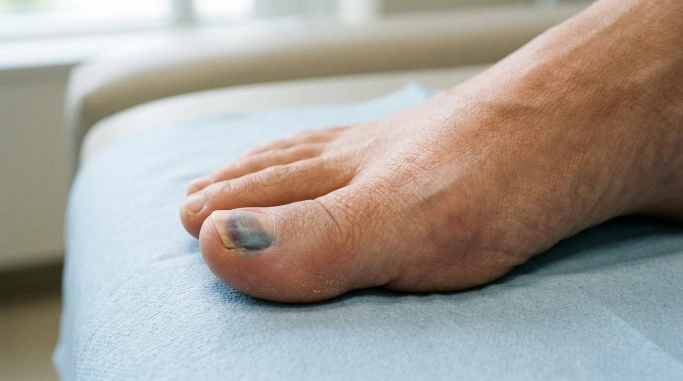
A purple toenail usually means that either the nail bed underneath has changed color or something has collected beneath the nail plate.
The nail plate is the hard part you normally paint or trim. The nail bed is the skin underneath it.
Because the nail plate is partly transparent, changes underneath can show through as red, purple, blue, brown, or black.
One of the most common explanations is a bruise beneath the nail. However, it is worth paying attention to whether:
- Only one toenail is affected.
- Several toenails look blue or purple.
- The toe is painful or swollen.
- You recently dropped something on your foot.
- You have been running or wearing tight shoes.
- Your toes feel unusually cold or numb.
- The discoloration is changing or growing out with the nail.
- You have blue discoloration elsewhere, such as your lips or fingers.
Those details can help separate a simple nail injury from a circulation or health problem.
1. A Bruise Under the Toenail
If one toenail suddenly becomes dark purple after an injury, a subungual hematoma is a common explanation.
That simply means blood has collected underneath the nail.
You might develop one after:
- Dropping something heavy on your toe.
- Stubbing your toe against furniture.
- Someone stepping on your foot.
- Wearing shoes that repeatedly hit the toenail.
- Running or hiking long distances.
- Playing sports that involve sudden stops.
According to the Cleveland Clinic’s guide to subungual hematoma, trauma can damage tiny blood vessels underneath the nail, allowing blood to collect beneath the nail plate. The nail can then look purple, blue-black, or almost black.
What a bruised toenail may feel like
A mild bruise may cause little more than discoloration.
A larger bruise may cause:
- Throbbing pain.
- Tenderness when you touch the nail.
- Pressure beneath the nail.
- Swelling around the toe.
- Partial lifting of the nail.
The color may remain for weeks or months because toenails grow slowly.
A reassuring sign is when the discolored area gradually moves toward the end of the toe as the nail grows.
Do not drill, burn, puncture, or cut into the nail yourself to release trapped blood. A healthcare professional can determine whether drainage is appropriate and check for injuries such as a fracture.
2. Repeated Pressure From Tight Shoes
You do not always need one dramatic accident to develop a purple toenail.
Repeated pressure can damage the nail bed a little at a time.
Imagine wearing sneakers where your longest toe touches the front of the shoe every time you walk downhill. After hundreds or thousands of steps, small blood vessels beneath the nail can become damaged.
This is especially common among runners, hikers, dancers, and people wearing shoes that are too short or narrow.
Check your footwear if:
- The discoloration appeared after exercise.
- Your toe repeatedly hits the front of your shoe.
- Several toes have tender spots.
- You frequently develop blisters.
- Your toenails feel sore after long walks.
Your everyday shoes should give your toes enough room to move without constantly rubbing against the front or sides.
3. Cold Temperatures and Temporary Circulation Changes
Have you noticed your toes becoming pale, blue, or purple when you are cold?
Cold temperatures cause blood vessels near the skin to narrow. In some people, this response is particularly noticeable in their fingers and toes.
One condition associated with these color changes is Raynaud’s disease.
The Mayo Clinic’s information on Raynaud’s disease explains that small blood vessels supplying the fingers and toes can narrow in response to cold or stress. Affected areas may become pale and then blue before changing color again as circulation returns.
You may also notice:
- Cold toes.
- Numbness.
- Tingling.
- Temporary blue, white, or purple coloring.
- Throbbing as your feet warm back up.
If your toes change color only when cold and return to normal after warming, temperature-related circulation changes may be involved.
However, frequent or severe episodes still deserve a conversation with your healthcare provider.
4. Reduced Blood Flow to the Feet
Purple or blue toes can sometimes indicate that blood is not reaching the area normally.
This is different from a simple bruise underneath one nail.
You may notice:
- More than one toe changing color.
- Unusually cold feet.
- Numbness or tingling.
- Pain when walking.
- Slow-healing sores.
- Changes in the surrounding skin as well as the nail.
Persistent circulation problems should not be handled as a cosmetic nail issue.
If a toe suddenly becomes blue or purple, very painful, cold, or numb without an obvious injury, seek prompt medical evaluation.
A nail polish change or pedicure will not solve an underlying blood-flow problem.
5. Low Oxygen Levels and Cyanosis
Another reason nails can look blue is cyanosis.
Cyanosis describes bluish or gray discoloration caused by insufficient oxygen in the blood or, in some cases, problems with circulation.
The NHS guidance on cyanosis notes that blue or gray coloration can appear underneath the nails as well as on the skin, lips, tongue, or gums.
This situation is very different from having one bruised toenail.
Seek emergency medical help if blue nails occur with:
- Difficulty breathing.
- Chest pain.
- Blue or gray lips, tongue, or face.
- Severe dizziness.
- Confusion.
- Sudden weakness.
In the United States, call 911 for symptoms suggesting a breathing or oxygen emergency.
Do not wait for a manicure appointment or attempt DIY nail treatments when blue discoloration is accompanied by symptoms like these.
6. Nail Polish or Surface Staining
Not every unusual nail color comes from inside your body.
Dark nail polish can sometimes leave temporary pigment on the nail plate, especially when worn for long periods without a base coat.
Staining usually behaves differently from a bruise.
A stained nail typically:
- Does not throb.
- Does not make the toe cold.
- Does not cause numbness.
- Affects the surface more evenly.
- May become clearer as the nail grows.
If you remove polish and discover purple-looking discoloration underneath, give your nails good lighting and examine them closely before immediately repainting them.
Covering an unexplained color change with another coat of polish can make it harder to track whether it is improving.
7. Could a Fungal Infection Make a Toenail Purple?
Toenail fungus more commonly causes nails to become yellow, white, brownish, thick, brittle, crumbly, or distorted rather than suddenly turning bright purple or blue.
However, a damaged nail can have more than one issue at the same time.
For example, repeated shoe trauma may cause bruising while an already damaged nail also becomes vulnerable to infection.
Signs that deserve professional evaluation include:
- Increasing nail thickness.
- Crumbling edges.
- Nail lifting.
- Persistent debris beneath the nail.
- Bad odor.
- Redness or swelling around the nail.
- Drainage or pus.
Do not assume every discolored nail is fungus and start aggressive antifungal treatment without understanding the cause.
Purple Toenail vs. Circulation Problem: Quick Comparison
| What you notice | More consistent with | What to do |
|---|---|---|
| One purple nail after hitting the toe | Nail bruise | Protect it and monitor |
| Purple nail after running or tight shoes | Repetitive trauma | Check shoe fit and reduce pressure |
| Toes change color mainly when cold | Temperature-related circulation change | Warm gradually and discuss repeated episodes with a clinician |
| Several blue/purple toes that remain cold | Circulation problem | Seek medical evaluation |
| Blue nails plus blue lips or breathing trouble | Possible oxygen problem | Seek emergency medical help |
| New dark streak that doesn’t grow out normally | Nail condition needing examination | See a dermatologist |
| Thick, crumbly, distorted nail | Possible fungal or other nail disorder | Get an appropriate diagnosis |
How to Check a Purple Toenail at Home
You cannot diagnose every nail condition yourself, but a simple visual check can help you decide your next step.
1. Remove nail polish
If possible, remove polish gently so you can see the entire nail.
Avoid aggressive scraping or buffing.
2. Look at the surrounding skin
Is just the nail discolored, or is the entire toe turning blue or purple?
That distinction matters.
3. Think about recent pressure or injury
Ask yourself whether you recently:
- Stubbed the toe.
- Dropped something on it.
- Started running more.
- Wore new shoes.
- Hiked downhill.
- Wore tight heels or boots.
Even repetitive shoe pressure can create bruising.
4. Compare both feet
Check whether the same color appears on several toes.
One bruised nail after an injury tells a different story from multiple cold, blue toes.
5. Check how the toe feels
Pay attention to:
- Pain.
- Temperature.
- Numbness.
- Tingling.
- Swelling.
A toe that is intensely painful, cold, numb, or suddenly discolored needs medical attention rather than cosmetic treatment.
6. Take a photograph
Take a clear photo in natural light.
Compare it again in one or two weeks if the situation is not urgent.
This can help you see whether a bruise is moving outward as the toenail grows or whether an unexplained mark is changing.
Expert Tip: When monitoring nail discoloration, focus on movement. A typical bruise should slowly move toward the free edge as the nail grows. A dark mark or streak that stays near the base, widens, or changes deserves a dermatologist’s evaluation.
What Should I Do for a Bruised Purple Toenail?
If the discoloration followed a minor injury and you have no serious warning signs, protecting the toe may be enough while it heals.
Try to:
- Wear roomy shoes.
- Avoid repeated pressure on the nail.
- Keep the foot clean and dry.
- Trim the nail carefully when needed.
- Avoid pulling off a loose nail.
- Pause activities that make the pain worse.
Use clean nail clippers or a file if trimming is necessary. Do not share nail tools, and clean reusable tools appropriately to reduce the chance of introducing bacteria around damaged skin.
If the pain is intense, pressure is building underneath the nail, the nail is badly damaged, or you think your toe could be broken, have it examined.
Why You Should Not Drain a Purple Toenail Yourself
You may see DIY advice suggesting heating a needle, using a drill bit, or piercing a bruised toenail.
Skip it.
Creating a hole through the nail at home can cause burns, introduce bacteria, injure the nail bed, or make an existing injury worse.
A healthcare professional can decide whether drainage is necessary and whether there may also be a fracture or deeper injury.
This is one situation where a DIY beauty-tool approach is not worth the risk.
What About a Dark Streak Instead of a Purple Bruise?

Not every dark toenail change is bruising.
A new brown or black streak running along the nail should be examined, particularly when it is changing, widening, or appearing without an obvious injury.
The American Academy of Dermatology’s guidance on nail changes recommends dermatologist evaluation for a new or changing dark streak because, although many nail changes are harmless, melanoma can sometimes develop beneath or around a nail.
That does not mean every dark toenail is melanoma.
It means unexplained or changing pigmentation should not automatically be dismissed as a bruise or covered with polish indefinitely.
When to See a Nail Technician or Dermatologist
A nail technician can help with cosmetic grooming when your toenail is otherwise healthy, but nail technicians do not diagnose medical conditions.
A nail technician may be appropriate when:
- Your nail color is normal.
- You want routine trimming or polish.
- A previous minor injury has fully healed.
- There is no pain, swelling, drainage, or suspicious discoloration.
Tell your technician about previous nail injuries before filing or buffing the affected area.
See a dermatologist or healthcare professional when:
- Purple discoloration appeared without an obvious reason.
- A mark is getting darker or wider.
- A dark streak does not seem to grow outward.
- The nail is separating from the nail bed.
- You have recurring unexplained nail changes.
- The surrounding skin changes color.
- You have persistent pain.
- You suspect an infection.
- Several toes repeatedly turn blue or purple.
Get urgent care when:
- A toe becomes suddenly blue, very cold, numb, or severely painful.
- There is significant swelling after an injury.
- You cannot walk normally after trauma.
- There is uncontrolled bleeding.
- You suspect a broken toe.
- Redness, warmth, swelling, or pus suggests infection.
Seek emergency care when:
Blue or purple nails occur along with breathing difficulty, chest pain, confusion, severe dizziness, or blue coloration of the lips, tongue, or face.
Common Mistakes to Avoid
When toenails look unusual, it is easy to focus on making them look normal again rather than figuring out why they changed.
Avoid these common mistakes:
- Covering unexplained discoloration with dark polish immediately. Monitor the nail first.
- Assuming every purple nail is fungus. Trauma and circulation changes can look completely different.
- Trying to drill or puncture a bruised nail. This can cause injury or infection.
- Wearing the same tight shoes. Continued pressure can repeatedly damage the nail.
- Pulling off a partially detached toenail. You can tear living tissue underneath.
- Aggressively buffing discoloration away. If the color is beneath the nail, buffing cannot remove it.
- Ignoring numbness or coldness. These symptoms may point to circulation rather than a cosmetic problem.
- Waiting on serious symptoms. Blue nails combined with breathing problems require medical attention.
- Ignoring a changing dark streak. Persistent nail pigmentation deserves professional evaluation.
How to Help Prevent Bruised or Purple Toenails
You cannot prevent every nail injury, but a few habits can lower your risk.
Wear properly fitted shoes
Choose footwear with enough room for your toes.
Your longest toe should not repeatedly slam into the end of the shoe while walking or running.
Keep toenails comfortably trimmed
Very long toenails are more likely to hit the inside of shoes.
Avoid cutting them excessively short, though, because that can increase irritation around the nail edges.
Increase exercise gradually
Suddenly doubling your running or hiking distance gives your feet much more repetitive impact than they are used to.
Gradual increases can help reduce pressure-related nail problems.
Keep nail tools clean
Do not share personal clippers and files.
If skin around a nail is damaged, good hygiene becomes even more important.
Give your nails occasional polish-free checks
If you frequently wear opaque polish, take occasional breaks long enough to examine the natural color, thickness, and attachment of each toenail.
This makes it easier to notice a new change early.
FAQs
Why is my toenail purple but it doesn’t hurt?
A painless purple toenail can still be an older bruise. Once the initial tenderness disappears, trapped blood may remain visible until the nail grows out. If there was no injury or the discoloration is changing instead of growing outward, have it evaluated.
Why are my toenails blue when I’m cold?
Cold temperatures can narrow small blood vessels in your toes and temporarily reduce blood flow. Conditions such as Raynaud’s can make these color changes more noticeable. Repeated or severe episodes should be discussed with a healthcare professional.
Can tight shoes cause purple toenails?
Yes. Repeated impact against the inside of a tight shoe can damage small blood vessels beneath the nail and cause bruising. Runners and hikers commonly experience this type of pressure-related nail injury.
How long does a purple bruised toenail take to go away?
The discomfort may improve much sooner than the appearance. Because the discoloration has to grow outward with the toenail, the mark can remain visible for months. Cleveland Clinic notes that complete nail regrowth after a subungual hematoma can take roughly six to nine months.
Should I be worried if all my toenails look blue?
Multiple blue toenails are less typical of one simple nail bruise. Cold exposure or circulation may be involved. Persistent blue nails, especially with coldness, numbness, pain, breathing difficulty, or blue lips, need medical evaluation.
Is a purple toenail always caused by poor circulation?
No. Trauma is one of the most common explanations when a single toenail is purple. Circulation becomes more concerning when several toes are affected or when discoloration is accompanied by coldness, numbness, pain, or changes in surrounding skin.
Should I go to a salon for a purple toenail?
A salon is not the right place to diagnose unexplained purple or blue discoloration. A nail technician can provide cosmetic care after a benign cause is known and the nail is healthy, but unexplained changes, pain, infection signs, or circulation concerns should be evaluated medically.
Conclusion
If you have been wondering, “Why are my toenails purple?”, start by looking at the bigger picture.
One purple nail after an injury, long run, or tight pair of shoes is often consistent with bruising beneath the nail. Temporary color changes during cold weather may relate to reduced blood flow. But persistent blue or purple toes, unexplained pigmentation, severe pain, numbness, or discoloration involving multiple nails deserve more attention.
Most importantly, do not treat an unexplained nail change purely as a beauty problem.
Remove polish, look carefully at the nail and surrounding skin, think about recent injuries, and monitor how the discoloration changes. If something does not look or feel right, choose a healthcare professional rather than trying aggressive DIY treatments.
And if blue nails appear with breathing difficulty, chest pain, confusion, or blue lips or tongue, seek emergency medical help immediately.
Paying attention to your toenails is not just about keeping your pedicure looking good. Sometimes a small color change is your cue to protect an injured toe—and sometimes it is a reason to get professional advice.

