
Why Are My Toenails Yellow? Common Causes, Care, and When to Get Help

You look down after removing your polish and notice something you were not expecting: your toenails look yellow.
It is easy to immediately think, Do I have toenail fungus? But yellow toenails do not always mean there is an infection. Polish staining, repeated pressure from shoes, nail injuries, aging, psoriasis, and other nail conditions can all change the color of a toenail.
So, why are my toenails yellow? The answer depends on more than color alone. Thickness, texture, odor, lifting, pain, surrounding skin changes, and how many nails are affected can all provide useful clues.
This guide explains the most common reasons toenails turn yellow, what you can safely do at home, how to use nail files without causing damage, and when a nail technician, podiatrist, or dermatologist should take a closer look.
Quick Answer
Yellow toenails can result from nail polish staining, fungal infection, repeated shoe pressure, injury, aging, psoriasis, or less commonly another health condition. Fungus is more likely when a yellow nail also becomes thick, brittle, crumbly, misshapen, or separated from the nail bed. Persistent or worsening changes should be professionally evaluated.
What Does a Yellow Toenail Actually Mean?
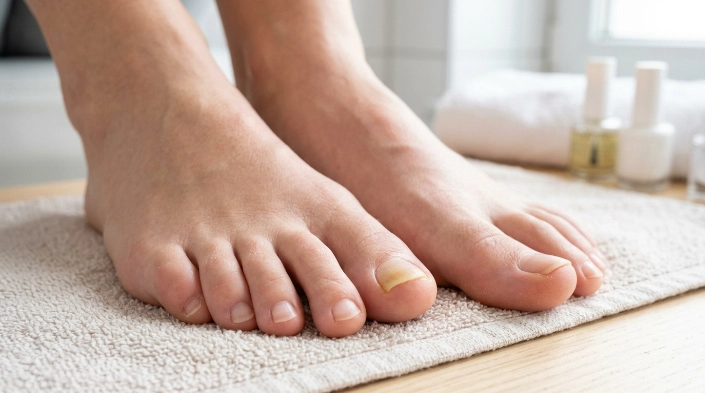
Yellow color is a symptom or visible change, not a diagnosis.
Sometimes the discoloration sits mainly on the surface of the nail. This commonly happens after wearing strongly pigmented polish.
Other times the nail plate itself changes. You may notice that it becomes thicker, rougher, more brittle, or partly detached from the skin underneath.
Those extra changes matter.
| What You Notice | Possible Explanation | Sensible Next Step |
|---|---|---|
| Yellow surface after dark polish | Polish staining | Take a polish break and monitor new growth |
| Yellow, thick, crumbly nail | Possible fungal infection | Consider medical evaluation |
| One yellow nail after repeated shoe pressure | Nail trauma | Reduce pressure and watch it grow out |
| Yellow nail with pits or lifting | Possible psoriasis or another nail condition | See a dermatologist |
| Yellowing with redness, swelling, or drainage | Infection or injury | Seek professional care |
| Several nails becoming thick and yellow without a clear reason | Multiple possible causes | Arrange a medical assessment |
The important point is that appearance alone cannot always tell you what is happening.
1. Toenail Fungus Is a Common Cause
A fungal nail infection, medically called onychomycosis, is one of the most familiar reasons for yellow toenails.
According to the American Academy of Dermatology’s guide to nail fungus symptoms, fungal nails may become discolored, thickened, brittle, cracked, misshapen, or separated from the nail bed.
Possible signs include:
- Yellow, white, or brown discoloration
- Thickening
- Crumbling or ragged edges
- Debris collecting underneath the nail
- Lifting from the nail bed
- A change in shape
- More than one nail gradually becoming affected
- Athlete’s foot at the same time
Toenail fungus often develops slowly.
You may first notice a small discolored area near the end or side of the nail. Over time, the change can spread.
However, a yellow nail is not enough to confirm fungus. Nail injuries, psoriasis, staining, and other conditions can look surprisingly similar.
Mayo Clinic also notes that other conditions can resemble a fungal infection, which is one reason healthcare professionals sometimes examine nail clippings or debris before deciding on treatment. Read Mayo Clinic’s nail fungus diagnosis guidance
2. Nail Polish Can Stain Toenails Yellow
If your nails looked normal before your last pedicure but became yellow after you removed a dark or brightly pigmented polish, staining may be the explanation.
Red, orange, burgundy, and other strong pigments can sometimes leave color behind on the nail plate, especially when polish is worn for long periods or applied without a base coat.
The American Academy of Dermatology’s guide to nail changes specifically notes that red nail polish without a base coat can make nails look yellow.
Polish staining is generally more reassuring when:
- The nail is still smooth
- It is not becoming thicker
- There is no crumbling
- There is no unpleasant odor
- The surrounding skin looks normal
- The yellow color slowly moves outward as the nail grows
Give the nails some time without polish rather than immediately covering the discoloration again.
If the yellowing continues to worsen underneath the growing nail, another cause becomes more likely.
3. Repeated Pressure and Nail Injuries Can Change Color
Your toenails deal with more physical stress than you may realize.
Running, hiking, dancing, long shifts on your feet, tight footwear, pointed shoes, and shoes that are too short can repeatedly push the toenail against the inside of the shoe.
Even if you do not remember one major injury, repeated small impacts can affect nail growth.
A traumatized toenail may become:
- Yellowish
- White
- Brown
- Thick
- Ridged
- Slightly lifted
- Misshapen
One clue is that only one or two pressure-prone toenails are affected.
Check the fit of your shoes. There should be enough room for your toes to move without repeatedly striking the front.
If there is severe pain, bleeding, dark discoloration, or significant lifting, avoid aggressive DIY trimming or filing.
4. Toenails Can Change With Age
Toenails tend to grow more slowly as we get older.
They may also become thicker, harder, more ridged, or somewhat discolored.
That does not mean every yellow toenail in an older adult is simply due to age, however. Fungal nail infections also become more common with increasing age and can produce similar changes.
Look at the whole pattern.
A slowly changing nail without pain, crumbling, lifting, or surrounding skin problems may be less urgent than a nail that is changing rapidly.
But persistent thickening and discoloration still deserve attention, particularly when several nails are affected.
5. Nail Psoriasis Can Look Similar to Fungus
Psoriasis can affect nails even when skin symptoms are not immediately obvious.
Nail psoriasis may cause:
- Small dents or pits
- Thickening
- Yellow or brown discoloration
- Separation from the nail bed
- Crumbling
- Buildup underneath the nail
This can look a lot like fungal infection.
That overlap matters because the treatment approach is different.
If your yellow toenails are also pitted, lifting, repeatedly changing, or accompanied by psoriasis elsewhere on the body, a dermatologist can help determine what is going on.
Avoid assuming that every thick yellow nail needs an antifungal product.
6. Rarely, Yellow Nails Can Be Related to Other Health Problems
Most yellow toenails are not a sign of a serious systemic illness.
Still, unexplained changes involving several nails sometimes deserve more attention.
The American Academy of Dermatology notes that yellow, thickened nails that seem to stop growing can occasionally be associated with conditions affecting the body rather than just the nail itself.
That does not mean that a yellow toenail automatically signals an internal disease.
Instead, consider medical advice if:
- Most or all nails are changing
- Nail growth appears unusually slow
- You cannot identify an obvious cause
- The change continues despite basic nail care
- You have additional unexplained health symptoms
A clinician can look at the complete picture rather than trying to diagnose the problem from nail color alone.
How to Tell Staining From Possible Fungus
There is no perfect home test, but certain patterns can help you decide what to do next.
Staining is more likely when:
- Yellowing appeared after removing polish
- The nail remains smooth
- Thickness has not changed
- There is no crumbling
- There is no lifting
- New nail growth near the cuticle looks normal
Fungus becomes more suspicious when:
- Yellowing gradually spreads
- The nail becomes thicker
- The edge starts crumbling
- Material collects underneath the nail
- The nail changes shape
- The nail begins lifting
- Several toenails become involved
The NHS describes fungal nail infections as commonly causing discoloration, thickening, brittleness, and sometimes lifting of the nail. See the NHS fungal nail infection guidance
Even then, only professional assessment and, when necessary, testing can confirm the diagnosis.
What Can I Safely Do at Home?

If the nail is not painful, severely damaged, or surrounded by irritated skin, basic nail care can make it easier to monitor.
1. Remove Nail Polish
Leave the nail bare for a while.
This allows you to see whether new nail growth near the cuticle looks clear or whether discoloration is continuing.
2. Keep Feet Clean and Dry
Fungi tend to thrive in warm, moist environments.
Dry carefully between your toes after bathing and change damp socks rather than leaving your feet wet for hours.
3. Trim Conservatively
Use clean toenail clippers and cut mostly straight across.
Do not dig deeply into the corners.
Aggressive trimming increases the risk of cuts, irritation, and ingrown toenails.
4. File Rough Edges Gently
A nail file can smooth sharp areas that catch on socks.
For a thick toenail, a medium or coarse file may make rough edges easier to manage, but do not aggressively grind the entire nail thinner.
Glass files are easy to clean and produce a smooth edge, while disposable emery boards can be convenient when you do not want to reuse a file.
If fungus is suspected, avoid using the same uncleaned file on healthy nails.
5. Do Not Share Nail Tools
Nail clippers, files, and other grooming tools can carry microorganisms.
The American Academy of Dermatology notes that fungi can spread through contaminated grooming tools and other shared items.
Clean reusable tools according to their material and manufacturer instructions, and avoid sharing them.
Expert Tip: Photograph the affected toenail in similar lighting once every few weeks. Toenails grow slowly, and side-by-side photos can make it easier to see whether clear new nail is growing or the discoloration is spreading.
Can You File Away a Yellow Toenail?
Filing can improve a rough edge, but it cannot fix the underlying cause of yellow discoloration.
If staining is superficial, gentle buffing may slightly reduce visible discoloration. However, repeatedly buffing or filing the top of the nail can make it thin and sensitive.
If the cause is fungal, removing visible debris or thinning the surface does not necessarily eliminate the infection.
Avoid:
- Deep scraping underneath the nail
- Cutting away attached nail tissue
- Filing until the nail feels sore
- Using a drill aggressively at home
- Sharing the file with other people
- Using the same uncleaned file on healthy and possibly infected nails
If the nail is extremely thick, painful, distorted, or difficult to cut safely, professional help is the better option.
DIY Care vs. Professional Care
| Option | Best For | Benefits | Limitations |
|---|---|---|---|
| Basic home grooming | Mild staining or rough edges | Convenient and inexpensive | Cannot diagnose the cause |
| Nail technician | Cosmetic grooming of otherwise healthy nails | Professional shaping and appearance | Should not diagnose or treat medical nail disease |
| Podiatrist | Difficult toenails and foot-related concerns | Foot-specific assessment and care | Cost varies by provider and insurance |
| Dermatologist | Persistent discoloration or suspected nail disease | Can diagnose nail conditions and recommend treatment | May require an appointment or testing |
| Pharmacy treatment | Some suspected fungal problems | Accessible | Not every yellow nail is fungal, and treatment can take months |
DIY care is most useful for hygiene, safe trimming, cosmetic staining, and monitoring.
Once infection, significant inflammation, pain, or another nail disease becomes possible, home cosmetic care has clear limits.
What About Over-the-Counter Fungus Treatments?
It is tempting to buy an antifungal treatment the moment you see yellow.
That approach can waste time if fungus is not actually the cause.
Fungal nail treatment is also rarely instant. The NHS notes that topical nail treatments may need to be used for many months, and healthy nail growth is what eventually replaces the damaged portion.
Prescription treatment may sometimes be considered when the infection is more significant.
Because medications can have side effects and may not be suitable for everyone, treatment decisions are best based on the likely cause and your health history.
When to See a Nail Technician or Dermatologist
A nail technician can help with ordinary cosmetic grooming when the nail and surrounding skin appear healthy.
However, technicians should not be expected to diagnose fungus, psoriasis, bacterial infection, or another medical problem.
Consider a dermatologist, podiatrist, or other healthcare professional if you notice:
- Increasing yellow discoloration
- Significant thickening
- Crumbling
- Nail separation
- Pain
- Swelling
- Redness
- Drainage
- Bleeding
- Difficulty walking
- Several nails changing
- Changes that continue despite basic care
Mayo Clinic recommends medical attention when nail changes become increasingly discolored, thickened, or misshapen, and particularly when there is pain, swelling, bleeding, or difficulty walking.
If you have diabetes, poor circulation, a weakened immune system, or reduced sensation in your feet, be especially cautious with DIY cutting and filing. Foot injuries and infections can be more complicated in these situations.
Common Mistakes to Avoid
- Assuming every yellow nail is fungus. Several conditions can produce similar discoloration.
- Covering the nail with polish immediately. Give yourself time to see how the nail changes.
- Aggressively filing the surface. Over-filing can weaken the nail.
- Digging underneath the nail. This can injure the nail bed and surrounding skin.
- Sharing nail tools. Files and clippers should be kept clean and personal.
- Ignoring athlete’s foot. Fungal skin infections can coexist with nail fungus.
- Wearing tight shoes every day. Repeated pressure can worsen damaged toenails.
- Expecting a yellow toenail to look normal overnight. Toenails grow slowly, so visible recovery can take months.
- Continuing DIY treatment despite pain or swelling. These are signs to stop experimenting and seek professional advice.
FAQs
Why are my toenails yellow but not thick?
Surface staining from nail polish is one possibility, especially if the nail is still smooth and strong. Early fungal infection and nail trauma can also cause color changes before significant thickening develops. Monitor new growth and seek advice if the yellowing persists or spreads.
Does a yellow toenail always mean fungus?
No. Fungus is only one possible explanation. Polish staining, trauma, psoriasis, age-related changes, and other nail conditions can also cause yellow discoloration.
Can dark nail polish make toenails yellow?
Yes. Strong polish pigments can stain the nail plate, particularly when polish is worn repeatedly without a base coat. The stain should gradually move toward the tip as healthy new nail grows.
How long does it take for a yellow toenail to grow out?
Toenails grow much more slowly than fingernails. Depending on the toe and your individual nail growth, replacing an entire damaged toenail can take many months. That is why changes often seem slow even when the underlying problem has improved.
Can I use a nail file on a yellow toenail?
Yes, but use it mainly to smooth rough or sharp edges. Do not aggressively grind the nail thin. If fungus may be present, keep the file clean and avoid using the same uncleaned tool on unaffected nails.
Should I get a pedicure if my toenail is yellow?
If yellowing appears to be simple surface staining and the nail and skin are otherwise healthy, ordinary cosmetic care may be reasonable. If the nail is thick, crumbly, lifting, painful, swollen, or possibly infected, get medical advice instead of relying on a salon pedicure.
When should yellow toenails worry me?
Arrange professional evaluation when yellowing keeps worsening, several nails are involved, the nail becomes thick or distorted, or you develop pain, redness, swelling, drainage, bleeding, or difficulty walking.
Conclusion
So, why are my toenails yellow? Sometimes the explanation is as simple as polish staining or repeated pressure from shoes. In other cases, a fungal infection, nail psoriasis, injury, or another nail condition may be responsible.
Look beyond the color.
Changes in thickness, texture, shape, lifting, pain, and the skin around your nail provide useful clues.
For mild cosmetic changes, keep the nail clean and dry, give it a break from polish, use clean tools, and file only as much as needed to smooth rough edges.
If the yellowing spreads, persists, becomes painful, or is accompanied by thickening, crumbling, swelling, or lifting, avoid trying to diagnose it yourself. A dermatologist, podiatrist, or other qualified healthcare professional can help identify the cause and guide you toward the safest next step.
Treat your toenails gently, monitor changes instead of hiding them, and get professional advice when the nail is telling you that something more than cosmetic care may be needed.
