
Why Nail Polish Never Fully Dries: A Beginner’s Guide to the Real Causes and Fixes

If your manicure keeps feeling sticky, soft, or easy to dent, you are not imagining it. Nail polish can seem dry on the surface while still staying soft underneath. That is usually why a nail can look finished, then smudge when you put on shoes, reach into a bag, or press a fingernail against something too soon.

The good news is that this problem is usually fixable. In most cases, the issue comes down to how the polish was applied, how many layers were used, the condition of the bottle, or the environment around you. Once you understand those pieces, it gets much easier to tell whether you need to wait longer, change your technique, or replace the polish.
Why polish can look dry but still stay soft
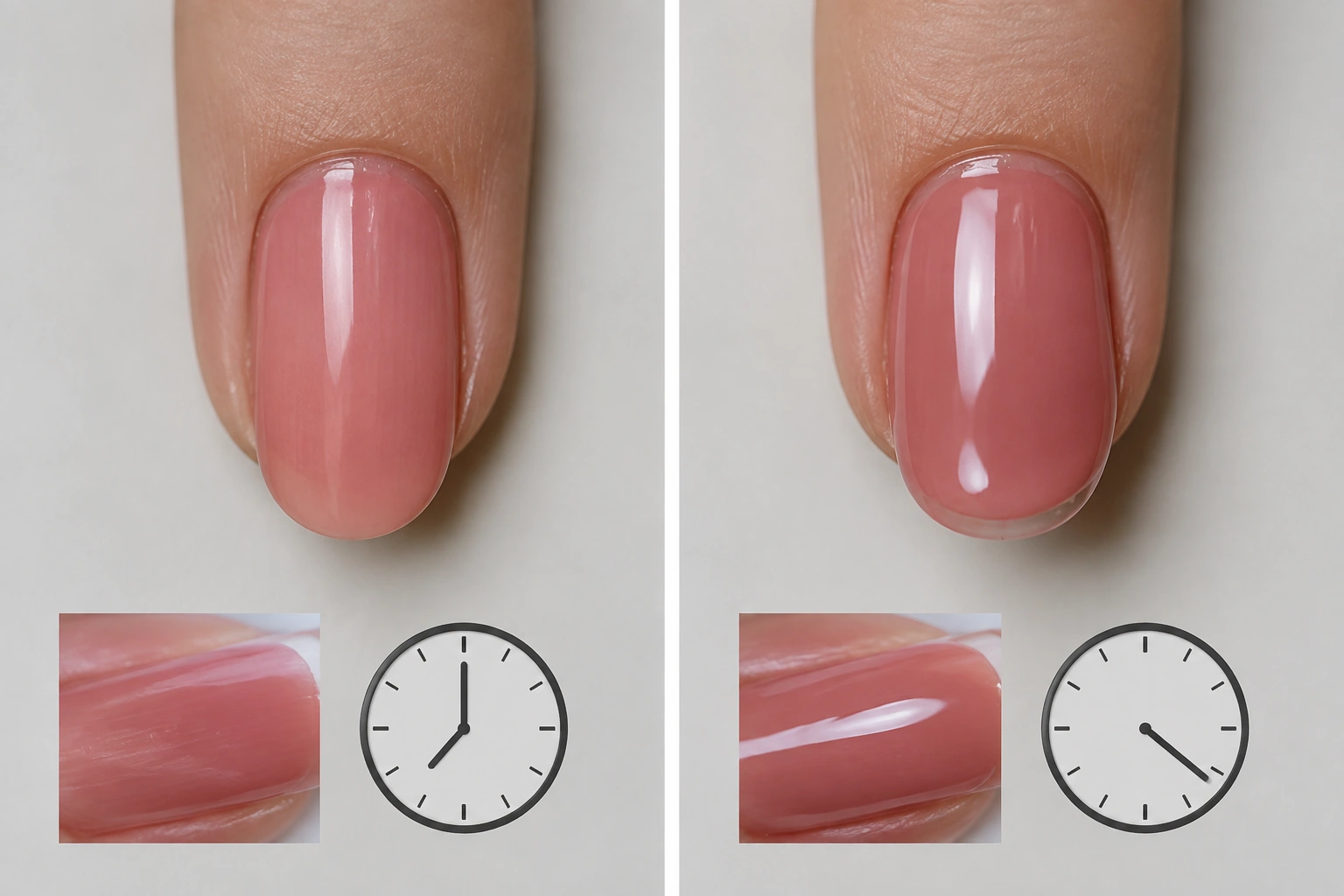
Fresh nail polish does not become hard all at once. The top layer often sets first, which can make the surface feel dry before the layers underneath have finished drying. That is why a manicure may seem fine for a while, then dent or wrinkle later.
Think of it like a thin skin forming on top. If the coats underneath are still holding onto solvent, the polish can stay soft for longer than you expect. This is also why touching the nail lightly is not always a reliable test. A nail can feel dry to the touch and still not be fully cured.
Here is a simple way to think about the stages:
| Stage | What it feels like | What it means |
|---|---|---|
| Surface-dry | Dry on top, may still feel slightly soft | The top layer has set, but deeper layers may still be soft |
| Touch-dry | Light contact does not leave a mark | Safer for gentle contact, but not ideal for pressure |
| Fully cured | Harder and more stable through the whole layer | Better for normal activities like putting on socks or shoes |
A practical example: if the nail no longer smudges when you lightly tap it, it may be touch-dry. But if a sock, blanket, zipper, or shoe can still leave a mark, it is not fully cured yet.
If you want a deeper timing breakdown for regular polish, you may also find our guide on how long regular nail polish takes to dry helpful.
How long nail polish usually takes to dry
There is no single exact drying time that works for every polish. Drying depends on the formula, the thickness of the coats, and the room around you. A thin manicure in a dry, breezy space will usually behave better than a thick manicure in a humid bathroom.
For beginners, these rough ranges are more useful than a single number:
- After about 10 minutes: the surface may feel less wet, but it is still easy to dent or smudge.
- After about 30 minutes: many thin coats are touch-dry, but they may still mark if you press, rub, or put on tight clothing.
- After several hours: the manicure is usually much safer for normal use, though thicker layers may still need longer.
- After a full day: most regular polish should be much more stable, unless it was applied very thickly or the bottle/formula is the problem.
What matters most for beginners is this: if polish still dents easily, it is not ready yet, even if it looks shiny and smooth. A manicure can appear finished well before it is actually stable.
A helpful rule is to judge polish by pressure, not just appearance. If a sock, blanket, zipper, or bag strap can still leave a mark, the polish needs more time. That is especially true with multiple coats.
For a broader overview of drying behavior, see our related article on how long nail polish takes to dry completely.
The main reasons nail polish does not fully dry
Most slow-drying manicures come from one or more of these issues:
Thick coats
A thick coat traps more solvent inside the polish layer. The top can set before the inside has finished drying, which leaves the manicure soft for longer.
Too many layers
Even if each coat is applied neatly, adding layer after layer increases the total amount of polish that has to dry. As a simple beginner rule, if you are using more than two or three color coats, drying time often becomes noticeably longer.
Old or thickened polish
As polish ages, it can become stringy, heavy, or uneven. That makes it harder to apply thin coats, and thick application usually dries more slowly.
Humid or poorly ventilated conditions
Moist air can slow the evaporation process that helps polish dry. A still room can also make drying feel sluggish.
Top coat or base coat issues
A heavy base coat or a thick regular top coat can add another layer that needs time to settle. Some formulas help protect the manicure, but they do not always speed drying.
If your manicure usually dries fine but one bottle keeps causing problems, the polish itself may be the issue. If every manicure is slow, the application method is more likely to blame.
Why thick coats dry so slowly
This is one of the biggest beginner mistakes, and it is easy to make. A thick coat can look better right away because it covers the nail in one pass. The problem is that it dries unevenly.
The top of the coat may harden first. Underneath, the polish can stay soft for much longer. That creates the classic “dry on top, sticky underneath” feeling. It is also why thick polish may dent hours later when the nail presses against fabric or another surface.
Thin coats usually dry more evenly because there is less material on the nail at once. They may take a little more patience, but they are often more reliable. If you need better coverage, two or three thin coats are usually safer than one heavy coat.
A simple example: one thick coat may seem convenient, but it can leave you waiting longer and increase the chance of smudges. Two thin coats may take a little more effort, yet they often give a smoother result and a lower risk of soft spots.
How base coat and top coat can help or slow drying
Base coat and top coat both matter, but they do different jobs.
A base coat helps polish grip the nail and can create a smoother surface for color. A top coat adds shine and protection. Neither one automatically means faster drying. In fact, if either formula is heavy, it can add more time.
A quick-dry top coat is different from a regular top coat. It is made to help the surface set faster and reduce smudging risk. That does not always solve a manicure that was applied too thickly underneath, but it can help when the rest of the application is already thin and even.
Here is the simplest decision rule:
– If your coats are already thin and your polish just needs a little help, a quick-dry top coat may be useful.
– If your polish is going on thick, a fast-drying top coat will not fully fix the problem.
If you are deciding whether a quick-dry product is worth trying, our guide on whether quick-dry nail polish really dries faster may help.
How humidity, temperature, and airflow affect drying
The environment around you can make a bigger difference than many beginners expect.
Humidity
High humidity can slow drying because the air is already holding a lot of moisture. That can make polish feel tacky for longer, especially if the coats are thick.
Temperature
A comfortable room temperature usually works better than a very cold or very hot space. In practice, unusually cold air may slow drying, while excessive heat can make polish set unevenly or wrinkle.
Airflow
Gentle airflow can help polish dry more evenly. A still room tends to make drying feel slower. At the same time, blowing directly on nails is not ideal because it can stir up dust or cause bubbles.
A practical setup is a clean, dry room with light air movement and no rush. A fan placed at a distance is often a better choice than breathing directly on your nails or waving your hands around.
For a related question many beginners ask, we also cover whether UV light dries regular nail polish, since regular polish and gel are not the same thing.
A simple checklist to figure out what is causing the tackiness
If you are not sure why your polish is still soft, use this quick decision path:
-
Did you apply thick coats or more than 2 to 3 color coats?
If yes, the problem is probably the application. -
Did the polish go on stringy, lumpy, or unusually heavy from the bottle?
If yes, the polish may be old or thickened. -
Is the room humid, steamy, or very still?
If yes, the environment may be slowing drying. -
Does only one bottle cause trouble, while other polishes dry normally?
If yes, the formula is likely the issue. -
Do all your manicures dry slowly, even with thin coats?
If yes, the application method or environment is the more likely cause.
This is the quickest way to decide whether you should wait longer, change how you apply polish, or replace the bottle.
When the polish formula is the problem
Sometimes the issue is not your technique at all. The bottle itself may be the reason polish seems to never fully dry.
Watch for these signs:
– The polish looks stringy when you pull out the brush
– It goes on unevenly or in lumps
– The color feels unusually heavy on the nail
– The bottle has thickened over time
– You need to keep adding polish to get smooth coverage
Old or thickened polish often leads to thick application, and thick application leads to slower drying. If the bottle has changed a lot since you first bought it, replacing it may be easier than trying to rescue it.
A fresh bottle usually spreads more smoothly and makes it easier to apply thin coats. That alone can improve drying more than any trick.
What to do right now if your polish is still tacky
If your manicure is already on and still feels soft, the safest move is usually to stop touching it and give it more time.
Here is what to do:
1. Keep your hands still for a while longer.
2. Avoid socks, gloves, tight sleeves, or anything that can press on the nails.
3. Hold off on washing dishes, showering, or cleaning if you can.
4. If you have a quick-dry top coat and the surface still feels smooth rather than stringy or wet, you can apply it carefully in one thin layer. If the polish is already wrinkled, dented, or easily moving under the brush, it is too late for that coat to help much.
5. If the manicure is very soft, do not try to fix it by adding more polish.
What not to do:
– Do not press or test the nails repeatedly
– Do not wipe the surface with a towel
– Do not try to speed things up with high heat or an open flame
– Do not blow directly on the nails so hard that you create bubbles or dust problems
If the polish has only just been applied, patience is usually the best repair tool.
How to prevent smudges and dents while polish cures
Fresh polish is easy to damage before it fully sets. A few simple habits can protect the finish.
Keep your hands away from tight contact with anything that can press into the nail. That includes shoes, heavy blankets, and bag straps. If you need to use your hands, be gentle and avoid dragging the fingertips across surfaces.
Also, avoid the habit of assuming a shiny nail is a finished nail. Shine does not always mean stability. The surface may look complete while the layers underneath are still soft enough to mark.
One useful trick is to plan your manicure for a time when you do not need to rush into chores. The less pressure your nails face during the early drying window, the better the result usually looks.
How to make nail polish dry faster next time
If slow drying keeps happening, change the application rather than just waiting longer.
Use thinner coats
This is the biggest improvement for most beginners. Thin coats dry more evenly and are less likely to trap soft layers underneath.
Use fewer layers when possible
If your color is already opaque after two coats, a third coat may only add drying time.
Keep polish from thickening
Close the bottle tightly and store it properly so it does not become stringy and heavy.
Choose a quick-dry top coat when speed matters
This can help seal the surface and reduce smudging, especially on a thin manicure.
Work in a better environment
A dry, comfortable room with light airflow usually gives more predictable results than a steamy bathroom.
If you want a practical comparison of drying behavior, our article on how long regular nail polish takes to fully dry may also be useful.
When to redo the manicure or replace the polish
Sometimes waiting longer is the right move. Other times, the polish needs to come off and the bottle needs to go.
Wait longer if:
- The manicure was applied in thin coats but still needs more time
- The polish is only slightly soft after about 30 minutes to a few hours
- The problem started right after application
- The bottle still looks normal and flows well
Redo the manicure if:
- You can see visible dents, wrinkles, or uneven layers
- The polish was applied so thickly that it is still soft after several hours
- You touched the nails too early and smudged the finish badly
Replace the polish if:
- The bottle is thick, stringy, or hard to apply smoothly
- Every manicure with that bottle dries poorly
- The formula has clearly changed over time
That decision can save you a lot of frustration. If the product is the problem, no amount of patience will fully fix it.
When to see a nail technician or dermatologist
If your polish always seems to stay tacky no matter what you do, a nail technician can help you check your application method and product choices. A dermatologist may be worth seeing if you also notice changes in nail shape, color, texture, or ongoing irritation around the nails.
For most beginners, though, the answer is simpler than it feels: polish usually does not “refuse” to dry. It is often drying unevenly, drying too slowly because of thick application, or being affected by the room and the product itself.
Once you start using thinner coats and paying attention to the polish formula, the problem usually becomes much easier to manage.

